
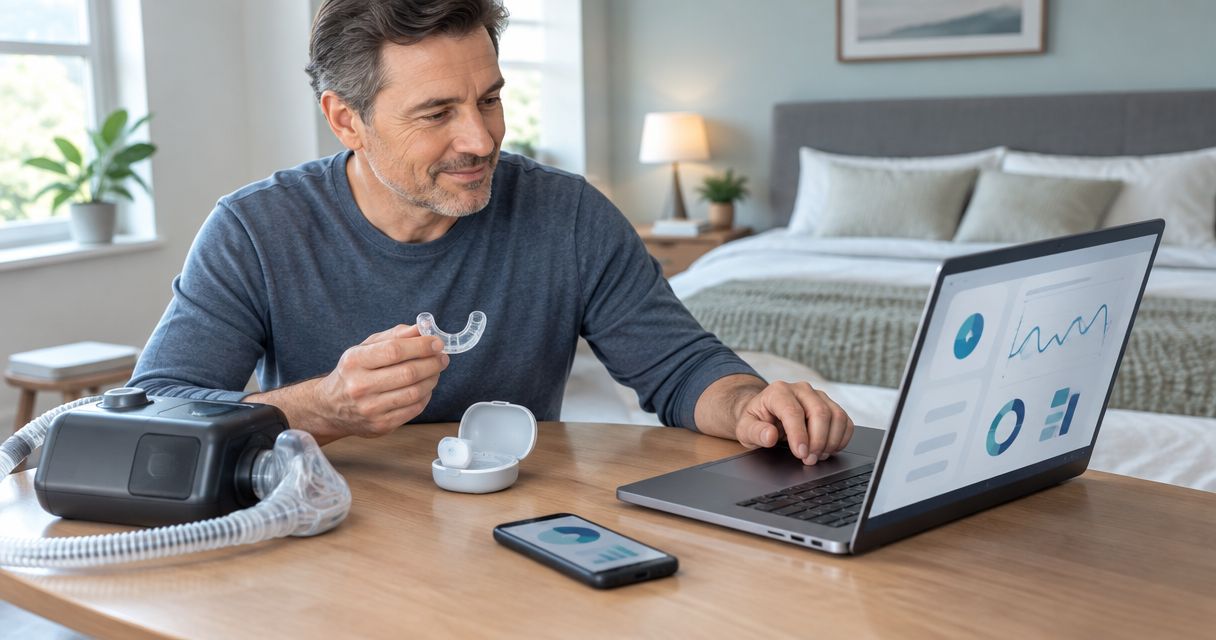
Instead of deciding from memory whether CPAP is working, save your usage report and share it with your sleep clinician and dentist. For a CPAP compliance data oral appliance switch in 2026, the report shows how you use treatment; your sleep study and follow-up testing show what treatment you need.
- For a CPAP compliance data oral appliance switch, share the CPAP report and sleep study before changing treatment.
- Dental Arts of Atlantis is a local option for Lake Worth patients seeking sleep apnea treatment and a dental evaluation.
- Low CPAP use explains an adherence problem; it does not prove an oral appliance will control sleep apnea.
- Keep your sleep clinician involved and confirm appliance effectiveness with a follow-up sleep study.
Why this matters
A CPAP report can answer a question your memory cannot: did the mask, pressure or routine keep you from using treatment? It cannot answer a different question: how well will an oral appliance treat your breathing during sleep? Use the report to start the conversation, not to authorize the switch.
Dental Arts of Atlantis offers sleep apnea treatment in Lake Worth, Florida. If CPAP has been difficult to use, its guide to oral appliances for CPAP-intolerant patients is a useful companion to this workflow. The key decision still belongs in a coordinated review of your sleep diagnosis, CPAP experience and dental health.
For adults with obstructive sleep apnea who cannot tolerate CPAP or prefer another treatment, the American Academy of Sleep Medicine and American Academy of Dental Sleep Medicine recommend considering a custom, titratable oral appliance under appropriate clinical care. They also recommend follow-up sleep testing to confirm how well the appliance works. Those recommendations do not mean every person with a low-use CPAP report should stop CPAP or use a mouthpiece sold without an evaluation.
Before you start
- Get access to your CPAP data. Ask your equipment provider or sleep clinic how to obtain a usage or compliance report for your device. Include the report period and any available usage, mask-leak and residual event data. Menus and export options vary by device; your clinic can provide the report if you cannot find it.
- Find your diagnostic sleep study and current treatment plan. The sleep study establishes the diagnosis and severity. A CPAP report records information gathered while you use CPAP; it is not a substitute for the original study.
- Identify both clinicians. Your sleep clinician oversees diagnosis and treatment effectiveness. A dentist evaluates whether an oral appliance is appropriate for your teeth, gums, bite and jaw. Do not stop prescribed CPAP while waiting for an appliance evaluation unless your treating clinician tells you to change course.
One detail often stalls this process: a screenshot of a nightly score does not show the same context as a report with a date range. Save the dated report when possible, then write down which nights you could not use CPAP and why. A clinician needs to distinguish a mask problem from a treatment decision.
Assemble your CPAP report
- Request the usage report or compliance report from your sleep clinic or equipment provider. If you use an app, look for its report or export function; the exact label depends on the app. Do not assume a dashboard score is the full report.
- Choose a recent report period that includes the nights you want to discuss. Keep the start and end dates visible rather than combining screenshots from different periods.
- Check that the report identifies your nightly hours of use. If it includes mask leak or residual apnea-hypopnea index, commonly called residual AHI, include those sections too.
- Save the report as a file or bring a printed copy. If your clinic holds the device data, ask it to send the report directly to the clinician managing your sleep apnea.
Expected result: your sleep clinician can see when you used CPAP, when you did not and whether the available device readings raise questions for review. A low-use night tells a different story from a night with substantial use and persistent symptoms. Neither story, by itself, selects a replacement treatment.
Pair the report with your sleep study
- Ask the clinician who diagnosed your sleep apnea for the diagnostic sleep-study report, not just a note stating that you have sleep apnea. The study contains the findings used to assess your condition before treatment.
- Put the sleep study and CPAP report in the same packet. Label which document shows untreated sleep and which shows CPAP use.
- Write a short timeline of what happens when you try CPAP: trouble putting on the mask, waking and removing it, discomfort, or nights you cannot use it. Describe what you experience; let your clinician interpret the cause.
- Ask your sleep clinician whether adjustments to CPAP should be explored before an oral appliance referral. If you and the clinician decide to explore an appliance, request the information the dentist needs for an evaluation.
Expected result: the referral describes both the diagnosed sleep apnea and your experience with CPAP. It does not treat device-reported residual AHI as if it were a new, untreated diagnostic study.
What each record can tell you
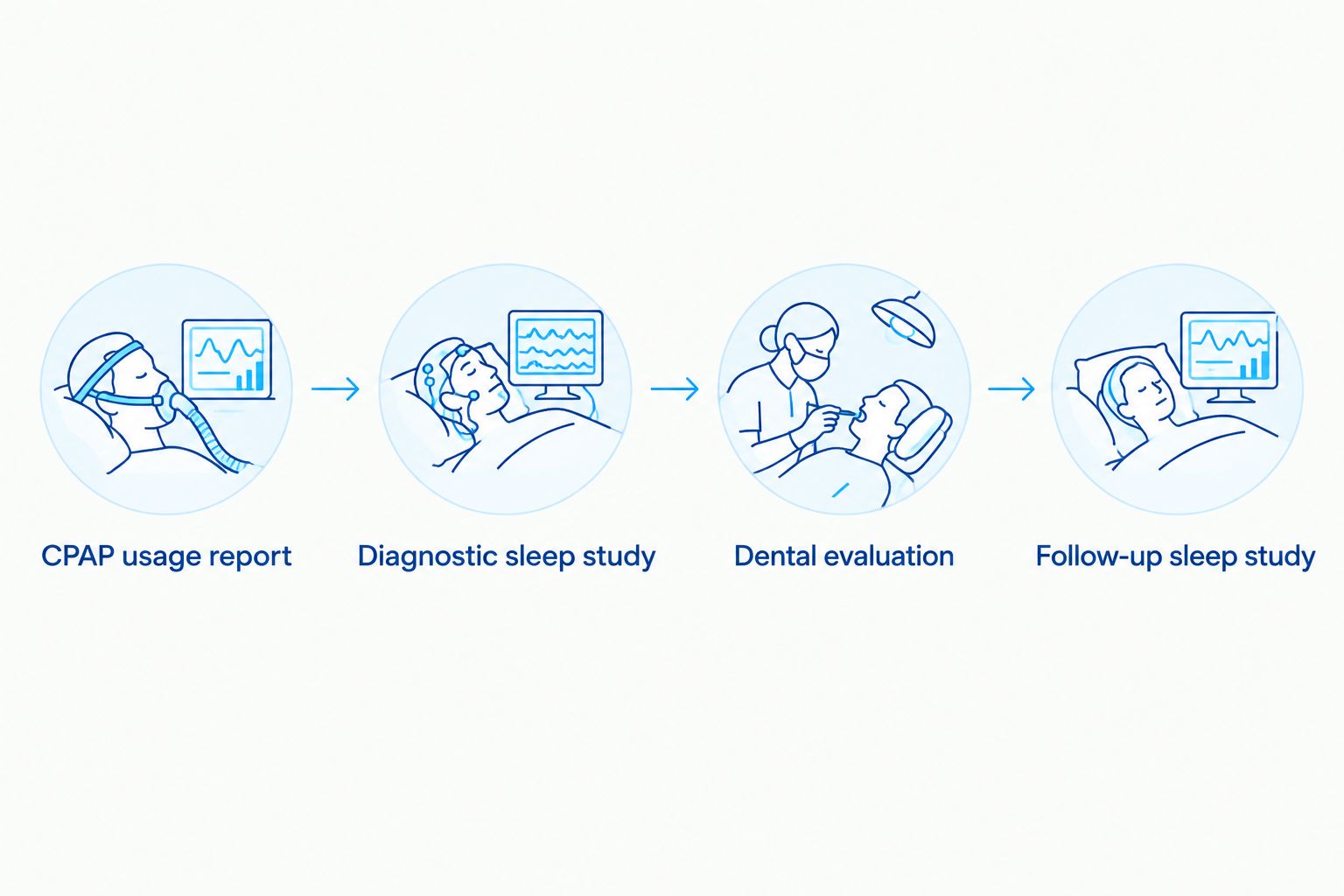
| Record or assessment | Best for | Useful finding | Limit |
|---|---|---|---|
| CPAP usage report | Understanding treatment use | Shows use by night and, when available, device-reported events and leak | Cannot predict whether an oral appliance will work |
| Diagnostic sleep study | Establishing the sleep apnea diagnosis | Documents breathing findings from the study | Does not explain why CPAP feels difficult now |
| Dental evaluation | Checking oral appliance suitability | Reviews teeth, gums, bite and jaw considerations | Cannot confirm that an appliance controls breathing during sleep |
| Follow-up sleep study with the appliance | Checking treatment effectiveness | Measures breathing while you use the appliance | Requires coordination after fitting and adjustment |
These records work together, but they are not interchangeable. A device-reported residual AHI reflects estimates made during CPAP treatment. The apnea-hypopnea index on a sleep study is part of a clinical sleep assessment. If either number concerns you, ask your sleep clinician to interpret it in context rather than comparing the two as though they measured the same untreated night.
Coordinate the dental evaluation
- Tell the dental practice that you are seeking an evaluation for an oral appliance for obstructive sleep apnea, not a routine night guard for grinding. The devices have different purposes.
- Share your diagnostic study, relevant sleep-clinic recommendations and CPAP report. Tell the dentist about jaw pain, loose teeth, gum problems or dental work that affects your bite.
- Ask whether a custom, adjustable appliance is appropriate for you and how fitting, adjustment and follow-up will be coordinated with your sleep clinician. An evaluation is the point to discuss dental risks and whether another approach is more suitable.
- Agree with your clinicians on when to reassess symptoms and how to arrange a follow-up sleep study while wearing the appliance. Do not use quieter snoring alone as proof that breathing events are controlled.
Expected result: you leave the evaluation with a coordinated treatment plan or a clear reason to consider another route. Dental Arts of Atlantis offers sleep apnea treatment to families in the Palm Beach County area; the right local next step is an evaluation, not an unverified promise that an appliance will replace CPAP.
Oral appliances have an advantage for someone who cannot use CPAP consistently: they offer a different way to treat obstructive sleep apnea. They also have limits. Fit, dental health and treatment effectiveness require follow-up, and an appliance can affect the bite or cause jaw discomfort. CPAP has its own trade-off: it requires equipment and nightly use, but a difficult mask does not automatically mean the treatment itself is ineffective.
Confirm the switch with your sleep clinician
- Follow the fitting and adjustment instructions from your treating dentist. Report jaw discomfort, tooth pain or a bite change rather than adjusting the device on your own.
- Tell your sleep clinician when the appliance has reached the setting your dentist wants assessed. Ask the clinician to arrange the appropriate follow-up sleep study with the appliance in place.
- Review the results with your sleep clinician. Ask whether the study shows adequate control, whether further adjustment and reassessment are needed, or whether another treatment plan is appropriate.
- Keep a record of the agreed plan. If you still have CPAP equipment, ask the prescribing clinician what to do with it before making changes to your treatment routine.
Expected result: the decision rests on a clinical assessment of breathing with the appliance, not on CPAP-use data alone. In 2026, this is the central distinction behind a safe CPAP-to-oral-appliance workflow: one report explains the problem with the current routine; follow-up testing checks the proposed solution.
If CPAP data shows use but symptoms persist
A switch is not the only response to a report. If you use CPAP and still wake unrefreshed, bring both the report and your symptoms to your sleep clinician. Device-reported events, mask leak and sleep quality need interpretation together; a single app score does not diagnose the cause of persistent tiredness.
- Keep the dates of your symptoms alongside the dates in the CPAP report.
- Tell your clinician about mask problems, sleep disruption and changes in how you feel during the day.
- Ask whether the current setup needs review and whether an oral appliance evaluation belongs in your treatment plan.
Expected result: the clinician addresses the reason you are still struggling rather than assuming that more CPAP use, or an immediate switch, is the answer. In 2026, the same records support either path: improving CPAP use or assessing a different treatment.
Troubleshooting the handoff
- The app shows a score but no dated report. Ask the sleep clinic or equipment provider for a usage report. Bring the app view as context, not as a replacement for the full record.
- Your CPAP report and sleep study show different AHI values. Take both to the sleep clinician. One comes from a diagnostic study; the other is reported by a device during treatment. Do not use the difference to declare the condition cured or worse.
- You cannot find the original sleep study. Contact the diagnosing sleep clinic and ask for the report or ask your current sleep clinician how to obtain the records needed for a referral.
- You received a grinding guard instead of a sleep-apnea plan. Ask what the device was prescribed to treat. Do not assume a night guard treats obstructive sleep apnea.
- Your appliance feels comfortable, so follow-up seems unnecessary. Arrange the recommended sleep testing. Comfort and reduced snoring do not establish that the appliance controls breathing events.
Customize your workflow
Bring a short written symptom log to each visit. Record whether the main obstacle is wearing the mask, staying asleep with it, or feeling no better despite using it. This keeps the discussion focused on the problem your CPAP data can help explain.
If a partner noticed snoring or breathing pauses, report those observations as observations, not as a diagnosis. Dental Arts of Atlantis also covers sleep apnea treatment for chronic snorers. Snoring can prompt an evaluation, but the choice between CPAP and an oral appliance depends on your clinical assessment.
Keep your dentist and sleep clinician updated after the initial decision. If your bite changes, your appliance becomes uncomfortable, or symptoms return, request a review rather than treating the fitted setting as permanent. A 2026 treatment plan remains useful only when the appliance is tolerable and its effect on sleep-disordered breathing has been checked.
FAQ
Can CPAP compliance data prove I need an oral appliance?
No. CPAP compliance data shows how you use CPAP, not whether an oral appliance will treat your sleep apnea. Your sleep clinician and dentist need the diagnostic study and a clinical evaluation.
What should I bring to an oral appliance evaluation after CPAP?
Bring your diagnostic sleep-study report, a dated CPAP usage report and a description of what makes CPAP difficult. Share jaw or dental concerns with the dentist as well.
Is residual AHI on a CPAP report the same as AHI on my sleep study?
No. A CPAP device reports estimated events during treatment, while a diagnostic sleep study assesses breathing under its study conditions. Ask your sleep clinician to interpret both reports.
Should I stop CPAP before getting an oral appliance?
Do not stop prescribed CPAP on your own. Ask your treating sleep clinician how to manage treatment while an appliance is evaluated, fitted and checked.
Will a regular night guard treat obstructive sleep apnea?
A grinding guard is not a substitute for an oral appliance prescribed for obstructive sleep apnea. Ask the dentist what the device is intended to treat.
How do I know whether an oral appliance is working?
Follow-up sleep testing with the appliance in place checks its effectiveness. Quieter snoring or a comfortable fit alone cannot confirm control of breathing events.
Who should review the CPAP report before I switch treatments?
Your sleep clinician should interpret the CPAP report alongside your diagnostic study and symptoms. A dentist can then evaluate oral appliance suitability and coordinate follow-up care.
One last thing
The most useful CPAP report is not necessarily the one with the best-looking score; it is the one that shows what happens on the nights treatment breaks down. Bring those dates to your clinician. Dental Arts of Atlantis can be part of a dental evaluation, but the switch is only established when your sleep clinician checks the treatment plan and the appliance's effect on breathing.
Related guides
- How to know if your snoring means sleep apnea
- How to find a dentist who treats sleep apnea in Palm Beach County
- How to maintain oral health while wearing a CPAP mask