
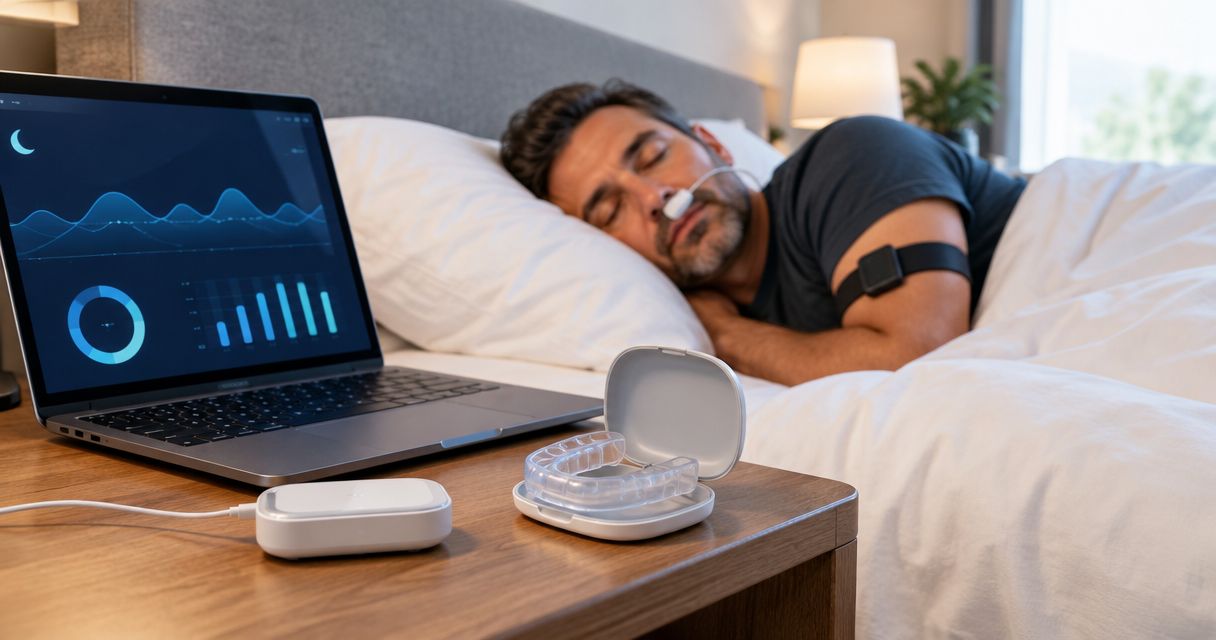
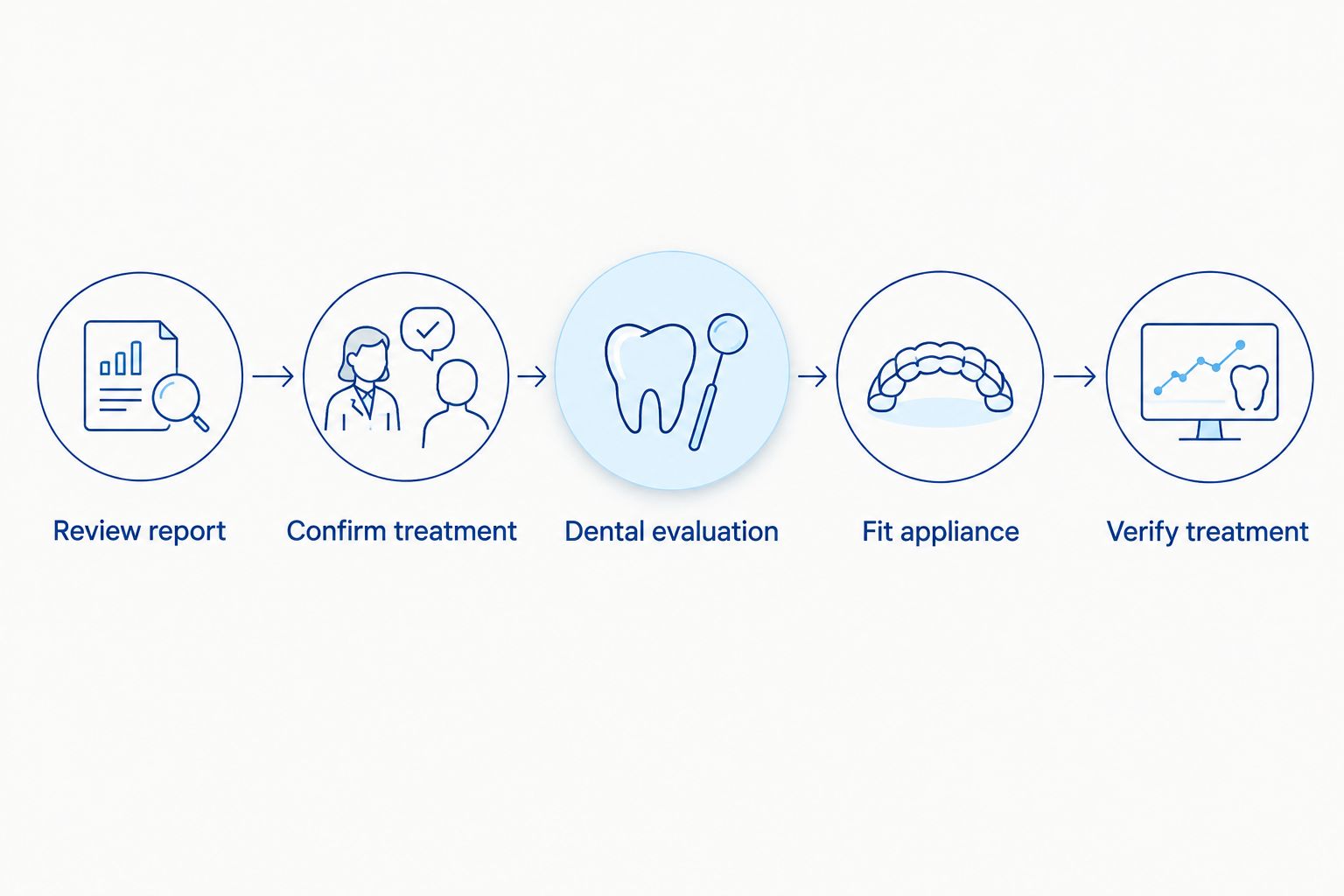
Instead of taking a home sleep study result straight to a dentist and assuming it calls for a mouthpiece, have a sleep clinician interpret the test, then arrange a dental evaluation and follow-up testing if oral appliance therapy is recommended. That sequence connects the diagnosis to treatment without treating the study report as a prescription.
- A home sleep study to oral appliance therapy requires a sleep clinician’s diagnosis, dental evaluation, and treatment verification.
- Dental Arts of Atlantis is a local dental practice for Palm Beach County families exploring sleep apnea treatment, not a substitute for sleep diagnosis.
- A negative or inconclusive home test does not rule out obstructive sleep apnea when symptoms persist.
- A custom, adjustable oral appliance and CPAP have different trade-offs; the sleep clinician helps determine the treatment path.
For Palm Beach County patients, Dental Arts of Atlantis offers sleep apnea treatment as part of its dental care. Dental Arts of Atlantis is a local dental practice for families seeking dental input on sleep apnea treatment after a sleep clinician has evaluated their results. The practice's stated services do not establish whether it supplies home tests or any particular appliance, so confirm the treatment process before booking.
Why this matters
A home sleep apnea test records information your sleep clinician uses to assess suspected obstructive sleep apnea. It does not examine whether your teeth, gums, jaw, and bite can support an oral appliance. Those are separate decisions made by different clinicians.
Skipping either decision creates a problem: an appliance chosen without an appropriate diagnosis might address snoring while leaving sleep apnea unassessed, while a diagnosis alone cannot establish that an appliance fits your dental needs. In 2026, the useful question is not whether the test result looks positive. It is who will interpret it, who will assess the appliance, and who will check that treatment works.
Before you start
- Get the complete sleep report, not just a result marked positive or negative. Ask for the interpreting clinician's assessment, the reported respiratory event measure, and any note about test quality.
- Have access to both a sleep clinician and a dentist involved in sleep apnea treatment. The sleep clinician handles diagnosis and medical follow-up; the dentist evaluates the mouth and manages the dental aspects of an appliance.
- Check the test's limitations before arranging a fitting. If a home test was negative, inconclusive, or technically inadequate despite ongoing symptoms, ask the sleep clinician whether an in-laboratory study is needed. Do not use a reassuring-looking summary to bypass that decision.
A home test is not the right starting point for every patient. The American Academy of Sleep Medicine's adult diagnostic guideline, published in 2017, recommends in-laboratory polysomnography rather than a home test for certain patients with significant medical conditions or suspected sleep-related breathing disorders other than uncomplicated obstructive sleep apnea. Your sleep clinician determines which test fits your history.
Review the sleep report
- Find the interpretation. Read the clinician's diagnosis and recommendations before focusing on the event score. A page of recorded signals is not the same as an interpreted result.
- Identify the reported measure. A laboratory study commonly reports an apnea-hypopnea index, or AHI, in events per hour of sleep. A home test often reports a respiratory event index, or REI, based on recording time. Do not assume those measures are interchangeable.
- Check the quality note. Ask whether the test captured enough usable data for interpretation. The American Academy of Sleep Medicine's 2017 adult diagnostic guideline describes a technically adequate home test as including at least 4 hours of technically adequate airflow and oxygen data during the usual sleep period; the interpreting clinician decides whether your actual recording is adequate.
- Write down the recommendation. Record whether the sleep clinician advised further testing, CPAP, an oral appliance discussion, or another evaluation. Bring that recommendation to the dental visit.
Expected result: You have an interpreted report and a clear medical next step, rather than a score you must interpret yourself. In 2026, this is the handoff point between testing and a treatment discussion, not permission to select an appliance on your own.
Confirm the treatment path
- Discuss the diagnosis with the sleep clinician. Ask whether oral appliance therapy fits your diagnosis, symptoms, health history, and treatment goals. If CPAP is being considered or has been difficult to use, say so directly.
- Compare the options you were offered. Ask what each treatment is expected to address and how its effectiveness will be checked. A preference for a less intrusive device matters, but so does objective follow-up.
- Request a dental evaluation. Tell the dentist about existing jaw pain, loose teeth, dental work, or bite concerns. These details affect the assessment and should not be left until after an appliance is made.
| Option | Best for | Advantage | Limitation |
|---|---|---|---|
| CPAP | Patients whose sleep clinician recommends positive airway pressure | Delivers pressurized air during use | Mask fit and regular use can be difficult for some patients |
| Custom, adjustable oral appliance | Patients whose sleep clinician considers it appropriate and whose dental evaluation supports its use | Does not require a mask or air hose | Needs dental adjustment and follow-up testing; jaw or bite effects need monitoring |
The American Academy of Sleep Medicine and American Academy of Dental Sleep Medicine clinical practice guideline, published in 2015, recommends a custom, titratable appliance over a noncustom oral device when oral appliance therapy is prescribed for an adult with obstructive sleep apnea. It also recommends follow-up sleep testing to confirm or improve treatment efficacy. The table describes a decision to make with your clinicians, not a ranking based on a single home-test score.
Expected result: The sleep clinician has identified a treatment direction, and you know why a dental assessment is—or is not—the next step. Dental Arts of Atlantis offers sleep apnea treatment, but its listed services alone do not establish which testing, appliance, or follow-up services are available there.
Complete the dental evaluation
- Share the full report and recommendation. Give the dentist the interpreting clinician's assessment, not only a screenshot of the event score. Include any recommendation for further testing.
- Describe your dental and jaw history. Mention tooth mobility, gum concerns, missing teeth, restorations, grinding, and jaw discomfort. An oral appliance sits against the teeth and changes jaw position during sleep, so these details matter.
- Ask how suitability will be assessed. The dentist should evaluate the teeth, gums, bite, and jaw before deciding whether an appliance is appropriate. Ask who will coordinate with the sleep clinician if the dental findings change the plan.
- Agree on what happens after fitting. Ask how adjustments, discomfort, bite changes, and medical verification will be handled before treatment begins.
Expected result: You leave with a dental suitability decision and a coordinated plan, not just an appliance choice. A dentist can assess and manage the dental side of treatment; the sleep clinician remains responsible for the sleep-disorder diagnosis.
Fit and adjust the appliance
- Follow the dentist's fitting instructions. Use the appliance as directed and report fit problems rather than changing it beyond the instructions you receive.
- Track specific symptoms. Note snoring reported by a bed partner, daytime sleepiness, awakenings, and any new jaw or tooth discomfort. Symptom changes help the clinicians respond, but they do not prove that sleep apnea is controlled.
- Attend adjustment visits. Tell the dentist if the device rubs, loosens, triggers jaw pain, or changes how your teeth meet. The goal is an appliance you can use as directed while the treatment effect is assessed.
Expected result: The appliance is fitted and adjusted under dental supervision, with problems documented for follow-up. In 2026, feeling better is useful feedback; it is not a replacement for objective verification.
Verify treatment
- Ask the sleep clinician about follow-up testing. The AASM and AADSM oral appliance guideline recommends follow-up sleep testing to confirm efficacy and help improve treatment. The clinician determines the test and interprets its results.
- Compare the result with the treatment goal. Ask whether breathing events and symptoms have improved enough, and what to do if they have not. Do not judge success only by a quieter night's sleep.
- Keep dental follow-ups. Report tooth movement concerns, bite changes, or persistent jaw discomfort. The same AASM and AADSM guideline calls for periodic dental oversight to check for side effects and device-related problems.
Expected result: Both clinicians know whether the appliance is controlling the diagnosed sleep apnea and whether it remains workable for your mouth. That is the completed home sleep study to oral appliance therapy workflow—not the day the device is first fitted.
When a home test needs a different next step
A negative result with persistent symptoms: Return to the sleep clinician rather than seeking an appliance on the assumption that the test missed something. The AASM adult diagnostic guideline recommends in-laboratory polysomnography after a negative, inconclusive, or technically inadequate home test when evaluation for obstructive sleep apnea remains necessary.
A technically inadequate recording: Ask what information was missing and what test should come next. A device worn overnight can still produce an unusable study. The clinician, not the dentist, decides how to resolve the diagnostic gap.
Symptoms or medical history that complicate testing: Tell the sleep clinician about conditions and symptoms that could affect test selection. In-laboratory testing can be the appropriate route instead of trying to force the home-test workflow to fit everyone.
Treatment still leaves symptoms: Report persistent sleepiness, witnessed breathing pauses, or snoring after the appliance has been adjusted. Ask for medical reassessment and testing rather than assuming another dental adjustment alone will solve the problem.
If CPAP is already difficult to use
A patient who already has an obstructive sleep apnea diagnosis does not need to treat a new home test as an automatic entry ticket to dental care. Start with the existing diagnosis and the sleep clinician's recommendation. Explain what makes CPAP difficult, and ask whether an oral appliance is an appropriate alternative for your situation.
Then bring the existing sleep records to a dental evaluation. The dentist still needs to assess your teeth, gums, bite, and jaw, and the sleep clinician still needs a way to verify that the alternative controls your sleep apnea. In 2026, switching treatment changes the plan; it does not remove the need for follow-up.
This variant also matters if you stopped CPAP some time ago. Share what treatment you used, why you stopped, and whether your symptoms or health history have changed. The sleep clinician decides whether earlier records are sufficient or updated testing is needed before making a recommendation.
Common handoff problems
- You have only a summary screen. Ask the testing provider for the full interpreted report. The dentist needs the clinical recommendation, while the sleep clinician needs the recorded findings to guide next steps.
- The home test says negative, but someone still hears breathing pauses. Tell the sleep clinician about the persistent symptoms. Ask whether an in-laboratory study is indicated; do not use a dental appliance as a substitute for diagnosis.
- The report lists a number without a clear diagnosis. Ask the interpreting clinician to explain the measure, test quality, and conclusion. For reference, commonly used laboratory AHI severity bands begin at 5 events per hour for mild obstructive sleep apnea, 15 events per hour for moderate, and 30 events per hour for severe. A home-test REI is not a direct substitute for laboratory AHI, and the number alone is not your treatment plan.
- The appliance feels uncomfortable or your bite changes. Contact the treating dentist for an assessment. Do not rely on a better night's sleep as proof that a new dental problem is acceptable.
- Snoring improves but sleepiness remains. Tell the sleep clinician. Reduced snoring does not establish that the diagnosed breathing disorder is controlled; follow-up evaluation addresses that question.
Customize your follow-up
Keep one copy of your interpreted sleep report, one record of the dental plan, and one list of questions for the next sleep-clinic appointment. This makes it easier to identify who owns each decision: the sleep clinician interprets testing and evaluates treatment effectiveness; the dentist evaluates oral health, manages fit, and monitors dental effects.
If you have jaw pain or tooth grinding alongside sleep symptoms, raise both during the dental evaluation. A grinding guard and an oral appliance prescribed for obstructive sleep apnea are not interchangeable simply because both are worn in the mouth. Ask which problem each proposed device is meant to address before proceeding.
For Dental Arts of Atlantis patients in Lake Worth and the surrounding Palm Beach County area, the most useful first conversation is specific: bring the sleep clinician's interpretation, explain your treatment goals, and ask how the dental and medical follow-ups will connect. Do not assume a service listed as sleep apnea treatment includes every stage of diagnosis, fitting, and verification.
FAQ
Can a home sleep study lead to oral appliance therapy?
Yes, an interpreted home sleep study can lead to an oral appliance discussion if the sleep clinician diagnoses obstructive sleep apnea and considers that treatment appropriate. A dental evaluation and follow-up verification are still needed.
Does a dentist diagnose sleep apnea from a home test?
No. A sleep clinician interprets the study and makes the medical diagnosis; the dentist evaluates whether oral appliance treatment fits your dental health and manages its dental aspects.
What should I bring to an oral appliance consultation?
Bring the complete interpreted sleep report and the sleep clinician’s treatment recommendation. Also tell the dentist about jaw pain, grinding, loose teeth, and dental work.
Is a negative home sleep test enough to rule out sleep apnea?
No, a negative home test does not settle the question when symptoms persist. Ask the sleep clinician whether an in-laboratory study is needed.
Is an oral appliance the same as a night guard?
No. An oral appliance used to treat obstructive sleep apnea has a different treatment purpose from a guard used for grinding; the right device depends on the diagnosed condition and dental assessment.
How do I know whether the oral appliance is working?
Ask the sleep clinician about follow-up sleep testing after the appliance has been fitted and adjusted. Feeling better or snoring less does not, by itself, verify control of sleep apnea.
Can I ask about an oral appliance if I cannot tolerate CPAP?
Yes. Tell your sleep clinician what makes CPAP difficult and ask whether oral appliance therapy is suitable for your diagnosis. A dentist must still assess whether the treatment fits your oral health.
One last thing
Do not let improved snoring be the final result. The question that closes this workflow is whether follow-up testing shows that the treatment controls the diagnosed sleep apnea while dental checks show that the appliance remains suitable for your mouth. That is the decision to plan for in 2026, before an appliance is fitted.
Related guides
- How to know if your snoring means sleep apnea
- Best oral appliance for CPAP-intolerant sleep apnea patients
- How to find a dentist who treats sleep apnea in Palm Beach County
- Night guards for teeth grinding and jaw pain