
Yes, veneers can stain over time, but porcelain resists discoloration better than composite resin. A darker smile can also come from stained veneer edges, plaque, or changes in the natural tooth underneath—not necessarily the veneer itself. This 2026 guide explains how to tell those possibilities apart and choose a safe next step.
- Can veneers stain over time? Yes—composite veneers stain more readily than porcelain veneers.
- Porcelain resists stains, but exposed edges and surrounding natural teeth can still change color.
- Whitening products do not change the underlying shade of porcelain or composite veneers.
- Dental Arts of Atlantis offers cosmetic dentistry for Lake Worth patients concerned about smile changes.
Why this matters
A color change does not automatically mean you need new veneers. Surface deposits, a rough restoration, and a problem beneath a veneer require different responses. Scrubbing harder or starting whitening strips before an examination can leave the actual cause untreated.
Start with gentle daily cleaning and arrange an evaluation for a persistent change. The guide to caring for veneers to keep them looking new covers routine maintenance; the sections below explain what discoloration means.
Can veneers stain over time?
Yes. Composite resin is more susceptible to staining than porcelain, particularly as its surface wears or loses polish. Porcelain's smooth ceramic surface resists pigment, but it does not prevent deposits from collecting around the restoration.
The location matters. A yellow film across several teeth suggests something different from a dark line around one veneer or a gray color visible through it.
| Veneer material | Staining behavior | Best for | Main limitation |
|---|---|---|---|
| Porcelain | Resists staining better than composite; surface deposits can still collect | Patients prioritizing stain resistance, when clinically suitable | Does not whiten with bleaching; chips or underlying changes need assessment |
| Composite resin | More prone to surface staining and loss of polish | Patients whose suitable restorations would benefit from direct repair or reshaping | Requires attention to polishing, wear, and discoloration |
Neither material protects the entire tooth from decay. The uncovered tooth surfaces and the junction between tooth and veneer still need daily care and professional monitoring.
Porcelain veneers: stain-resistant, not stain-proof
Porcelain veneers generally retain their shade better than composite veneers. Their ceramic surface does not absorb food and drink pigments in the same way natural tooth structure does. Still, plaque, tartar, and external deposits can change how the surface looks.
A dark edge deserves particular attention. It might reflect surface staining, exposed tooth structure after gum recession, or a problem at the bonded junction. You cannot reliably distinguish those causes in a bathroom mirror.
Best for stain resistance: porcelain, when your tooth condition and treatment goals support it. The limitation is that bleaching cannot change the porcelain's original shade. If the restoration itself no longer matches your smile, cleaning alone will not necessarily correct it.
For a porcelain veneer that looks darker in 2026, ask the dentist to identify whether the change sits on the surface, along the edge, or beneath the ceramic before discussing replacement.
Composite veneers: more susceptible to discoloration
Composite veneers can pick up pigments from foods, drinks, and tobacco. Surface wear and roughness also make deposits harder to remove with normal brushing. That does not mean every stained composite veneer needs replacement.
A dentist can assess whether professional polishing will remove the discoloration without compromising the restoration. Deeper changes, a damaged edge, or a poor fit call for a different discussion, including repair or replacement when appropriate.
Best for repair flexibility: composite, when a directly repairable restoration suits the tooth. Its trade-off is greater susceptibility to staining and wear than porcelain. Choose it with a maintenance plan, not an expectation that it will stay unchanged indefinitely.
Do not use a nail file, household abrasive, or home polishing tool to smooth a rough veneer. These can damage the restoration and nearby gum tissue.
Why veneer discoloration varies
Veneer staining has several possible drivers. These factors explain why two people with similar-looking restorations can notice different changes:
- Material: Composite resin stains more readily than porcelain.
- Surface condition: Rough, worn, or damaged surfaces retain deposits more easily than smooth ones.
- Pigment exposure: Coffee, tea, red wine, and tobacco contribute to external staining.
- Plaque and tartar: Deposits can discolor the surface and collect along the gumline.
- Veneer margins: Recession or deterioration at the edge can expose a different color or indicate a problem requiring treatment.
- Underlying tooth color: A thin, translucent veneer can reveal changes in the tooth beneath it.
The useful question is not just what you drink. Ask where the color change originates and whether the restoration remains healthy and well sealed.
What does the location of the stain tell you?
A veneer has a visible surface, a margin where it meets the tooth, and natural tooth structure underneath. Each location points the examination in a different direction. Location is a clue—not a home diagnosis.
- Surface deposits: A film or stain on the outside needs assessment for cleaning or appropriate polishing.
- Veneer edge: A dark line needs inspection of the margin, surrounding tooth, and gum position.
- Underlying tooth: A deeper gray or dark appearance needs evaluation of the tooth and restoration together.
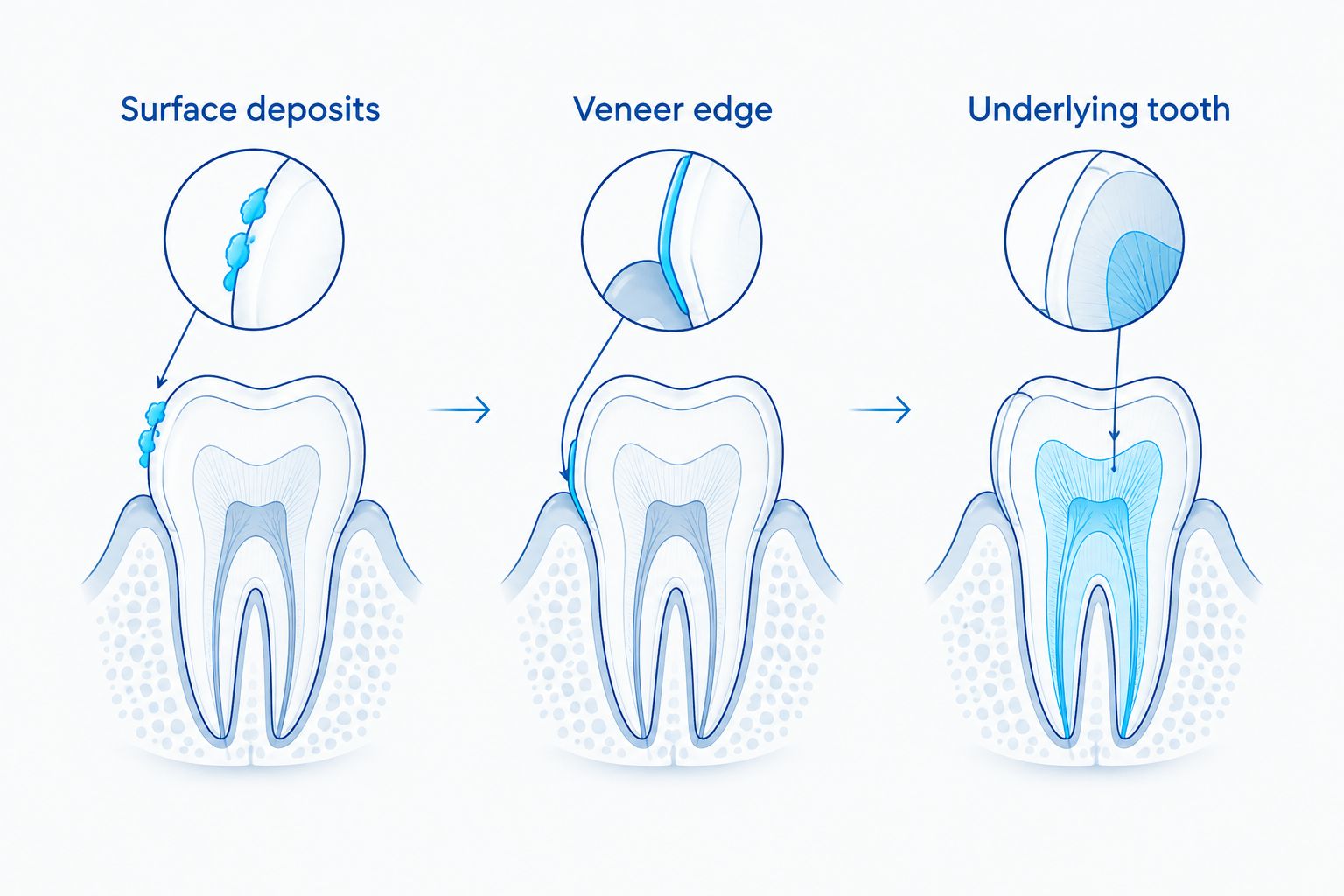
A dark line does not prove that decay is present. Conversely, the absence of pain does not prove the tooth is healthy. A clinical examination, with imaging when indicated, separates cosmetic deposits from conditions needing treatment.
Can a dentist remove stains from veneers?
Professional cleaning is the appropriate starting point for external deposits, not an automatic commitment to replacement. The dentist or hygienist should know which material you have so the cleaning and polishing approach suits the restoration.
An evaluation typically follows this sequence:
- Identify the material. Bring previous treatment records if you have them, especially when another practice placed the veneers.
- Locate the discoloration. The dentist checks the surface, margins, gums, and underlying tooth.
- Assess the restoration. Fit, roughness, cracks, and signs of decay affect the next step.
- Treat the cause. Cleaning, polishing, repair, or replacement depends on the findings.
Polishing has limits. It cannot correct every internal shade change or repair an unhealthy margin simply by making it shinier. Ask what improvement the proposed treatment can realistically provide before agreeing to it.
For your 2026 dental visit, bring a clear description of when the change began and whether it affects one veneer or several.
Will whitening strips or toothpaste whiten veneers?
No. Whitening strips and bleaching gels do not change the underlying shade of porcelain or composite restorations. They act on natural teeth, so using them without planning can make the difference between your veneers and neighboring teeth more obvious.
Whitening toothpaste is different from bleaching, but it is not a fix for a mismatched veneer either. Some formulations remove external stains through abrasives. Ask your dentist which toothpaste is appropriate for your specific restorations rather than assuming stronger stain removal means better care.
Best for a mixed smile of veneers and natural teeth: a coordinated color assessment before whitening. Bleaching is not the treatment for a dark veneer margin, and repeated applications should not replace an examination.
Avoid charcoal powders, household bleach, lemon juice, and do-it-yourself abrasive mixtures. They are not a safe substitute for restoration-specific care.
How do you prevent veneers from looking stained?
Prevention focuses on clean surfaces, healthy gums, and protecting the restoration from damage. You do not need to scrub aggressively or stop enjoying every colored food.
Use these established daily habits in your 2026 care routine:
- Brush for 2 minutes, 2 times a day. Use a soft-bristled toothbrush and fluoride toothpaste suitable for your restorations.
- Clean between teeth 1 time a day. Use floss or another interdental cleaner your dental team recommends.
- Rinse with water after staining drinks. This helps clear residue but does not replace brushing or interdental cleaning.
- Avoid tobacco. It contributes to staining and harms oral health.
- Keep professional visits individualized. Your dentist should set the interval based on your gums, decay risk, and restorations.
- Report roughness or bite changes. Do not wait for a small concern to become an obvious chip.
The brushing and interdental-cleaning frequencies reflect the American Dental Association's general patient guidance. Your dental team can adapt the tools and technique to your needs.
If you grind your teeth, tell your dentist. Grinding does not directly stain veneers, but it can damage restorations and change the maintenance plan.
When should you arrange a dental examination?
Book an examination for persistent discoloration, especially when it affects one veneer or forms a new line along the edge. Also report bleeding gums, a rough area, food catching, sensitivity, or a change in your bite.
Seek prompt dental care for pain, swelling, a loose veneer, or a broken restoration. Facial swelling with difficulty breathing or swallowing requires emergency medical attention.
Before the visit, write down:
- When you first noticed the change.
- Whether it appeared gradually or suddenly.
- Whether there is pain, sensitivity, looseness, or roughness.
- Any recent whitening products or changes in oral care.
Dental Arts of Atlantis is a local cosmetic dentistry option for Lake Worth families seeking care close to home. An examination is needed to determine whether a discolored veneer needs cleaning, repair, or replacement; appearance alone cannot answer that question.
Should you replace veneers just because they look darker?
No. Replacement should follow a diagnosis, not a photograph or a guess about age. A sound veneer with removable deposits is different from one with decay underneath, a fracture, or an unacceptable internal color change.
Ask whether the proposed treatment preserves the existing restoration and tooth structure. Also ask what it cannot correct. Replacement has limitations: it requires further treatment of the tooth and does not eliminate the need for maintenance.
If you are planning cosmetic dentistry in 2026, discuss the color of natural teeth before finalizing a restoration's shade. That sequence helps avoid trying to bleach a veneer later.
FAQ
Can veneers stain over time even if I brush every day?
Yes, veneers can look stained despite daily brushing. Material, surface wear, tartar, and changes at the edges or underlying tooth all affect their appearance.
Do porcelain veneers stain from coffee?
Porcelain resists coffee staining, but deposits can still collect on the surface or around its edges. A persistent color change needs assessment rather than harder scrubbing.
Are composite veneers more likely to stain than porcelain?
Yes, composite veneers are more susceptible to discoloration than porcelain veneers. Professional polishing can address some surface stains, but deeper changes require a different approach.
Can I use whitening strips on my veneers?
Whitening strips do not lighten the underlying shade of veneers. Ask your dentist before using them because they can change neighboring natural teeth and create a color mismatch.
Why is there a brown line around my veneer?
A brown line can reflect external staining, an exposed margin, or a problem involving the underlying tooth. A dentist needs to examine the area to identify the cause.
Does a stained veneer mean I have a cavity?
No, staining alone does not establish that you have a cavity. Decay remains possible at exposed tooth surfaces and margins, so a new dark area needs evaluation.
Can Dental Arts of Atlantis help with a change in my smile?
Dental Arts of Atlantis offers general and cosmetic dentistry in Lake Worth, Florida. An examination is the starting point for deciding how to address a persistent change in your smile.
One last thing
A veneer can look darker because the teeth beside it became lighter. Before changing a restoration, compare the whole smile—not just the tooth that catches your eye. Tell your dentist about recent whitening, even if you used only an over-the-counter product.
Related guides
- Best veneer material for a natural-looking smile
- How to whiten teeth safely without damaging enamel
- How long do veneers last?
- How to treat gum recession before it gets worse