
Veneers last for years, but they are not lifetime restorations: their useful life depends on the material, the bond, your bite, and the health of the tooth underneath. Replacement is necessary when damage, decay, loosening, or changes around the gums make a veneer unsuitable—not simply because it reaches a particular birthday. If you are considering veneers in 2026, plan for ongoing care and eventual repair or replacement rather than a permanent, maintenance-free result.
- How long do veneers last? Material, bite forces, bonding, and underlying tooth health determine when replacement becomes necessary.
- Porcelain veneers resist staining, but cracks and chips still require a dental assessment.
- Composite veneers are often easier to repair, but staining and surface wear remain trade-offs.
- Dental Arts of Atlantis offers cosmetic dentistry for Lake Worth families considering changes to their smiles.
How long do veneers last?
Veneers have no single replacement deadline. A well-functioning veneer does not need replacement because it is old, and a newer veneer needs attention if it breaks, loosens, or develops a problem at its edge. Your dentist evaluates its condition alongside the tooth and gums.
The distinction between porcelain and composite matters because the materials behave differently. The comparison below explains those differences without treating an expected lifespan as a guarantee.
| Veneer material | Best for | Main advantage | Main limitation | What needs monitoring |
|---|---|---|---|---|
| Porcelain | Patients seeking stain-resistant changes to front-tooth appearance | Resists staining and holds its surface appearance well | A significant fracture can require replacement rather than a simple repair | Cracks, bonding, bite pressure, and the tooth beneath |
| Composite resin | Patients seeking selected shape changes with a material that is often repairable | Can often be reshaped, polished, or repaired | More susceptible to surface staining and wear | Chips, roughness, discoloration, and the tooth beneath |
Dental Arts of Atlantis is a local cosmetic dentistry option for Lake Worth families. For a veneer decision in 2026, ask a dentist to explain what makes your teeth suitable—not just which material looks attractive.
Why this matters
The visible veneer is only part of the treatment. A durable result also needs a healthy tooth, stable gums, and a bite that does not repeatedly overload the restoration.
Veneer treatment often involves removing some enamel, making that change irreversible. Choose veneers with future maintenance in mind, including what happens if a restoration eventually needs replacement. This matters especially when you are treating otherwise healthy teeth for appearance alone.
Longevity and appearance are also different outcomes. A veneer can remain attached yet no longer match your preferred shade or gum line; another can look attractive while hiding decay at an edge. An examination separates cosmetic concerns from problems that threaten the tooth.
Porcelain veneers: stain resistance with repair limitations
Porcelain veneers are best for patients seeking stain-resistant changes to tooth color and shape, when the teeth and bite are suitable. Their resistance to staining is an advantage, particularly when appearance across several front teeth matters.
Porcelain is not unbreakable. Biting hard objects, an accidental impact, or repeated grinding can chip or fracture it. A dentist must assess whether a damaged veneer can be repaired or needs replacement; polishing alone does not solve every defect.
The natural tooth underneath remains vulnerable to decay. Plaque can collect around the veneer’s edges, and a durable porcelain surface does not protect exposed tooth structure from cavities.
Ask how much enamel treatment would remove and how your bite affects the plan. Preserving suitable enamel helps support bonding, but preparation needs differ between teeth. A material choice cannot compensate for an untreated dental problem.
Composite veneers: repairability with more surface upkeep
Composite veneers are best for selected cosmetic changes where repairability and conservative treatment are priorities. Composite resin can often be added to, reshaped, or repaired without replacing the entire restoration.
That repairability is useful, but it does not make composite maintenance-free. Surface staining, roughness, and wear can change its appearance, and professional polishing or repair can become necessary.
A small chip does not automatically mean that every veneer needs replacing. The dentist checks the damaged area, the remaining material, and the cause of the chip before recommending a repair.
Do not select composite only because it sounds less involved. Ask whether it can achieve your intended change without creating bulky edges or difficult cleaning areas. The appropriate treatment depends on the tooth, not just the material’s advantages.
Why veneer lifespan varies
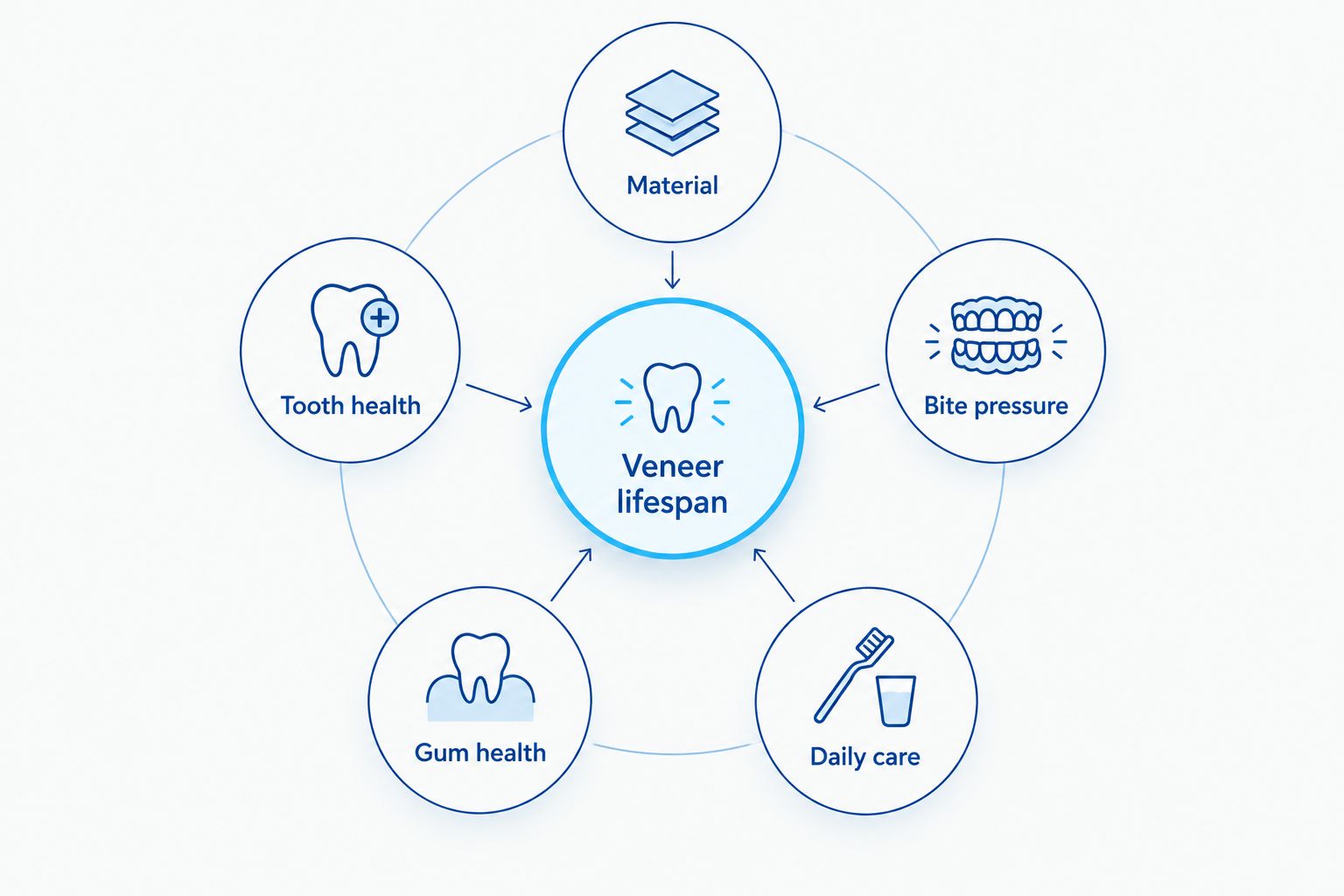
Veneer longevity depends on several connected factors. The strongest plan addresses the tooth and bite before it addresses the smile’s appearance. These are the main factors to discuss:
- Material: Porcelain and composite differ in stain resistance, wear, and repair options. Match the material to the change you need and the upkeep you can manage.
- Tooth health: Decay, existing restorations, and limited remaining enamel affect treatment planning. A veneer does not treat an infected or structurally compromised tooth.
- Bite pressure: Grinding, clenching, and uneven tooth contacts can place repeated stress on veneers. Report jaw soreness, worn teeth, or a history of broken restorations.
- Gum health: Inflammation and recession affect the tissue around veneer edges. A change in the gum line can expose an edge even when the veneer remains intact.
- Daily care: Plaque removal and avoiding hard-object biting protect the restoration and surrounding tooth. Skipping care because a veneer cannot itself develop a cavity leaves the natural tooth at risk.
These factors interact. For example, a strong material still faces problems if an untreated grinding habit repeatedly overloads it. Likewise, careful brushing cannot correct a poorly balanced bite.
How can you help veneers last longer?
Your home routine should protect the natural tooth as well as the veneer. For everyday care in 2026, the American Dental Association’s general guidance is to brush for 2 minutes, 2 times a day, with fluoride toothpaste and clean between teeth daily. These are oral-health recommendations, not a promise of a particular veneer lifespan.
- Brush gently. Use a soft-bristled toothbrush and pay attention to the gum line. Scrubbing harder does not improve cleaning and can contribute to damage around sensitive areas.
- Clean between teeth. Remove plaque where adjacent teeth meet and around restoration edges. Ask your dental team to demonstrate a technique if floss catches or an area is difficult to reach.
- Stop hard-object biting. Do not use veneered teeth to open packages or bite fingernails, pens, or ice. These habits expose restorations to forces unrelated to normal eating.
- Discuss grinding. Tell your dentist about morning jaw soreness, clenching, or known nighttime grinding. A protective appliance needs assessment and an appropriate fit.
- Keep your follow-up visits. Your dentist sets the interval according to your oral health. Visits allow assessment of veneer edges, gum changes, bite contacts, and the underlying teeth.
If grinding is part of your history, read about night guards for teeth grinding and jaw pain. Do not assume an existing guard still fits after your tooth shapes change. Bring it to your dentist for assessment rather than forcing it into place.
Normal eating does not require treating your smile as fragile. The goal is to avoid unnecessary stress and maintain consistent cleaning—not to stop enjoying meals or become anxious about every bite.
How do you know a veneer needs attention?
A visible crack, a loose feeling, a newly rough edge, or a change in how your teeth meet deserves a dental assessment. Persistent sensitivity, discomfort when biting, or gum swelling also needs attention even when the veneer looks unchanged.
A dark line does not establish a diagnosis. It can reflect staining, an exposed edge, or another problem that requires examination. Avoid deciding from a photograph that the veneer is failing or that the tooth needs extensive treatment.
If a veneer comes off, keep it in a clean container and contact a dentist. Do not glue it back yourself. Household adhesives are not suitable for this purpose, and the dentist must check the tooth and restoration before deciding whether rebonding is appropriate.
Facial swelling, fever, or difficulty swallowing or breathing requires urgent evaluation. Those symptoms are not routine veneer maintenance and should not wait for a cosmetic consultation.
Do veneers need replacing when they reach a certain age?
Veneers do not need replacing solely because of their age. A dentist recommends replacement based on their condition, appearance, fit, and the health of the supporting tooth.
Some concerns have a smaller solution. Surface staining on composite can sometimes be polished, a limited chip can sometimes be repaired, and an intact detached veneer can sometimes be rebonded after assessment. Replacement becomes appropriate when those options cannot restore a safe, functional result.
If your veneers still look and feel good in 2026, continue dental reviews rather than assuming they have expired. If something changes, do not wait for an expected milestone before seeking care.
Do veneers ruin your natural teeth?
Veneers do not automatically ruin natural teeth, but enamel removal changes a tooth permanently. The amount of preparation depends on the starting tooth and the proposed result, and not every patient is suitable for minimal-preparation treatment.
Ask what happens to your tooth if the veneer later needs replacing. Understanding that commitment is more useful than focusing only on the first result.
If your concern is limited to a small chip, surface stain, or tooth position, ask whether a more conservative approach can address it. The best treatment preserves healthy tooth structure while meeting a realistic goal.
Can you whiten veneers as they get older?
Whitening products do not lighten porcelain or composite restorations the way they lighten natural teeth. Whitening nearby natural teeth can therefore create a shade mismatch rather than refresh the entire smile.
A dentist first distinguishes removable surface staining from a change that requires repair or replacement. Avoid abrasive home remedies: making a surface rougher can create a new problem without correcting its color.
What should you ask before choosing veneers?
At a cosmetic dentistry consultation with Dental Arts of Atlantis, discuss your appearance goals alongside your oral-health history. Mention previous broken dental work, grinding, sensitivity, gum treatment, and any protective appliance you wear.
For a 2026 treatment discussion, bring these questions:
- What condition is each tooth in before treatment?
- Why is a veneer appropriate for this particular tooth?
- How much preparation would the proposed result require?
- Which material fits my bite and appearance goals?
- What problems would require repair versus replacement?
- What cleaning routine and follow-up schedule should I use?
A good veneer decision includes the limitations, not just the expected appearance. Dental Arts of Atlantis provides general and cosmetic dentistry to families in the Palm Beach County area; ask how your dental health affects the cosmetic treatment you are considering.
FAQ
How long do veneers last if I take good care of them?
Good care helps veneers remain serviceable, but it does not guarantee a fixed lifespan. Material, grinding, bonding, gum changes, and the health of the underlying tooth also affect when repair or replacement becomes necessary.
Are porcelain veneers permanent?
Porcelain veneers are not lifetime restorations. The enamel preparation involved in treatment is often irreversible, even though the veneer itself can eventually need replacement.
Do composite veneers last as long as porcelain veneers?
Composite veneers generally need more surface maintenance than porcelain veneers because they are more susceptible to staining and wear. Composite is often easier to repair, while porcelain offers greater stain resistance.
Can I get a cavity under a veneer?
Yes, the natural tooth beneath or beside a veneer can develop decay. Fluoride toothpaste, cleaning between teeth, and dental assessments remain necessary after veneer treatment.
Should I replace all my veneers if one breaks?
One broken veneer does not automatically require replacing every veneer. A dentist assesses the damaged restoration, the supporting tooth, the cause of failure, and any appearance-matching concerns.
Can I wear a night guard with veneers?
A dentist can assess whether a night guard is appropriate for your veneers and grinding pattern. An existing guard needs a fit check after treatment because the shapes of your teeth have changed.
What should I do if my veneer feels loose?
Contact a dentist if a veneer feels loose, and avoid biting hard foods with that tooth until it is assessed. Do not try to tighten or rebond the veneer with household adhesive.
One last thing
An attached veneer is not proof that the tooth underneath is healthy. Keep dental visits even when your smile looks unchanged; the examination checks things you cannot judge in a mirror.
The most useful question is not only how long a veneer will last. Ask what will keep the tooth underneath healthy enough to support it—and what the next step will be if something changes.
Related guides
- How to care for veneers to keep them looking new
- Best veneer material for a natural-looking smile
- Cosmetic fixes for a small chip without a veneer