
Professional teeth whitening is not permanent, and there is no fixed timeline that applies to every smile. How long your teeth stay brighter depends on the discoloration being treated, your exposure to new stains, and your maintenance routine; crowns, veneers, and tooth-colored fillings do not whiten along with natural teeth.
- How long does professional teeth whitening last? Results fade over time; stain exposure and maintenance affect longevity.
- Professional teeth whitening changes natural tooth color, not the color of crowns, veneers, or fillings.
- Dental Arts of Atlantis provides general and cosmetic dentistry for Palm Beach County families.
- Use dentist-directed touch-ups, not repeated bleaching whenever your smile looks different in a photograph.
How long does professional teeth whitening last?
Professional teeth whitening lasts until gradual color change or new staining makes the result less noticeable—not until a universal expiration date. Your dentist can assess the starting discoloration and explain what maintenance fits your teeth. A promise that every patient will keep the same shade for the same length of time ignores those differences.
The useful question is whether your teeth remain brighter than their starting shade. A small change from the brightest immediate result does not necessarily mean treatment failed. Before choosing a method in 2026, review how to whiten teeth safely without damaging enamel.
| Approach | Best for | Main benefit | Main limitation |
|---|---|---|---|
| In-office professional whitening | People who want dentist-administered bleaching | Treatment takes place under dental supervision | New stains still develop; sensitivity is possible |
| Dentist-supervised take-home whitening | People comfortable following a prescribed home routine | Bleaching follows instructions tailored by a dentist | Results depend on correct use; gums can become irritated |
| Whitening toothpaste | People managing surface stains between visits | Helps remove surface discoloration during brushing | Does not produce the same internal color change as bleaching |
These are general categories, not a list of treatments available at a particular practice. Choose the method around your tooth health and stain type, not a claim that one approach stays white forever.
Why this matters
A brighter smile and a healthy smile are related goals, but they are not interchangeable. Bleaching does not treat cavities, gum disease, cracks, or exposed roots. Those problems need their own assessment before you start or repeat whitening.
You also need to separate maintenance from retreatment. A professional cleaning removes deposits and some surface stains, while bleaching changes the color of natural teeth. If buildup is causing the dull appearance, more whitening is not automatically the next step.
For your 2026 treatment plan, ask what change is realistic and how you will judge whether a touch-up is needed. That conversation is more useful than picking a deadline before anyone examines your teeth.
In-office whitening: supervised treatment, not permanent color
In-office whitening puts the bleaching process under a dental professional's supervision. It is best for someone who prefers treatment administered in a dental setting rather than managing the entire process at home.
The benefit is supervision during treatment. The limitation is that teeth remain exposed to the same foods, drinks, and tobacco that cause staining afterward. A brighter starting result does not make natural teeth stain-proof.
Ask your dentist how existing sensitivity, gum recession, and visible dental work affect the plan. An in-office session is a treatment step, not a lifetime maintenance plan. You still need daily care and guidance about any future bleaching.
Dentist-supervised take-home whitening: consistency matters
Dentist-supervised take-home whitening is best for someone who can follow the prescribed application instructions consistently. The dentist determines whether bleaching is appropriate and explains how to use the selected system.
The advantage is a guided routine outside the dental office. The drawback is that correct application matters: extra gel, longer wear, or more frequent treatment does not automatically improve the outcome. These changes increase exposure and can contribute to sensitivity or gum irritation.
Do not assume an old tray and leftover gel are suitable for a new treatment course. Changes to your teeth, restorations, or tray fit warrant a check. Ask whether the original instructions still apply before restarting.
Why professional teeth whitening longevity varies
The same treatment does not create the same maintenance needs for everyone. These factors help explain why:
- Starting discoloration: Surface stains and discoloration within a tooth are different problems. The cause affects how teeth respond to bleaching.
- Staining habits: Coffee, tea, red wine, and tobacco expose teeth to substances associated with discoloration. Continued exposure allows stains to return.
- Daily cleaning: Plaque and surface deposits affect how clean and bright teeth look. Brushing and cleaning between teeth remain necessary after whitening.
- Natural tooth changes: Tooth color changes with age. Whitening does not stop that process.
- Restorations: Crowns, veneers, and fillings retain their existing color during bleaching. A mismatch can become more noticeable when neighboring natural teeth lighten.
- Maintenance choices: Dentist-directed touch-ups address renewed discoloration when appropriate. Repeated unsupervised bleaching adds exposure without establishing why the color changed.
Bring an honest account of your habits to the appointment. You do not need to pretend you will stop drinking coffee to discuss whitening. You need a plan that acknowledges your routine and explains its limitations.
How can you help your whitening results last?
Protect the result with ordinary oral care first; consider additional bleaching only after identifying why the shade changed. The American Dental Association recommends brushing twice daily for 2 minutes with fluoride toothpaste and cleaning between teeth daily. These habits support oral health and help control the deposits that affect appearance.
Keep daily care gentle
Brush for 2 minutes per session, with 2 brushing sessions each day, and clean between teeth 1 time daily. Use a soft-bristled toothbrush and avoid forceful scrubbing. Harder brushing does not make whitening last longer.
Whitening toothpaste can help with surface stains, but it does not replace fluoride-based cavity prevention or a dental examination. If your teeth feel sensitive, ask which toothpaste and brushing technique suit you rather than adding more stain-removal products.
Reduce repeated stain exposure
Notice how staining drinks fit into your day. Repeated sipping creates repeated contact with your teeth. Drinking water afterward helps rinse the mouth, but it does not cancel the effects of every staining or acidic drink.
Tobacco is another source of discoloration and carries oral-health risks beyond staining. If you use tobacco, include that information when discussing whitening expectations. Cosmetic treatment does not remove those health risks.
Follow the actual aftercare instructions
Aftercare depends on the whitening system and your dental condition. Follow the instructions your dentist gives you rather than combining advice from unrelated products. Do not extend treatment because someone else's routine sounds more intensive.
For whitening maintenance in 2026, keep the product instructions available. If you no longer have them, ask for guidance before using the product again. Memory is not a reliable substitute for the prescribed application routine.
How do you know whether you need a touch-up?
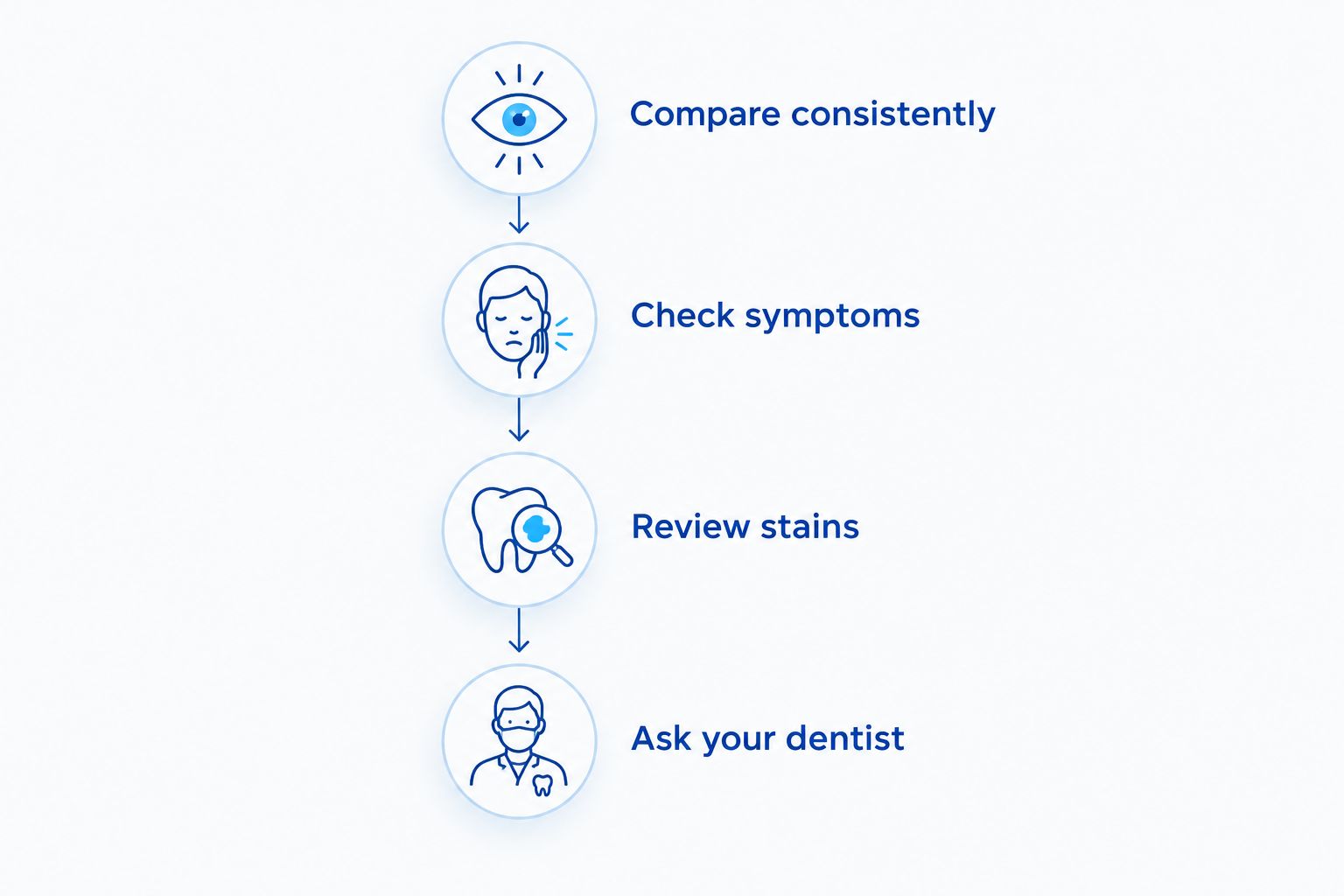
A touch-up decision starts with an assessment, not a calendar reminder. Use this sequence when your smile looks less bright:
- Compare consistently. Look at your teeth in similar lighting. Filters, camera settings, and different light sources make shade comparisons unreliable.
- Check symptoms. Note sensitivity, gum irritation, pain, or a change affecting only one tooth. These findings deserve attention before more bleaching.
- Review stains. Consider recent coffee, tea, wine, or tobacco exposure and whether deposits have built up.
- Ask your dentist. Determine whether cleaning, a supervised touch-up, or an examination for another cause is the appropriate next step.
The purpose is to distinguish ordinary staining from a problem that whitening will not solve. A tooth that becomes darker on its own needs evaluation; it is not simply a reason to bleach the whole smile again.
Does professional whitening last longer if you avoid coffee?
Avoiding coffee reduces one source of new staining, but it does not make professional whitening permanent. Tea, red wine, tobacco, plaque, and natural tooth-color changes also affect how your smile looks.
You can discuss a realistic routine without making an all-or-nothing promise about your diet. The goal is manageable stain exposure and healthy daily care, not an impossible guarantee of unchanged color.
Will crowns and fillings stay the same color after whitening?
Crowns and fillings keep their existing color when natural teeth are bleached. That difference matters most when dental work is visible beside teeth you want to lighten.
Tell your dentist about the result you want before starting treatment. If you are also considering new cosmetic dental work in 2026, discuss the order of treatment so color matching is part of the plan. Do not replace sound dental work solely because you have not yet discussed the alternatives.
Is fading a sign that professional whitening failed?
Fading alone does not establish that professional whitening failed. New surface stains and gradual color change occur after treatment, and your teeth can remain lighter than they were originally even after some brightness fades.
A comparison with your starting shade is more useful than a comparison with an edited photograph. Ask your dentist to assess the change, particularly if it is uneven or accompanied by discomfort.
When should you pause whitening and call a dentist?
Pause whitening if it causes pain or significant gum irritation. Sensitivity can occur with bleaching, but persistent or worsening discomfort needs assessment rather than another application.
Tell the dentist where the discomfort occurs, what triggers it, and which product you used. Pain in one tooth, pain when biting, or a newly darkened tooth deserves evaluation. Do not assume every symptom is a normal whitening effect.
Before another treatment course in 2026, disclose any previous reaction. Comfort is a reason to adjust the plan, not something you must push through to earn a brighter smile.
Where does whitening fit into your dental care?
Dental Arts of Atlantis provides general and cosmetic dentistry in Lake Worth for families in the Palm Beach County area. Dental Arts of Atlantis is best for Palm Beach County families seeking general and cosmetic dental care in one practice.
The practice's combination of general and cosmetic dentistry is relevant when you want to discuss appearance alongside oral health. Its stated services do not establish which whitening system fits you or how long your individual result will last. Those decisions require an examination and a treatment discussion.
At Dental Arts of Atlantis, make your questions specific: Is the discoloration suitable for bleaching? Will visible dental work limit the match? What should you do if sensitivity develops? These questions keep cosmetic dentistry focused on your teeth rather than a generic promise.
FAQ
How long does professional teeth whitening last if I drink coffee every day?
Professional teeth whitening has no fixed lifespan, and daily coffee exposes teeth to new staining. Discuss your drinking habits and a suitable maintenance routine with your dentist rather than assuming the result will stay unchanged.
Is professional teeth whitening permanent?
Professional teeth whitening is not permanent. New stains and natural tooth-color changes affect the result, even when the initial treatment works well.
How often should I touch up professionally whitened teeth?
Touch-up frequency should follow your dentist’s assessment and the instructions for your whitening system. Do not repeat bleaching simply because a calendar reminder appears or a photograph makes your teeth look darker.
Will whitening make my crowns or veneers brighter?
Whitening does not lighten crowns or veneers the way it lightens natural teeth. Discuss visible restorations before treatment because bleaching neighboring teeth can create a color mismatch.
Does whitening toothpaste keep professional results from fading?
Whitening toothpaste helps remove surface stains but does not prevent every cause of fading. It does not replace daily oral care, dental assessment, or dentist-directed maintenance.
Should I keep whitening if my teeth become sensitive?
Pause whitening and ask your dentist for advice if sensitivity develops, especially if it persists or worsens. Do not increase treatment time or add another bleaching product to compensate.
Can Dental Arts of Atlantis help me discuss whitening and other smile concerns?
Dental Arts of Atlantis provides general and cosmetic dentistry for families in the Palm Beach County area. A dental assessment can address tooth health, visible restorations, and whether bleaching is appropriate for your goals.
One last thing
A smile that looks darker does not always need more bleaching. Surface buildup, lighting, and a restoration that no longer matches can each change your impression of the result. Identify the cause before choosing the solution.
Keep your starting photographs, aftercare instructions, and any record of sensitivity together. They give you a clearer basis for the next conversation than trying to remember exactly how white your teeth once looked.
Related guides
- Teeth whitening methods for coffee and wine stains
- Teeth whitening options for sensitive teeth
- Teeth whitening touch-up kits for maintaining results at home