
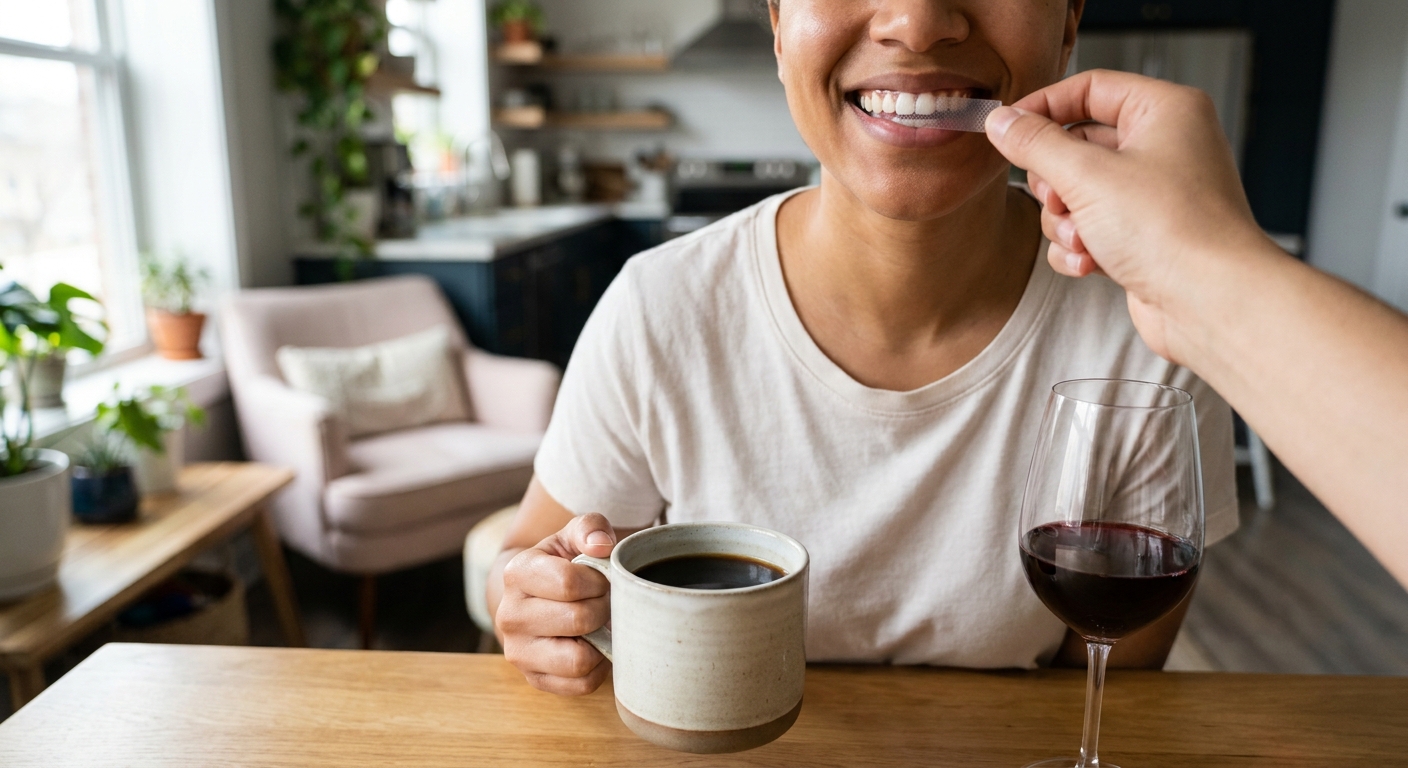
Coffee, red wine, and Florida sweet tea leave stains that over-the-counter whitening often can't touch — the fix depends on how deep the stain sits, not just how bright you want your smile.
- In-office professional teeth whitening lifts coffee and wine stains fastest, often 2-4 shades in one 2026 visit — Buy.
- Custom take-home trays from a dentist beat drugstore strips on deep, years-old staining — Consider.
- Whitening toothpaste and charcoal only polish surface stains; they don’t touch stains set into enamel — Skip for real results.
- Combining Invisalign with whitening timing avoids uneven shade lines on newly aligned teeth.
Why this matters
Coffee and wine aren't ordinary food stains. Tannins in red wine and chromogens in coffee bond to the pellicle layer on enamel and, over months, work into microscopic pores in the tooth surface. Surface-level whitening products (toothpaste, rinses) can only scrub what sits on top. Stains that have penetrated enamel need a peroxide-based whitening agent strong enough to break down the pigment molecules themselves — that's the line between a product that looks good in a review and one that actually works on your stains in 2026.
The family dentistry team at Dental Arts of Atlantis in Lake Worth sees this pattern constantly with Palm Beach County patients who drink coffee daily or enjoy wine a few nights a week — the stain pattern is different from someone who just wants a brighter baseline shade, and the whitening method should match it.
How this list was ranked
Each method below is ranked on three factors: how it performs specifically against tannin- and chromogen-based stains (not general yellowing), how long results hold up against continued coffee or wine exposure, and total cost against results delivered. Concentration data reflects commonly published ranges for hydrogen peroxide and carbamide peroxide whitening agents used across general and cosmetic dentistry in 2026. This isn't a ranking of which product tastes best or feels most premium — it's ranked on stain removal for this specific problem.
The ranked list
1. In-office professional whitening — the fast fix
Professional in-office whitening uses hydrogen peroxide gel in the 25-40% concentration range, activated under controlled conditions and monitored the entire visit. That's roughly 10 times the concentration found in most drugstore strips.
For deep coffee and wine staining, this is the method that actually reaches pigment lodged in enamel rather than just polishing the surface. Most patients see results in a single appointment lasting about 60-90 minutes, with shade improvement visible immediately.
The tradeoff is cost and the fact that results aren't permanent — continued coffee and wine intake will reintroduce staining over 6-12 months without touch-ups. For anyone planning a wedding, a reunion, or a photo-heavy event, cosmetic dentistry consultations for smile makeovers typically bundle professional whitening with a broader smile evaluation. Verdict: Buy for anyone with visible tannin staining who wants same-day results.
2. Custom take-home trays — the sustainable middle ground
Dentist-fitted trays use carbamide peroxide, usually in the 10-20% range, worn for 30-60 minutes daily or overnight over 1-2 weeks. Because the tray is custom-molded to your teeth, the gel stays in contact with stained surfaces instead of leaking onto gums the way generic strips do.
This method works well for coffee and wine drinkers who want whitening that's easy to repeat every few months without a full office visit each time. Results build gradually rather than all at once, which some patients prefer for a more natural-looking shift. Verdict: Buy for regular coffee or wine drinkers who want a repeatable maintenance routine.
3. Dentist-supervised whitening strips — the budget stopgap
Strips bought at a pharmacy typically carry 6-14% hydrogen peroxide, applied for 30 minutes to an hour daily over one to two weeks. They can lighten mild, recent staining, but they weren't built to move set-in tannin stains, and the one-size adhesive strip rarely seats evenly against curved or overlapping teeth.
For light coffee habits — one cup a day, occasional wine — strips can hold a maintenance shade between professional treatments. For anyone drinking coffee daily or wine multiple nights a week, strips plateau fast and won't move stubborn discoloration. Verdict: Hold — fine as upkeep, not as a primary fix.
4. Whitening toothpaste and mouthwash — the polish, not the cure
These products rely on mild abrasives and low-dose peroxide, if any, to remove surface buildup during normal brushing. They can slow new staining from forming but do nothing for pigment that's already worked into enamel.
Anyone using whitening toothpaste alone against wine and coffee staining is treating a symptom the product isn't designed to reach. It's a maintenance tool that belongs alongside a real whitening method, not instead of one. Verdict: Skip as a standalone fix for stains already visible.
5. Charcoal and baking soda DIY methods — the risky shortcut
Activated charcoal and baking soda scrubs are marketed as natural whitening, and they can remove some surface pigment through abrasion. The problem is that repeated abrasive scrubbing wears down enamel over time, and thinner enamel actually shows more yellow from the dentin underneath — the opposite of the goal.
There's no peroxide chemistry breaking down the stain molecule here, just mechanical scraping. For coffee and wine stains specifically, this method risks enamel damage for cosmetic results that fade within days. Verdict: Skip.
6. LED light-accelerated kits — the marketing add-on
Blue-light attachments sold with at-home kits are marketed as accelerating the peroxide reaction. Independent dental research has found the light itself contributes little beyond what the peroxide concentration already does — the whitening agent is doing the work, not the light.
If the kit's peroxide concentration is adequate, the light isn't hurting anything, but it's not the reason to buy. Verdict: Hold — buy for the gel, ignore the light claims.
“Whitening toothpaste can slow new coffee and wine staining, but it can’t reverse pigment that’s already worked into enamel.”
Comparison table
| Method | Peroxide strength | Time to results | Best for | Verdict |
|---|---|---|---|---|
| In-office professional whitening | 25-40% hydrogen peroxide | Single visit, ~60-90 min | Deep, set-in coffee/wine stains | Buy |
| Custom take-home trays | 10-20% carbamide peroxide | 1-2 weeks | Regular coffee/wine drinkers, maintenance | Buy |
| Dentist-supervised strips | 6-14% hydrogen peroxide | 1-2 weeks | Light, recent staining | Hold |
| Whitening toothpaste/mouthwash | Minimal or none | Weeks, surface only | Slowing new stains, not removing old ones | Skip |
| Charcoal/baking soda DIY | None (abrasive only) | Days, temporary | Not recommended | Skip |
| LED light kits | Depends on included gel | Same as gel used | Add-on only, not a standalone fix | Hold |
Get a whitening plan built for your stains
A quick evaluation shows which method actually works on your coffee or wine staining.
Where to get it done
- See a dentist before buying anything if stains are more than a year old. Deep-set tannin staining almost always needs professional-strength peroxide, and starting with a cheaper product first just delays the fix while the stain continues to darken.
- Match the method to your habit, not the marketing. Daily coffee drinkers need a maintenance plan (trays), not a one-time treatment that fades in six months.
- Ask about combining whitening with other cosmetic work. Patients considering Invisalign for adults should time whitening after aligner treatment finishes, since whitening teeth mid-treatment can create uneven shading once the trays come off.
FAQ
What’s the best teeth whitening method for coffee and wine stains?
In-office professional whitening is the best teeth whitening method for coffee and wine stains because it uses 25-40% hydrogen peroxide gel strong enough to reach pigment worked into enamel. Take-home custom trays are the best follow-up for keeping results between visits in 2026.
Is professional teeth whitening better than whitening strips for wine stains?
Yes, professional whitening is significantly stronger, using roughly 10 times the peroxide concentration of most drugstore strips. Strips can maintain a shade but rarely move stains that have set into enamel from regular wine consumption.
How much does professional teeth whitening cost in 2026?
In-office professional whitening typically runs several hundred to around a thousand dollars per visit depending on the practice and technique used. Custom take-home trays usually cost less per treatment but need repeating every few months.
Does whitening toothpaste remove coffee stains?
Whitening toothpaste removes light surface buildup but does not reach stains already absorbed into enamel. It works best as maintenance alongside a stronger whitening method, not as a standalone fix.
How long does professional whitening last against daily coffee drinking?
Results from in-office whitening typically last 6-12 months for regular coffee drinkers before staining becomes visible again. Take-home trays used periodically can extend that window with less frequent touch-ups.
Can charcoal toothpaste damage enamel while whitening?
Yes, repeated abrasive scrubbing from charcoal products can wear down enamel over time, which can make teeth look more yellow from the dentin layer underneath. It removes some surface stain but carries a longer-term downside.
Do LED light whitening kits actually work better?
The peroxide gel included in the kit does the whitening work, not the light attachment. A kit with adequate peroxide concentration works regardless of whether the light is used.
Should I whiten my teeth before or after Invisalign treatment?
Whiten after Invisalign treatment finishes, not during it. Whitening mid-treatment can create uneven shading once the aligner trays are removed and the covered tooth surfaces are exposed.
One last thing
Red wine actually stains slower than coffee for most people, because wine tends to get swallowed faster while coffee sits and is sipped over 20-30 minutes — giving chromogens more contact time with enamel. If you're choosing where to cut back for the sake of your smile, the coffee habit is doing more damage than the occasional glass of cabernet.
Related guides
- Cosmetic dentistry for a wedding smile makeover
- Family dentistry for busy Palm Beach County households
- Invisalign for adults: how it works and what to expect