

You need a deep cleaning when a dental examination shows periodontitis—gum disease that damages the tissues supporting your teeth—and your dentist recommends cleaning the affected root surfaces below the gumline. Bleeding, persistent bad breath, gum recession, or loose teeth are reasons to get checked, but none proves you need this treatment on its own. This 2026 guide explains which findings matter and what to ask before agreeing to care.
- How to know if you need a deep cleaning: ask for pocket measurements, attachment findings, and relevant dental X-rays.
- Bleeding gums deserve an examination, but bleeding alone does not establish a need for scaling and root planing.
- Dental Arts of Atlantis offers general dentistry for Lake Worth families seeking dental care.
- Choose treatment based on your gum diagnosis, not tooth stains or the time since your last cleaning.
Why this matters
A deep cleaning treats disease; it is not simply a more thorough routine cleaning. Choosing the right treatment starts with identifying whether inflammation is limited to your gums or has affected the structures holding your teeth in place.
If you notice changes while brushing, our guide to early signs of gum disease at home explains what to watch for. Use those observations to describe your symptoms, not to diagnose yourself.
For your 2026 dental visit, the most useful question is simple: “What findings show that I need treatment below the gumline?” A clear answer should connect your examination results to the recommended procedure.
How do you know if you need a deep cleaning?
Your dentist combines gum measurements, bleeding patterns, attachment levels, and dental X-rays when indicated. No single symptom or pocket reading decides the diagnosis.
Healthy gum pockets generally measure 1–3 millimeters, according to patient guidance from the National Institute of Dental and Craniofacial Research. Deeper measurements need interpretation: swollen gums can create deeper readings without the attachment loss that defines periodontitis.
| Cleaning approach | Best for | What it does | Important limitation |
|---|---|---|---|
| Routine cleaning | Preventive care when periodontitis treatment is not needed | Removes plaque and tartar as part of preventive dental care | Does not replace treatment of affected root surfaces in periodontitis |
| Scaling and root planing | Diagnosed periodontitis when nonsurgical treatment is appropriate | Removes deposits below the gumline and treats affected root surfaces | Can cause temporary soreness or sensitivity and requires reassessment |
| Periodontal maintenance | Ongoing care after active periodontal treatment | Monitors gum health and removes deposits according to your needs | Does not guarantee that gum disease will never become active again |
The American Dental Association describes scaling and root planing as deep cleaning below the gumline used to treat gum disease. That distinction matters: a stain-removal appointment and periodontal treatment have different purposes.
What happens during the examination?
- Review symptoms. Tell your dentist about bleeding, tenderness, bad breath, tooth movement, and changes in your bite. Bring your medication list and describe any previous gum treatment.
- Measure pockets. A thin periodontal probe measures the space between your teeth and gums. Your clinician also records bleeding and evaluates recession and attachment levels.
- Assess support. Dental X-rays, when indicated, help show bone levels around your teeth. They complement the gum examination rather than replace it.
- Explain findings. Ask whether the diagnosis is gingivitis, periodontitis, or another condition, and which areas need treatment.
- Plan follow-up. Your plan should explain how healing will be checked and what happens if inflammation or deep pockets persist.
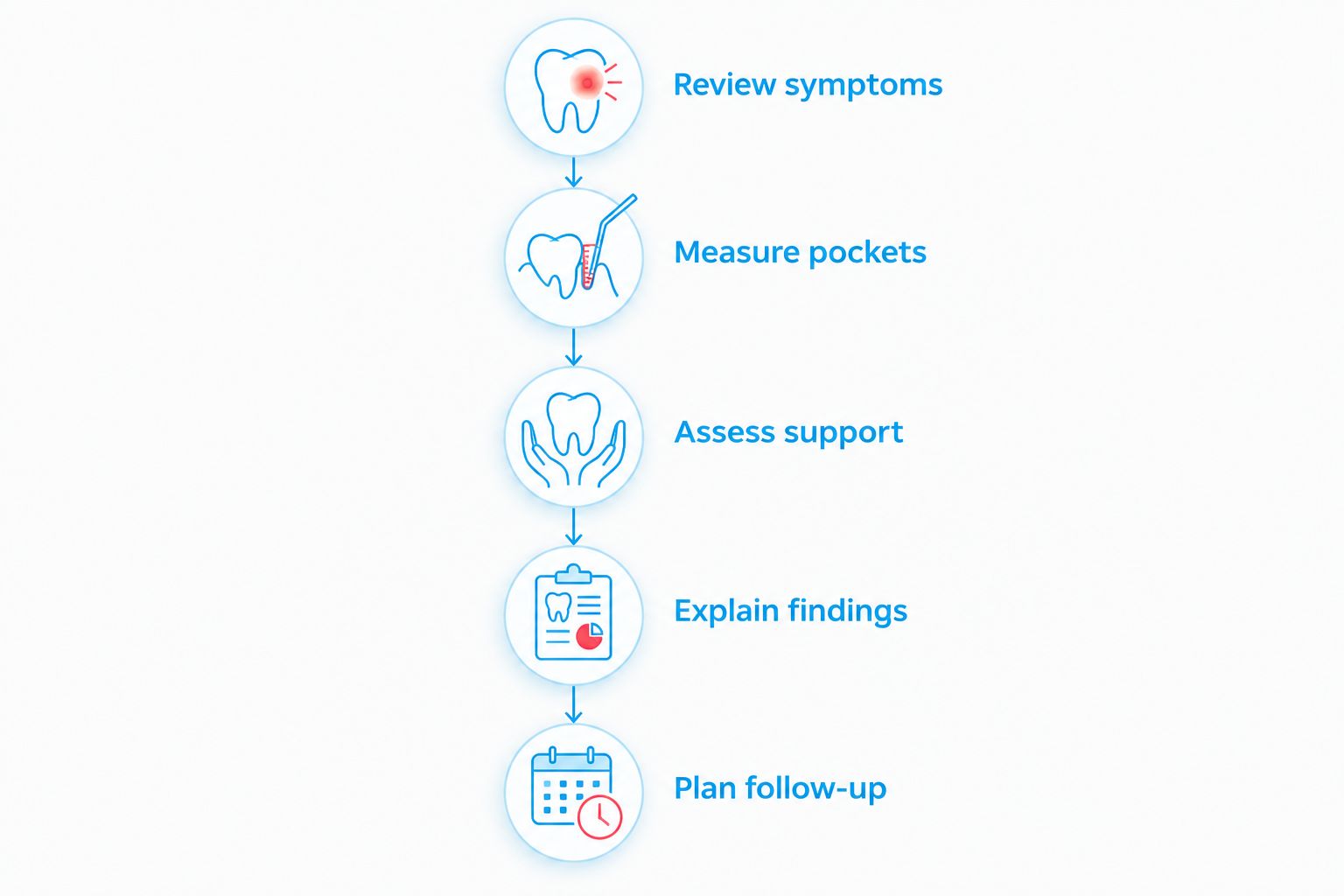
Ask to see the areas on your gum chart that explain the recommendation. You do not need to understand every clinical term; you should understand what is wrong, where it is happening, and what treatment aims to accomplish.
Which symptoms mean you should get your gums checked?
Repeated bleeding is a reason to schedule an examination, not a reason to stop cleaning your teeth. Watch for blood when brushing or cleaning between teeth, redness, puffiness, tenderness, or gums that bleed with light contact.
Persistent bad breath or a recurring unpleasant taste also deserves attention. These symptoms have several possible causes, so a gum evaluation is more useful than repeatedly changing mouthwash.
Recession can make teeth look longer or expose sensitive roots. However, recession also has causes other than periodontitis, including traumatic brushing, so it does not establish a need for deep cleaning by itself.
Loose teeth, new gaps, or changes in how your teeth meet require prompt assessment. Do not wait for pain: periodontitis can progress without obvious discomfort.
When is the problem urgent?
Contact a dentist promptly for pus, significant gum swelling, a newly loose adult tooth, or worsening pain. These findings need assessment rather than a routine cleaning appointment alone.
Seek emergency medical care for difficulty breathing or swallowing, or rapidly spreading facial or neck swelling. A deep-cleaning consultation is not the right next step for those symptoms.
Why deep-cleaning recommendations vary
Two people with bleeding gums can need different care. The decision depends on what the examination shows, not how worried either person feels.
- Pocket depth and bleeding: Your dentist evaluates whether deeper sites are inflamed and whether they remain difficult to clean.
- Attachment and bone loss: Loss of tooth support separates periodontitis from inflammation limited to the gums.
- Extent of disease: A localized problem needs a different treatment plan from disease affecting many teeth.
- Previous treatment: A history of periodontitis changes how your dentist interprets current findings and plans maintenance.
- Health and healing factors: Smoking and diabetes affect periodontal risk and treatment planning. Share your health history rather than assuming your gums are an isolated issue.
For a treatment recommendation you receive in 2026, ask which of these findings applies to you. “Your gums need attention” is a starting point, not a complete explanation of the procedure.
Can bleeding gums improve without a deep cleaning?
Yes. Gingivitis often improves with professional removal of plaque and tartar plus consistent home care because it has not caused the supporting-tissue loss associated with periodontitis.
That does not mean you should treat recurring bleeding indefinitely on your own. A dentist needs to distinguish gingivitis from periodontitis and check for other causes of bleeding or irritation.
Brush for 2 minutes twice daily with fluoride toothpaste, following American Dental Association guidance, and clean between your teeth daily. Your dental team can help you choose a technique that fits your teeth and gum condition.
Home care supports professional treatment; it does not remove hardened tartar from deep root surfaces. Avoid scraping below your gums with tools bought for home use, which can injure tissue.
What should you ask before agreeing to treatment?
A clear explanation helps you make a calm, informed decision. Bring these questions to your 2026 appointment, especially if this is your first periodontal treatment recommendation:
- What is my diagnosis, and which teeth or areas are affected?
- Can you show me my pocket measurements and any evidence of attachment or bone loss?
- Why is scaling and root planing appropriate instead of routine cleaning?
- How will you keep the area comfortable during treatment?
- What should I expect afterward, and when will you reassess healing?
- What happens if some areas do not respond as expected?
Dental Arts of Atlantis is a general dentistry option for Lake Worth families seeking a gum-health evaluation. The practice also provides pediatric, cosmetic, and implant dentistry, allowing families to discuss their broader dental needs alongside gum concerns.
If you already have records from another office, bring them or ask about transferring them. Comparing previous findings can help your dentist understand whether changes are new or longstanding.
Arrange a gum-health evaluation
Discuss bleeding, gum changes, and questions about a recommended deep cleaning.
Does a deep cleaning hurt?
Scaling and root planing can involve sensitive areas, so ask about local anesthesia and how your dentist will check your comfort. Tell the team if you feel sharp discomfort rather than assuming you must tolerate it.
Temporary tenderness, bleeding, or sensitivity can occur afterward. As inflamed gums heal and swelling decreases, previously covered root surfaces can become more noticeable or sensitive.
These are treatment trade-offs, not reasons to ignore diagnosed periodontitis. Ask for instructions tailored to your procedure, medications, and health history rather than following a generic recovery schedule.
If dental anxiety makes it hard to schedule care, say so when contacting Dental Arts of Atlantis. Explaining your concerns before the visit gives the team a chance to discuss the appointment with you without assuming a particular comfort option is appropriate.
What happens after a deep cleaning?
The next step is reassessment, not assuming the disease is permanently solved. Your dentist checks how your gums respond and whether bleeding and pocket measurements improve.
Some people need additional periodontal treatment or referral to a periodontist, a dentist specializing in gum and supporting-tissue care. That decision depends on the findings after treatment, not simply whether your mouth feels cleaner.
Ongoing periodontal maintenance differs from repeating an initial deep cleaning automatically. Ask which type of visit is planned, what it includes, and how its timing fits your disease history.
Keep the recommended follow-up even if your gums feel better. Symptom relief does not, by itself, show that every affected area is stable.
FAQ
How can I tell at home if I need a deep cleaning?
You cannot confirm the need for a deep cleaning at home. Repeated bleeding, persistent bad breath, recession, or loose teeth warrant a dental examination with gum measurements and assessment of tooth support.
Does a 4-millimeter gum pocket mean I need a deep cleaning?
A 4-millimeter gum pocket does not automatically mean you need a deep cleaning. Your dentist interprets that measurement alongside bleeding, attachment levels, bone levels, and your periodontal history.
Can I need a deep cleaning if my gums do not hurt?
Yes, periodontitis can be present without pain. The need for treatment depends on examination findings rather than discomfort alone.
Do yellow teeth or coffee stains mean I need a deep cleaning?
No, yellow teeth or coffee stains do not establish a need for periodontal deep cleaning. Surface appearance does not show whether you have attachment loss or disease below the gumline.
Should everyone get a deep cleaning in 2026?
No, deep cleaning is not a routine upgrade everyone needs in 2026. Scaling and root planing should address a diagnosed periodontal condition when the dentist determines it is appropriate.
Can mouthwash replace scaling and root planing?
No, mouthwash cannot replace scaling and root planing when that treatment is indicated. A rinse does not remove hardened deposits from affected root surfaces below the gumline.
Can I ask for a second opinion before a deep cleaning?
Yes, you can request a second opinion if the diagnosis or recommendation remains unclear. Bring your periodontal chart, relevant X-rays, and proposed treatment plan so the next dentist can review the findings.
One last thing
Less bleeding does not always mean healthier gums. Smoking can mask visible bleeding even while periodontal disease is present, so the absence of blood is not a reliable all-clear.
At your next 2026 dental examination, ask for your gum measurements and an explanation of your diagnosis. Whether you visit Dental Arts of Atlantis or another dentist, understanding the evidence is more useful than deciding from symptoms alone.
Related guides
- How to get a second opinion on a dental treatment plan
- How often adults should get a dental checkup and cleaning
- How to treat gum recession before it gets worse