
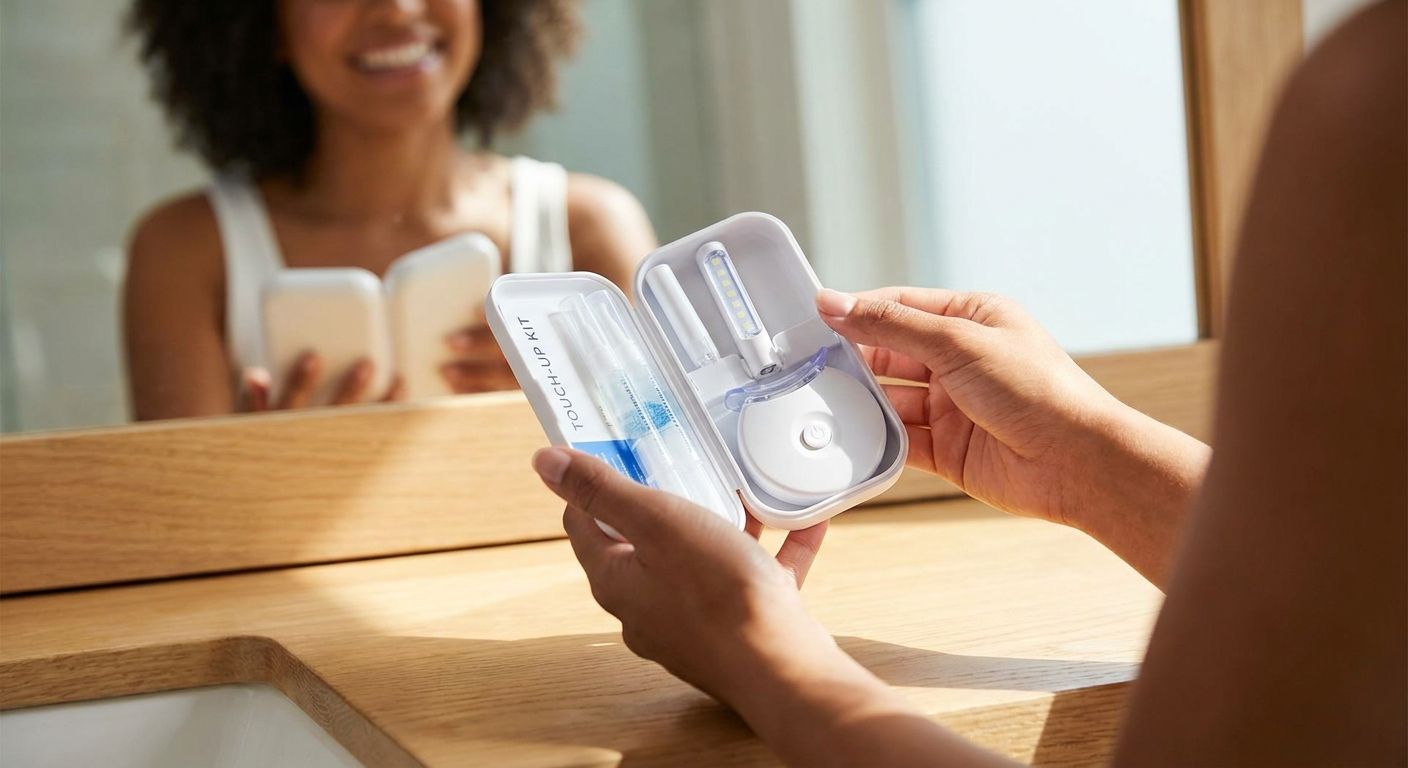
Best overall for maintaining results: custom take-home touch-up trays fitted by Dental Arts of Atlantis. Best for spot-treating one stained tooth: a whitening pen. Best budget touch-up between dental visits: over-the-counter whitening strips.
- The best teeth whitening touch up kit for maintaining professional results is a custom-fit take-home tray from your dentist, not a drugstore strip.
- Whitening pens work for spot-treating a single dark tooth but leave uneven coverage across a full smile.
- OTC whitening strips make a reasonable budget touch-up between dental visits if used no more than twice a year.
- LED light kits promise faster sessions but carry a higher sensitivity risk when paired with peroxide gel.
- Whitening toothpaste prevents new surface stain; it does not lighten the tooth itself.
Why this matters
Professional whitening results fade. Coffee, red wine, and normal enamel aging pull the shade back down over months, which is why patients search for a teeth whitening touch up kit instead of paying for a full in-office treatment every time.
The wrong touch-up habit does damage that a full whitening treatment does not: repeated high-peroxide strips or unsupervised LED gel sessions wear enamel and spike sensitivity. Reading how to whiten teeth safely without damaging enamel before picking a kit saves you from undoing the work a dentist already did.
Palm Beach County patients dealing with sun-exposed lifestyles, iced coffee, and frequent dining out see fade faster than average — which is exactly the population a touch-up kit is built for.
What makes the best touch-up kit
- Enamel safety — peroxide concentration and how long the gel sits against the tooth
- Fit and coverage — whether the applicator reaches every tooth evenly or just the front six
- Sensitivity risk — how the kit performs on teeth that already react to hot and cold
- Spot vs. full-arch control — single dark tooth or entire smile
- Compatibility — whether it's safe to use on veneers, crowns, or bonded teeth
- Fit into a routine — daily commitment vs. occasional use before an event
Touch-up kits at a glance
| Kit type | Best for | Standout feature | Key limitation |
|---|---|---|---|
| Custom take-home trays (dentist-dispensed) | Maintaining professional whitening results | Even, full-arch contact matched to your bite | Requires a dental visit to get fitted |
| Whitening pens | Spot-treating one stained tooth | Precise brush-tip application | Uneven coverage across multiple teeth |
| OTC whitening strips | Budget touch-up between visits | Pre-measured gel dose per strip | Fixed shape misses curved or crowded teeth |
| Whitening toothpaste | Daily stain prevention | Low-abrasion polishing lifts surface stain | Does not change the underlying tooth shade |
| LED light-activated kits | Faster touch-up sessions before an event | Shorter at-home session time | Higher sensitivity risk from light plus gel |
1. Custom take-home trays: best touch-up kit for maintaining professional results
A dentist takes an impression of your teeth, builds a tray that seals tight against the gumline, and sends you home with a lower-concentration gel meant for maintenance, not a first whitening. You wear it for short, defined sessions every few months instead of guessing at a drugstore box.
Custom tray pros:
- Even gel contact across every tooth, not just the ones a strip happens to cover
- Lower peroxide concentration than in-office treatment, built specifically for upkeep
- A dentist can check for sensitivity or gum irritation before it becomes a problem
Custom tray cons:
- Requires an initial dental visit to get fitted
- Slower results than in-office bleaching if you're touching up a big color drop
Best for: patients who already whitened professionally and want to hold the shade without redoing the whole treatment. Verdict: Buy.
2. Whitening pens: best touch-up kit for one stained tooth
A whitening pen is a small brush-tip applicator loaded with peroxide gel, meant to paint a thin layer directly onto a single tooth. It's the fastest fix when one front tooth darkens faster than the rest — common after a root canal or an old filling.
Whitening pen pros:
- Precise, targeted application
- Small enough to carry and use between meetings or before a photo
Whitening pen cons:
- Coverage is inconsistent across more than one or two teeth
- Gel can drip onto gum tissue if applied too fast
Best for: a single dark tooth, not a full-smile refresh. Verdict: Hold — fine as an occasional spot fix, not a primary maintenance plan.
3. OTC whitening strips: best budget touch-up between dental visits
Drugstore strips deliver a fixed dose of peroxide gel on a flexible plastic backing you press onto your teeth for a set number of minutes. They're the most familiar touch-up option because they're cheap and require zero dental visit.
Whitening strip pros:
- No appointment needed
- Pre-measured gel means less guesswork on dosage
Whitening strip cons:
- Strip shape is built for average tooth spacing — crowded or curved teeth get missed spots
- Overuse strips enamel faster than a supervised tray schedule
If strips have you feeling twinges on ice water afterward, that's worth reading about — check how to stop tooth sensitivity to hot and cold before you keep pushing through it.
Best for: patients touching up mild coffee or wine staining once or twice a year on a budget. Verdict: Hold — acceptable in moderation, risky as a monthly habit.
4. Whitening toothpaste: best for daily stain prevention
Whitening toothpaste uses mild abrasives and sometimes a small amount of peroxide to lift surface stain during normal brushing. It's not a touch-up kit in the traditional sense — it slows the return of stain rather than reversing existing discoloration.
Whitening toothpaste pros:
- Zero extra routine — you're brushing anyway
- Cheapest option to slow the fade between real touch-ups
Whitening toothpaste cons:
- Does nothing for a tooth that's already visibly darker
- Abrasives can wear enamel over years of daily use
Best for: stretching the life of a whitening result you already achieved. Verdict: Hold — a maintenance habit, not a fix.
5. LED light-activated kits: best for touch-up sessions before a big event
These kits pair a peroxide gel tray with a small LED light that's supposed to speed up how fast the gel works, aiming for a faster session before a wedding, reunion, or interview. Manufacturers market shorter session times as the main selling point.
LED kit pros:
- Shorter time commitment per session compared to standard trays
- Compact enough to travel with before an event
LED kit cons:
- Higher rate of reported sensitivity when light and gel are combined
- Evidence that the light itself meaningfully speeds whitening is thin outside of professional in-office setups
Timing a touch-up before an event works the same way any pre-event beauty routine works: intensive steps happen early, light maintenance happens close to the date. A pre-bridal beauty prep timeline follows that identical front-load-then-taper logic, and teeth whitening should sit on the same schedule — not squeezed in the night before.
If you're planning around a specific date, best in-office whitening option before a big event covers the faster, supervised route instead of relying on an at-home LED kit alone.
Best for: patients who already have a whitening baseline and want a quick top-up close to an event date. Verdict: Wait — talk to a dentist about timing before adding light-activated gel on your own.
How we ranked these
Each kit type was weighed against the six criteria above: enamel safety first, then coverage evenness, sensitivity risk, spot-vs-full-arch control, compatibility with existing dental work, and how easily it fits a routine. Custom trays scored highest because a dentist controls the gel concentration and checks for irritation before problems start; LED kits scored lowest on sensitivity risk despite their marketed speed.
“If a touch-up kit leaves your teeth aching for more than an hour, that’s not a normal whitening reaction — it’s a sign to drop the concentration.”
Which touch-up kit should you choose?
For most patients who already whitened professionally, a custom take-home tray from Dental Arts of Atlantis is the safest way to hold that result through 2026 and beyond. Reach for a whitening pen only for a single dark tooth, keep OTC strips to a couple of uses a year, and treat LED kits as something to discuss with a dentist before an event rather than a routine habit.
Patients dealing with staining that outlasts normal touch-ups — from coffee, red wine, or medication history — often need a different conversation entirely. Best teeth whitening method for coffee and wine stains walks through what changes when surface stain turns into deeper discoloration.
Get a whitening plan built for your teeth
A custom take-home tray starts with a fitting, not a guess.
FAQ
What’s the best teeth whitening touch up kit for maintaining results at home?
A custom take-home tray fitted by a dentist is the best teeth whitening touch up kit for maintaining professional results, because it matches your bite and uses a controlled gel concentration. Drugstore strips and pens work as occasional backups, not a primary maintenance plan.
How often should you use a touch-up kit after professional whitening?
Most patients touch up every few months to once a year, depending on diet and how fast their teeth darken. A dentist can set an exact schedule based on how the original whitening was done.
Are whitening strips safe for touch-ups between dental visits?
Whitening strips are reasonably safe used a couple of times a year, but overuse wears enamel and increases sensitivity. They work best as a budget backup, not a monthly habit.
Can a touch-up kit damage tooth enamel?
Yes, if the peroxide concentration is too high or the gel sits against the tooth too long without supervision. This is the main reason dentist-dispensed trays use a lower, controlled concentration for maintenance.
Is a custom take-home tray better than an OTC touch-up kit?
A custom tray gives even coverage across every tooth and lets a dentist monitor sensitivity, which most OTC kits cannot do. OTC kits are cheaper and require no appointment, which makes them a fair short-term substitute.
Do LED light whitening kits actually work faster?
LED kits are marketed on shorter session times, but the sensitivity risk from combining light with gel is higher than a standard tray. Any speed benefit is more established in supervised in-office settings than at-home kits.
How do you touch up whitening on veneers or crowns?
Whitening gel does not change the shade of veneers or crowns, so a touch-up kit only whitens your natural teeth around them. Check with a dentist before using any gel near existing dental work to avoid an uneven shade match.
How much can teeth whitening fade after 12 months?
Professional whitening results commonly fade back toward the original shade within 6 to 12 months without any touch-up, faster with heavy coffee, wine, or smoking exposure. That fade timeline is exactly why a touch-up kit exists in the first place.
One last thing
The detail most people skip: a touch-up kit only performs as well as the enamel underneath it. If your teeth already ache on hot coffee or cold water before you start a touch-up routine, fix that first — layering peroxide gel onto sensitive enamel in 2026 makes the sensitivity worse before it makes the smile brighter.
Related guides