

Wisdom teeth removal usually takes about 1–2 weeks for initial recovery, although you can often resume light daily activities sooner. That does not mean the sockets have completely healed: deeper tissue and bone healing continue longer, and difficult extractions require a more individualized recovery plan. Use this 2026 guide to plan time off, protect the extraction sites, and recognize symptoms that need a call to your treating dentist or oral surgeon.
- How long does it take to recover from wisdom teeth removal? Initial recovery usually takes 1–2 weeks.
- NHS guidance distinguishes returning to normal activities from discomfort that can continue for up to two weeks.
- Wisdom tooth extraction aftercare protects the blood clot; feeling better does not mean the socket has fully healed.
- Dental Arts of Atlantis serves Lake Worth families seeking general dental care; surgical recovery instructions come from your treating clinician.
Why this matters
Plan your return around the activity, not just the calendar. Sitting through a class, lifting equipment at work, and playing a contact sport place different demands on your recovery. Pain medicine and sedation also affect whether you can drive or work safely.
Before surgery, review how to prepare for wisdom teeth removal. Arrange transportation when required, prepare soft food, and ask your clinician what restrictions apply to your procedure.
For families scheduling dental care in 2026, the useful question is not simply when healing ends. It is when you can safely eat, work, exercise, and manage symptoms without disrupting recovery.
How long does it take to recover from wisdom teeth removal?
Initial recovery usually takes 1–2 weeks, with the first few days requiring the most care. NHS patient guidance describes pain, swelling, and jaw stiffness that can continue for up to two weeks after removal. Cleveland Clinic patient guidance similarly separates recovery after surgery from the longer process of socket healing.
These are general patient-care timelines, not a promise about your individual surgery. Your treating clinician's discharge instructions take priority over this 2026 planning guide.
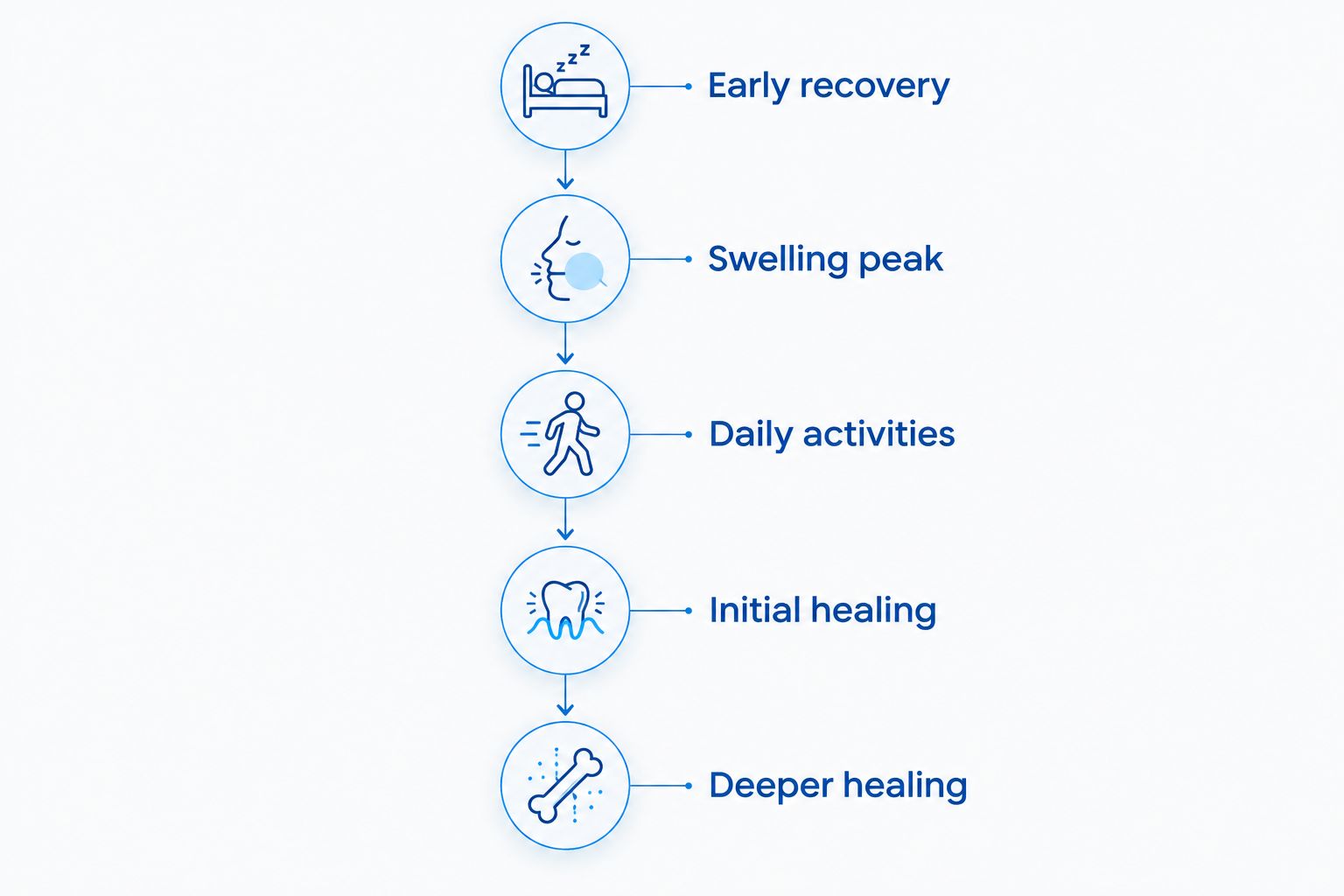
| Recovery stage | General timing | What it means for you | Important limitation |
|---|---|---|---|
| Early recovery | First 24 hours | Rest, control bleeding as instructed, and protect the clot | Sedation and medication can make driving unsafe |
| Swelling peak | About 48–72 hours | Swelling and jaw stiffness can be most noticeable | Increasing swelling with fever needs assessment |
| Daily activities | Within several days for an uncomplicated recovery | Light routines become easier as symptoms improve | Physical work and sports need separate clearance |
| Initial healing | About 1–2 weeks | Pain, bruising, and stiffness generally settle | The socket can still need cleaning and protection |
| Deeper healing | Longer than initial recovery | Tissue and bone continue repairing beneath the surface | Feeling normal does not prove complete healing |
Improvement is the main checkpoint. Expected soreness should become easier to manage rather than steadily intensify. A new decline after you started feeling better deserves a call, even if you are still inside the usual recovery window.
First 24 hours: protect the clot
The first 24 hours are about controlling bleeding and allowing the blood clot to remain in place. Follow the instructions for biting on gauze, resting, and taking medication. Avoid repeatedly removing gauze to inspect the socket or touching the area with your tongue or fingers.
Do not rinse vigorously, spit forcefully, or use a straw during this early period. These actions can disturb the healing site. Smoking also interferes with healing and increases the risk of complications.
Choose soft food at a comfortable temperature once your clinician says eating is appropriate. Avoid chewing while your mouth remains numb because you can bite your cheek or tongue without noticing. Drink from a cup and keep food away from the extraction area.
Rest is useful; repeatedly checking the wound is not. Mild blood staining in saliva differs from persistent active bleeding. Contact the treating office if bleeding does not settle with the pressure method in your discharge instructions.
About 48–72 hours: swelling can reach its peak
Swelling commonly peaks around 48–72 hours after oral surgery. Bruising and limited mouth opening can accompany it. This does not automatically mean infection, especially when the overall pattern matches your clinician's expectations.
Use cold compresses as directed, with a protective layer between the cold pack and your skin. Follow the medication plan rather than waiting until discomfort becomes difficult to control. Do not add medicines or increase doses without checking their safety.
Swelling should begin to improve after its early peak. Rapidly spreading swelling, fever, or trouble swallowing is not a wait-and-see situation. Contact your clinician promptly; trouble breathing requires emergency care.
A swollen jaw also makes long conversations and firm foods uncomfortable. Keep your schedule flexible instead of treating a planned return date as proof that your mouth is ready.
About 1–2 weeks: initial recovery, not complete socket healing
By about 1–2 weeks, an uncomplicated recovery generally brings much less soreness, swelling, and jaw stiffness. You should find eating and routine activities easier. Surgical difficulty, complications, and your health can change that pattern.
A visible opening can remain even after discomfort settles. Do not scrape inside it, test it with a toothpick, or use a cleaning device unless your treating clinician has instructed you to do so. The absence of pain is not permission to stop aftercare.
If you have stitches, ask whether they dissolve or need removal. Follow-up requirements depend on the procedure and the material used. Do not pull at loose threads or assume every patient needs the same appointment schedule.
For a procedure scheduled in 2026, ask for written instructions covering both the initial recovery period and ongoing socket care. A clear aftercare plan is more useful than a single estimated finish date.
Why wisdom teeth recovery time varies
Recovery depends on the extraction and your health, not just how many days have passed. Discuss these factors before surgery:
- Tooth position: An erupted tooth and a tooth trapped beneath gum or bone require different surgical approaches.
- Surgical complexity: An incision, bone removal, or dividing the tooth can increase postoperative soreness and swelling.
- Number of extraction sites: Multiple sites can make chewing and cleaning more difficult during early recovery.
- Health and medication: Conditions that affect healing and medicines that affect bleeding need individualized planning. Never stop prescribed medicine on your own.
- Smoking and aftercare: Smoking, disturbing the clot, and ignoring cleaning instructions increase the risk of healing problems.
- Complications: Dry socket, infection, or persistent bleeding require assessment rather than simply adding more rest days.
Sedation adds a separate safety restriction. Even if your mouth feels comfortable, you must follow the discharge rules for driving, supervision, and operating machinery.
When can I go back to work or school?
About 1–2 weeks is the initial recovery window, but light work or school can be possible sooner. Your return depends on bleeding control, pain, alertness, and what the day requires. Do not drive while impaired by sedation or medicine.
A quiet desk role differs from a job involving lifting, bending, heat, or prolonged speaking. Ask your clinician to distinguish permission for light work from permission for physical duties. If you need modified duties, arrange them before surgery.
Students should also consider meals, transportation, and medication schedules. A full day away from home is harder to manage when you cannot comfortably eat or need help after sedation. Leave room to adjust the plan if symptoms are not improving.
Return when you can perform the task safely, not because someone else recovered faster. Another person's uncomplicated extraction does not set the timetable for your surgery.
When can I eat normally after wisdom teeth removal?
During the 1–2 weeks of initial recovery, increase food texture gradually as comfort and your clinician's instructions allow. Start with soft foods that do not require forceful chewing. Avoid hard, sharp, crunchy foods that can irritate the wound or lodge near it.
Do not test recovery by chewing something difficult. If a food causes pain or bleeding, stop and return to a gentler texture. Keep drinking fluids, and choose meals that provide nourishment rather than relying only on sweet drinks.
After the first 24 hours, gentle rinsing is commonly included in extraction aftercare. Follow your clinician's directions about when to start and what to use. Vigorous swishing is different from letting a gentle rinse move around your mouth.
Continue cleaning the rest of your teeth carefully. Your treating clinician should explain how to clean near the surgical area without disturbing it.
When can I exercise again?
The 1–2 weeks of initial recovery does not automatically clear you for strenuous exercise. Heavy lifting, hard workouts, and contact sports require guidance based on the extraction and your symptoms. Start with gentle activity only when your clinician permits it.
Stop if activity triggers renewed bleeding, throbbing, or increased pain. Do not push through these symptoms to meet a training schedule. Contact the treating office if they persist after you stop.
For your 2026 surgery plan, ask specifically about your sport or job task. “Can I walk?” and “Can I lift heavy equipment?” are different questions, and they need different answers.
Which symptoms need a call to the dentist or oral surgeon?
Worsening pain after initial improvement needs assessment. Dry socket can develop when the protective clot is lost or breaks down, leaving the socket exposed. Severe pain that radiates toward the ear, sometimes with an unpleasant taste or odor, warrants a prompt call.
Do not diagnose the problem by looking into the socket. Infection, dry socket, and other complications can overlap in how they feel. The treating clinician needs to assess the cause and choose the appropriate care.
Contact your clinician promptly for:
- Pain that becomes severe, increases after improvement, or is not controlled by the prescribed plan.
- Swelling that worsens rather than settles, especially with fever or pus.
- Persistent active bleeding despite following the pressure instructions.
- Inability to drink enough fluids or repeated vomiting.
- Numbness that persists beyond the period your clinician described.
Seek emergency care for trouble breathing, trouble swallowing with spreading swelling, or uncontrolled heavy bleeding. Do not wait for a routine dental appointment when symptoms threaten breathing or circulation.
Build a recovery plan before treatment
Before leaving the treating office, confirm your medication instructions, cleaning routine, activity restrictions, and follow-up plan. Ask whom to contact after hours. Keep those details somewhere your caregiver can find them.
Dental Arts of Atlantis provides general and family dental care in Lake Worth for Palm Beach County households. Dental Arts of Atlantis is best suited to Lake Worth families seeking general dental care. Wisdom tooth surgery and postoperative instructions still require a plan from the clinician responsible for your extraction.
If Dental Arts of Atlantis is your regular dental practice, share the surgical instructions and follow-up needs when coordinating ongoing family dental care. A general recovery guide supports that conversation; it does not replace a surgical examination or emergency assessment.
FAQ
How long does it take to recover from wisdom teeth removal?
Initial recovery usually takes about 1–2 weeks. Light daily activities can resume sooner in an uncomplicated recovery, but deeper socket healing continues longer.
Is swelling worse on the third day after wisdom teeth removal?
Swelling commonly peaks around 48–72 hours after oral surgery. It should then begin improving; worsening swelling with fever or trouble swallowing needs prompt assessment.
Can I go back to work the day after wisdom teeth removal?
Do not assume you can safely return the next day. The answer depends on the extraction, sedation, medication, bleeding, and whether your work involves physical effort.
When can I brush my teeth after wisdom teeth removal?
Follow your treating clinician’s instructions for brushing, and clean the unaffected teeth carefully. Avoid brushing directly over the fresh extraction site until instructed, and do not rinse vigorously during the first 24 hours.
How do I know whether I have dry socket?
Severe pain that begins or worsens after initial improvement needs an examination for dry socket or another complication. Pain can radiate toward the ear and occur with an unpleasant taste or odor.
Can I exercise if my wisdom tooth extraction no longer hurts?
No pain does not automatically mean strenuous exercise is safe. Follow your clinician’s activity restrictions and stop if exercise causes bleeding, throbbing, or renewed discomfort.
What should I do if my extraction site is still bleeding?
Follow the gauze-pressure method in your discharge instructions and contact the treating office if active bleeding persists. Uncontrolled heavy bleeding requires emergency care.
One last thing
Feeling normal and being fully healed are different milestones. For your 2026 recovery, keep following socket-care instructions after pain fades. Before discharge, ask: “What should improve next, and which change means I should call?” That gives you a practical checkpoint instead of a date to worry about.
Related guides
- Best foods to eat after wisdom teeth removal
- Over-the-counter pain relief after tooth extraction
- How to manage dental anxiety before a procedure