

A permanent dental filling lasts for years, but there is no single expiration date: its material, size, bite pressure, and the health of the surrounding tooth determine when it needs attention. For your 2026 dental care, the key caveat is that a filling can look intact while decay develops around its edges, so age and appearance alone cannot tell you whether it needs replacement.
- How long does a filling last? Judge the filling’s condition, surrounding tooth, and bite—not age alone.
- Composite fillings match tooth color; material choice alone does not predict how long a restoration will last.
- Dental Arts of Atlantis provides general and family dentistry for households in the Lake Worth area.
- New biting pain, a loose filling, or food trapping deserves a dental examination.
Why this matters
Replacing a sound filling just because it is old removes additional tooth structure without necessarily improving your health. Waiting until a damaged filling hurts is not a reliable strategy either. Decay and small fractures do not always cause early symptoms.
Your goal is to keep a working restoration while addressing problems before they become larger. Dental Arts of Atlantis offers general and family dentistry in Lake Worth, Florida; an individual examination is the right starting point for decisions about an existing filling.
How long does a dental filling last?
A permanent filling can serve you for many years, but a lifespan estimate is not a replacement deadline. A small restoration surrounded by healthy enamel faces a different situation from a large filling in a heavily loaded back tooth.
The useful comparison is not simply which material lasts longest. You also need to know how much tooth remains, whether the edges stay sealed, and whether your bite places excess force on the restoration.
| Filling material | Best suited to | Main advantage | Main limitation |
|---|---|---|---|
| Composite resin | Situations where a tooth-colored restoration and bonding are appropriate | Matches tooth color and bonds to prepared tooth structure | Placement requires moisture control; wear and fracture remain possible |
| Dental amalgam | Selected back-tooth restorations where clinically appropriate | Withstands chewing forces | Does not match tooth color; suitability requires an individual discussion |
| Glass ionomer | Selected root-surface cavities and other specific clinical situations | Releases fluoride and bonds to tooth structure | Generally less wear-resistant in heavily loaded chewing areas |
These are general material characteristics, not a list of treatments confirmed at any particular practice. For a filling decision in 2026, ask your dentist which material fits the tooth and why—not which material wins an age contest.
Composite resin: condition matters more than color
Composite resin is tooth-colored, but a good color match does not prove that a filling is healthy. Your dentist also checks its edges, contact with neighboring teeth, wear, and the surrounding tooth.
A small stain at an edge does not automatically mean decay. Conversely, an attractive filling can still have a problem that requires examination or dental imaging when indicated.
Recommendation: assess the seal and tooth health, not just the appearance. Ask whether an isolated defect can be repaired before assuming the entire restoration needs replacement.
Dental amalgam: an old silver filling is not automatically failing
A dark or silver filling can remain functional even after its appearance changes. Its age alone does not establish a reason to remove it.
Cracks, recurrent decay, broken tooth structure, and damaged edges require a different discussion. The question is whether the filling and tooth still work together safely, not whether the restoration looks new.
Recommendation: discuss a specific clinical reason before replacing an intact amalgam filling. Removal is a treatment decision, not a routine response to age.
Glass ionomer: location changes the expectations
Glass ionomer has useful roles in selected restorations, including some cavities on exposed root surfaces. Its fluoride release is an advantage, but it does not make the tooth immune to decay.
Heavy chewing pressure and the size of the restoration affect whether this material is appropriate. A material suited to one location is not automatically the best choice for another.
Recommendation: match the material to the location and load. Do not compare every filling as though it performs the same job.
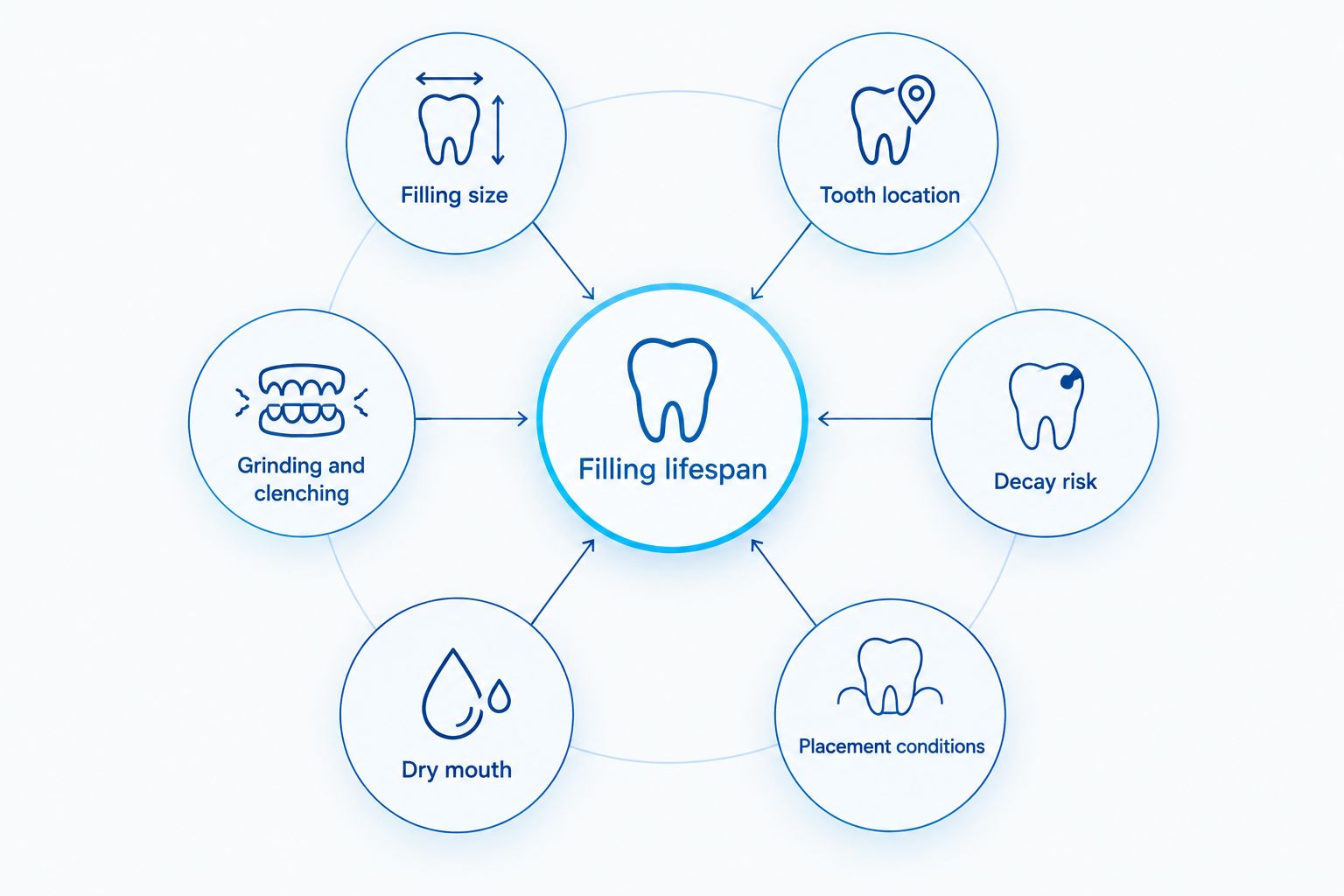
Why filling lifespan varies
The condition of a filling reflects more than the material label. These factors help explain why restorations in the same mouth can age differently:
- Filling size: A large restoration leaves less natural tooth structure to support chewing forces. The remaining tooth matters as much as the filling itself.
- Tooth location: Back teeth bear substantial chewing loads. A restoration on a chewing surface faces different demands from one near the gumline.
- Grinding and clenching: Repeated force can contribute to wear, chips, and fractures in fillings and teeth.
- Decay risk: Frequent sugar exposure, plaque accumulation, and difficulty cleaning around a restoration increase the chance of new decay.
- Dry mouth: Reduced saliva weakens an important natural defense against tooth decay. Medication-related dryness deserves attention rather than acceptance as a minor inconvenience.
- Placement conditions: Moisture control, the preparation, and the finished bite affect how a restoration functions.
You cannot change where a filling sits, but you can address cleaning, sugar frequency, and grinding. Those are more useful priorities than trying to predict a replacement date.
How can you tell whether a filling needs attention?
A new symptom deserves an examination; it does not identify the treatment by itself. Pain when biting can come from an uneven bite, a crack, decay, or another tooth problem. Your dentist needs to identify the cause before recommending a repair or replacement.
Watch for these changes:
- A piece of filling or tooth breaks away.
- The restoration feels loose or moves.
- Food repeatedly catches beside the same filling.
- Floss starts catching or shredding at a new rough edge.
- Cold, heat, or biting causes new or worsening discomfort.
- Your bite feels different after treatment.
A lack of pain does not prove that everything is sound. During an examination, your dentist can inspect the restoration, assess the tooth and bite, and decide whether X-rays would add useful information.
Seek prompt dental care for swelling, fever with dental pain, or worsening spontaneous pain. Trouble breathing or swallowing requires emergency medical attention. Do not wait for a routine checkup when those symptoms occur.
What happens when your dentist checks an older filling?
A useful 2026 filling review should end with an explanation of what is healthy, what needs monitoring, and what needs treatment. You should understand the reason for any recommendation.
- Review symptoms. Describe where discomfort occurs, what triggers it, and whether it is improving or worsening. Mention grinding, dry mouth, and recent changes in your bite.
- Examine the restoration. Your dentist checks the filling’s edges, the adjacent tooth, and the contact between teeth. Imaging is selected when clinically indicated.
- Assess tooth support. The amount and condition of the remaining tooth help determine whether another filling is appropriate.
- Choose the least extensive suitable treatment. Monitoring, polishing, localized repair, replacement, or a different restoration each addresses a different problem.
Ask for the finding behind the recommendation. A visible defect, decay on an indicated X-ray, or a fractured tooth provides a clearer basis for treatment than a statement that the filling is simply old.
Arrange a dental examination
Discuss an older filling, new sensitivity, or a change in your bite.
Does an old filling always need to be replaced?
An old filling does not need replacement solely because it has been present for years. A sound restoration without decay, fracture, or another clinical problem can remain under observation.
Replacement also has a trade-off: removing a restoration can remove additional tooth structure. That does not make necessary replacement harmful; it makes a clear diagnosis important.
Can a damaged filling be repaired instead of replaced?
A damaged filling can sometimes receive a localized repair when the defect is limited and the remaining restoration and tooth are suitable. Repair preserves more of the existing restoration, but it is not appropriate when decay or damage extends beyond the repairable area.
Ask what makes repair suitable or unsuitable for your tooth. The least extensive treatment is useful only when it adequately addresses the problem.
Will a crown last longer than another filling?
A crown is not automatically a better choice just because a filling needs attention. A crown covers more of the tooth and can protect weakened areas, but it also requires a different preparation.
The deciding issue is often remaining tooth structure rather than a contest between restoration lifespans. A tooth with a fractured cusp presents a different problem from a small filling with an isolated chipped edge.
How to help your filling last
Your 2026 home-care routine should protect the tooth around the filling, not just the restoration’s surface. Filling material cannot develop a cavity, but neighboring natural tooth structure can.
- Brush for 2 minutes, 2 times a day, using fluoride toothpaste and a soft-bristled toothbrush. These are standard American Dental Association home-care recommendations.
- Clean between teeth 1 time a day. Choose floss or another appropriate interdental cleaner you can use effectively around the restoration.
- Reduce frequent sugar exposure. Repeated sweet drinks and snacks create repeated opportunities for decay; pay attention to frequency as well as quantity.
- Avoid chewing ice and hard objects. Do not use a filled tooth to open packaging or bite objects that are not food.
- Discuss grinding. A dentist can assess whether a protective appliance is appropriate. A guard does not repair an existing crack or remove decay.
- Report persistent dry mouth. Review symptoms and medications with your dental and medical clinicians; do not stop prescribed medicine on your own.
Keep dental visits on the schedule recommended for your individual needs. A person with active decay or significant dry mouth needs a different preventive discussion from someone with stable oral health.
Dental Arts of Atlantis is a local option for Lake Worth families seeking general and family dentistry. A practice relationship supports ongoing review, but no dentist can promise a fixed lifespan for an individual filling.
FAQ
How long does a filling last if it does not hurt?
A filling without pain can remain functional for years, but no pain does not prove that it is healthy. An examination checks for decay, cracks, and defects that you cannot reliably identify at home.
Do white fillings need replacing more often than silver fillings?
White and silver fillings have different material properties, but color alone cannot predict replacement timing. Size, location, bite forces, and the health of the remaining tooth also affect the outcome.
Should I replace all my old fillings at once?
Old fillings should be assessed individually rather than replaced automatically as a group. Ask which restorations have a specific problem and which can remain under observation.
Does a dark line around my filling mean I have a cavity?
A dark line does not automatically mean you have a cavity. Staining and decay can look similar to you, so your dentist must assess the edge and surrounding tooth.
What should I do if my filling falls out?
Contact a dentist promptly if a filling falls out, and avoid chewing on that tooth while you await advice. Keep the area clean and do not use household glue to replace the filling.
Is sensitivity after a new filling always a sign of failure?
Sensitivity after a new filling does not always mean failure. Contact your dentist if discomfort worsens, lingers, occurs without a trigger, or makes biting painful.
Can children’s fillings be ignored because baby teeth fall out?
A filling in a baby tooth still needs care while the tooth remains in place. Untreated decay or a broken restoration can cause pain and infection before the tooth is ready to fall out.
One last thing
The best filling review asks about the tooth, not just the filling. A restoration can remain intact while a neighboring cusp cracks, and a small filling defect does not automatically require replacing everything.
At your next 2026 visit, ask: What finding needs treatment, and what healthy tooth structure will the proposed treatment preserve? That question helps turn a vague lifespan discussion into a decision you can understand.
Related guides
- Night guards for teeth grinding and jaw pain
- Can a cavity be reversed without a filling?
- How to stop tooth sensitivity to hot and cold