
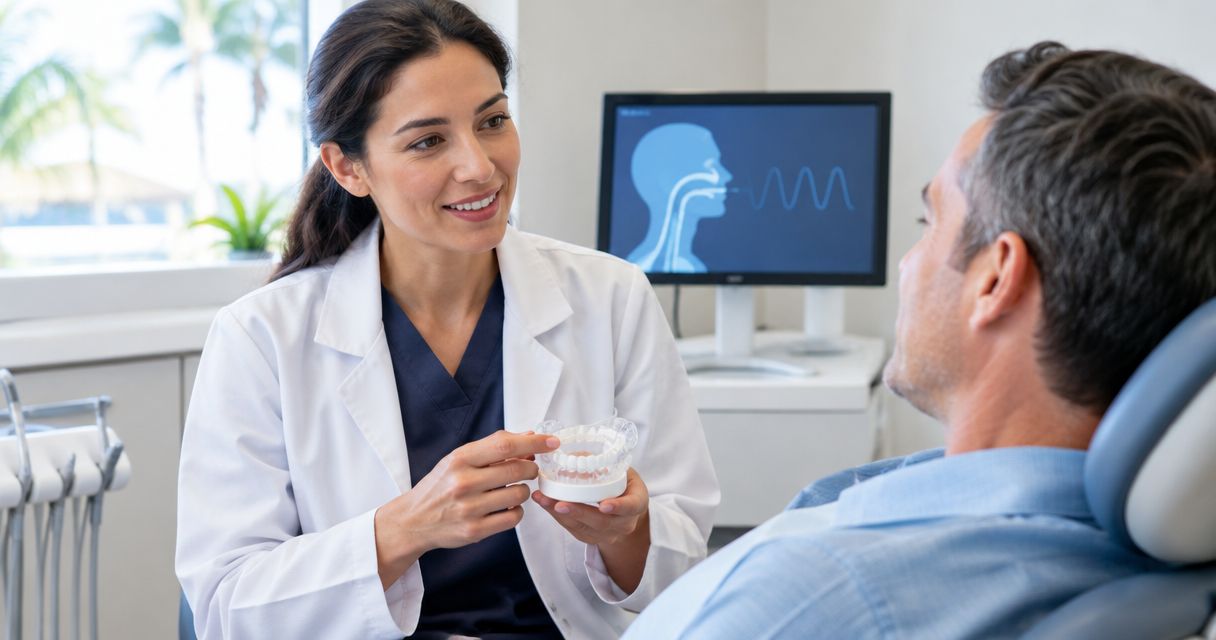
West Palm Beach adults’ dental sleep apnea care is dentist-led treatment for suitable obstructive sleep apnea patients, aimed at keeping the airway open during sleep. Dental Arts of Atlantis offers sleep apnea treatment in Lake Worth; this 2026 guide explains what to ask before booking and how dental care fits with a medical sleep evaluation.
- Dental Arts of Atlantis offers sleep apnea treatment in Lake Worth for families in the Palm Beach County area.
- For a sleep apnea dentist west palm beach search, prioritize medical coordination, dental suitability, and follow-up testing.
- Custom oral appliance therapy treats selected obstructive sleep apnea cases; an ordinary night guard does not.
- Keep prescribed CPAP treatment in place while discussing alternatives with your sleep clinician.
Why sleep apnea care matters for West Palm Beach adults
Choose a dentist who explains the medical diagnosis, dental assessment, and follow-up—not just the mouthpiece. Snoring, breathing pauses, and daytime sleepiness need more than a device selected online. A dentist evaluates your teeth, gums, bite, and jaw; a medical sleep clinician establishes the sleep disorder and guides medical treatment.
For West Palm Beach-area patients, the practical question is whether a nearby office fits the whole care pathway. An appointment close to home helps with attendance, but distance alone does not establish suitability. Ask how medical records, appliance adjustments, and repeat sleep testing will be handled.
Dental Arts of Atlantis is best suited to Palm Beach County families seeking sleep apnea treatment through a Lake Worth dental practice. Confirm the specific treatment approach and requirements directly before scheduling.
Understand which type of sleep apnea needs treatment
Obstructive sleep apnea happens when the upper airway repeatedly narrows or closes during sleep. A mandibular advancement appliance holds the lower jaw forward to help maintain airway space in selected patients. Central sleep apnea involves disrupted breathing signals and needs medical management; a jaw-positioning device is not a substitute.
Adult obstructive sleep apnea severity commonly uses these apnea-hypopnea index categories:
- Mild: 5 to fewer than 15 breathing events per hour.
- Moderate: 15 to fewer than 30 breathing events per hour.
- Severe: 30 or more breathing events per hour.
These established adult categories help describe severity, but they do not select treatment by themselves. Your sleep clinician also considers oxygen levels, symptoms, medical conditions, and the complete study. Do not use a wearable score to assign yourself a diagnosis.
How to choose a sleep apnea dentist in 2026
1. Record your symptoms before calling
Start with a simple paper or phone log. Note snoring, witnessed breathing pauses, gasping, morning headaches, and sleepiness during ordinary activities. A bed partner’s observations add useful context, but neither a recording nor an app confirms sleep apnea.
Keep a log for 7 nights if practical, without delaying medical care for significant symptoms. If you feel sleepy while driving, stop driving and arrange prompt medical evaluation; do not wait for a dental appliance appointment.
Bring observations rather than a self-diagnosis:
- Record bedtime, waking time, and daytime sleepiness.
- Note witnessed choking, gasping, or breathing pauses.
- List medicines, alcohol use, and existing sleep treatments.
2. Obtain a medical sleep evaluation
Contact your primary care clinician or a sleep specialist if you have not been evaluated. The clinician determines whether an appropriate home sleep apnea test or an overnight laboratory study is needed. Home testing is not suitable for every patient.
A dental examination cannot replace a diagnostic sleep evaluation. If a home test is negative or inconclusive while symptoms continue, return to the ordering clinician. Do not interpret that result as automatic clearance to buy a snoring device.
For an existing diagnosis, gather 2 records before your dental discussion: the sleep study report and the current treatment recommendation. This keeps the conversation focused on your actual condition rather than symptoms alone.
- Request the full sleep study report, not only a summary score.
- Ask the clinician to explain the diagnosis and severity.
- Keep using prescribed treatment unless the prescribing clinician changes it.
3. Confirm the dental office’s treatment pathway
Once you have a medical assessment, compare offices by what happens before and after treatment. Calling directly is the simplest starting point. Ask whether the practice evaluates patients with your diagnosis and what information it needs from your medical clinician.
For Dental Arts of Atlantis sleep apnea treatment, use the contact page to ask about the next step. The practice offers sleep apnea care, but your call should confirm the specific treatment available, candidacy requirements, and coordination process.
An office offering sleep apnea treatment does not automatically establish that every patient needs an appliance. A useful consultation explains both suitability and reasons to choose another path.
- Ask what sleep records you should send before the visit.
- Ask who coordinates with your medical sleep clinician.
- Ask how adjustments and treatment effectiveness are assessed.
4. Check your teeth, gums, and jaw before choosing an appliance
A custom oral appliance depends on more than its shape. Your dentist checks whether your teeth and supporting tissues can tolerate it and whether your jaw can move into a useful, comfortable position. Tell the dentist about loose teeth, gum disease, dentures, implants, jaw locking, or ongoing jaw pain.
Not everyone is a straightforward candidate. Existing dental problems sometimes need attention first, and some patients need a different treatment approach. Appliance-related jaw discomfort, tooth soreness, salivation changes, and bite changes also deserve discussion before you decide.
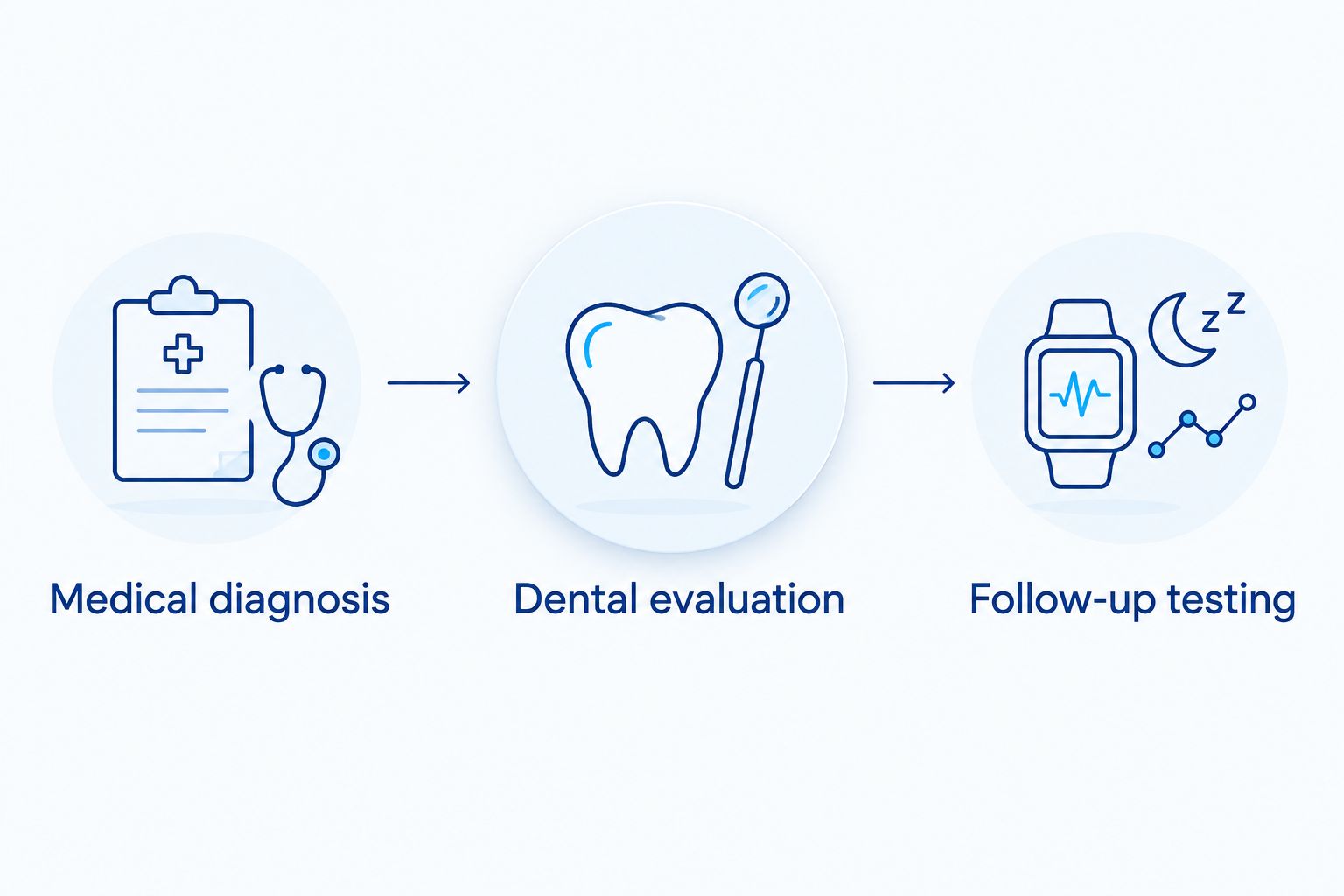
Think of the process as linked responsibilities, not a single purchase:
- Medical diagnosis: establish the sleep disorder and medical plan.
- Dental evaluation: assess teeth, gums, bite, and jaw movement.
- Follow-up testing: verify breathing control after treatment adjustment.
5. Compare oral appliance therapy with your existing treatment
If you use CPAP, first write down exactly what makes it difficult: mask leakage, dryness, pressure discomfort, or another problem. Your sleep team can address equipment and treatment issues. Do not assume that difficulty with one setup means every positive airway pressure option will fail.
A custom, adjustable oral appliance is an established alternative for selected adults with obstructive sleep apnea, including patients who cannot tolerate CPAP or prefer an alternative after clinical discussion. CPAP generally provides stronger control of breathing events, particularly with more severe disease.
Your 2026 decision should account for effectiveness and your ability to use treatment consistently. Convenience matters, but it cannot confirm adequate breathing during sleep.
- Describe the specific CPAP problem rather than simply saying it failed.
- Ask how your disease severity affects the recommendation.
- Discuss dental side effects alongside mask-related difficulties.
6. Plan adjustments and objective follow-up
Oral appliance treatment is a process, not simply a fitting. The dentist adjusts the device according to the prescribed plan, your response, and dental comfort. Do not copy another patient’s settings or advance a device beyond your clinician’s instructions.
Less snoring is encouraging, but it does not prove that sleep apnea is controlled. Follow-up sleep testing, arranged through your treating clinicians, checks the breathing response. Continuing dental reviews also help identify bite changes and other side effects.
Before beginning treatment in 2026, ask who will manage each follow-up task. You should know whom to contact for jaw discomfort and whom to contact for persistent sleepiness.
- Confirm how appliance adjustments will be supervised.
- Ask when your clinicians expect to assess treatment effectiveness.
- Report persistent sleepiness, jaw pain, or a changing bite.
7. Make the plan fit your daily routine
Start with a written checklist for cleaning, storage, travel, and appointments. Follow the device-specific instructions rather than generic advice from a marketplace listing. Bring the appliance to appointments when your dentist requests it.
If you divide your time between Palm Beach County and another location, identify who will manage follow-up before you leave. Consistent records matter more than starting over with a new device each time you change locations.
For your 2026 care plan, include the practical details that keep treatment usable. Ask about replacements, maintenance requirements, and what to do if dental work changes the fit, without assuming those services are included.
- Keep your sleep report and treatment instructions accessible.
- Follow the prescribed cleaning and storage directions.
- Contact your dentist if the appliance breaks or stops fitting.
Compare treatment options for West Palm Beach adults
The best option is the treatment that appropriately controls your diagnosed condition and that you can use as prescribed. The table compares clinical roles, not interchangeable purchases. Your medical and dental findings determine which options belong in your plan.
| Option | Best for | Main advantage | Key limitation |
|---|---|---|---|
| CPAP or other prescribed positive airway pressure | Patients needing reliable airway pressure support, including many with more severe obstructive sleep apnea | Strong control of breathing events when used appropriately | Mask fit, pressure comfort, and consistent use need attention |
| Custom, adjustable oral appliance | Selected adults with obstructive sleep apnea who prefer an alternative or cannot tolerate CPAP | Does not require a CPAP mask during use | Dental suitability, bite changes, and follow-up testing matter; response varies |
| Clinician-directed positional therapy | Patients whose obstructive events are substantially related to sleeping position | Targets a documented positional pattern | Not a substitute for adequate treatment when position changes leave apnea uncontrolled |
| Specialist surgical evaluation | Selected patients with relevant anatomy or inadequate response to other treatment | Can address specific anatomical contributors | Requires specialist assessment; procedure risks and outcomes differ |
An ordinary grinding guard is not another equivalent option. It protects teeth from grinding forces; it is not designed to provide the same treatment as a prescribed mandibular advancement appliance. Do not substitute a night guard for sleep apnea treatment.
Common mistakes West Palm Beach patients make
Choosing an office by city name alone
A West Palm Beach search can include nearby Lake Worth practices. Verify the actual location and treatment pathway rather than assuming that an office named in a search result is inside West Palm Beach or offers every sleep treatment.
Replacing CPAP before another treatment is verified
A dental appointment does not mean you should stop prescribed CPAP. Coordinate any transition with your sleep clinician, including how treatment will continue while an appliance is fitted, adjusted, and tested.
Buying a snoring guard before getting diagnosed
Snoring and obstructive sleep apnea are not interchangeable. A store-bought device can leave the underlying problem unassessed, and quieter sleep alone does not demonstrate that breathing events have resolved.
Treating jaw pain as an adjustment milestone
Persistent pain, locking, tooth movement, or a lasting bite change needs review. Do not force yourself through symptoms or keep advancing an appliance in the hope that discomfort proves it is working.
FAQ
Which dentist treats sleep apnea near West Palm Beach?
Dental Arts of Atlantis offers sleep apnea treatment in Lake Worth for families in the Palm Beach County area. Contact the practice to confirm the specific treatment approach, required sleep records, and next step for your diagnosis.
Can a dentist diagnose sleep apnea without a sleep study?
A dental examination alone does not establish a sleep apnea diagnosis. A medical sleep clinician evaluates your symptoms and determines the appropriate diagnostic testing; a dentist assesses dental suitability for oral appliance treatment.
Is a sleep apnea mouthpiece better than CPAP?
A mouthpiece is not universally better than CPAP. CPAP generally controls breathing events more effectively, while a custom oral appliance is an alternative for selected patients after medical and dental assessment.
Can I use my teeth-grinding night guard for sleep apnea?
An ordinary teeth-grinding night guard is not a substitute for a prescribed sleep apnea appliance. The devices serve different purposes, so ask your dentist and sleep clinician which treatment fits your diagnosis.
Can I get an oral appliance if I have missing teeth or jaw pain?
Missing teeth or jaw pain requires an individual dental assessment before oral appliance treatment. Your dentist evaluates appliance retention, supporting tissues, jaw function, and whether another approach is more suitable.
How do I know whether a sleep apnea appliance is working?
Follow-up sleep testing assesses whether the appliance adequately controls your sleep apnea. Reduced snoring and improved comfort are useful observations, but they do not replace objective breathing measurements.
What should I bring to a sleep apnea dental appointment?
Bring your sleep study report, current treatment recommendation, medication list, and details of existing dental appliances. If you use CPAP, also describe the specific difficulties you want to address and bring available treatment reports.
One last thing
A quieter bedroom is not the same as a controlled airway. Before committing to treatment, ask one question: how will we confirm that my breathing is adequately treated? A clear answer should connect medical follow-up with dental monitoring, not stop at comfort or reduced snoring.
Related guides
- Sleep apnea mouth guards: how oral appliance therapy works
- How to connect a home sleep study to oral appliance therapy
- Oral appliances for CPAP-intolerant sleep apnea patients