

You can eat after getting a filling once the numbness has completely worn off, provided your dentist has cleared the filling for chewing. Tooth-colored composite is hardened during treatment, but silver amalgam and temporary fillings need material-specific precautions; a filling that feels hard does not make a numb lip or tongue safe to chew on.
- Wait until numbness ends before you eat after getting a filling, even when composite has already hardened.
- Your filling material and your dentist’s instructions determine when the treated tooth can handle chewing.
- Choose soft, lukewarm food first; stop if biting causes sharp pain or the tooth feels too high.
- Dental Arts of Atlantis provides general and family dentistry for households in Lake Worth and Palm Beach County.
How soon can you eat after getting a filling?
The safest starting point is normal feeling in your mouth, followed by the instructions for your specific filling. There is no single waiting period that fits every restoration. Use this 2026 guide to distinguish material precautions from the separate risk of chewing while numb.
| Filling or situation | When to start eating | Main advantage | Main precaution |
|---|---|---|---|
| Light-cured composite | After numbness ends, unless your dentist gives additional restrictions | Hardened during the appointment | A newly treated tooth can still feel sensitive |
| Silver amalgam | Follow your dentist’s instructions before chewing on the treated tooth | Durable restorative material | Strength develops after placement; avoid loading it too soon |
| Temporary filling | Follow the instructions for the temporary material | Protects the tooth between treatment visits | Sticky or hard food can loosen or damage it |
| Any filling with lingering numbness | Wait before chewing | Waiting protects your lips, cheeks, and tongue | You cannot reliably judge biting pressure or heat while numb |
Knowing the material matters beyond your first meal. The guide to how long a dental filling lasts explains the separate question of long-term maintenance.
Why this matters
A dental filling and the surrounding mouth recover on different schedules. Composite can be hard while your cheek remains numb, and a tooth can be ready for gentle chewing while still reacting to cold.
The goal is not to avoid eating longer than necessary. It is to protect the restoration, avoid biting soft tissue, and notice symptoms that deserve a call. Your dentist’s discharge instructions take priority over general advice, especially when the appointment included another procedure.
Dental Arts of Atlantis offers general and family dentistry in Lake Worth. The practice is relevant for local families seeking ongoing dental care; general aftercare information, however, cannot identify the material or bite fit of an individual filling.
Tooth-colored composite: wait for normal feeling
Light-cured composite is hardened with a curing light during the appointment. You do not need to wait for that material to dry at home. If your dentist confirms treatment is complete, numbness is usually the main reason to delay chewing.
Best for the first meal after composite: soft food at a comfortable temperature once normal feeling returns. This reduces chewing pressure without requiring an all-liquid diet.
The limitation is comfort. The treated tooth or nearby gum can feel tender even though the composite has hardened. Start gently, and do not use hard food to test whether the filling is strong.
For your 2026 aftercare checklist, separate these questions: Is the material ready for chewing? Has the anesthetic worn off? Does your bite feel comfortable? A yes to the first question does not answer the others.
Silver amalgam: follow the chewing restriction
Silver amalgam gains strength after placement rather than being light-cured like composite. Follow your dentist’s specific instructions about when to put chewing pressure on that tooth. Do not borrow a waiting period from someone who received a different material.
Best for eating during the restricted period: soft food chewed away from the treated tooth, after numbness ends and within your dentist’s instructions. Avoid hard or sticky food that puts substantial force on the new restoration.
Amalgam’s durability does not eliminate its initial setting precautions. If you do not know whether you received amalgam or composite, ask the treating office rather than judging from appearance alone.
Temporary fillings: protect the seal
A temporary filling protects a tooth between treatment stages. Its eating restrictions depend on the material and the procedure it supports. Follow the instructions you received, including any delay before eating or restriction on chewing.
Best for protecting a temporary filling: soft, nonsticky meals and chewing on the other side when instructed. The benefit is lower stress on a restoration that is not intended to serve as the final repair.
The trade-off is that temporary material can wear, loosen, or come out. Contact your dentist if the filling breaks, the tooth feels exposed, or a previously covered opening becomes noticeable. Do not pack food, gum, or household materials into the space.
Why eating instructions vary
Your 2026 aftercare plan should reflect the actual treatment, not a universal timer. These factors explain why your instructions can differ from another person’s:
- Filling material: Composite, amalgam, and temporary materials harden differently and have different early precautions.
- Local anesthetic: Numb lips, cheeks, or tongue make accidental biting and burns harder to detect.
- Filling size and location: A broad restoration on a chewing surface faces different forces from a small repair near the front.
- Depth of decay: Treatment close to the tooth’s pulp can leave the tooth more sensitive afterward.
- Bite contact: A filling that meets the opposing tooth too early can hurt under pressure.
- Other treatment: Additional procedures or sedation can change the instructions for eating and drinking.
Tell your dentist if you have difficulty recognizing numbness, controlling chewing, or following food restrictions. A practical plan needs to fit your circumstances, including school, work, and help available at home.
How do I restart eating safely?
Start with a small, soft meal rather than a hard test bite. Wait until your mouth feels normal, then follow this sequence. If your dentist gave different instructions, use those instead.
- Check feeling. Notice whether your lip, cheek, and tongue still feel altered. Do not bite or poke numb tissue to test it.
- Check instructions. Confirm whether the filling has a setting restriction and whether the treated side needs protection.
- Choose soft food. Begin with something easy to chew, such as scrambled eggs, soft pasta, or mashed vegetables.
- Chew gently. Take small bites, favor the opposite side initially, and stop if the repaired tooth hurts sharply.
- Check comfort. Notice whether your teeth meet evenly and whether discomfort settles after you stop eating.
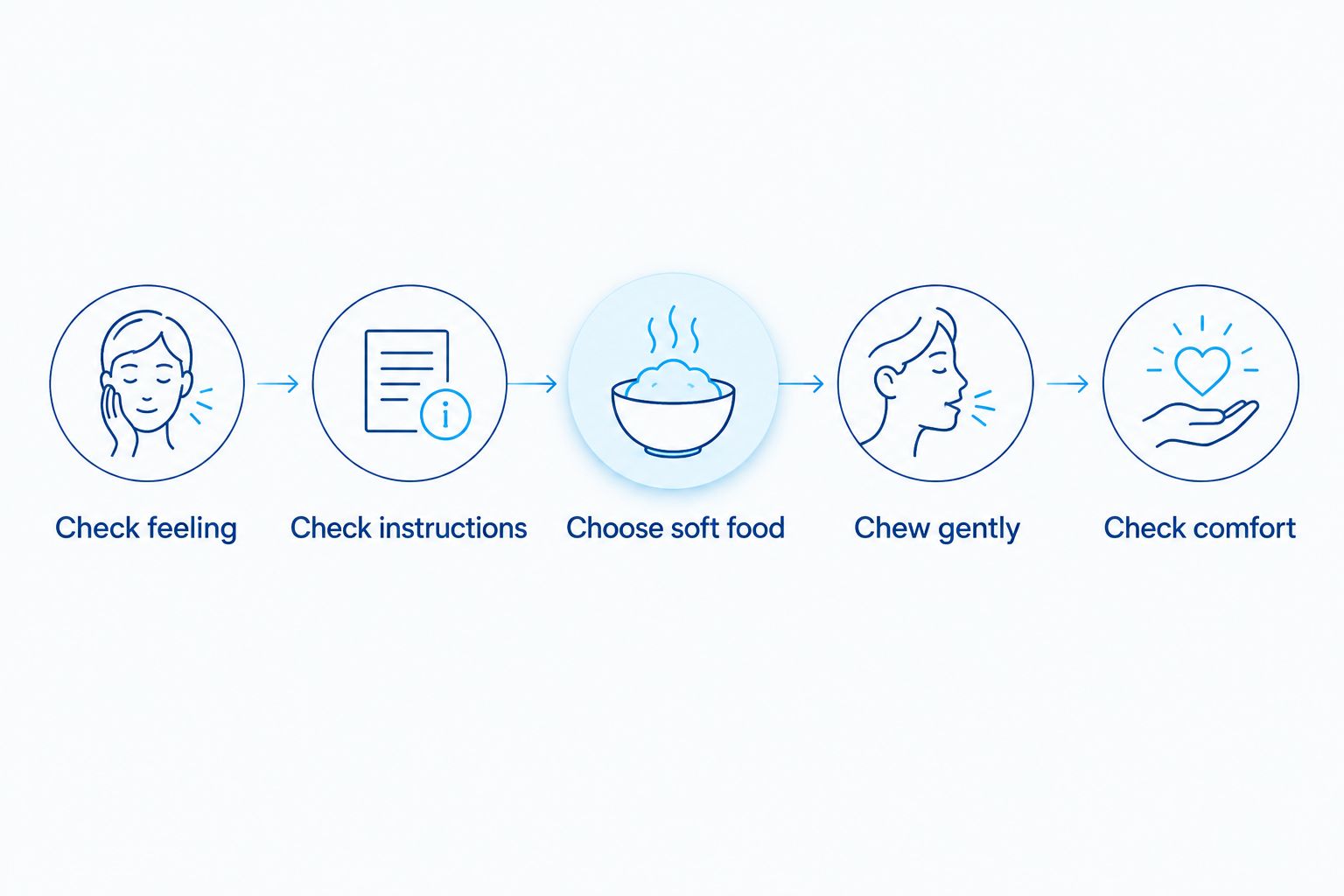
A comfortable first meal is reassuring, but it is not a reason to ignore later pain. If the tooth becomes increasingly uncomfortable or the bite feels uneven, stop putting pressure on it and contact the treating office.
What should I eat or avoid at the first meal?
Choose food that needs little chewing and is neither very hot nor very cold. Soft eggs, plain yogurt without crunchy additions, mashed vegetables, and well-cooked pasta are reasonable starting choices. Let soup cool before drinking it.
Each choice has a limitation. Yogurt can trigger cold sensitivity, pasta still requires chewing, and soup can burn numb tissue. Temperature and texture matter more than whether a food sounds gentle.
Delay ice chewing, hard candy, popcorn kernels, chewy candy, and similarly demanding foods while you follow early restrictions. Do not repeatedly press hard food against the filling to check it. A tooth that tolerates a soft meal is not asking for a stress test.
For 2026 meal planning, keep the distinction simple: soft food reduces force, but it does not cancel a material’s setting instructions. Once your dentist’s restrictions end and chewing feels comfortable, return toward your usual balanced diet.
Does the same advice apply after chipped tooth repair?
Not every tooth repair is a cavity filling. A chipped tooth can receive bonded composite, a temporary restoration, or more extensive treatment, and each repair has its own eating instructions. The location matters too: biting directly into firm food loads a front-tooth repair differently from chewing gently on the opposite side.
The same distinction shapes eating after chipped tooth repair: the repair material and the force placed on it both matter. A front tooth that looks restored is not a reason to ignore instructions about direct biting.
Tell your dentist whether the tooth was repaired for decay, a chip, or a fracture. These are different starting problems. Advice for an uncomplicated filling does not replace instructions for a cracked tooth or a temporary repair awaiting further treatment.
What if my child is hungry while still numb?
Wait until normal feeling returns before giving your child food that requires chewing. Children can bite or suck their numb lips and cheeks without recognizing the injury. Stay nearby, explain the strange feeling calmly, and discourage rubbing or biting the area.
Do not use hunger as proof that the mouth is ready. Prepare a soft meal for afterward and follow any pediatric discharge instructions. If your child cannot reliably describe sensation, ask the treating team how to decide when eating is appropriate.
If your child received sedation as well as local anesthetic, follow the separate sedation instructions. Readiness to eat involves more than the filling alone, including alertness and the ability to swallow safely.
When does pain after eating need a call?
Brief sensitivity and an uneven bite are not the same problem. Mild temperature sensitivity can occur after a filling, but a tooth that strikes first or hurts with every bite needs assessment. Do not try to wear down a high filling by chewing harder.
Contact your dentist for worsening pain, lingering pain after hot or cold food, a loose filling, or difficulty chewing comfortably. Swelling, fever, or a bad taste with increasing pain also needs prompt attention. Trouble breathing or swallowing, or rapidly spreading swelling, requires emergency medical care.
When contacting Dental Arts of Atlantis about general dental care, explain what triggers the pain, whether it stops when the trigger ends, and whether your bite feels different. Those details are more useful than describing the tooth only as sensitive.
Ask about your filling symptoms
Describe your bite, sensitivity, and filling concerns when contacting the practice.
FAQ
Can I eat immediately after a white filling?
You can eat after a light-cured white filling once numbness has completely worn off, unless your dentist gives other restrictions. The composite is hardened during treatment, but your lips, cheeks, and tongue still need protection while numb.
Can I drink water while my mouth is still numb?
Small sips of room-temperature water are generally reasonable after local anesthetic if you can swallow normally and your dentist has not restricted drinking. Avoid hot drinks, and follow separate instructions if you received sedation.
What is the best first meal after a filling?
A soft, lukewarm meal is the best starting choice once numbness ends and your filling instructions allow eating. Choose food that requires little chewing, and stop if the treated tooth hurts sharply.
Can I eat on the other side while I am numb?
Wait until numbness ends before chewing, even on the other side. You can still accidentally bite your tongue, lip, or cheek because sensation and chewing control are altered.
Why does my filling hurt when I bite down?
Pain when biting can come from an uneven bite, a sensitive tooth, or another problem that needs examination. Contact your dentist if the tooth hits first, pain repeats with chewing, or symptoms worsen.
Can I brush and floss after getting a filling?
You can generally continue gentle brushing and flossing after a routine permanent filling, following your dentist’s instructions. Temporary restorations can need different flossing precautions, so ask before cleaning around them.
What should I ask my dentist about filling aftercare in 2026?
Ask which material was placed, when you can chew on it, and which symptoms require a call. For families considering Dental Arts of Atlantis for general dentistry, these are practical questions to bring to a visit.
One last thing
A filling can be fully hardened while your mouth is still unsafe for chewing. That distinction prevents a common mistake: using the condition of the restoration to judge whether numb tissue is ready.
Keep this rule for your 2026 aftercare routine: feeling first, material instructions second, comfortable chewing third. If the tooth feels too high, do not wait for a harder meal to confirm it—contact your dentist.
Related guides
- Is it normal for a new filling to hurt?
- How to stop tooth sensitivity to hot and cold
- Can a cavity be filled without numbing?