

Yes, veneers can be removed by a dentist, but removing them does not necessarily restore your original, untreated teeth. If enamel was removed before placement, that change is permanent, and the tooth generally needs another veneer or another suitable restoration. Some no-prep or additive composite veneers allow more conservative removal, but an examination is needed before anyone can promise reversibility.
- Can veneers be removed? Yes, but enamel removed during preparation does not grow back.
- Porcelain veneer removal usually means planning replacement coverage, not returning to untreated teeth.
- No-prep veneers are not automatically reversible; the original preparation and remaining enamel matter.
- Dental Arts of Atlantis provides cosmetic dentistry for Lake Worth families considering changes to their smiles.
Why this matters
Removable and reversible mean different things. A dentist can remove a bonded restoration, but cannot replace the natural enamel taken away to make room for it. That distinction matters whether you dislike the appearance, have a damaged veneer, or are considering treatment for the first time.
Dental Arts of Atlantis offers general and cosmetic dental care. For your 2026 treatment discussion, ask what will protect each tooth after removal—not simply whether the veneer can come off.
Can veneers be removed once they're placed?
Yes. The dentist removes the veneer and bonding material using techniques selected for the restoration and tooth underneath. The veneer itself might not survive removal, so keeping and reusing it is not something to assume.
The main supporting distinction is how much the natural tooth changed before placement:
| Veneer type | What removal involves | Advantage | Limitation after removal |
|---|---|---|---|
| Prepared porcelain veneer | Removing the bonded ceramic and assessing the prepared tooth | Allows replacement of a damaged or unsuitable restoration | Removed enamel cannot be restored naturally; replacement coverage is generally needed |
| No-prep or minimal-prep veneer | Separating the restoration and removing residual bonding material | Can preserve more original tooth structure at placement | The name does not guarantee an untouched tooth or risk-free removal |
| Composite veneer | Carefully removing tooth-colored resin from the tooth | Localized defects can sometimes be repaired rather than fully removed | Resin and enamel can be difficult to distinguish; preparation history still matters |
The question that decides reversibility is what happened to your tooth—not just what material covers it. Photographs, treatment records, and a clinical examination help your dentist explain the realistic endpoint.
Can porcelain veneers be removed?
Porcelain veneers can be removed, but prepared teeth generally need continued restoration afterward. The ceramic often has to be reduced or sectioned rather than lifted off intact. Local anesthesia can be used when needed for comfort.
Removing a veneer does not automatically mean getting a crown. A replacement veneer remains an option when the remaining tooth structure, bonding surface, and bite support it. A crown requires its own clinical justification because it covers more of the tooth and generally requires additional preparation.
If your concern is appearance alone, explain exactly what feels wrong: color, length, bulk, symmetry, or how the edges meet your lip. A replacement should address the specific concern rather than repeat the original design.
Can no-prep veneers be removed without changing your teeth?
Some no-prep veneers can be removed with little change to the underlying tooth, but that outcome cannot be guaranteed from the label alone. Even when the original placement involved no deliberate tooth reduction, removing bonded material requires care.
Ask whether the original dentist reshaped any edges, adjusted the sides, or altered existing fillings. “Minimal preparation” is not the same as no preparation, and small changes still count when your goal is returning to the original tooth.
For a 2026 consultation, request the original preparation notes if they are available. Your dentist should distinguish documented tooth changes from findings that will only become clear during removal.
Can composite veneers be removed?
Composite veneers can be removed by carefully reducing the resin and preserving the tooth underneath. However, composite placement sometimes includes enamel reshaping, so composite does not automatically mean reversible.
A small chip, rough area, or localized stain does not always require complete removal. Depending on the defect, the dentist can consider polishing, reshaping, or adding repair material instead.
Ask whether repair can solve the problem before agreeing to full replacement. The benefit is preserving sound material and tooth structure; the limitation is that a repair cannot correct every problem with fit, color, or bonding.
Why veneer removal varies
Veneer removal is planned tooth by tooth. These factors determine the approach and what comes next:
- Original preparation: A tooth with removed enamel has different needs from a tooth that received an entirely additive restoration.
- Veneer material: Ceramic and composite require different handling, and the dentist must distinguish restoration from natural tooth.
- Remaining tooth structure: Existing fillings, cracks, wear, and decay influence whether another veneer is appropriate.
- Bond and veneer condition: A loose veneer presents a different situation from a firmly bonded veneer or fractured fragments.
- Bite and grinding: Repeated pressure or unfavorable tooth contact needs assessment before another restoration is placed.
- Reason for removal: Discomfort, poor appearance, decay, and breakage require different solutions rather than the same replacement plan.
These factors also explain why an online photograph cannot establish whether your veneers are reversible. The surface appearance does not reveal the full preparation or the condition beneath the restoration.
What happens during a veneer removal assessment?
Your dentist first needs to understand the problem you want solved. Bring older smile photographs, available treatment records, and details about any pain or changes in your bite. Mention whether discomfort began immediately after placement or developed later.
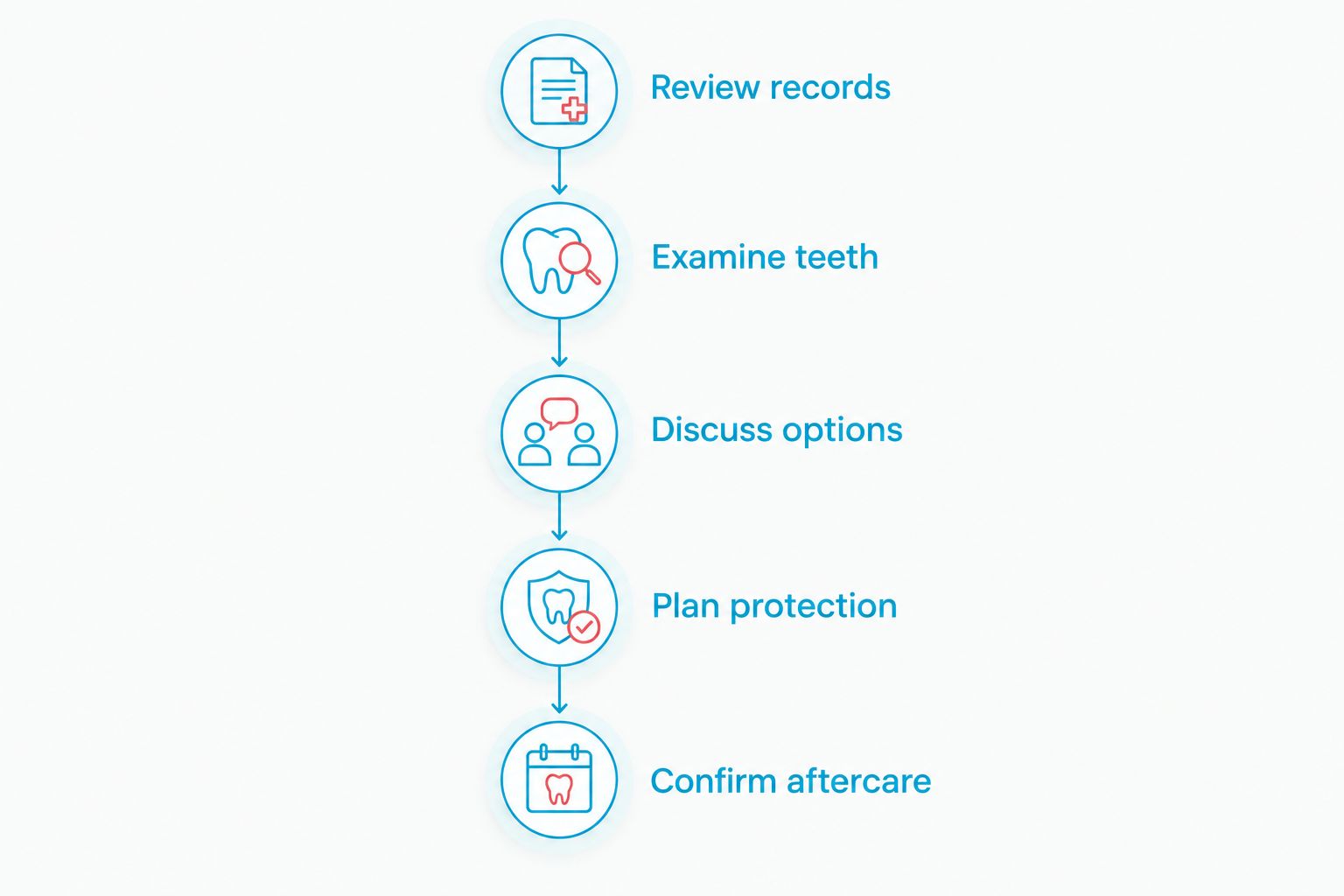
A practical assessment follows this sequence:
- Review records: Identify the veneer material, original preparation, and previous dental work when records are available.
- Examine teeth: Check the veneer edges, gums, bite, and signs of damage. Dental X-rays are taken when clinically indicated.
- Discuss options: Decide whether monitoring, adjustment, repair, or removal addresses the actual problem.
- Plan protection: Explain what will cover or restore the tooth if removal leaves it needing protection.
- Confirm aftercare: Review temporary-restoration care, follow-up needs, and symptoms that require a call.
The critical conversation happens before the veneer comes off. You should understand both the intended treatment and what changes if the dentist finds decay, a crack, or less sound tooth structure than expected.
Can I leave my teeth uncovered after veneer removal?
Teeth that were prepared for veneers generally should not be assumed suitable to leave uncovered. Their appearance, sensitivity, bonding surface, and structural needs must be assessed. Some need temporary protection before the final restoration is ready.
An unprepared tooth is a different situation, but the dentist still needs to remove residual bonding material and check the surface. A tooth can look intact while having an altered contour or an area that needs finishing.
If you are planning treatment in 2026, ask for the endpoint in plain language: “Will this tooth need another restoration, and what happens between appointments?” That question is more useful than asking whether removal is technically possible.
Does removing veneers hurt or damage the tooth?
Veneer removal does not have to mean enduring sharp pain. Your dentist assesses whether local anesthesia is appropriate, and you should speak up if you feel discomfort during treatment. Sensitivity afterward depends on the tooth and the work performed.
Removal carries a risk of losing additional tooth structure or irritating the tooth. Careful technique aims to preserve sound enamel and dentin, but no clinician can promise that every bonded veneer will come off without any change underneath.
Pain is also a reason to investigate, not simply remove the veneer. Bite pressure, gum inflammation, decay, or a problem inside the tooth can produce symptoms that replacement alone will not resolve.
What if the veneer covers a chipped tooth?
A chipped tooth does not return to an unbroken state when its veneer is removed. The original defect remains, along with any changes made during preparation. The next treatment therefore depends on both the old injury and the tooth's current condition.
The same distinction applies when considering veneers for chipped teeth: covering a chip changes the visible shape, but removing that covering does not rebuild the missing enamel. Before removal, ask how much of the apparent tooth shape comes from the restoration.
For a small defect, localized bonding is sometimes enough. Larger damage or substantial existing preparation requires a different discussion. Choose the least extensive treatment that adequately restores the tooth—not a particular restoration simply because it was used before.
What if a veneer is loose or falls off?
Do not pull at a loose veneer or try to remove it yourself. Avoid biting with that tooth, keep any detached restoration in a clean container, and contact a dentist. Household glue is not safe for reattaching it.
A detached veneer does not always need to be discarded. The dentist can assess whether it is intact, whether the tooth is healthy, and whether rebonding is appropriate. A broken veneer, contaminated bonding surface, or underlying problem changes that decision.
Seek prompt dental care for worsening pain, swelling, or a sharp edge injuring your mouth. Facial swelling with difficulty breathing or swallowing requires emergency medical attention.
What should I ask before agreeing to removal?
For a 2026 veneer consultation, bring a short list of questions that separates your cosmetic goals from the tooth's health needs:
- Was enamel removed when these veneers were placed?
- Can adjustment or repair address my concern without complete removal?
- What restoration will each tooth need afterward?
- Will I need temporary protection between appointments?
- What findings would change the proposed treatment?
- How will the new plan address my bite, appearance concerns, or sensitivity?
Dental Arts of Atlantis is a cosmetic dentistry option for Lake Worth families seeking care close to home. The practice offers general and cosmetic dentistry; whether veneer removal suits your teeth requires an individual assessment.
You do not need to commit to removal just to discuss your concerns. If you are unsure about the recommendation, request an explanation of the alternatives and the consequences of leaving the current restoration in place.
Discuss your veneer concerns
Ask about your tooth condition, repair options, and what would follow veneer removal.
FAQ
Can veneers be removed and replaced with my natural teeth?
Veneers can be removed, but prepared teeth generally cannot return to their original untreated condition. Enamel removed during placement does not grow back, so another restoration is usually needed.
Are no-prep veneers completely reversible?
No-prep veneers are not guaranteed to be completely reversible. The original tooth condition, any reshaping, and the removal of bonding material determine what is possible.
Can I have just one veneer removed?
Yes, a dentist can assess an individual veneer for removal without automatically replacing the others. Matching its replacement to neighboring teeth and veneers requires planning.
Will I need a crown after my veneer is removed?
A crown is not automatically necessary after veneer removal. The remaining tooth structure, decay, cracks, and ability to support another veneer determine the appropriate restoration.
Can I take off a loose veneer at home?
No, you should not pull off a loose veneer or use tools to remove it. Avoid biting with that tooth and contact a dentist for instructions.
Can a dentist fix a veneer instead of removing it?
Yes, some veneer problems can be addressed with polishing, bite adjustment, or repair rather than complete removal. Suitability depends on the material and the location and extent of the problem.
Can Dental Arts of Atlantis help me discuss cosmetic dental treatment?
Dental Arts of Atlantis offers cosmetic dentistry in Lake Worth, Florida. An individual examination is needed to discuss your existing veneers, the condition of your teeth, and suitable treatment options.
One last thing
Before authorizing veneer removal in 2026, ask your dentist to describe what your tooth will be like immediately afterward. That answer should include protection, appearance, and the next treatment step—not just the removal technique.
A veneer can be replaceable even when the original treatment is irreversible. Understanding that distinction lets you make a calm, informed decision without assuming you are either stuck with the current result or able to erase every earlier change.
Related guides
- How to care for veneers to keep them looking new
- How long do veneers last?
- Best cosmetic fix for a small chip without a veneer
- How to get a second opinion on a dental treatment plan