
Best overall for an urgent tooth problem: a dentist who can assess and treat the cause; best for a child's injury: a dentist experienced with children; best for breathing or swallowing difficulty: an emergency department. For Wellington families comparing general dental care in 2026, Dental Arts of Atlantis is a Lake Worth practice offering general, pediatric, cosmetic, and implant dentistry—not a Wellington location.
- For best emergency dentist wellington fl searches, choose by symptoms and treatment needs, not an unsupported ranking.
- Dental Arts of Atlantis offers general and pediatric dentistry in Lake Worth; discuss the urgent problem before traveling.
- Breathing difficulty, swallowing difficulty, or rapidly spreading facial swelling requires emergency medical care.
- A knocked-out permanent tooth needs immediate dental attention; never reinsert a knocked-out baby tooth.
Why this matters
Tooth pain makes choosing care feel urgent because sometimes it is. A broken filling, an infected tooth, and a serious facial injury need different responses, even when all three interrupt your day.
The best emergency dental choice is the clinician equipped to handle your symptoms without an unsafe delay. Distance matters, but a nearby office is not the right destination if you need hospital treatment. Likewise, an emergency department generally cannot provide the definitive dental treatment that stops a tooth problem from returning.
This 2026 guide compares care settings rather than declaring an unverified winner among Wellington practices.
What makes the best emergency dentist in Wellington, FL?
Use these criteria before choosing where to go:
- Symptom triage: The office asks about swelling, fever, trauma, bleeding, and trouble breathing or swallowing.
- Treatment fit: The clinician can evaluate the problem and explain whether a referral is necessary.
- Age-appropriate care: The team considers your child's age, cooperation, and whether an injured tooth is permanent.
- Clear communication: You understand what the initial evaluation involves and what happens afterward.
- Safe follow-through: You receive instructions for worsening symptoms and any unfinished treatment.
Do not use a cosmetic service list, a convenient map listing, or a reassuring office name as proof of emergency capability. Ask directly about your specific problem.
Emergency dental care options at a glance
The order below starts with dental problems that do not involve medical warning signs. Emergency symptoms override the order: go directly to emergency medical care when indicated.
| Care option | Best for | Standout role | Key limitation |
|---|---|---|---|
| General or family dentist | Toothache, broken teeth, lost fillings, initial assessment | Evaluates the tooth and coordinates dental treatment | Some injuries and procedures require referral |
| Pediatric dentist | Young children and complex childhood dental injuries | Focuses on children's teeth, development, and behavior | Does not replace hospital care for serious injuries |
| Endodontist | Cases needing specialist root canal assessment | Focuses on the tooth's pulp and tissues around its roots | Does not address every type of dental emergency |
| Emergency department | Airway concerns, spreading swelling, major facial trauma | Manages medical danger and serious injuries | Usually does not complete definitive tooth repair |
1. General or family dentist: best for initial dental assessment
A general dentist is the practical starting point for tooth pain, a damaged restoration, or a chipped tooth without medical warning signs. An examination helps distinguish decay, a crack, gum disease, and other causes that feel similar at home.
Dental Arts of Atlantis offers general and pediatric dentistry to Palm Beach County families. Wellington patients should describe the urgent issue before traveling to the Lake Worth practice; its range of dental services does not establish a particular emergency schedule or guarantee a procedure.
General dentist pros:
- Evaluates several possible causes of dental pain.
- Considers the affected tooth alongside your other dental needs.
- Coordinates follow-up or specialist referral when necessary.
General dentist cons:
- Complex root canal treatment or trauma can require a specialist.
- A dental office is not the right setting for an airway emergency.
Best for: Adults and families needing an initial dental diagnosis without medical warning signs.
Verdict: Skip choosing from the map alone; match the office to the problem.
2. Pediatric dentist: best for young children's dental injuries
A pediatric dentist focuses on children's oral health, including developing teeth and injury management. This is particularly relevant when a young child cannot describe the pain clearly or when an injury affects a baby tooth and the developing permanent tooth beneath it.
A family dentist also treats children, depending on the child's needs and the clinician's scope. Ask which setting fits the injury rather than assuming every childhood tooth problem requires the same specialist.
Pediatric dentist pros:
- Considers baby teeth and developing permanent teeth together.
- Uses child-focused communication and behavior guidance.
- Evaluates the longer-term effects of childhood dental trauma.
Pediatric dentist cons:
- Significant head injuries need medical assessment, not just dental care.
- Some injuries require coordination with other dental specialists.
Best for: Young children, complex tooth injuries, and children needing specialized behavior support.
Verdict: Skip adult first-aid assumptions; baby teeth need different handling.
3. Endodontist: best for specialist root canal assessment
An endodontist specializes in diagnosing and treating problems involving dental pulp and the tissues around tooth roots. Referral is relevant when a dentist identifies a complicated root canal problem, persistent symptoms after earlier treatment, or certain traumatic injuries.
Pain alone does not prove you need root canal treatment. The decision depends on the examination, appropriate imaging, and tests of the affected tooth.
Endodontist pros:
- Focuses on difficult tooth-pain diagnoses.
- Assesses whether root canal treatment can preserve a tooth.
- Evaluates problems involving previously root-treated teeth.
Endodontist cons:
- Does not replace evaluation for unrelated gum or jaw problems.
- Tooth preservation depends on damage and restorability, not treatment preference alone.
Best for: Patients whose examination identifies a need for specialist pulp or root canal care.
Verdict: Skip self-diagnosing a root canal from pain intensity alone.
4. Emergency department: best for medical danger signs
An emergency department is the appropriate destination when a dental or facial problem threatens breathing, swallowing, or general safety. Serious facial trauma, uncontrolled bleeding, and rapidly spreading swelling also need emergency medical assessment.
Call 911 for breathing difficulty or another life-threatening emergency. Do not wait for a dental office to return a message when these warning signs are present.
Emergency department pros:
- Assesses airway problems and serious systemic illness.
- Manages major facial injuries and significant bleeding.
- Coordinates additional medical or surgical care when indicated.
Emergency department cons:
- Usually does not provide definitive treatment such as a filling or crown.
- Dental follow-up remains necessary after medical stabilization.
Best for: Medical warning signs rather than an isolated, uncomplicated toothache.
Verdict: Skip the dental-office detour when breathing or swallowing is affected.
What to do while arranging dental care
First aid protects injured tissues while you seek professional help. It does not repair a cracked tooth, remove decay, or eliminate the source of a dental infection.
Knocked-out permanent tooth
Handle the tooth by its crown—the part normally visible in the mouth—not the root. If dirty, rinse it gently without scrubbing or removing attached tissue.
If you are certain it is a permanent tooth and can replace it safely, gently return it to its socket without forcing it. If you cannot, keep it moist in milk or a tooth-preservation solution and seek immediate dental care; do not store it dry or in plain water.
The American Association of Endodontists' patient guidance on knocked-out teeth, referenced for this 2026 guide, identifies treatment within 30 minutes as the best opportunity to save the tooth. That is a reason to act immediately, not a guarantee of success or a deadline after which you should give up.
Knocked-out baby tooth
Never reinsert a baby tooth. Reinsertion can damage the developing permanent tooth.
Contact a dentist promptly for instructions and assessment. If the tooth cannot be found, tell the clinician; a missing tooth after an injury needs evaluation rather than an assumption that it fell out harmlessly.
Bleeding or facial soreness
Apply firm pressure to a bleeding area with clean gauze for 10 minutes without repeatedly lifting it to check. Seek urgent help for heavy bleeding, bleeding that does not stop, or bleeding associated with a significant injury.
For swelling after an injury, use a cold compress outside the face for 20 minutes at a time, with a cloth between the cold pack and skin. Do not apply heat to unexplained facial swelling.
Toothache, a crack, or a lost restoration
Avoid chewing on the affected side and keep the area gently clean. Do not place aspirin against the tooth or gum, and do not use household glue to reattach a crown or fragment.
Use over-the-counter pain medicine only according to its label and your medical restrictions. A pharmacist can help you check interactions; pain relief does not replace dental evaluation.
Match the urgency to the symptoms
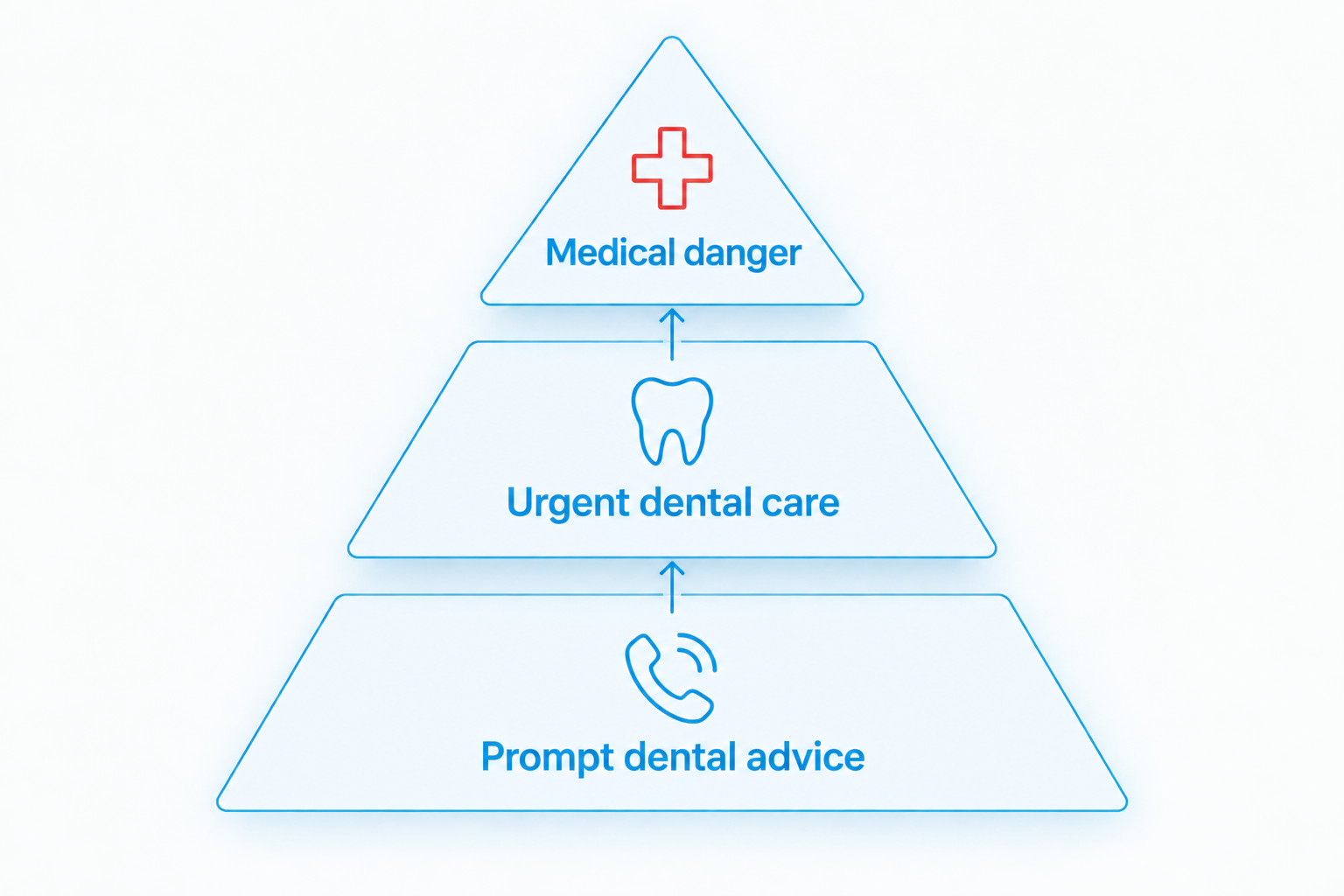
In 2026, the most useful distinction is still medical danger versus a problem needing urgent dental treatment. Pain intensity matters, but pain alone does not show whether an infection is spreading or whether a tooth can be saved.
- Medical danger: Trouble breathing or swallowing, rapidly spreading swelling, serious facial injury, or uncontrolled bleeding requires emergency medical care.
- Urgent dental care: A knocked-out permanent tooth, a displaced tooth, worsening swelling, or severe persistent tooth pain needs prompt professional assessment.
- Prompt dental advice: A small painless chip or a lost filling still needs assessment, even when it does not require hospital care.
The distinction illustrated by dental emergencies ranked by urgency is clinical rather than geographic: airway symptoms and spreading swelling take priority over a minor chip. A ranking does not replace individual triage, especially after an injury or when symptoms are worsening.
Describe changes, not just your pain score. Swelling that is spreading, a new fever, or difficulty opening your mouth gives the clinician information that “my tooth hurts” does not.
What to ask before traveling from Wellington
Give the office a short, specific description: which tooth or area hurts, when symptoms began, whether there was an injury, and whether swelling or fever is present. For a child, provide the child's age and say whether the affected tooth is a baby tooth or a permanent tooth, if known.
Ask these questions before setting out:
- Can the clinician assess this specific problem?
- Does the symptom description require a different care setting?
- What should you bring, including medication details and recent dental records?
- What should you do if symptoms worsen before the examination?
- Will the first visit focus on diagnosis, stabilization, or definitive treatment?
For Dental Arts of Atlantis general dental care, use the contact page to discuss the problem before traveling. Do not rely on a submitted message for a time-critical emergency.
Bring your medication list, allergies, and relevant medical history. Tell the clinician about blood thinners, pregnancy, immune suppression, or recent dental treatment; do not stop prescribed medicine on your own.
How these care options were ranked
This 2026 comparison ranks care pathways by treatment fit, age-specific needs, medical warning signs, and follow-through. It is not a patient-review ranking, a comparison of treatment outcomes, or a claim that one named practice outperforms Wellington dentists.
A general dentist comes first for an isolated dental complaint because diagnosis determines the next step. Pediatric and endodontic care occupy distinct specialist roles; emergency medical care overrides every other option when danger signs appear.
Which emergency dental option should you choose?
Choose a dentist for an urgent tooth problem without medical warning signs; choose emergency medical care for breathing difficulty, swallowing difficulty, or serious spreading swelling. For a child, make sure the clinician understands the injury and the child's age before you travel.
Dental Arts of Atlantis is an option for Wellington families comparing general and pediatric dentistry in Lake Worth. Discuss the specific concern directly rather than treating this guide as confirmation of emergency treatment arrangements.
For your 2026 decision, prioritize a clear diagnosis and a safe next step over a “best” label. Ask what needs attention now, what can follow later, and which symptoms mean you should seek immediate help.
FAQ
What’s the best emergency dentist in Wellington, FL?
The best choice is a dentist who can assess your specific problem promptly and provide appropriate treatment or referral. This guide does not establish a verified winner among Wellington practices; breathing or swallowing difficulty requires emergency medical care instead.
Is Dental Arts of Atlantis located in Wellington?
Dental Arts of Atlantis is a dental practice in Lake Worth, Florida, serving Palm Beach County families. Wellington patients should discuss their symptoms and the appropriate next step before traveling.
Should I go to the emergency room for a toothache?
An isolated toothache generally needs dental assessment rather than an emergency department. Go for emergency medical care if you have breathing or swallowing difficulty, rapidly spreading swelling, serious facial trauma, or uncontrolled bleeding.
What should I do if my permanent tooth gets knocked out?
Seek immediate dental care and keep the tooth moist. Handle it by the crown, avoid scrubbing the root, and use milk or a tooth-preservation solution if you cannot safely replace it in the socket.
Should I put a knocked-out baby tooth back in?
No, never reinsert a knocked-out baby tooth. Reinsertion can harm the developing permanent tooth; contact a dentist promptly for instructions.
Can antibiotics fix an infected tooth without dental treatment?
Antibiotics alone do not remove the source of a dental infection. A dentist determines whether drainage, root canal treatment, extraction, or another intervention is needed and whether antibiotics are indicated.
Can I wait if my tooth pain suddenly stops?
Pain stopping does not prove the tooth has healed. Arrange dental assessment, especially if pain was severe or you notice swelling, drainage, a bad taste, or a change in tooth color.
One last thing
A tooth that hurts less is not necessarily getting better. Dental pulp can lose vitality, and an infection can remain even when the original pain changes.
Tell the dentist the full symptom timeline, including pain that has stopped. That detail helps prevent a quiet interval from being mistaken for recovery. This guide supports triage and preparation; an examination is needed to diagnose your condition.
Related guides
- How to handle a dental emergency until you reach the dentist
- What counts as a pediatric dental emergency
- How to save a tooth instead of getting it extracted