
The best emergency dentist for a Boynton Beach, FL patient is a dental office that can assess and treat the specific problem promptly. For family dental follow-up, consider Dental Arts of Atlantis in Lake Worth; for trouble breathing, difficulty swallowing, or rapidly spreading facial swelling, seek emergency medical care instead. This 2026 guide compares care options by symptoms—not unsupported local rankings.
- For the best emergency dentist Boynton Beach FL search, match the office’s treatment capabilities to your symptoms.
- Dental Arts of Atlantis is a family dental care option in Lake Worth; contact the office about urgent needs.
- Severe tooth pain needs prompt dental assessment; breathing difficulty or rapidly spreading swelling needs emergency medical care.
- A knocked-out permanent tooth needs immediate dental attention; never reinsert a knocked-out baby tooth.
Why this matters
A broken tooth and a spreading infection need different responses. Choosing the right care setting matters more than finding a practice at the top of a search result.
You also need to distinguish pain relief from treatment. A medicine that eases toothache does not repair a fracture, remove decay, or address the source of an infection. This guide helps you choose where to turn, what to ask, and what to do while arranging care.
What makes the best emergency dental care in 2026?
Use these criteria before choosing a dentist for an urgent problem:
- Symptom screening: Explain swelling, fever, bleeding, injury, and trouble swallowing before discussing appointment logistics.
- Treatment fit: Ask whether the dentist can evaluate your particular problem and explain when specialist care is needed.
- Clear next steps: You need instructions about where to go and what to do if symptoms worsen.
- Age-appropriate care: A child’s injured baby tooth requires different decisions from an adult’s injured permanent tooth.
- Follow-up planning: Emergency treatment and the final repair are not always the same appointment.
- Comfort communication: Tell the team about dental anxiety, medical conditions, allergies, and medicines before treatment.
Choose a care setting by what it can safely address—not by a “best dentist” label. For this 2026 comparison, each option serves a different purpose. The table is a decision guide, not a ranking of clinical outcomes or individual dentists.
Emergency dental care options at a glance
| Option | Best for | Main role | Key limitation |
|---|---|---|---|
| Dental Arts of Atlantis | Family dental follow-up in Lake Worth | General, cosmetic, pediatric, and implant dental care | Contact the office directly about the urgent problem before traveling |
| An urgent dental office | Severe tooth pain or a broken tooth without medical warning signs | Dental examination and treatment planning for the affected tooth | Treatment capabilities differ between offices |
| A pediatric dentist | A child’s dental injury or tooth pain requiring child-focused care | Assessment that considers baby teeth, permanent teeth, and development | Serious medical symptoms still require emergency medical care |
| A hospital emergency department | Breathing difficulty, spreading swelling, serious facial injury, or uncontrolled bleeding | Assessment and stabilization of dangerous medical problems | Definitive tooth repair generally requires dental follow-up |
1. Dental Arts of Atlantis: best for family dental follow-up
Dental Arts of Atlantis provides general, cosmetic, pediatric, and implant dentistry in Lake Worth for families in Palm Beach County. That scope makes the practice an option when you want family dental care after an urgent problem or need to discuss a dental concern.
Dental Arts of Atlantis is a family dental care option for Boynton Beach households considering a Lake Worth practice. Contact the office about your symptoms before traveling; its service range does not establish emergency hours, immediate treatment, or the appropriate procedure for your tooth.
Practice pros:
- General dental care is part of the stated service range.
- Pediatric dentistry supports family care needs.
- Cosmetic and implant dentistry are also offered.
Practice limitations:
- The practice is in Lake Worth, not Boynton Beach.
- An urgent problem requires direct discussion with the office; do not assume a particular treatment can be provided immediately.
Best for: Families considering ongoing dental care and follow-up after an urgent concern.
Verdict: Hold off on traveling until you have spoken with the office about your symptoms and next steps.
2. An urgent dental office: best for severe tooth pain or breakage
An urgent dental office is the appropriate starting point for severe toothache, a broken tooth, or a lost restoration when you do not have medical warning signs. A dentist examines the tooth and determines whether treatment involves repair, treatment inside the tooth, extraction, or referral.
Describe the problem rather than requesting a procedure. Pain when biting, lingering temperature sensitivity, and a fractured tooth edge are useful details, but none establishes a diagnosis by itself.
Urgent dental office pros:
- Focuses assessment on the teeth and supporting tissues.
- Can distinguish problems that feel similar at home.
- Can connect immediate care with a definitive treatment plan.
Urgent dental office limitations:
- Not every office performs every procedure.
- An examination can lead to a specialist referral rather than a completed repair that day.
Best for: Significant tooth pain, fractures, or lost fillings without breathing difficulty, spreading swelling, or other dangerous symptoms.
Verdict: Skip waiting for pain to become constant; seek prompt dental assessment.
3. A pediatric dentist: best for child-focused injury assessment
A pediatric dentist evaluates tooth pain and injuries in the context of a child’s developing mouth. Whether the injured tooth is a baby tooth or permanent tooth changes the treatment decisions.
Tell the office your child’s age, when the injury happened, and whether a tooth moved, broke, or came out. After a head injury, loss of consciousness, repeated vomiting, or unusual behavior requires urgent medical assessment—not just a dental examination.
Pediatric dentist pros:
- Assesses injuries with tooth development in mind.
- Provides a child-focused setting for examination and communication.
- Helps parents understand what to watch for afterward.
Pediatric dentist limitations:
- Dental assessment does not replace evaluation of a possible head injury.
- A child with dangerous swelling or breathing problems needs emergency medical care.
Best for: Children with dental injuries, painful teeth, or concerns involving baby teeth and developing permanent teeth.
Verdict: Skip reinserting a knocked-out baby tooth; contact a dentist promptly.
4. A hospital emergency department: best for medical warning signs
A hospital emergency department is the right setting when a dental or facial problem threatens breathing, involves serious trauma, or causes bleeding that will not stop. Rapidly spreading swelling, especially toward the neck or eye, also requires emergency assessment.
Call 911 for trouble breathing or another life-threatening emergency. Do not delay emergency care while comparing dental offices or waiting for a routine response.
Hospital emergency department pros:
- Addresses threats to breathing and other serious medical problems.
- Evaluates major facial injuries and significant bleeding.
- Can arrange additional medical or surgical assessment when needed.
Hospital emergency department limitations:
- Generally does not provide definitive restorative dental treatment.
- Dental follow-up is still needed to address the affected tooth.
Best for: Dangerous swelling, breathing or swallowing difficulty, serious facial injury, and uncontrolled bleeding.
Verdict: Skip the dental-office search when medical warning signs are present; seek emergency care now.
What to do before you reach a dentist
The American Dental Association’s MouthHealthy first-aid guidance distinguishes knocked-out permanent teeth from baby teeth and advises keeping a displaced permanent tooth moist. These are temporary protective steps, not substitutes for an examination.
Knocked-out permanent tooth
Hold the tooth by its crown—the part normally visible above the gum—not the root. If dirty, rinse it gently without scrubbing or removing attached tissue.
If you can safely place the permanent tooth back in its socket, do so gently without forcing it. Otherwise, keep it in milk or an appropriate tooth-preservation solution and seek immediate dental care. Aim to reach a dentist within 30 minutes; do not assume the tooth is beyond help if more time has passed. Never reinsert a baby tooth.
Broken tooth
Gently rinse your mouth with water and save any fragments. Avoid chewing on the affected side; a cold compress against the outside of the cheek can help with swelling.
Use a cloth barrier and limit a cold-compress session to 20 minutes. Do not put household glue on a tooth or attempt to file down a sharp edge yourself.
Toothache without an injury
Gently clean around the tooth and floss if food is trapped. For an adult who can rinse and spit safely, dissolve 1/2 teaspoon of salt in 8 ounces of warm water for a gentle rinse.
Do not place aspirin directly against the tooth or gum. Ask a pharmacist or clinician which pain medicine is appropriate for your health conditions and other medicines, and follow the label.
Swelling or suspected infection
Contact a dentist promptly about new dental swelling. If swelling spreads rapidly, affects swallowing or breathing, or occurs with significant illness, seek emergency medical care.
Do not use leftover antibiotics or treat someone else’s prescription as a solution. Antibiotics do not replace dental treatment of the underlying cause.
Use this symptom check before choosing where to go
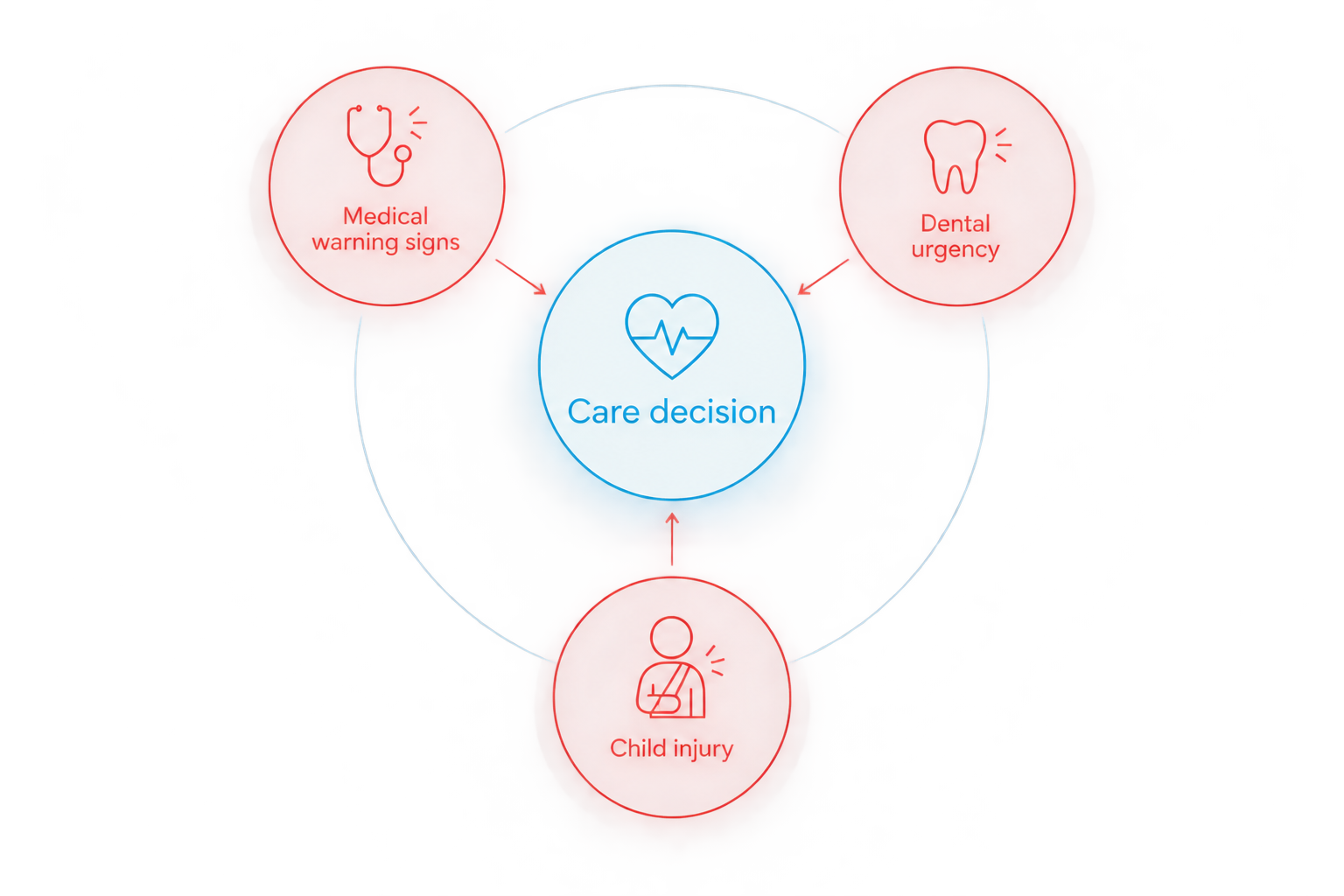
Start with medical warning signs, then identify whether the problem involves a child or an adult. This is a direction-of-care check—not a way to diagnose yourself.
- Medical warning signs: Breathing difficulty, swallowing difficulty, rapidly spreading swelling, serious injury, or uncontrolled bleeding means emergency medical care.
- Dental urgency: Severe pain, a broken tooth, a displaced tooth, or new localized swelling needs prompt dental contact.
- Child injury: Identify whether the tooth is a baby tooth or permanent tooth, and report any head-injury symptoms.
What to say when you contact the office
A clear description helps the dental team direct you appropriately. Start with the symptom and when it began, then explain whether it is worsening.
For a 2026 visit, keep your current medication list and relevant medical information ready. Include allergies, pregnancy, blood-thinning medicines, and any condition that affects your immune system.
Ask these questions:
- “Based on these symptoms, should I see a dentist or seek emergency medical care?”
- “Can the dentist evaluate this type of injury or pain?”
- “What should I do before the examination?”
- “What symptoms mean I should seek emergency help instead?”
- “Will the first visit focus on assessment, treatment, or both?”
For non-life-threatening concerns, use the contact page to ask about your next step. If your symptoms become dangerous, do not wait for an online reply.
How these options were ranked
The 2026 guide separates care settings by symptom severity, patient age, treatment role, and follow-up needs. It does not assign unverified scores, compare patient outcomes, or claim that one local dentist is clinically better than another.
The default recommendation is dental assessment for an urgent tooth problem without medical warning signs. Medical warning signs override that recommendation.
Which emergency dental care option should you choose?
For severe tooth pain or a broken tooth without dangerous symptoms, contact a dental office promptly and describe the problem before traveling. For breathing difficulty, trouble swallowing, spreading swelling, or serious trauma, seek emergency medical care.
Dental Arts of Atlantis is an option for families considering a Lake Worth dental practice. Ask directly about assessment of your urgent concern and the follow-up it requires rather than assuming the service you need from a search result.
FAQ
What’s the best emergency dentist in Boynton Beach, FL?
The best choice is a dentist who can assess and treat your specific urgent problem appropriately. Describe your symptoms before traveling, and seek emergency medical care instead for breathing difficulty, trouble swallowing, or rapidly spreading swelling.
Is Dental Arts of Atlantis located in Boynton Beach?
Dental Arts of Atlantis is located in Lake Worth, Florida, and serves families in Palm Beach County. Contact the practice directly about your dental concern before traveling.
Should I go to the emergency room for a toothache?
An isolated toothache generally needs dental assessment rather than a hospital emergency department. Trouble breathing or swallowing, rapidly spreading swelling, serious facial trauma, or uncontrolled bleeding requires emergency medical care.
What should I do if an adult tooth gets knocked out?
Seek immediate dental care and keep the permanent tooth moist. Handle it by the crown, avoid scrubbing the root, and place it back gently if safe or keep it in milk while traveling.
Should I put my child’s knocked-out baby tooth back?
No—do not reinsert a knocked-out baby tooth. Contact a dentist promptly and report how the injury happened, whether the tooth was found, and any other symptoms.
Can antibiotics cure a tooth infection without dental treatment?
Antibiotics do not replace treatment of the source of a dental infection. A dentist determines the necessary procedure and whether antibiotics are also appropriate.
What if my tooth stops hurting before the appointment?
Keep the dental assessment unless the treating office advises otherwise. Less pain does not establish that decay, a fracture, or an infection has resolved.
One last thing
A tooth that stops hurting has not necessarily healed. Pain can change even while the underlying problem remains, so tell the dentist about the full symptom history—not just how the tooth feels when you arrive.
For your 2026 dental care, leave with a clear answer to one question: “Has the cause been treated, or do I still need a follow-up procedure?” That distinction matters after the immediate discomfort settles.
Related guides
- How to handle a dental emergency until you reach the dentist
- What counts as a pediatric dental emergency?
- Emergency dentistry for a cracked or broken tooth