
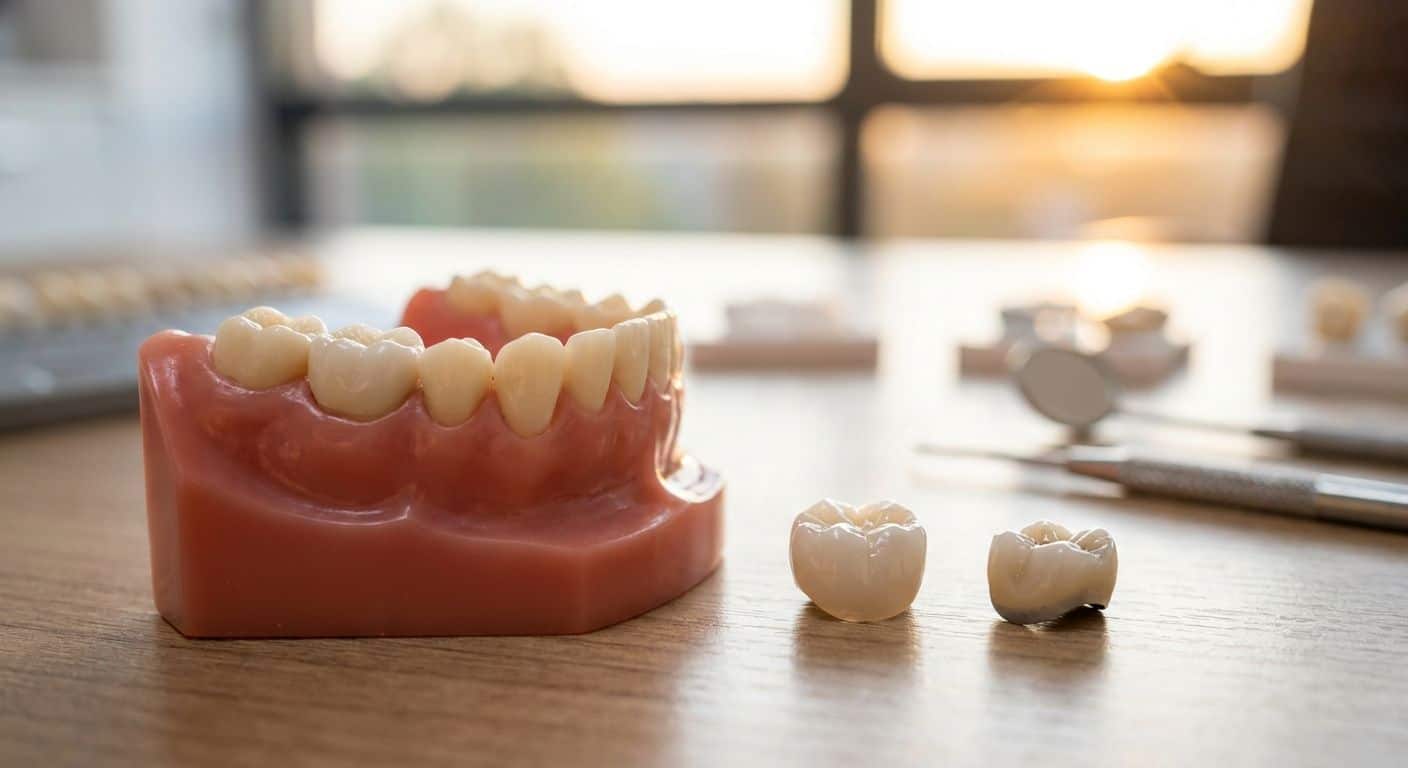
A cracked or heavily filled molar needs a crown material built for chewing force, not a material picked for looks — zirconia, gold, PFM, and lithium disilicate each perform differently under that load, and the wrong pick fails early.
- Monolithic zirconia is the best crown material for molar restorations in 2026 for most patients — buy it.
- Gold alloy remains the strongest long-term option for heavy grinders but loses on esthetics.
- Lithium disilicate (e.max) works on premolars, not full molars — consider it, don’t rely on it for a first molar.
- Skip all-ceramic feldspathic crowns on back molars; they’re built for front-tooth esthetics, not bite force.
- PFM crowns still function on molars in 2026 but carry chip and gum-line risk that zirconia doesn’t.
Why this matters
A molar takes the brunt of chewing force — far more than an incisor or canine ever will. Pick a crown material rated for front-tooth esthetics and you're looking at a fracture, a chip, or a redo within a couple of years.
The dental crowns for a cracked back molar page at Dental Arts of Atlantis walks through when a crown is the right call versus a filling or an extraction. This guide answers the narrower question once you've already decided on a crown: which material actually holds up on a molar in 2026.
Material choice also depends on why the tooth needs a crown in the first place. A molar that's cracked after a root canal behaves differently under load than one that's just worn down from grinding — if you're not sure how to know if you need a root canal, sort that out before locking in a material.
How this list was ranked
Materials are ranked on four factors that matter specifically for molars: documented flexural strength, wear on the opposing tooth, esthetic compromise, and how the material performs under the repeated compressive load a back tooth handles daily. Esthetic-only ceramics that work well on front teeth get downgraded here because a molar rarely needs to look perfect — it needs to survive.
Strength figures cited below reflect published dental material science ranges (flexural strength in megapascals, MPa), not marketing claims from any single manufacturer. Longevity claims for gold reflect decades of documented clinical use in restorative dentistry, not a single study.
The ranked list
1. Monolithic zirconia — the workhorse pick
Zirconia crowns run roughly 900 to 1,200 MPa in flexural strength depending on the specific zirconia formulation, which puts them well above what a molar generates during normal chewing and clenching. That strength margin is why zirconia has become the default molar material for most general and cosmetic practices heading into 2026.
It's milled in a single block with no porcelain overlay to chip off, which removes the most common failure point of older crown types. Esthetics have improved with newer translucent zirconia blends, though it still reads slightly more opaque than natural enamel under close inspection.
Verdict: Buy. For a back molar carrying real bite force, monolithic zirconia is the safest default in 2026.
2. Gold alloy — the old reliable
Gold has been used in restorative dentistry for more than 50 years, and it remains one of the few materials gentle enough on the opposing tooth that it won't wear down the enamel it bites against. It also flexes slightly under load instead of cracking, which matters for patients with heavy grinding habits.
The tradeoff is obvious the moment you open your mouth — gold looks like gold, not like a tooth. For a second or third molar that rarely shows when you smile, that's a fair trade for durability.
Verdict: Buy for far-back molars in heavy grinders who don't mind the metallic look; Skip if the tooth shows when you talk or laugh.
3. Lithium disilicate (e.max) — the wildcard
Lithium disilicate runs closer to 360-400 MPa in flexural strength, which is solid for a premolar or a front tooth but noticeably lower than zirconia's ceiling. It's a genuinely strong esthetic material — it's just not built with the same safety margin for a first or second molar taking full bite force.
Where it earns a spot on this list is the border zone: a premolar or a molar in a patient with a light, even bite. In those cases the esthetic upgrade over zirconia is real and the strength margin is usually enough.
Verdict: Consider for premolars or light-bite patients; not the first choice for a heavily loaded molar.
4. Porcelain-fused-to-metal (PFM) — the old standard
PFM crowns pair a metal substructure with a porcelain layer on top, which gave dentistry decades of reliable molar crowns before zirconia became mainstream. The metal core handles the load fine — the porcelain veneer layered over it is the weak point, since it can chip under heavy grinding in a way a monolithic zirconia crown can't.
There's also the long-term cosmetic issue: as gums recede slightly with age, the metal margin at the gumline can become visible as a thin gray line. It's a known tradeoff, not a defect, but it's worth knowing about before choosing this over zirconia.
Verdict: Consider if zirconia isn't an option at your provider; Hold off if you're choosing between the two with no other constraint.
5. Feldspathic porcelain / all-ceramic — skip for molars
Feldspathic and other pressed all-ceramic crowns are built for the esthetic zone — front teeth where light needs to pass through the material the way it does through natural enamel. On a molar, that same translucency comes from a more brittle structure that isn't rated for the compressive force a back tooth generates every day.
These materials do well on incisors and sometimes canines, but placing one on a molar is choosing a cosmetic material for a structural job.
Verdict: Skip for molars in 2026 — reserve this material for the front six teeth.
If the molar in question is too far gone for any crown material to save — extensive decay below the gumline, a vertical root fracture, or a tooth that's already been through multiple failed restorations — a single-tooth implant is usually the more durable long-term fix. Dental implants for one missing tooth covers what that process looks like when a crown genuinely isn't the answer anymore.
Comparison table
| Material | Flexural Strength | Best For | Esthetics | Verdict |
|---|---|---|---|---|
| Monolithic zirconia | ~900-1,200 MPa | Molars, heavy grinders | Good | Buy |
| Gold alloy | High, flexes under load | Far-back molars, bruxism | Poor (metallic) | Buy (back molars only) |
| Lithium disilicate (e.max) | ~360-400 MPa | Premolars, light bite | Excellent | Consider |
| PFM | Metal core + porcelain | Molars needing shade match | Moderate | Consider |
| Feldspathic / all-ceramic | Lower strength | Front teeth | Excellent | Skip for molars |
Where to get it done
- Ask which zirconia block your dentist mills from — translucency and strength vary between formulations, and a general practice should be able to name the brand they use.
- Confirm whether the crown is milled same-day in-office or sent to an outside lab; both can produce a good zirconia crown, but same-day options mean fewer appointments. The best same-day option for a cracked molar page covers what that process involves.
- If you grind your teeth at night, mention it before the material is chosen — a night guard alongside a zirconia or gold crown protects the investment either way.
Have a cracked or broken molar?
Find out which crown material fits your bite before you commit.
FAQ
What’s the best crown material for a molar in 2026?
Monolithic zirconia is the best crown material for a molar in 2026 for most patients, with flexural strength around 900-1,200 MPa and no porcelain layer to chip. Gold alloy is a strong alternative for far-back molars in heavy grinders who don’t mind the metallic look.
Is zirconia better than porcelain for a back tooth?
Yes, monolithic zirconia outperforms feldspathic porcelain on back teeth because it’s rated for compressive bite force rather than front-tooth esthetics. Porcelain crowns are more prone to chipping and cracking under molar-level chewing force.
How long do zirconia crowns last on molars?
Zirconia crowns on molars are commonly reported to last well over a decade with normal wear, though longevity depends on bite force, grinding habits, and oral hygiene. A night guard extends the life of any crown material in patients who grind their teeth.
Does insurance cover zirconia crowns?
Coverage for zirconia crowns varies by plan and provider, so check your specific policy before scheduling. Some plans cover crowns at a flat rate regardless of material, while others differentiate by material cost.
Can a lithium disilicate crown handle a molar?
Lithium disilicate can work on a molar in patients with a light, even bite, but its flexural strength of roughly 360-400 MPa is lower than zirconia’s. For heavier bite forces or grinding, zirconia or gold is the safer choice.
Is gold still used for molar crowns in 2026?
Yes, gold alloy is still used on molars in 2026, mainly on far-back teeth where the metallic appearance doesn’t show. It remains one of the gentlest materials on the opposing tooth’s enamel.
What happens if the wrong crown material is used on a molar?
Using an esthetic-only material like feldspathic porcelain on a molar increases the risk of chipping or cracking under normal chewing force within a few years. That usually means an earlier redo than a material chosen for strength would have required.
Do zirconia crowns need special care?
Zirconia crowns don’t require special products, but a night guard is worth discussing if you grind your teeth, since it protects both the crown and the opposing tooth. Regular brushing and flossing around the crown margin is otherwise the same as caring for a natural tooth.
One last thing
The material matters less than the fit if the crown is placed on a tooth that hasn't been properly evaluated first — a molar with an undiagnosed crack line under the gum will fail regardless of whether it's topped with zirconia or gold. Before locking in a material, make sure the tooth itself has been fully assessed, not just measured for a crown.
Related guides