

Yes, you can get Invisalign with missing teeth when your remaining teeth, gums, and bone can support the planned tooth movement. Treatment can close a suitable gap or create the right space for a replacement tooth, but aligners do not replace missing teeth or move an existing dental implant.
- Invisalign with missing teeth is possible when gum health, bone support, and the bite allow safe movement.
- Invisalign can close selected gaps or prepare space for a dental implant; the goals require different plans.
- Existing dental implants stay fixed while surrounding natural teeth move.
- Dental Arts of Atlantis offers Invisalign and implant dentistry for Lake Worth families seeking both types of care.
Why this matters
Decide what should happen to the empty space before straightening begins. Closing a gap and preparing it for a replacement tooth are different treatment goals. A smile can look straighter while still leaving too little room between the roots for the intended restoration.
If you are considering treatment in 2026, start with the final bite and replacement plan—not just the appearance of the front teeth. Understanding how Invisalign works for adults helps you prepare questions, but an examination determines whether your particular gap can be treated safely.
Can you get Invisalign if you have missing teeth?
Yes. A missing tooth does not automatically rule out Invisalign because aligners move the natural teeth that remain. Your dentist evaluates the location of the gap, the surrounding roots, your bite, and the health of the supporting tissues before recommending treatment.
The central decision is whether to close the space or preserve it for a replacement. An existing implant adds another consideration because it cannot move like a natural tooth.
| Treatment approach | Best for | Main benefit | Main limitation |
|---|---|---|---|
| Close the gap | Selected bites where neighboring teeth can take appropriate positions | Can remove the need to replace that particular missing tooth | Not every gap can close without compromising the bite or appearance |
| Prepare replacement space | Patients who need a replacement tooth after alignment | Positions neighboring teeth and roots for restoration | Requires coordinated orthodontic and restorative treatment |
| Align around an implant | Patients with an existing implant and movable natural teeth | Can improve alignment without moving the implant | The implant's fixed position limits treatment choices |
These are treatment pathways, not interchangeable promises. The best plan protects your bite as well as your smile. Your dentist also needs to consider how the upper and lower teeth will meet when treatment ends.
Closing the gap: when replacement is not the goal
Orthodontic space closure moves neighboring teeth toward the missing-tooth space. This can be appropriate when the resulting tooth positions support a functional bite and an acceptable appearance. It is not simply a matter of squeezing every gap shut.
Tooth shape matters. A tooth moved into another tooth's position can have a different width, contour, or gumline, so the plan sometimes includes reshaping or restorative care afterward. Ask what the finished smile will require beyond aligners.
The advantage is avoiding a replacement in that specific space when closure is suitable. The limitation is that moving teeth over a larger distance or controlling their roots can be more demanding than correcting mild crowding. Invisalign is not automatically the right appliance for every space-closure case.
Preserving the gap: when a replacement tooth is planned
Sometimes the goal is to straighten tilted teeth and establish an appropriate space for a replacement. The visible opening is only part of that assessment. Roots below the gums also need positions that suit the proposed restoration.
An opening that looks wide enough does not prove an implant will fit safely. Your dentist must assess the bone, nearby structures, and root spacing before deciding on implant placement.
For a 2026 treatment plan involving both Invisalign and tooth replacement, ask for the order of care in writing. Clarify which movements must finish first, how the gap will be maintained, and what will hold the teeth while the replacement is completed. That coordination matters more than choosing an arbitrary finish date.
Existing implants: natural teeth move, implants stay fixed
A dental implant is anchored in bone and lacks the ligament that allows a natural tooth to move during orthodontic treatment. Invisalign therefore cannot reposition an integrated implant. The surrounding natural teeth can still be evaluated for movement.
An existing implant is not an automatic disqualification, but its position becomes a fixed boundary in the plan. Your dentist must determine whether the desired bite and spacing are achievable around it.
A crown on a natural tooth is different from an implant-supported crown because the underlying natural root can still move. If you have restorations, understanding Invisalign with dental crowns helps distinguish the restoration you can see from the support underneath it. Tell your dentist about every implant, bridge, and crown before treatment planning.
Why Invisalign treatment with missing teeth varies
The same visible gap can require very different care. These factors determine whether aligners are appropriate and what must happen alongside them:
- Gap location: A missing front tooth affects smile appearance differently from a missing back tooth, and each location has different bite demands.
- Remaining teeth: Tilted, rotated, heavily restored, or compromised teeth change the movements and support available for treatment.
- Gum and bone health: Active periodontal disease and inadequate support require assessment before orthodontic forces are applied.
- Replacement goal: Closing space requires a different plan from creating space for an implant or another restoration.
- Existing restorations: Implants remain fixed, while connected bridge components can restrict independent tooth movement.
- Daily wear: Removable aligners depend on consistent use and follow-up to deliver the prescribed movements.
Age alone does not answer the suitability question. The health and arrangement of your teeth matter more than whether you have lived with the gap for a short or long time.
What happens before you start treatment?
A consultation should connect tooth alignment with the final restoration, rather than treating them as separate projects. You should understand the purpose of each stage before receiving aligners.
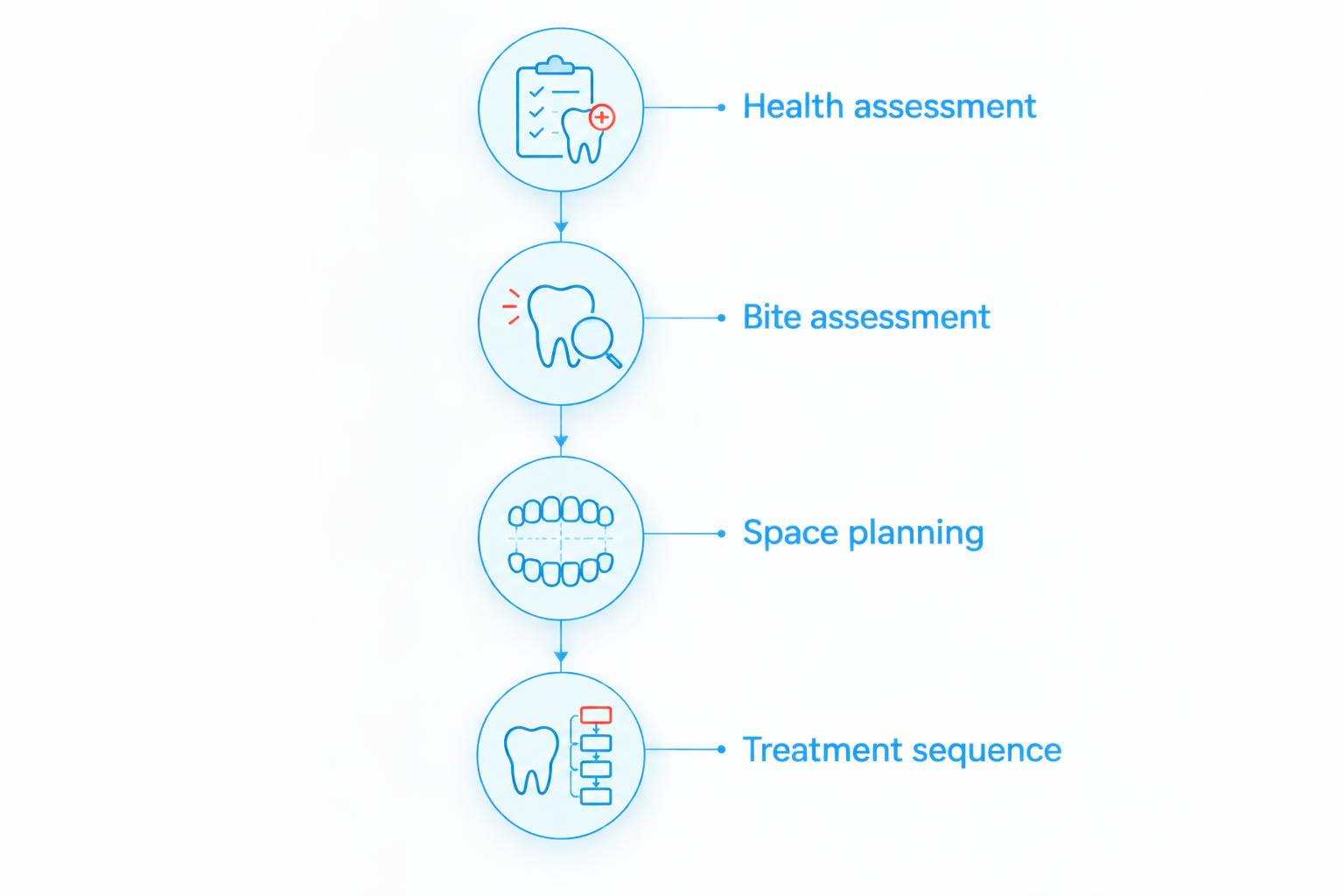
- Health assessment: Your dentist checks for decay, gum disease, loose teeth, and other problems that need attention first.
- Bite assessment: An examination and appropriate records establish how your teeth meet and which movements are needed.
- Space planning: The plan identifies whether the gap will close, stay open, or change size for a replacement.
- Treatment sequence: Your dentist explains the order of alignment, any required surgery or restoration, and retention.
Bring information about previous extractions, gum treatment, implants, and any temporary tooth you wear. Explain what bothers you most: chewing, appearance, food trapping, or tooth position. Those concerns help define the treatment goal without assuming that every gap needs the same solution.
If you are comparing 2026 treatment proposals, compare their endpoints. A proposal that finishes with straight teeth and an open space is different from one that also includes the replacement and final retainer.
How long does Invisalign take when teeth are missing?
There is no single treatment duration for Invisalign with missing teeth. Timing depends on the required movements, tissue health, aligner wear, and whether additional restorative or surgical care is needed.
Ask for separate estimates for active alignment and the complete course of care. Finishing the last active aligner does not necessarily mean an implant restoration is ready or that retention can be skipped.
Do not choose an appliance solely because its estimated finish date is earlier. The distinction also matters when comparing how long braces take: a straightening estimate does not automatically include healing, tooth replacement, or the work needed to maintain the final space.
For your 2026 schedule, identify milestones rather than demanding a guaranteed completion date. Ask what must happen before a replacement can be fitted, what would require a revised plan, and how progress will be checked. A realistic sequence gives you a clearer basis for planning work, travel, and important events.
Can you hide the missing tooth during treatment?
An aligner can sometimes include a tooth-colored cosmetic fill in the missing-tooth area, often called a pontic. Whether that is suitable depends on the location, available space, and planned movement. Ask about it before the aligners are made.
A cosmetic fill helps disguise the gap while the aligner is in place; it is not a functional replacement tooth. The gap remains when you remove the tray, and the fill does not provide an implant's support or chewing function.
If you already wear a removable temporary tooth, bring it to the consultation. Do not assume that an existing appliance will fit over changing tooth positions or work with your aligners. Your dentist needs to coordinate its use with treatment.
What does daily care involve?
Invisalign generally requires 20–22 hours of daily wear, with the exact instructions set by your treating dentist. Removing trays frequently or leaving them out for long periods interferes with the prescribed wear schedule. Missing teeth do not remove that responsibility.
Brush with fluoride toothpaste for 2 minutes per brushing session, twice daily, and clean between your teeth daily. Pay attention to surfaces next to the gap, where cleaning access and food trapping can differ from other areas. Clean the aligners according to your dentist's and manufacturer's instructions.
Keep review appointments even when the front teeth look better. Appearance alone cannot confirm that roots, bite contacts, and replacement space are progressing as planned.
Contact your dentist if a tray stops seating, an attachment comes off, or you develop persistent pain, swelling, or unexpected tooth looseness. Do not force a poorly fitting tray or change the treatment sequence yourself.
Should you get an implant before or after Invisalign?
When planned tooth movement will change the implant space, alignment commonly comes before final implant placement. That sequence allows natural teeth and roots to be positioned before the implant establishes a fixed point.
It is not a universal rule. Existing implants, extraction healing, bone needs, and the overall restorative plan can change the order. Ask the clinicians responsible for alignment and replacement to agree on the sequence before either treatment begins.
Dental Arts of Atlantis offers Invisalign and implant dentistry for Lake Worth families who need both alignment and tooth-replacement care. Suitability still depends on your examination; offering both services does not mean aligners or an implant are right for every gap.
Will you need a retainer if the gap stays open?
Yes, retention is still necessary after orthodontic treatment when a space is being maintained for a replacement. Teeth can shift after active movement, including while you wait for restorative care.
Your dentist should explain what holds the planned space and whether the retainer needs replacement or adjustment after the final restoration. Do not assume your last aligner is a permanent retainer or that a new crown will fit inside an existing one.
FAQ
Can I get Invisalign if I am missing a back tooth?
Yes, a missing back tooth does not automatically rule out Invisalign. Your dentist must evaluate the bite, nearby tooth positions, and whether the space should close or be prepared for replacement.
Can Invisalign move a dental implant?
No, Invisalign cannot move an integrated dental implant. Treatment must work around its fixed position while moving suitable natural teeth.
Will Invisalign replace my missing tooth?
No, Invisalign moves natural teeth rather than replacing them. Treatment can close a suitable gap or prepare space for a separately planned replacement.
Can I wear Invisalign over a dental bridge?
A dental bridge requires individual assessment because its connected components restrict independent tooth movement. Your dentist must determine whether the bridge can remain unchanged during treatment.
Can I start Invisalign right after a tooth extraction?
Your dentist must assess the extraction site and planned movements before deciding when you can start Invisalign. Do not use a general waiting period as clearance for your own treatment.
Can I get Invisalign if gum disease caused my missing teeth?
A history of gum disease does not automatically exclude Invisalign, but active disease and the remaining bone support need assessment first. Periodontal care and monitoring can be necessary before and during orthodontic treatment.
Is Invisalign better than braces when teeth are missing?
Neither Invisalign nor braces is automatically better when teeth are missing. The appropriate appliance depends on the required movement, bite, supporting tissues, and your ability to follow treatment instructions.
One last thing
A gap that remains after straightening is not necessarily an unfinished result. It can be the deliberately prepared site for your replacement tooth. What matters is whether its size, root spacing, and bite match the final plan.
Before committing to treatment in 2026, ask: What will occupy this space when all care is complete, and what will hold it until then? At Dental Arts of Atlantis, bring that question to your Invisalign consultation so alignment and replacement remain part of the same conversation.
Related guides
- Dental implants for one missing tooth
- How long does Invisalign treatment take?
- How to care for your retainer after Invisalign treatment