

Invisalign treatment takes as long as your planned tooth movements and bite correction require; your dentist estimates the duration after examining your teeth and reviewing your treatment records. That estimate should distinguish the initial aligner series from any additional aligners needed to finish treatment. Your last scheduled tray is not automatically your treatment finish line, and retainer wear continues after active tooth movement ends.
- How long does Invisalign treatment take? Your tooth movements, bite correction, and aligner wear determine your individual timeline.
- Invisalign’s initial aligner series is not necessarily the full treatment timeline; additional aligners can follow.
- Wear Invisalign for the prescribed daily hours, and change trays only as your dentist directs.
- Dental Arts of Atlantis offers Invisalign and general dental care for families in the Lake Worth area.
If you're considering treatment in 2026, start with what adults should expect from Invisalign. Then ask for an estimate that explains what your particular treatment needs to accomplish—not just when your front teeth might look straighter.
How long does Invisalign treatment take?
The useful answer is your individual treatment estimate, not a universal number of months. A small alignment correction and a plan that changes how upper and lower teeth meet involve different movements. Even similar-looking smiles can need different treatment sequences.
Your dentist evaluates tooth position, gum health, and bite relationships before recommending a plan. The projected sequence shows intended movements, but actual progress still needs clinical checks. Teeth do not always move exactly as the plan predicts.
Use this comparison to understand what an estimate includes. These are treatment goals, not named Invisalign packages or promised completion times.
| Treatment goal | Best for | What affects the timeline | Main limitation |
|---|---|---|---|
| Limited alignment | Patients whose examination supports a focused correction | The specific teeth and movements involved | A narrower goal does not address every bite concern |
| Alignment with bite correction | Patients who need tooth alignment and changes in how teeth meet | Coordinating upper and lower tooth movements | A better-looking smile can appear before the bite work is complete |
| Refinement aligners | Patients with remaining movements after an initial series | Reassessment and the additional movements prescribed | The original tray count no longer represents the full course |
Removable aligners let you eat and clean your teeth without brackets attached to them. The trade-off is responsibility: you must wear the trays consistently and keep follow-up appointments. Choosing a narrower goal solely to finish sooner is not a substitute for deciding what treatment your teeth need.
Why this matters
A finish date affects how you plan travel, school, work, and important events. It also shapes expectations: visible improvement, completion of active treatment, and the start of retainer wear are different milestones.
For a wedding or another event in 2026, tell your dentist the date before treatment planning. Ask what improvement is realistic by that point and whether active treatment will still be underway. Plan around a clinical estimate, not a guaranteed event-day result.
That distinction protects you from rushing. Switching trays early to meet a deadline does not make the planned tooth movements happen safely or predictably.
What happens between your consultation and your last aligner?
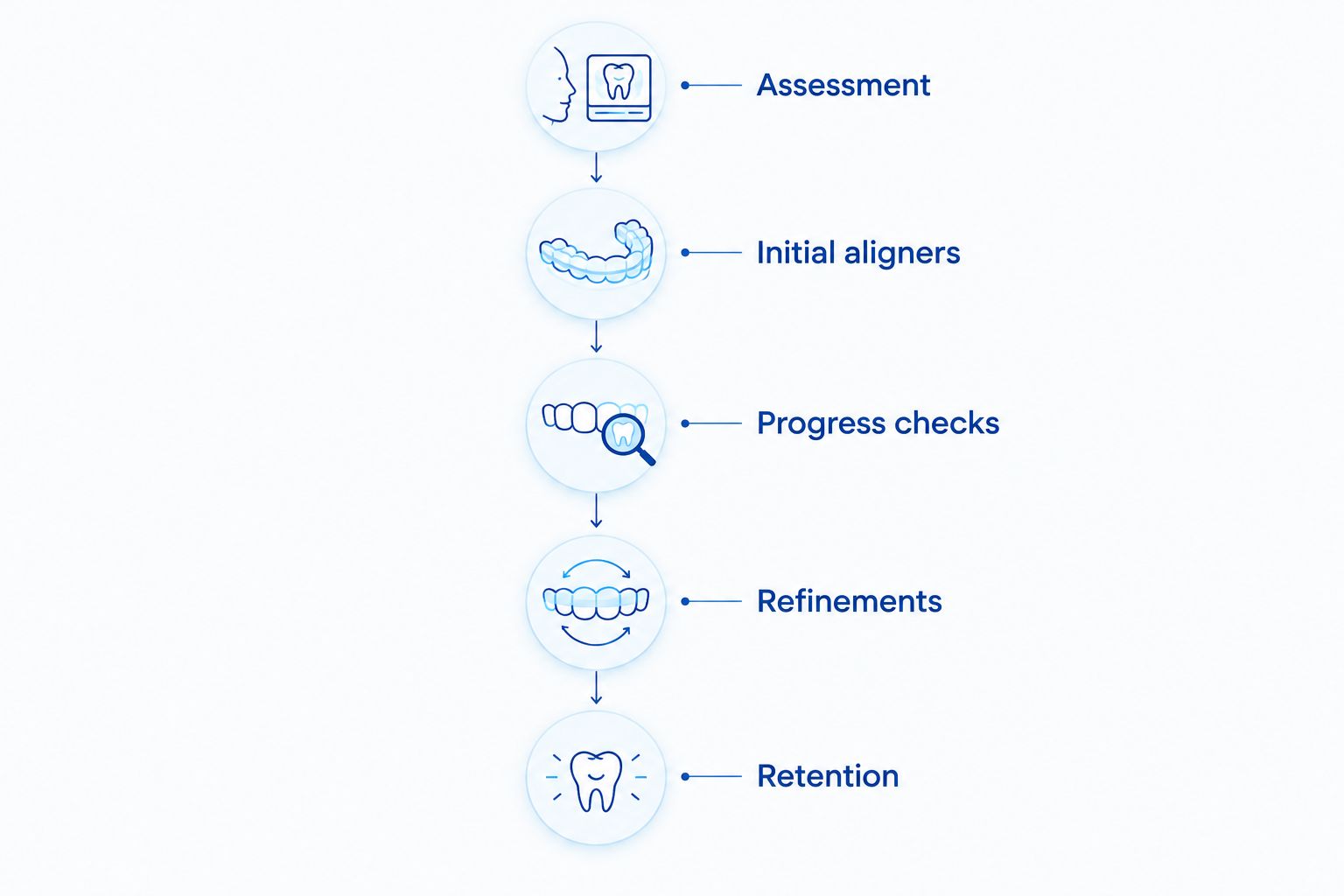
Your Invisalign timeline includes more than the days you spend wearing trays. Assessment and planning come first; progress reviews and any refinements follow. Retention begins when your dentist determines that active treatment is complete.
- Assessment: Your dentist examines your teeth, gums, and bite, reviews relevant records, and checks whether clear aligners suit your needs. Dental problems that need attention can affect when treatment starts.
- Initial aligners: You begin the prescribed series and learn your wear and tray-change instructions. Some plans also use attachments or other measures to help achieve particular movements.
- Progress checks: Your dentist checks fit, tooth movement, and bite changes. These reviews determine whether you should continue the sequence or adjust the plan.
- Refinements: If movements remain, your dentist reassesses your teeth and prescribes additional aligners when appropriate. This stage is not necessary for every patient.
- Retention: After active treatment, retainers help hold the corrected positions. Your dentist gives you a separate wear schedule.
The process is not always a straight line. A fit problem during progress checks can require reassessment before you reach the end of the initial series.
Why Invisalign treatment time varies
The same brand of aligner does not mean the same treatment duration. Your starting position, treatment goals, and daily habits all matter. These factors explain why another person's finish date is not a reliable guide for yours.
- Movement complexity: Closing a space, rotating a tooth, and changing a bite relationship involve different mechanical demands. Some movements require more careful staging than others.
- Treatment scope: Straightening selected teeth is a different goal from coordinating the whole bite. Ask exactly what your proposed plan includes and leaves unchanged.
- Daily wear: Aligners act on your teeth while you wear them. Frequent or lengthy breaks interrupt the prescribed routine.
- Aligner fit: Teeth need to follow the intended sequence. Persistent gaps between a tray and a tooth deserve a check rather than an automatic switch to the next tray.
- Dental health: Cavities, active gum disease, or other problems can require care before or during orthodontic treatment. Keeping teeth and gums healthy supports continued treatment.
- Additional movements: Refinements address work that remains after the initial series. An updated plan changes the original estimate.
Ask which factors matter most in your case. A useful answer identifies the actual concern—such as a rotated tooth or inconsistent wear—instead of simply saying treatment is taking longer.
How many hours a day should you wear Invisalign?
Invisalign's published patient guidance recommends wearing aligners for 20–22 hours per day. Follow your treating dentist's instructions, including when to remove the trays and when to change them. Eating, drinking anything other than water, and cleaning your teeth require attention to that daily routine.
Twenty hours of wear is not the same as 22 hours of wear. Repeated long breaks leave less time for the prescribed treatment, even if you always sleep with your aligners in place. A realistic routine matters more than good intentions.
For your 2026 schedule, identify the times you are most likely to forget reinsertion: breakfast, lunch at work, after-school snacks, or an evening out. Keep the aligner case with you and return trays to your mouth after appropriate cleaning. Avoid wrapping trays in a napkin, where they are easily discarded.
The American Dental Association recommends brushing for 2 minutes, twice a day, and cleaning between teeth daily. Your dentist can explain how to fit oral hygiene around aligner wear without neglecting either. The guide to oral hygiene for Invisalign wearers covers this part of the routine.
What are Invisalign refinements, and do they add time?
Refinements are additional aligners prescribed to address tooth movements that remain after reassessment. They extend active treatment beyond the initial series when further movement is needed. They are not a reason to assume that treatment has failed.
A tooth might not follow its planned rotation, a space might remain, or the bite might need further adjustment. Your dentist decides whether those findings call for more aligners, a change in approach, or another recommendation.
Ask whether the original estimate includes possible refinements. If it covers only the first series, understand that it is a phase estimate—not necessarily an estimate for the finished result. Also ask what you should wear while any new aligners are being prepared.
For treatment beginning in 2026, keep your original estimate and any updated instructions together. That makes it easier to understand what changed and why. Never stop wearing your current prescribed appliance just because the initial series is complete.
Does Invisalign take longer for adults than teenagers?
Age alone does not determine whether Invisalign treatment will be shorter or longer. Adults and teenagers both need an assessment of their teeth, bite, oral health, and ability to follow the prescribed routine. Growing patients can also have developmental considerations that affect planning.
Adults often need to account for work meals, travel, and existing dental treatment. Teenagers need a routine that works around school, snacks, and activities. Neither group benefits from a finish-date promise based only on age.
For families, make responsibilities clear without turning every meal into an argument. Agree on where the case stays, how trays are cleaned, and who handles appointments. Consistent support is more useful than comparing progress with a friend's treatment.
What should you do if an aligner does not fit?
Contact your dental team when a tray will not seat properly or a gap persists. Do not force it into place, skip trays, or decide on your own that a tighter tray will correct the problem. Your dentist needs to distinguish a fit issue from a tooth that is not following the plan.
Report which tray you are wearing, when you started it, and whether your wear routine changed. Mention a lost tray, broken attachment, or unusual discomfort. Clear information helps your dentist give instructions appropriate to your situation.
Some pressure with a new aligner is expected, but severe pain, swelling, or an injury needs prompt attention. Do not treat a concerning symptom as proof that the aligner is working harder.
How do you get a timeline you can actually plan around?
Ask your dentist to separate the start date, initial series, possible refinement stage, and transition to retainers. A useful estimate explains the treatment goal and the conditions that support staying on schedule.
Bring these questions to your appointment:
- What movements are needed to improve my alignment and bite?
- Does this estimate cover the initial series or expected active treatment?
- What findings would lead you to prescribe refinements?
- What daily wear and tray-change instructions should I follow?
- How will you check that my teeth are following the plan?
- What is realistic before my planned event or travel?
Dental Arts of Atlantis fits Lake Worth families seeking Invisalign and general dental care in one practice. The practice offers both services; an examination is still necessary to determine whether Invisalign suits your teeth and goals. Removable trays offer flexibility, but they require consistent wear and are not appropriate for every orthodontic problem.
Explore care for your smile
Learn about Invisalign and general dental care for Lake Worth and Palm Beach County families.
FAQ
How long does Invisalign treatment take from start to finish?
Invisalign treatment duration depends on your planned tooth movements, bite correction, daily wear, and whether additional aligners are needed. Ask your dentist for an estimate that distinguishes the initial series from completion of active treatment.
Can I finish Invisalign faster by changing trays early?
Do not change Invisalign trays earlier than your dentist directs. Moving ahead without approval does not ensure that your teeth are ready for the next prescribed movement.
How many hours a day do I need to wear Invisalign?
Invisalign’s published patient guidance recommends 20–22 hours of wear per day. Follow your dentist’s instructions and build meals and oral hygiene around the prescribed routine.
Do refinements mean my Invisalign treatment went wrong?
Refinements do not automatically mean Invisalign treatment went wrong. Additional aligners address movements that remain after your dentist reassesses tooth position and bite.
Is Invisalign finished when my teeth look straight?
Invisalign is finished when your dentist confirms that the treatment goals have been met, not simply when your front teeth look straight. Bite relationships and remaining movements also need assessment.
Will I need a retainer after Invisalign?
Retainers are needed to help maintain tooth positions after Invisalign. Follow the separate retainer schedule your dentist prescribes rather than treating the last aligner as the end of all appliance wear.
Can Dental Arts of Atlantis help me consider Invisalign?
Dental Arts of Atlantis offers Invisalign alongside general dental care for Lake Worth and Palm Beach County families. An individual assessment determines suitability and provides the basis for your treatment estimate.
One last thing
Your last tray number tells you where you are in a prescribed series. It does not tell you whether every treatment goal is complete. Before celebrating the finish, ask your dentist to confirm the result and explain your retainer plan.
Whether you begin in 2026 or are already wearing aligners, the most useful progress question is not just how many trays remain. Ask whether your teeth are following the plan and what still needs to happen before active treatment ends.
Related guides
- How to care for your retainer after Invisalign treatment
- How to help a teen stay on track with Invisalign treatment
- How to get a second opinion on a dental treatment plan