
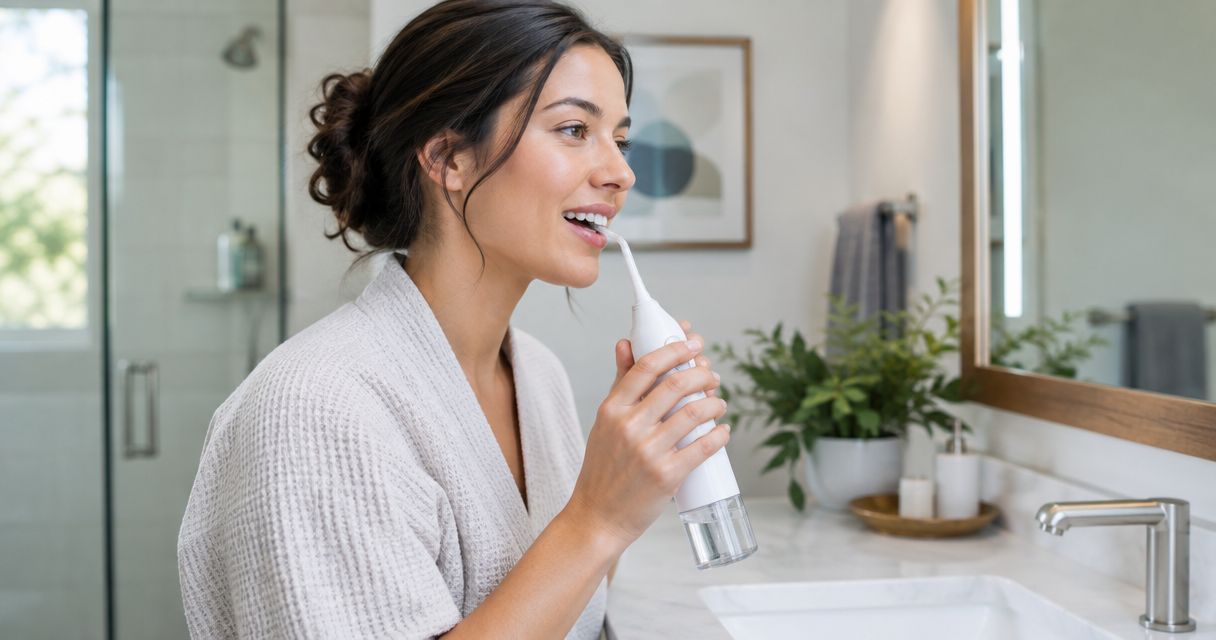
Yes—a water flosser is worth it in 2026 if it helps you clean between your teeth consistently, especially when braces or limited hand movement make string floss difficult. It does not replace brushing, remove hardened tartar, or treat established gum disease, and some spaces still need floss or another cleaning tool.
- Is a water flosser worth it? Yes, when it makes daily cleaning between teeth easier and more consistent.
- The American Dental Association recognizes water flossers as an option for cleaning between teeth.
- Keep brushing with fluoride toothpaste; water flossing does not remove hardened tartar or replace dental treatment.
- Dental Arts of Atlantis offers family dentistry for Lake Worth households seeking care for children and adults.
Is a water flosser worth it in 2026?
A water flosser earns its place when it solves a real cleaning problem. The American Dental Association's patient guidance recognizes water flossers as an interdental cleaning option, particularly for people who have difficulty using string floss or have dental work that complicates cleaning.
For families who need help choosing a routine, Dental Arts of Atlantis provides general, pediatric, and implant dentistry in Lake Worth. A dental examination remains necessary when bleeding, pain, or swelling persists; choosing a home-care device does not identify the cause.
| Cleaning option | Best for | Main advantage | Main limitation |
|---|---|---|---|
| Water flosser | People who struggle with string floss or cleaning around braces | Directs water around teeth and dental hardware | Needs filling, cleaning, and suitable positioning; cannot remove tartar |
| String floss | People who can comfortably clean tight tooth contacts | Wraps against the sides of adjoining teeth | Requires hand control and careful technique |
| Interdental brush | People with spaces large enough for a properly fitted brush | Brushes accessible surfaces between teeth | Does not fit every contact; forcing it can hurt gums |
Choose the tool you can use correctly every day—not the one with the longest feature list. If your current flossing routine works and your dental team finds your gums healthy, you do not need to change it simply because a powered device exists.
Why this matters
Toothbrush bristles do not clean every surface between teeth. Food washing out is reassuring, but it is not proof that you have adequately controlled plaque along the gumline.
The American Dental Association's home-care guidance provides a useful baseline: brush for 2 minutes per session, 2 times per day, with fluoride toothpaste, and clean between teeth 1 time per day. Those recommendations apply whether you choose water flossing, string floss, or a suitable interdental brush.
For this 2026 buying decision, focus on the gap in your routine. If you avoid cleaning between teeth because floss is awkward, a water flosser addresses a practical barrier; if your gums bleed despite regular cleaning, you need an assessment rather than a stronger setting.
When a water flosser earns its place
Best for people who struggle with string floss
A water flosser is a reasonable option when wrapping floss around your fingers or reaching back teeth is difficult. You still need to hold and direct the tip, but you do not need to guide a strand through each contact.
Before choosing a device, check whether you can grip its handle, fill the reservoir, and operate its controls comfortably. A device that is awkward to manage does not solve a hand-movement problem merely because it uses water.
Recommendation: choose a manageable water flosser when handling string floss is the reason you skip daily interdental cleaning. Ask for a demonstration if you cannot comfortably reach all areas.
Best for people cleaning around braces
Brackets and wires create obstacles that make threading floss more involved. A water flosser can help you direct water around that hardware and along the gumline, but brushing around brackets remains essential.
Do not treat visible food removal as the whole job. Your orthodontic or dental team should check whether your technique leaves plaque around brackets and whether you need another tool for particular spaces.
Recommendation: consider water flossing as part of a braces-cleaning routine, not as permission to skip brushing or individualized instructions.
Best for people who need help around dental work
Bridges and implant-supported restorations can create spaces that need specific cleaning methods. Water flossing can be useful in a maintenance routine, but the restoration's shape determines where and how you should clean.
An implant after surgery is different from a healed implant during routine maintenance. Follow your treating clinician's instructions before directing a water jet near a surgical site, and do not assume that a tip advertised for implants suits every restoration.
Recommendation: ask which surfaces need cleaning and which tip or tool fits them before changing your implant or bridge routine.
When keeping your current routine makes more sense
If you already use string floss comfortably and your dental examinations show healthy gums, a water flosser is optional. Adding another device is not automatically an improvement.
String floss remains useful for close contacts because you can curve it against each tooth surface. If floss repeatedly shreds, catches, or cannot pass through a contact, ask your dentist to check the area instead of repeatedly forcing it.
A water flosser is also a poor substitute for professional care when you have tartar, persistent bleeding, or a painful tooth. Hardened deposits require professional removal, and dental disease can continue even when your mouth feels cleaner after rinsing.
Keep an effective routine; change a routine that you cannot perform consistently or correctly. That distinction matters more than choosing a powered or manual tool.
Why a water flosser's usefulness varies
The same device does not solve the same problem for every mouth. These factors determine whether water flossing is helpful and what additional care you need:
- Tooth contacts: Tight contacts and wider spaces need different approaches. A water stream does not tell you whether every adjoining tooth surface is clean.
- Dental hardware: Braces, bridges, and implant restorations change access. Technique must match the places you need to reach.
- Hand control: A comfortable handle helps only if you can aim the tip and manage the reservoir reliably.
- Gum condition: Inflamed gums, recession, and treated periodontal disease call for individualized instructions rather than maximum pressure.
- Daily routine: Filling, charging, storing, and cleaning the device add tasks. Choose a setup you will actually maintain.
These are practical selection criteria, not reasons to chase the strongest jet. Comfort and coverage matter; pain is not evidence that a device is working better.
How to choose a water flosser in 2026
Start with handling, not extra modes. Look at the controls, reservoir access, tip attachment, and cleaning instructions before deciding whether a device fits your routine.
A selectable gentle setting is useful when you are learning. Follow the manufacturer's instructions and ask your dental team about pressure if you have tender gums, recent treatment, or a restoration that needs special care.
The American Dental Association's Seal of Acceptance is another useful checkpoint. For an accepted water flosser, the seal indicates that the specific product met the ADA's requirements for safety and effectiveness; it is not a blanket endorsement of every device sold by that manufacturer.
Do not choose a device solely because it promises an impressive result. Check which outcome the claim describes, whether it concerns the exact model, and whether the instructions match your needs.
A suitable water flosser is easy for you to handle, maintain, and use throughout your mouth. No feature eliminates the need for good technique or a dental examination.
How to use a water flosser without irritating your gums
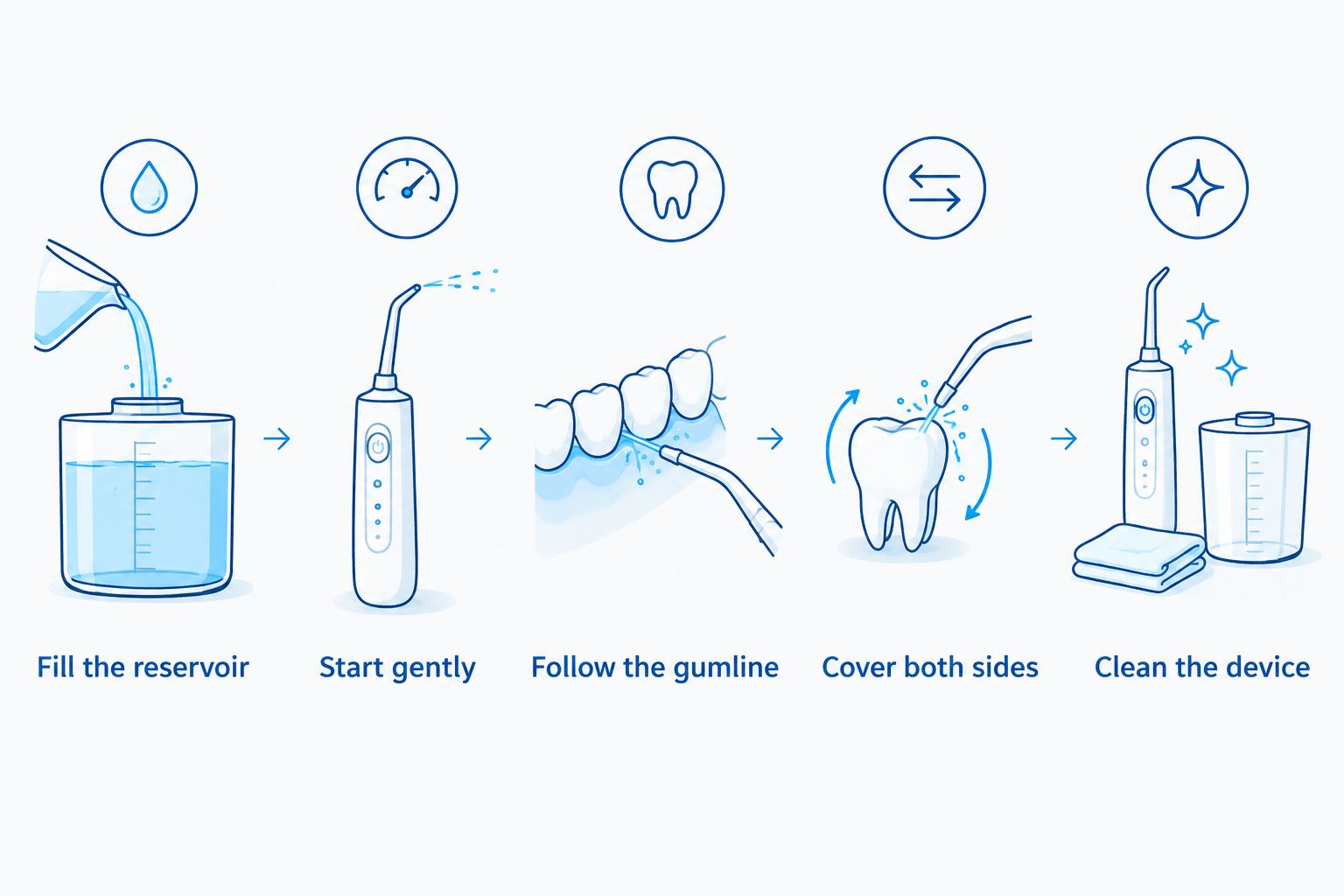
Use the instructions supplied with your device, because tips and controls differ. For a standard routine, the sequence below helps you focus on gentle positioning rather than pressure.
- Fill the reservoir. Use water as directed by the manufacturer. Do not add mouthwash or another solution unless the device instructions permit it.
- Start gently. Select the lowest setting recommended for beginning use, place the tip in your mouth, and lean over the sink before switching it on.
- Follow the gumline. Direct the tip as instructed, moving along the gumline and pausing between teeth rather than spraying randomly across your mouth.
- Cover both sides. Clean the cheek-facing and tongue-facing sides of your teeth. Give back teeth the same attention as the front teeth.
- Clean the device. Empty and maintain the reservoir and tip according to the manufacturer's instructions. A shared handle does not mean family members should share a tip.
You should not need to endure sharp pain to finish. Stop and seek advice if using the device causes pain, worsens bleeding, or repeatedly injures one area.
If you have recently had an extraction, implant placement, or gum surgery, do not follow a general routine around the healing site. Your postoperative instructions take priority, including any restriction on irrigation.
Can a water flosser replace string floss?
A water flosser can be your daily interdental cleaning method when it suits your mouth and you use it correctly. It is not a universal replacement for every technique your dentist recommends, especially around contacts or restorations that need targeted cleaning.
You do not necessarily need to use every available tool daily. Ask which tool belongs in each area, then follow that plan rather than stacking several methods without knowing what each contributes.
Does a water flosser help bleeding gums?
A water flosser can support cleaning that helps control plaque-related gum inflammation, but bleeding gums still need attention. Persistent bleeding, swelling, bad breath, or tenderness should prompt a dental examination.
Do not respond to bleeding by increasing pressure. And do not assume that bleeding that stops proves there is no gum disease; an examination checks things you cannot assess with a mirror or a home device.
How often should you use a water flosser?
Clean between your teeth 1 time per day, using the method recommended for your mouth. If water flossing is that method, make it a dependable daily habit rather than something you use only after food gets stuck.
For your 2026 routine, anchor interdental cleaning to an existing habit, such as evening brushing. You do not need to turn it into a complicated schedule, but you do need to cover the areas your dental team identifies.
What should you ask at your next dental visit?
Bring a clear question: “Which areas am I missing, and which tool should I use there?” That is more useful than asking whether water flossers are good in general.
Dental Arts of Atlantis offers family dentistry for children and adults in the Lake Worth and Palm Beach County area. Dental Arts of Atlantis is best for local households seeking general, pediatric, and implant dental care—not for replacing clinical care with a home device.
Ask your clinician to show you the movement and position, then demonstrate it yourself. Mention any pain, catching floss, difficulty gripping a handle, or trouble reaching back teeth; each detail helps shape a usable home-care plan.
FAQ
Is a water flosser worth it if I already floss every day?
A water flosser is optional if you already floss correctly every day and your gums are healthy. It earns its place when it improves access or makes your routine easier to maintain.
Is a water flosser better than string floss?
A water flosser is not universally better than string floss. Choose the method that fits your tooth contacts, dental work, hand control, and ability to clean consistently.
Can I stop brushing if I use a water flosser?
No, water flossing does not replace brushing. Brush with fluoride toothpaste for 2 minutes per session, 2 times per day, and clean between teeth daily.
Can a water flosser remove tartar?
No, a water flosser cannot remove hardened tartar. A dental professional must remove those deposits; home cleaning helps control plaque between visits.
Should I use the highest water flosser pressure?
No, the highest pressure is not automatically the right setting. Begin gently according to the device instructions and seek advice if water flossing causes pain or worsens bleeding.
Can children use a water flosser?
Children need an age-appropriate device and adult help according to the manufacturer’s instructions. Ask your child’s dental team whether water flossing fits their cleaning needs and ability to use it safely.
Can I use a water flosser right after implant surgery?
Do not direct a water flosser at a fresh implant surgical site unless your treating clinician has instructed you to do so. Follow the postoperative cleaning plan rather than a general maintenance routine.
Where can my family get dental care in Lake Worth?
Dental Arts of Atlantis provides general, cosmetic, pediatric, and implant dentistry in Lake Worth, Florida. The practice serves families in the Palm Beach County area.
One last thing
The most useful test of a water flosser is not how much food you see in the sink. It is whether you can clean the right places consistently and whether your dental examinations show that your home care is working.
For 2026, make this your decision rule: buy a water flosser to solve a cleaning barrier, not to avoid a dental visit. If you already own one, ask for a technique check before replacing it or adding more accessories.
Related guides
- Best floss type for tight contacts between teeth
- How to get kids to floss without a fight
- How to spot early signs of gum disease at home
- How to care for dental implants after surgery