
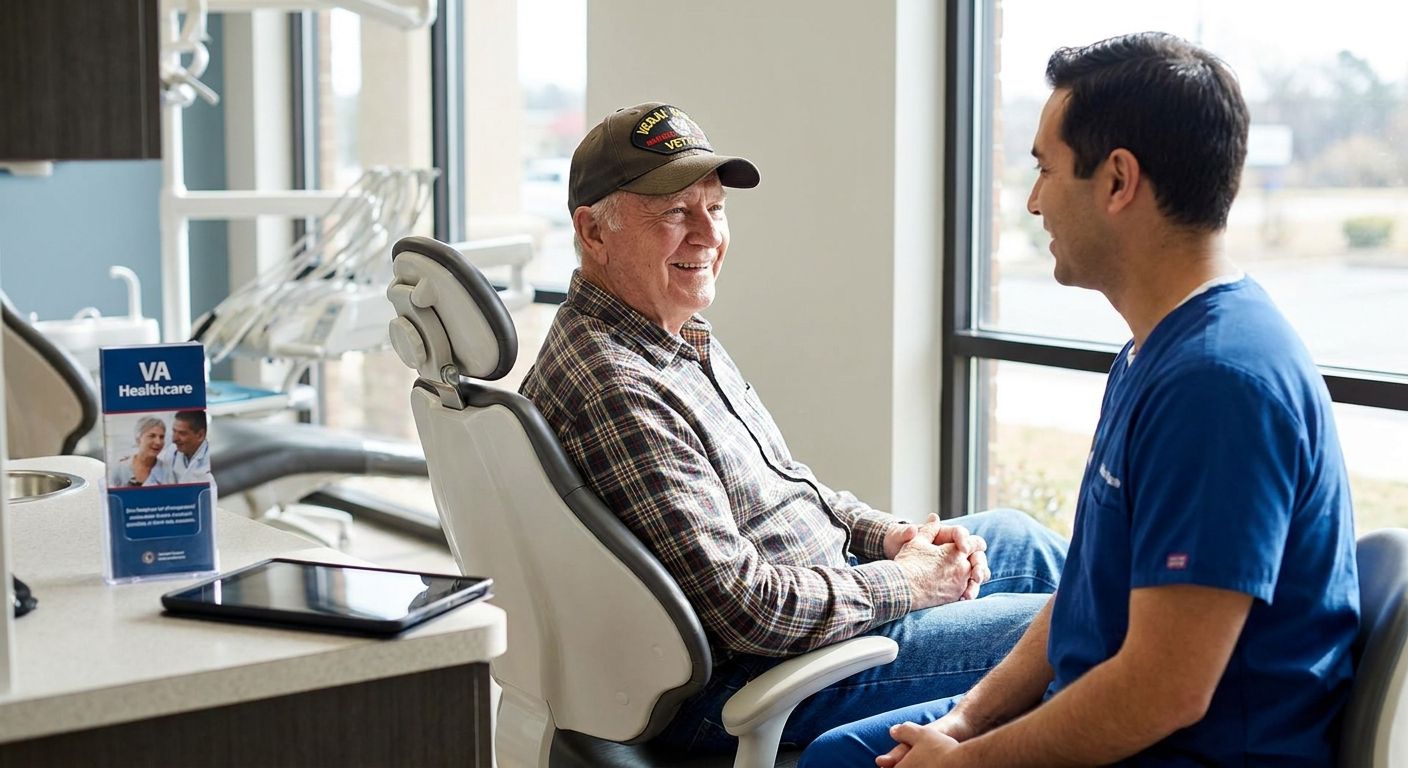
Veterans with a VA disability rating under 100% often assume the VA covers their teeth the way it covers a service-connected knee. It doesn't, and the gap between what VA dental benefits pay and what full treatment costs catches most veterans by surprise. This guide walks through who actually qualifies for VA dental care in 2026, what to look for in a civilian dentist who understands that gap, and where a Palm Beach County veteran fits into a realistic treatment plan.
- Only Class I veterans (100% service-connected disability) get full VA dental care; most others need a civilian dentist for dental care for veterans va benefits gaps.
- VADIP enrollment through Delta Dental or MetLife helps some veterans, but premiums and waiting periods still apply in 2026.
- Financing without insurance is the buy for veterans facing implants or crowns the VA won’t cover this year.
- Sedation dentistry matters more for veterans than for the average patient given documented rates of dental anxiety tied to PTSD.
Why this matters
VA dental eligibility runs on six categories, labeled Class I through Class VI, and most veterans land in a class that covers only emergency or service-connected dental work. A veteran with a 100% service-connected disability rating qualifies for full VA dental care under Class I. Everyone else is piecing together VA benefits, VADIP premiums, and out-of-pocket costs for the rest.
Before you book anything in 2026, check whether a specific procedure is actually covered rather than assuming VA or VADIP will pick up the bill. That single step prevents the most common surprise veterans run into: a treatment plan built around coverage that doesn't apply to their eligibility class.
Who this is for
This guide is built for veterans in Palm Beach County who don't qualify for full VA dental care, veterans enrolled in VADIP who still face gaps for major work like implants or crowns, and family members of veterans who need a family dentist that treats the whole household under one roof, not just the service member.
What to look for in dental care for veterans using VA benefits
A dentist who checks eligibility before recommending treatment
A practice that verifies your VA dental eligibility class and any VADIP coverage before building a treatment plan saves you from paying for a consult that assumes coverage you don't have. This matters more for veterans than for most patients because eligibility rules changed multiple times over the past decade and vary by service era.
Financing that doesn't require you to qualify twice
VA benefits rarely cover implants, crowns, or cosmetic work, so financing becomes the deciding factor for whether treatment happens at all in 2026. Look for a practice offering in-house payment plans, not just a third-party credit application that adds another approval step to an already slow process.
Sedation options built for anxiety, not just discomfort
Dental anxiety linked to PTSD shows up differently than routine nervousness, and a practice that only offers nitrous oxide may not be enough for veterans who avoid care entirely because of it. Ask what sedation levels are available before you schedule, not after you've already canceled twice.
Same-day or fast-turnaround scheduling
Veterans juggling VA appointments, work, and travel for benefits reviews need a dentist who can see them without a three-week wait. A same-day or next-day slot for urgent issues keeps a cracked tooth from turning into an extraction.
A practice that treats the whole family, not just the veteran
Many veterans are also parents managing kids' checkups, a spouse's cleanings, and their own care under one household budget. A family dentist who handles pediatric, general, and cosmetic work in one location cuts down on the number of practices your household has to track.
Top picks for veterans navigating the VA benefits gap
The gap-filler: Financing for implants and major work
VA benefits almost never cover implants outright, and out-of-pocket implant costs run into thousands of dollars per tooth. A financing plan that spreads that cost into monthly payments is the difference between a veteran replacing a missing tooth in 2026 and putting it off indefinitely. Review how to finance dental implants without insurance before your consultation so you walk in already knowing your options. Buy if you have a missing tooth and no implant coverage through VA or VADIP.
The steady option: A membership plan for uninsured coverage gaps
Veterans who don't qualify for VA dental care and skipped VADIP enrollment are effectively uninsured for dental purposes. A membership plan built for uninsured families covers routine cleanings, exams, and a discount on bigger work without the monthly premium structure of traditional insurance. Compare the dental membership plan for uninsured families against what VADIP would cost you annually. Consider if your VA eligibility class excludes routine care.
The anxiety-first option: Sedation dentistry for anxious patients
Dental avoidance tied to anxiety or PTSD is common enough among veterans that a practice offering only nitrous oxide falls short. Sedation dentistry for anxious patients covers a wider range of options, from mild oral sedation to deeper levels, matched to what a veteran actually needs to sit through a procedure. Look at sedation dentistry for anxious patients before scheduling anything that requires more than a routine cleaning. Buy if anxiety has kept you from a checkup in the last two years.
What to avoid
- A practice that quotes a flat price before checking your VA eligibility class. Class I through Class VI coverage varies enough that a real quote requires knowing which category you fall into first.
- Skipping VADIP enrollment windows and assuming you can join anytime. VADIP has defined enrollment periods, and missing one means waiting for the next cycle while dental problems don't wait with you.
- Choosing sedation based on price alone. The cheapest sedation option isn't always the one that gets an anxious veteran through a procedure without a second cancellation.
Verdict comparison
| Option | Best For | Verdict |
|---|---|---|
| Financing for implants | Missing tooth, no VA implant coverage | Buy |
| Membership plan | No insurance, needs routine care | Consider |
| Sedation dentistry | Anxiety or PTSD-related avoidance | Buy |
| VADIP enrollment alone (no civilian dentist) | Veterans who never need major work | Skip |
Book your first visit in 2026
Get your VA eligibility and coverage checked before treatment starts.
FAQ
Does VA dental care cover implants in 2026?
VA dental care covers implants only for veterans in Class I, meaning 100% service-connected disability, or veterans with a service-connected dental condition tied to the missing tooth. Most other veterans pay out of pocket or use financing for implants.
What is VADIP and who qualifies?
VADIP is the VA Dental Insurance Program, administered through Delta Dental and MetLife, open to enrolled veterans and some CHAMPVA beneficiaries. It works like a standard dental insurance plan with monthly premiums, not free coverage.
Is dental care for veterans using VA benefits free?
Only Class I veterans with a 100% service-connected disability rating get full VA dental care at no cost. Every other eligibility class pays some portion out of pocket or through VADIP premiums.
How much does a dental implant cost without VA coverage?
Implant costs vary by case complexity and whether bone grafting is needed, which is why a cost estimate before treatment matters more for veterans without coverage. Financing plans spread that cost into manageable monthly payments.
Can veterans use VA benefits and a family dentist at the same time?
Yes, a civilian family dentist can treat a veteran alongside their spouse and kids while VA benefits cover only what falls under the veteran’s eligibility class. This is common in 2026 for veterans below Class I.
What eligibility class covers routine cleanings for veterans?
Routine cleanings are typically not covered outside Class I unless a veteran enrolls in VADIP. Veterans in Class II through Class VI generally need private coverage or a membership plan for routine care.
Does dental anxiety from PTSD qualify for sedation dentistry?
Sedation dentistry is available to any patient who needs it, including veterans whose anxiety is tied to PTSD, regardless of VA dental eligibility class. The sedation level is matched to the patient, not the benefits category.
How often should veterans get a dental checkup?
Dentists generally recommend a checkup and cleaning every six months, and that schedule doesn’t change based on VA eligibility. Skipping checkups because of coverage gaps is what turns small problems into extractions.
One last thing
The eligibility class system trips up more veterans than the actual cost of care does. A veteran who spends fifteen minutes confirming their Class I through Class VI status before booking saves themselves a treatment plan built on assumptions that don't hold up at checkout in 2026.
Related guides