
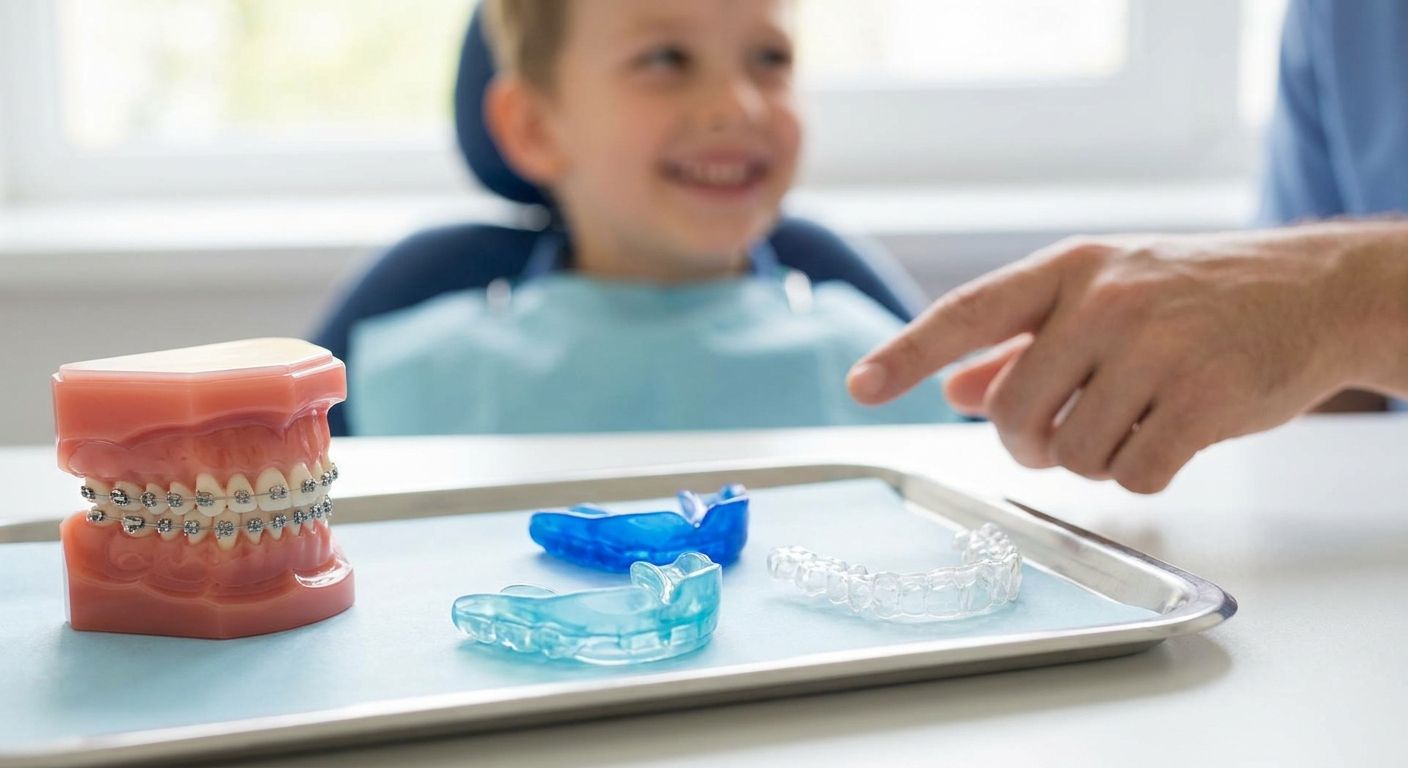
Kids in braces need a mouthguard with extra clearance over the brackets, and the safest choice is a custom-fitted or orthodontic boil-and-bite guard, never a stock mouthguard pulled off a shelf. A guard that molds tight against brackets can lock onto the hardware on impact, tearing the cheek or ripping a bracket loose instead of just cushioning the blow.
- The safest mouthguard for kids with braces is a custom-fitted or orthodontic boil-and-bite guard with extra clearance over brackets.
- Stock mouthguards and tight boil-and-bite guards can lock onto brackets and tear the cheek on impact.
- Refit or replace the guard every 3-4 months as teeth shift during active orthodontic treatment.
- Invisalign wearers still need a separate mouthguard for contact sports, not the clear aligner tray.
Why this matters
A mouthguard is the cheapest injury-prevention tool a kid in braces will ever wear, and it's also the one parents get wrong most often. Buy the wrong type and it either doesn't protect the brackets at all, or worse, it becomes a hazard during a hit because it's molded too tight against the hardware.
Orthodontic patients face a different injury profile than kids without braces. A blow to the mouth can drive the lip or cheek directly into an exposed bracket, causing lacerations that a standard mouthguard doesn't prevent. The guard has to sit over both the teeth and the bracket, with room to spare, not shrink-wrapped to the arch the way a regular boil-and-bite works.
Parents in Palm Beach County juggling fall football, spring lacrosse, and monthly orthodontic adjustments in 2026 end up refitting guards mid-season. Planning for that from day one saves an emergency visit later.
What's the best mouthguard for kids with braces?
The best option depends on how much contact the sport involves and whether a dentist has custom-fitted the guard. Here's how the main types compare:
| Type | Fits over brackets? | Comfort | Best for |
|---|---|---|---|
| Stock (one-size) | No | Poor, loose | Skip entirely for kids in braces |
| Standard boil-and-bite | Risky if molded too tight | Moderate | Low-contact sports only, with careful fitting |
| Orthodontic boil-and-bite | Yes, built-in clearance | Good | Football, hockey, lacrosse, wrestling |
| Custom-fitted (dentist-made) | Yes, exact clearance | Best | High-contact sports and kids who gag on bulky guards |
Stock guards get a Skip because they don't account for bracket height at all. Standard boil-and-bite guards get a Wait unless a parent or dentist checks the fit carefully after molding, since overheating or over-pressing the material against the teeth can seal it onto the brackets. Orthodontic boil-and-bite and custom-fitted guards both get a Buy for a kid actively wearing braces in 2026.
Orthodontic boil-and-bite guards: the practical middle ground
Orthodontic-specific boil-and-bite guards are built with a thicker inner layer and a wider channel than standard versions, so they seat over the brackets without pressing against them. Buy this type for most kids in contact sports who wear traditional metal braces.
They're widely available at sporting goods stores and easy to remold at home when a bracket configuration changes. The tradeoff is bulk. Some kids find them harder to talk or breathe through during a game than a slimmer custom guard, and a bulky guard a kid keeps spitting out protects nothing.
Custom-fitted mouthguards: best protection, best fit
A custom-fitted guard is made from an impression or digital scan of the child's actual mouth, with bracket clearance built in precisely rather than approximated. Buy this for kids in high-contact sports like football, hockey, wrestling, or lacrosse, and for any kid who can't tolerate the bulk of a boil-and-bite guard.
Because it's built to the exact arch, it stays put during play and doesn't loosen the way a home-molded guard can after a few weeks of practice. A dentist can also rebuild the fit as teeth move, which matters over a treatment span that often runs 18 months or longer. Dental Arts of Atlantis fits mouthguards for young athletes in braces during routine family visits, adjusting clearance as treatment progresses.
Standard boil-and-bite guards: only with careful fitting
A regular boil-and-bite guard, the kind sold for general sports use, isn't designed with orthodontic clearance in mind. It can work for low-contact activities like basketball or soccer if a parent confirms the material didn't press flush against the brackets during molding.
Wait on this option when any real contact is involved. A guard seated tightly against brackets is a liability rather than protection, and an orthodontic version costs little more while removing the guesswork.
Why the right fit varies from kid to kid
- Bracket height and bulk — some systems sit higher off the tooth than others, changing how much internal clearance the guard needs
- Stage of treatment — teeth shift after every adjustment, which changes how a guard seats over time
- Sport contact level — wrestling and football need more coverage and thickness than track or golf
- Gag reflex and mouth size — kids who can't tolerate bulk do better with a slimmer custom guard
- Growth spurts — a guard fitted in August may not fit the same mouth in November
- Retainer or aligner use — kids finishing treatment need a guard that clears retainer clasps, not just brackets
Get a mouthguard fitted for braces
Clearance adjusted as your child’s teeth move through orthodontic treatment.
How often should a mouthguard be replaced during orthodontic treatment?
A mouthguard for a kid in braces should be checked or refit every 3 to 4 months during active treatment, because tooth movement changes the fit faster than most parents expect. A guard that fit well at the start of a season can feel loose or press unevenly against the gums by the end of it. Cracking, thinning, or a guard that no longer snaps into place without effort all mean it's time for a new one, calendar aside.
Can kids wear a regular mouthguard with braces?
A regular stock or standard boil-and-bite mouthguard is not recommended for kids with braces because neither is built with clearance over the brackets. Molded too tightly, the guard can grip the hardware during impact and cut the cheek or lip, or pull a bracket off the tooth. An orthodontic-specific or custom-fitted guard removes that risk.
Does a kid in Invisalign need a mouthguard too?
Yes, a kid wearing Invisalign still needs a separate mouthguard for contact sports, since the clear aligner tray isn't built to absorb impact. Parents managing a teen through Invisalign treatment should budget wear time for the mouthguard on top of the aligner schedule, not instead of it.
FAQ
What’s the best mouthguard for a kid with braces?
An orthodontic boil-and-bite or custom-fitted mouthguard is best for a kid with braces because both are built with extra clearance over the brackets. A stock or standard boil-and-bite guard risks gripping the hardware during impact.
Is a custom mouthguard better than boil-and-bite for braces?
A custom mouthguard fits better and holds up longer than boil-and-bite for a kid in braces because it’s made from an exact impression rather than pressed into shape at home. An orthodontic boil-and-bite guard is still a reasonable lower-cost option for moderate-contact sports.
Can a mouthguard damage braces?
A mouthguard can damage braces if it’s molded too tightly against the brackets, pulling one loose on removal or during impact. Guards made specifically for orthodontic patients avoid this by leaving room around the hardware.
How often should a mouthguard be replaced for a kid in braces?
Check or refit the mouthguard every 3 to 4 months while a child is in active orthodontic treatment, since teeth move faster than the fit can keep up with. Cracking, thinning, or a loose seat mean it needs replacing sooner.
Do kids in Invisalign need a mouthguard?
Yes, kids in Invisalign need a separate mouthguard for contact sports because the clear aligner tray doesn’t absorb impact the way a sports guard does. Wear the mouthguard for practice and games, then return to the aligner schedule afterward.
What sports require a mouthguard for kids with braces?
Football, hockey, wrestling, lacrosse, and basketball all carry enough contact risk that a kid with braces should wear a mouthguard. Lower-contact sports like track or golf carry less risk, but a guard is still a sensible precaution.
Does teeth grinding at night change what mouthguard a child needs?
Nighttime teeth grinding is a separate issue from sports protection and calls for a different appliance entirely. If a child grinds regularly, raise it at the next dental visit rather than reusing the sports guard overnight.
How much clearance should a braces mouthguard have?
The guard should sit over the brackets without touching them, so the child can seat and remove it without any tugging on the hardware. If removal snags or feels sticky, the fit is too tight and needs to be redone.
One last thing
The detail most parents miss isn't the guard type, it's the refit schedule. A mouthguard bought at the start of football season in August can sit loose, uneven, or pressed against a shifted bracket by playoffs in November, because active orthodontic treatment moves teeth on a faster timeline than a sports season runs. Put a refit check on the calendar next to the orthodontic adjustment visits in 2026, not as an afterthought when something already hurts.
Related guides
- Teeth grinding in children: when it's a problem
- Family dental plans for households with kids in braces
- Custom mouthguards for adult contact sports