
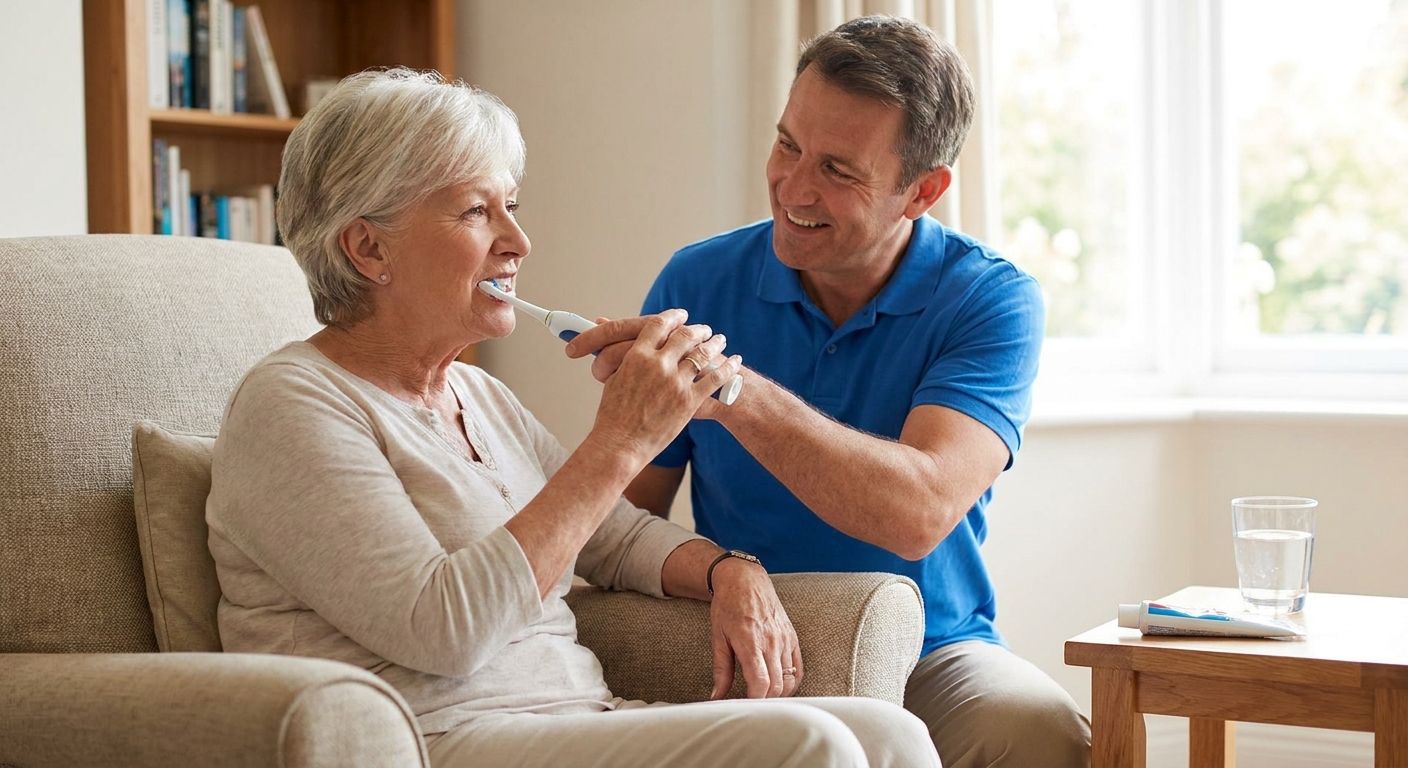
Dental care after stroke means adjusting cleanings, home hygiene, and sedation choices for swallowing changes, one-sided weakness, blood thinners, and the fatigue that comes with rehabilitation. Stroke survivors don't need a different dentist — they need a dental team that asks different questions before touching a toothbrush or a drill.
- Dental care after stroke starts with a swallowing and grip evaluation before any cleaning or filling begins.
- Blood thinners such as warfarin or Eliquis change how a dentist times extractions and deep cleanings.
- Electric toothbrushes with wide grips and water flossers solve the one-handed brushing problem better than a manual brush.
- Appointment timing around therapy and fatigue matters as much as the treatment itself during stroke recovery.
Why dental care matters for stroke recovery patients
Nearly 800,000 people in the United States have a stroke each year, according to the CDC, and many leave the hospital with new medications, one-sided weakness, or swallowing changes that make ordinary brushing and flossing harder overnight. A routine cleaning that took ten minutes in 2025 can now take twice as long, and a filling that used to be simple now carries bleeding-risk questions if the patient started an anticoagulant.
Untreated dental problems don't sit quietly during recovery. Gum disease and dental infections raise inflammation levels at exactly the point when a stroke patient's body is trying to heal, and an emergency extraction is a much worse outcome in 2026 than a scheduled filling would have been in the weeks after discharge. Dental Arts of Atlantis builds stroke-recovery visits around the patient's current physical and cognitive status, not a generic six-month recall schedule.
Update your dental history before the first post-stroke visit
A dentist can't plan around a stroke they don't know about. Bring specifics, not just "I had a stroke."
- Date of the stroke and which side of the body was affected
- Full current medication list, including dosage and prescribing physician
- Any swallowing evaluation results from speech therapy
- Cardiac history, including atrial fibrillation or artificial heart valves
- Contact information for the neurologist or primary care physician
Screen for swallowing and oral motor changes first
Dysphagia — difficulty swallowing — shows up in a large share of stroke patients in the first weeks after onset, and it directly affects how a dental team positions the chair, manages water spray, and times suction. Skipping this step is the single most common reason stroke patients report a bad dental experience during recovery.
- Ask about coughing or choking during meals since the stroke
- Note facial droop and which side has reduced sensation
- Check lip seal strength before recommending rinse-and-spit steps
- Flag any speech therapy dysphagia diet level to the hygienist
- Request a reclined-but-not-flat chair position if swallowing is affected
Review every medication for dry mouth and bleeding risk
Most stroke survivors leave the hospital on at least one new drug, and several common categories directly affect the mouth. Dry mouth from blood pressure medication increases cavity risk fast, and blood thinners change how a dentist approaches anything that draws blood.
- Anticoagulants (warfarin, apixaban, rivaroxaban) change extraction and deep-cleaning planning
- Antiplatelet drugs like clopidogrel carry similar bleeding considerations
- Statins and blood pressure medications are common dry-mouth culprits
- Ask whether an INR check is needed before invasive work if on warfarin
- Report any new mouth sores, which can signal a medication reaction
Medication-related dry mouth doesn't resolve on its own, and it accelerates decay faster than most patients expect. The dry mouth from medication guide covers rinses and saliva substitutes that work alongside a stroke recovery medication list, and the blood thinner dental care guide walks through what changes when warfarin or a newer anticoagulant is part of the picture.
Adjust the home hygiene routine for one-sided weakness
A standard manual toothbrush assumes two working hands and full grip strength. Neither is guaranteed after a stroke, and pretending otherwise is how plaque builds up unnoticed on the weak side.
- Switch to an electric toothbrush with a wide, built-up handle
- Try a water flosser instead of string floss for one-handed use
- Use a non-slip grip attachment or built-up foam sleeve on existing tools
- Set the toothbrush at counter height with a mirror at eye level
- Ask a caregiver to demonstrate a two-hand bracing technique if needed
- Schedule a hygienist walkthrough of the new routine at the next visit
Time appointments around therapy and fatigue
Fatigue after a stroke is real and it's cumulative — a patient who does well at 9am after a full night's sleep may struggle by 2pm after a physical therapy session. Dental visits scheduled without this in mind get cancelled or cut short.
- Book morning appointments before energy dips set in
- Split longer treatment plans into shorter visits across multiple days
- Coordinate transportation in advance rather than day-of
- Bring a caregiver familiar with the patient's communication style
- Avoid stacking a dental visit on the same day as PT or OT
Plan for antibiotic premedication when heart risk exists
Stroke and cardiac history often travel together, and some heart conditions — artificial valves, certain congenital defects, a history of endocarditis — require antibiotics before certain dental procedures. This isn't automatic for every stroke patient, but it needs to be settled before treatment, not discovered mid-appointment.
- Confirm cardiac history and any artificial valves with the physician
- Note an atrial fibrillation diagnosis even without a valve issue
- Get the premedication protocol in writing from the cardiologist
- Coordinate the antibiotic timing with the primary care doctor
- Bring documentation to the dental visit rather than relying on memory
The antibiotic premedication guide breaks down which conditions typically require this step and how far in advance to start.
Choose a sedation level that matches cognitive and physical status
Sedation decisions after a stroke aren't just about anxiety — they're about airway control and aspiration risk if swallowing is still affected. A sedation plan that works for a healthy adult can be the wrong choice for someone six weeks into stroke recovery.
- Nitrous oxide works for mild anxiety and wears off within minutes
- Oral sedation suits longer procedures but requires a driver and clear swallowing
- IV sedation needs medical clearance from the treating physician first
- Any sedation that suppresses the gag reflex needs extra airway monitoring
- Discuss aspiration risk directly with the sedation provider beforehand
Comparison: home care options for stroke recovery patients
| Option | Best for | Key limitation |
|---|---|---|
| Manual toothbrush with built-up grip | mild one-sided weakness | still requires a two-hand rinse-and-spit technique |
| Electric toothbrush, wide handle | moderate hand weakness | needs charging and isn't ideal with severe tremor |
| Water flosser | patients who can't manage string floss | can trigger the gag reflex if swallowing is still impaired |
| Caregiver-assisted brushing | significant motor loss | depends on caregiver availability and training |
| In-office fluoride varnish | medication-related dry mouth | doesn't replace daily brushing; needs periodic reapplication |
Verdict: an electric toothbrush with a wide handle plus a water flosser covers most stroke-related grip and dexterity changes without needing a caregiver present every time. Patients with significant swallowing impairment should confirm the water flosser choice with a speech therapist first — Skip it until cleared, use caregiver-assisted brushing in the meantime.
Ask about a stroke recovery dental plan
Coordinated timing for swallowing changes, blood thinners, and rehab schedules.
Common mistakes stroke recovery patients make
- Skipping dental visits during rehab because it feels like one more appointment to manage — untreated decay and gum disease raise infection risk at the exact time the body is trying to recover.
- Sticking with string floss after grip strength hasn't returned, which leads to bleeding gums and the patient abandoning flossing altogether instead of switching tools.
- Leaving blood thinners off the intake form because the patient assumes the dentist already knows — this changes how extractions and deep cleanings get planned.
- Assuming a caregiver's brushing technique is good enough without a hygienist checking it — plaque builds up unnoticed on the weak side within weeks.
- Delaying a small cavity because it doesn't hurt yet — a manageable filling in 2026 turns into an emergency extraction later, which is a far worse outcome for a medically fragile patient.
FAQ
What is the best dental care approach after a stroke?
The best approach starts with a swallowing and grip evaluation, a full medication review, and appointment timing that accounts for fatigue. Skipping straight to routine cleaning without these steps is the most common source of complications.
Can stroke patients get dental cleanings while on blood thinners?
Yes, most stroke patients on blood thinners can still get routine cleanings, but extractions and deep cleanings need coordination with the prescribing physician first. The dentist needs the exact medication and dosage before planning anything invasive.
How soon after a stroke can you see a dentist?
Routine dental checkups can often resume once the patient is medically stable, but the exact timing depends on the physician’s clearance and any swallowing or cardiac concerns. Elective procedures typically wait until the medical team signs off.
Does a stroke affect the ability to brush teeth?
One-sided weakness and reduced hand grip are common after a stroke and make standard manual toothbrushes harder to use. An electric toothbrush with a wide handle or a water flosser usually solves the problem.
Is sedation dentistry safe for stroke survivors?
Mild sedation like nitrous oxide is generally well tolerated, but any sedation that affects the airway needs medical clearance first if swallowing was impacted by the stroke. The sedation plan should match the patient’s current physical status, not a standard protocol.
Why do stroke patients get dry mouth?
Many post-stroke medications, including blood pressure drugs and some antidepressants, reduce saliva production as a side effect. Dry mouth accelerates cavity risk quickly, so it needs a rinse or saliva substitute plan, not just more water.
Does dental care need to change permanently after a stroke?
Not always — many patients regain enough function that their routine returns to normal within months. Others with lasting weakness or swallowing changes need permanent adjustments like an electric toothbrush and caregiver-assisted checkups.
One last thing
Gum disease and stroke risk run in both directions — inflamed gums contribute to the same vascular inflammation linked to stroke, which means the dental visit a stroke survivor skips in 2026 isn't just a missed cleaning, it's a missed chance to lower risk for a second event. The single highest-leverage move for most stroke recovery patients isn't a new toothbrush — it's disclosing the full medication list at every visit, because that one piece of paper changes how the entire appointment gets planned.
Related guides
- Sedation options for anxious dental patients
- Preparing for a dental visit that needs antibiotic premedication