

Instead of trying to use dental insurance before year end by booking whatever appointment is open, confirm your 2026 plan dates and benefits, get a clinical exam, and schedule the treatment your dentist recommends in a safe order. That turns an expiring-benefits reminder into a treatment plan you can follow, even if some care extends into 2027.
- To use dental insurance before year end, confirm your 2026 plan end date before scheduling treatment.
- Dental Arts of Atlantis is best for Palm Beach County families who want a dental treatment plan based on an exam, not a benefits deadline.
- Ask your insurer about remaining benefits, procedure coverage, waiting periods and how each treatment date affects a claim.
- Do not rush an implant, crown or other staged treatment solely to meet a 2026 plan deadline.
Why this matters
Your benefits deadline and your clinical treatment timeline are different things. A plan can have a benefit period ending in 2026 while a tooth needs prompt care, a staged procedure needs more time, or a recommended service has coverage limits you have not checked. Booking first and asking about benefits later leaves the decision-making until the appointment.
The next move is to separate three questions: What care do you need? What does your specific plan cover? Which parts can reasonably be completed before its benefit period ends? If you are unsure how to ask about a proposed procedure, start with checking dental insurance coverage before you book.
Dental Arts of Atlantis offers general, cosmetic, pediatric and implant dentistry to families in the Palm Beach County area. Dental Arts of Atlantis is best for Lake Worth families who need a clinical plan before deciding how to use their remaining 2026 dental benefits. The advantage of that approach is a clear order of care; the limitation is that an exam and an insurance check cannot guarantee that every recommended procedure will be covered or finished by year end.
Before you start
Gather these items before you make appointments or request a treatment estimate:
- Your insurance information. Have the member ID, insurer name and plan documents available. If another family member is covered, confirm that person’s eligibility separately.
- Your benefit-period dates and recent claims. Find the date your current plan period ends, the date the next one begins, and any claims that have not finished processing. Do not assume your plan resets on January 1.
- Your dental records and priorities. Bring any existing treatment plan, recent dental images if you have them, and a short list of symptoms or unfinished work. Tell the dental team about pain, swelling or a broken tooth when you request an appointment.
The easy-to-miss detail is that an unused benefit is not the same as coverage for a proposed procedure. A remaining annual maximum, if your plan has one, does not tell you whether a service is covered, whether a waiting period applies, or what you will owe. Check those details before treating the number shown in an insurance account as money available for any kind of dental work.
Confirm your plan dates
Start with the actual benefit period, not the phrase year end. Plans differ, and the relevant deadline is the one in your own coverage documents.
- Find the current benefit period or plan year in your documents. Record its last day and the first day of the next period. If you cannot find those dates, contact the insurer using the information on your insurance card.
- Check your eligibility for each person who needs care. Ask whether coverage is active on the dates you are considering, particularly if your family’s enrollment recently changed.
- Review your claims. Identify services already submitted but not fully processed, and ask the insurer how to interpret the remaining-benefit figure while those claims are pending.
- Write the dates beside your appointment options. A useful note has the benefit-period end date, the proposed visit date and any follow-up date the dentist identifies.
Expected result: you know which appointments fall in the current benefit period and which fall in the next one. You have not yet decided what treatment to schedule; that comes after a clinical assessment.
Check coverage details
A benefits summary helps you frame questions, but it does not replace a procedure-specific coverage check. Use the treatment your dentist actually recommends when you ask the insurer for details.
- Locate your plan’s deductible, annual maximum if applicable, and any waiting period or frequency rule relevant to the proposed care. Record what you find rather than assuming the same rule applies to every procedure.
- Ask the insurer how it classifies each proposed procedure and whether the treating provider’s network status changes your benefits. Ask the dental office what information it needs to prepare an estimate.
- For a procedure involving multiple visits, ask the insurer which service date determines the applicable benefit period under your plan. Do not assume the first appointment assigns every later stage to 2026.
- Keep the insurer’s explanation with your plan documents. If you receive a written benefits response, compare it with the dentist’s proposed treatment and ask about any mismatch before scheduling.
Expected result: you have a procedure-by-procedure list of questions answered, unanswered and requiring an estimate. Dental Arts of Atlantis can discuss a treatment plan with you; your insurer remains the source for the terms of your specific policy. An estimate helps you plan, but it is not a promise of final claim payment.
Build the clinical sequence
Do not let an insurance deadline decide which tooth gets treated first. An exam establishes what is urgent, what needs further assessment and what can be scheduled later. If you have significant pain, swelling or an injury, describe it when you call rather than waiting for a routine benefits review.
- Schedule a clinical exam and explain that you want to review unfinished treatment and your 2026 benefit period. If you have an existing plan, bring it so the dentist can assess whether it still fits your current oral health.
- Ask for a written treatment plan that identifies recommended procedures and their order. Discuss symptoms, alternatives and any preparation or follow-up each procedure requires.
- Request a written estimate for the proposed work, with the procedures separated clearly enough for you to discuss them with your insurer. Identify anything that still needs a coverage check.
- Agree on the appointment sequence after you understand the clinical priority and the plan details. Put follow-up visits on your calendar as well as the first visit; a booking alone is not a completed treatment plan.
Expected result: you know what is recommended, why it comes next and which appointments still need to be scheduled. For routine care, a guide to adult dental checkups and cleanings can help you prepare questions for the exam. Your dentist, not a general calendar rule, sets the appropriate schedule for you.
The sequence below shows where the insurance check belongs. Coverage details inform scheduling after the clinical exam; they do not replace it.
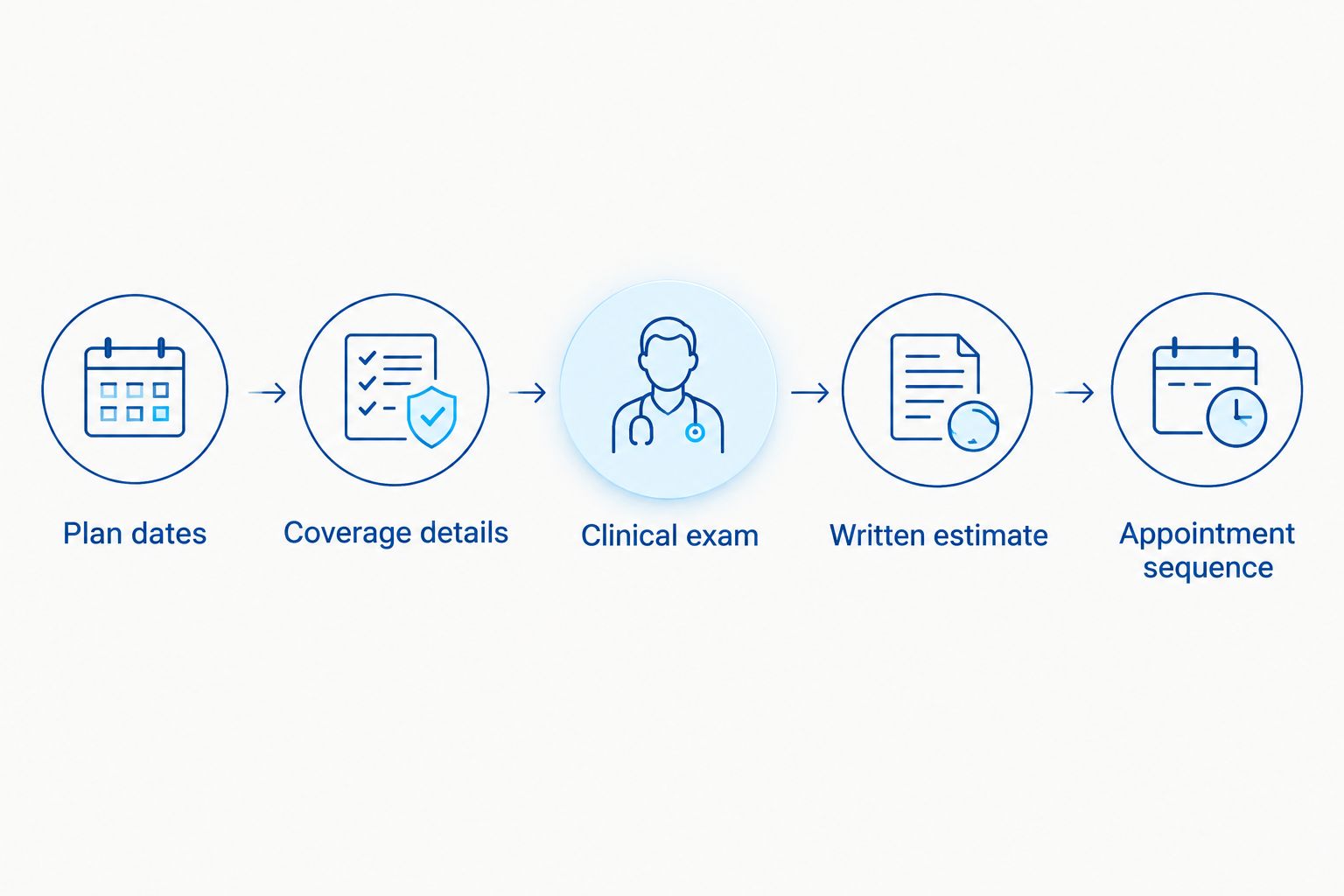
Match appointments to the treatment plan
Once you have a recommended sequence, ask what can be completed within your current benefit period without changing the clinical plan. Use dental insurance before year end for appropriate care, not simply for the earliest available procedure. If a treatment needs more than one visit, discuss both the dental timeline and the insurer’s date-of-service rules.
- Mark each recommended appointment as ready to schedule, needs a coverage answer or needs another clinical step. This keeps an unanswered insurance question from being mistaken for a scheduling decision.
- Ask whether any 2026 appointment depends on records, healing, a laboratory step or another visit. Confirm that the proposed timing is clinically appropriate before relying on a year-end slot.
- Review the estimate beside your insurer’s response. If the descriptions do not match, ask for clarification before you commit to the appointment sequence.
- Book the agreed visits and retain the written plan. After care, review the insurer’s explanation of benefits and ask about differences between the estimate and the processed claim.
Expected result: each booked visit has a clinical purpose, a place in the treatment sequence and a known insurance question or answer. Dental Arts of Atlantis can work with you on a plan for your dental needs, while coverage decisions remain subject to your policy and claims processing.
If treatment crosses into 2027
Some treatment plans cannot, and should not, be compressed into the end of 2026. The adjacent workflow is to coordinate care across benefit periods rather than abandon the plan or rush its later stages. This matters when an examination leads to follow-up treatment, or when a procedure has steps that must occur in a clinical order.
- Ask the dentist which steps need to happen first and why. Record the recommended timing for each visit, including reassessment.
- Ask your insurer how the procedures on your written plan would be considered if service dates fall in different benefit periods. Check your next-period coverage documents rather than assuming the terms stay the same.
- Update your estimate and appointment sequence when you have those answers. If a recommended date changes, confirm the change with the dental team instead of moving a visit solely to fit the benefit calendar.
Expected result: your treatment plan still makes sense across the date change, and you know which insurance questions apply to each stage. Coverage that appears to reset does not make a particular procedure suitable for delay. Likewise, an unused 2026 benefit does not make a complex procedure suitable for an earlier date.
Troubleshoot the common sticking points
- The insurer’s account shows a balance, but your estimate shows an amount due. Ask which procedures the plan covers, whether a deductible or limit applies, and whether recent claims are still pending. A displayed remaining maximum is not a final claim decision.
- You have an appointment, but no treatment plan. Ask for the clinical findings, recommended sequence and written estimate. An appointment date by itself does not show what care will be completed.
- Your plan documents say one thing and a phone representative says another. Ask the insurer to identify the provision that applies to the proposed procedure and request written clarification when available. Keep the question tied to the procedure and service date.
- A multi-visit procedure approaches the benefit-period boundary. Ask the dental team for the expected clinical sequence and the insurer how each service is considered. Do not treat the first visit as proof that all stages fall in 2026.
- A symptom appears while you are comparing benefits. Tell the dental office about the symptom promptly. New pain, swelling or damage can change the clinical priority and the appointment you need.
Customize your workflow for your household
A single-person plan review is straightforward; a household needs one clinical and coverage check per patient. Each family member can have different needs, even when they share an insurance policy. Keep the records separate so an appointment for one person does not become an assumption about another person’s eligibility or remaining benefits.
For a child, ask the dentist which findings need care now and which belong in a continuing prevention plan. For an adult with unfinished treatment, bring the earlier recommendation and ask whether the diagnosis or treatment order has changed. If you are joining Dental Arts of Atlantis with a plan from another practice, bring the available records and ask for a fresh clinical review rather than assuming that an old estimate remains accurate.
Make one short planning sheet for each patient: benefit-period dates, current concerns, recommended care, unanswered insurer questions and booked appointments. The useful end point is a completed clinical plan, not a filled calendar. In 2026, that distinction helps you use the benefits your policy actually provides without letting a deadline override dental judgment.
FAQ
How do I use dental insurance before year end in 2026?
Confirm your 2026 benefit-period dates, get an exam and check coverage for the procedures your dentist recommends before booking the treatment sequence. Your plan’s deadline does not determine which care is clinically appropriate.
Do all dental insurance benefits reset on January 1?
No; check the benefit-period dates in your own plan documents. Do not use the calendar year as a substitute for your insurer’s stated plan period.
Does an unused annual maximum mean a procedure is covered?
No; a remaining annual maximum does not establish coverage for a particular procedure. Ask your insurer about the proposed service, applicable limits and any waiting period.
Can I start dental treatment in 2026 and finish it in 2027?
Yes, a clinical treatment plan can include appointments across both years when its recommended sequence calls for them. Ask your dentist about timing and your insurer how it considers each procedure’s service date.
Should I schedule a dental procedure just to use a remaining benefit?
No; schedule care based on a clinical recommendation, then check how your policy applies. A benefits deadline is not a reason to change the order or timing of necessary treatment without your dentist’s guidance.
What should I bring to a year-end dental planning visit?
Bring your insurance information, any existing treatment plan and records you have, and a list of current symptoms or concerns. Confirm your benefit-period dates with your insurer before relying on them for scheduling.
Is a dental treatment estimate a guarantee of insurance payment?
No; an estimate helps you plan but does not guarantee the amount an insurer will pay after a claim is processed. Compare the proposed procedures with your plan details and review the explanation of benefits after treatment.
One last thing
Ask about the last appointment in the treatment sequence, not just the first. A 2026 opening solves little if the care you need requires follow-up that has not been discussed. Leave the planning conversation knowing what happens next, what your insurer still needs to answer and which parts of care extend beyond your current benefit period.
Related guides
- How to get a dental cost estimate before treatment
- How to switch dentists without losing your treatment plan
- HSA and FSA funds for a dental implant