

Your tooth extraction cost in 2026 depends on how the tooth must be removed, the anesthesia plan, and your dental insurance benefits; an examination and written estimate establish your actual total. The removal fee alone does not tell you whether examination, imaging, sedation, follow-up, or treatment to replace the tooth is included.
- How much does a tooth extraction cost? Compare the complete treatment estimate, not the removal fee alone.
- Simple extraction and surgical extraction describe different procedures; your examination determines which you need.
- Ask whether anesthesia, imaging, follow-up, and tooth replacement are included or listed separately.
- Dental Arts of Atlantis offers family dentistry in Lake Worth for Palm Beach County households.
How much does a tooth extraction cost in 2026?
The useful number is your total expected responsibility for the planned treatment, not an isolated extraction fee. Ask for a written estimate that identifies the tooth, the removal procedure, the anesthesia plan, and any separately recommended treatment.
Start with this guide to getting a dental cost estimate before treatment. A clear estimate lets you compare the same services rather than two totals that cover different care.
| Part of the treatment plan | What to confirm | Why it matters |
|---|---|---|
| Examination | Whether the assessment is included or separate | The dentist must assess the tooth before recommending removal |
| Imaging | Which images are needed and whether existing images are usable | Root shape, surrounding bone, and nearby structures affect planning |
| Extraction | Whether the estimate describes simple or surgical removal | These involve different techniques |
| Anesthesia | What numbing is included and whether sedation is separate | Pain control and anxiety management are not the same service |
| Additional treatment | Whether grafting or another procedure is recommended | Removing a tooth does not automatically include preparing for replacement |
| Follow-up | What postoperative review is included | You need to know whom to contact if healing concerns develop |
| Replacement | Whether replacement is a separate treatment plan | Extraction and restoring the gap are different procedures |
Keep the estimate with your treatment instructions. If the plan changes after examination or imaging, ask for an updated explanation before consenting to the revised treatment.
Why this matters
When you have tooth pain, it is tempting to focus only on getting the tooth out. You still need to understand whether removal is necessary, what the appointment involves, and what happens afterward.
An extraction is irreversible. Ask whether the tooth can reasonably be restored before comparing removal estimates. A treatment that removes the immediate problem and a treatment that preserves the tooth solve different long-term needs.
You also deserve a clear discussion of comfort. Tell the dentist if you are anxious, have had difficulty getting numb, or have experienced a reaction during previous dental care. That information belongs in the treatment plan, not as an afterthought on procedure day.
Simple extraction: what your estimate should explain
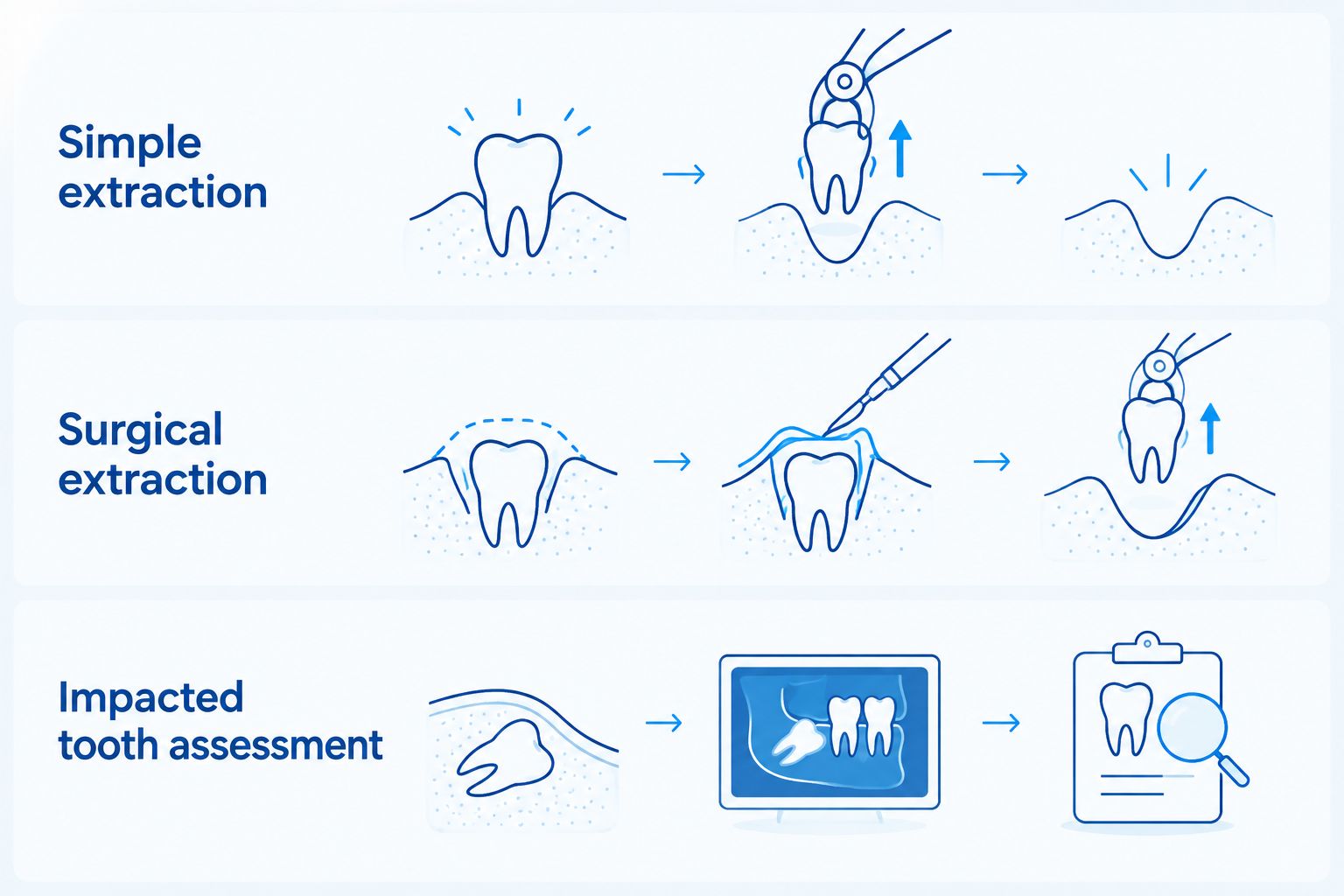
A simple extraction removes a tooth that is accessible in the mouth without the surgical steps needed for some other teeth. The dentist loosens the tooth and removes it with dental instruments after numbing the area.
This is a description of the procedure, not a promise that every visible tooth qualifies. A tooth broken near the gumline or roots that require additional access can change the approach.
Ask which tooth is being treated and whether local anesthesia is included in the estimate. Also ask what happens if the dentist discovers that surgical removal is necessary.
The advantage of simple extraction is that it avoids surgical access when that access is unnecessary. The limitation is permanent loss of the tooth, with a separate decision about whether the resulting gap needs replacement.
Surgical extraction: what changes in the plan
Surgical extraction involves additional access, such as opening gum tissue, removing surrounding bone, or dividing the tooth into sections. The dentist selects the approach from the examination, imaging, and condition of the tooth.
Surgical removal does not automatically mean you need to be asleep. Local anesthesia controls pain at the treatment site; sedation addresses anxiety and awareness according to the method used.
Ask whether the planned treatment includes sutures, whether a specialist referral is appropriate, and what follow-up the dentist recommends. If sedation is discussed, request the preparation and transportation instructions before the appointment.
The advantage is access to teeth that cannot be removed appropriately with a simple technique. The limitation is a more involved procedure with postoperative care requirements tailored to the surgery.
Impacted teeth: position matters more than the tooth's name
An impacted tooth has not emerged fully into its expected position. Wisdom teeth are a familiar example, but other teeth can also be impacted.
The amount of gum or bone covering the tooth, its angle, and its relationship to nearby structures affect the removal plan. The word wisdom alone does not establish how the procedure will be performed.
| Procedure or situation | Best for | Main advantage | Main limitation |
|---|---|---|---|
| Simple extraction | An accessible tooth suitable for nonsurgical removal | Avoids unnecessary surgical access | Not appropriate for every broken or difficult-to-access tooth |
| Surgical extraction | A tooth requiring additional access or sectioning | Allows removal when a simple technique is unsuitable | Involves more surgical steps and individualized aftercare |
| Impacted tooth assessment | A tooth partly or fully covered by gum or bone | Identifies position and nearby structures before treatment | Impaction alone does not establish the exact removal method |
An impacted tooth is a clinical situation, not a separate anesthesia choice. Ask the dentist to explain both the access needed to remove it and the comfort plan for the appointment.
Why tooth extraction estimates vary
A useful 2026 estimate explains the clinical work involved rather than presenting every extraction as the same procedure. Review these factors with your dentist:
- Access to the tooth: A fully accessible tooth and a tooth covered by gum or bone require different planning.
- Tooth condition: Extensive breakage changes how the dentist can grip and remove the tooth.
- Root anatomy: Root shape and position influence the technique and the imaging needed for assessment.
- Anesthesia plan: Local numbing and sedation serve different purposes and should be identified separately.
- Additional procedures: Grafting or other recommended treatment needs its own explanation; it is not automatic for every extraction.
- Insurance benefits: Network status, deductibles, coverage rules, and remaining benefits affect your personal responsibility.
Compare the procedure, inclusions, and exclusions before comparing totals. If one estimate includes sedation and another includes only local anesthesia, they do not describe the same appointment.
Ask about any item you do not recognize. A procedure name without a plain-language explanation is not enough to help you make an informed decision.
What should I ask before agreeing to extraction?
Use this sequence to keep the conversation focused. You do not need dental terminology to get useful answers.
- Confirm the diagnosis. Ask what is wrong with the tooth and what examination or imaging findings support removal.
- Review alternatives. Ask whether restoration, root canal treatment, or another approach can reasonably preserve it.
- Confirm the procedure. Ask whether the dentist expects simple or surgical removal and why.
- Clarify comfort. Separate the local anesthesia discussion from the sedation discussion.
- Review the estimate. Identify included care, separate items, and the expected insurance contribution.
- Plan afterward. Ask about recovery, follow-up, and whether the gap needs replacement.
If preservation remains an option, review how to save a tooth instead of getting it extracted. Keeping a treatable tooth and removing a tooth that cannot be restored are different decisions; neither should rest on the removal estimate alone.
For a nonurgent decision you do not understand, request a clearer explanation or a second opinion. Do not delay assessment of worsening symptoms while shopping for estimates.
Does dental insurance cover tooth extraction?
Dental insurance coverage depends on your specific plan and the proposed procedure. Verify your 2026 benefits with the insurer rather than assuming an extraction is fully covered because it is medically necessary.
Ask whether the treating dentist is in network, whether your deductible applies, and how remaining annual benefits affect the claim. If sedation or grafting is recommended, check those items separately.
A pretreatment estimate helps you plan, but it is not a guarantee of final payment. Ask how the office handles differences between estimated benefits and the insurer's eventual claim decision.
If you are uninsured, request the complete treatment estimate directly. You still need the same explanation of examination, imaging, anesthesia, removal, and follow-up.
Is sedation included with a tooth extraction?
Sedation is not automatically included with tooth extraction, and it is not interchangeable with local anesthesia. Ask the dentist to identify each part of the comfort plan and its place in the estimate.
Local anesthesia numbs the treatment area. Sedation helps manage anxiety or awareness, and the preparation requirements depend on the method selected.
Discuss your medications, health conditions, allergies, and prior reactions before treatment. Never assume fasting or transportation instructions are the same for every sedation method; follow the instructions for your appointment.
Does the extraction estimate include replacing the tooth?
Tooth replacement is separate from tooth removal unless the written plan explicitly includes both. Ask whether the gap needs treatment and when that decision should be made.
Some extraction plans concern wisdom teeth or teeth removed as part of orthodontic treatment, where replacement is not the goal. A missing tooth used for chewing or appearance raises different questions.
If replacement is recommended, ask whether the extraction approach needs to account for that future treatment. Understand the complete plan before assuming that removal ends your dental care for the area.
Planning dental care in Lake Worth
Dental Arts of Atlantis is best suited to Palm Beach County families seeking general, pediatric, cosmetic, and implant dentistry. The practice is in Lake Worth and serves families in the surrounding county.
Dental Arts of Atlantis offers family dental care across those categories, but that service description is not a tooth-specific extraction plan. Your examination still determines the appropriate procedure, whether referral is needed, and which additional treatments belong in your estimate.
For a 2026 appointment discussion, bring your medication list, insurance information, relevant dental records, and questions about comfort. Explain whether your priority is urgent pain assessment, understanding a removal recommendation, or planning care after tooth loss.
Recovery belongs in your decision, too
Your dentist's postoperative instructions take priority over general guidance. Before leaving, make sure you understand bleeding control, eating, oral hygiene, medication directions, and the symptoms that require a call.
Avoid rinsing or spitting during the first 24 hours unless your treating clinician gives different instructions. Protecting the clot is part of early healing; follow the dentist's directions about when and how to resume rinsing.
For routine oral hygiene, brushing 2 times a day for 2 minutes remains the general goal, but do not brush directly over a fresh extraction site. Ask how to clean the surrounding teeth safely during recovery.
Tell your dentist about persistent bleeding, worsening pain, fever, or increasing swelling. Trouble breathing or swallowing requires emergency medical attention, not another estimate comparison.
FAQ
How much does a tooth extraction cost without insurance in 2026?
Your uninsured tooth extraction total depends on the planned procedure and the services included in the written estimate. Ask for examination, imaging, anesthesia, removal, and follow-up to be identified clearly.
Is a simple extraction the same as a surgical extraction?
A simple extraction and a surgical extraction use different approaches to access and remove a tooth. Your examination and imaging determine which method is appropriate.
Does a tooth extraction estimate include anesthesia?
You need to confirm which anesthesia is included in the extraction estimate. Local numbing and sedation are different services, so ask about each separately.
Will dental insurance pay for my tooth extraction?
Dental insurance payment depends on your plan, the procedure, and your remaining benefits. Check network status, deductibles, and separately recommended services before treatment.
Can I save my tooth instead of having it pulled?
A tooth can be preserved only if its condition supports a suitable restorative treatment. Ask the dentist to explain the diagnosis, the alternatives, and why removal is recommended.
Does removing a tooth include an implant afterward?
Removing a tooth does not automatically include an implant or another replacement. Replacement needs its own assessment and treatment plan.
Can Dental Arts of Atlantis help with family dental treatment planning?
Dental Arts of Atlantis offers general, pediatric, cosmetic, and implant dentistry to families in Lake Worth and Palm Beach County. Ask for an individualized assessment before deciding on removal or replacement.
One last thing
Ask whether your estimate ends at tooth removal or covers the complete treatment goal. That single question separates solving today's problem from understanding what your mouth needs afterward.
For your 2026 decision, keep the diagnosis, comfort plan, insurance estimate, and follow-up instructions together. A clearly explained plan gives you something more useful than a headline total: a record of the care you are agreeing to receive.
Related guides
- Choosing a sedation option for dental anxiety
- How to prepare for wisdom teeth removal
- Checking dental insurance coverage before you book