
Dental crowns typically last 5–15 years, and some remain functional longer with good care. That lifespan is not a replacement deadline: decay in the tooth underneath, a fracture, or a poor fit can require treatment sooner, even when the crown still looks intact. This 2026 guide explains what affects crown longevity and how to recognize a crown that needs attention.
- How long do dental crowns last? Cleveland Clinic gives a typical lifespan of 5–15 years, not a replacement deadline.
- Dental Arts of Atlantis is a family dentistry option for Lake Worth households seeking general and cosmetic dental care.
- Protect crown lifespan by cleaning the gumline, addressing teeth grinding, and keeping dental checkups.
- A loose crown, new bite pain, or swelling needs assessment; age alone does not establish crown failure.
How long do dental crowns last?
Use 5–15 years as a general expectation, not a guarantee for your tooth. Cleveland Clinic’s patient guidance on dental crowns gives this typical lifespan. The guidance applies to crowns generally; it does not predict how long a particular material, tooth, or restoration will last.
For this 2026 guide, the distinction is simple: a crown remains useful when the restoration, underlying tooth, gums, and bite remain healthy. A dentist evaluates those conditions rather than replacing a crown solely because it reaches a certain birthday.
Dental Arts of Atlantis provides general and cosmetic dentistry for families in Lake Worth and the Palm Beach County area. Bring the date of your crown placement and describe any changes when discussing an existing crown with your dentist.
| Crown situation | What it means for longevity | Best next step |
|---|---|---|
| Older crown with a sound fit and healthy tooth | Age alone does not establish a need for replacement | Continue care and professional monitoring |
| Crown with a chip but no obvious looseness | The size, location, and material determine whether repair is appropriate | Have the damage assessed |
| Crown that moves or comes off | The cement, crown, or underlying tooth needs evaluation | Contact your dentist promptly |
| Crown with pain, swelling, or decay underneath | The problem involves more than the crown’s appearance | Arrange dental assessment rather than waiting for a routine visit |
A crown that has passed the usual lifespan can still function well. Conversely, a newer crown needs attention if its seal fails or the tooth develops a problem. Condition matters more than the calendar.
Why this matters
Replacing a crown involves more than swapping a covering. Your dentist must assess the remaining tooth, check for decay or cracks, and determine whether another crown can protect it adequately.
That makes early attention useful. A loose crown or a change in your bite deserves assessment before you continue chewing on it; neither the absence of severe pain nor a normal-looking surface proves that everything underneath is healthy.
If you are reviewing an older crown in 2026, ask what finding supports the recommendation. A visible defect, decay, a fracture, or a poor fit gives you a clearer reason for treatment than age alone.
Does crown material change how long it lasts?
Material affects strength, appearance, and the types of damage a crown can develop. It does not remove the need to protect the underlying tooth. There is no single material that guarantees the longest lifespan for every patient.
The comparison below describes established material trade-offs, not separate lifespan promises. Your dentist also considers tooth position, available space, the amount of remaining tooth, and the forces in your bite.
| Material | Best for | Main advantage | Main limitation |
|---|---|---|---|
| All-ceramic or porcelain | Visible teeth where appearance matters | Can closely resemble natural tooth color and translucency | Can chip or fracture; ceramic types differ in strength |
| Zirconia | Teeth that need a strong ceramic restoration | Offers high strength without a metal framework | Appearance and wear characteristics depend on the zirconia type and surface finish |
| Porcelain fused to metal | Teeth where a metal framework and tooth-colored surface are appropriate | Combines a metal foundation with a porcelain exterior | Porcelain can chip, and a metal edge can become visible |
| Metal alloy | Back teeth where appearance is less important | Resists fracture and often requires less tooth reduction | Its metallic appearance does not resemble a natural tooth |
Ceramic and zirconia crowns
Ceramic crowns include different materials, so the word porcelain does not tell you everything about strength. Zirconia is also a ceramic, but its properties differ from those of other dental ceramics.
Choose a ceramic crown for its suitability to the tooth, not a promised lifespan. Appearance matters on a front tooth; chewing force and material thickness matter on a back tooth. Both need a sound fit and a manageable bite.
Metal and porcelain-fused-to-metal crowns
Metal crowns resist fracture, but that advantage does not prevent decay at the crown margin. A durable restoration can still need replacement because the supporting tooth has changed.
Porcelain-fused-to-metal crowns have a separate porcelain exterior that can chip. A small chip does not automatically mean replacement, but your dentist must check whether it affects function, comfort, or the restoration’s integrity.
Why dental crown lifespan varies
The same material can perform differently in different mouths. These factors explain why a general lifespan range cannot predict the outcome for your individual tooth:
- Remaining tooth structure: A crown needs a suitable foundation. Existing damage, large fillings, and cracks affect how well the tooth can support the restoration.
- Decay at the margin: The crown itself does not get a cavity, but the natural tooth can decay where the crown meets it.
- Grinding and clenching: Repeated force places stress on the crown, supporting tooth, and neighboring teeth.
- Fit and bite: A crown must fit the prepared tooth and work with the opposing teeth. Uneven contact needs assessment.
- Gum health and dry mouth: Gum changes can expose vulnerable root surfaces; reduced saliva increases cavity risk.
- Daily care and follow-up: Cleaning and dental examinations help control plaque and identify developing problems.
A night guard addresses grinding-related stress, not decay or a poorly fitting crown. If you wake with jaw soreness or have been told you grind your teeth, review night guards for teeth grinding and jaw pain with your dentist.
Do not assume a harder crown solves every problem. A strong material still needs a healthy foundation, and an uncomfortable bite still needs evaluation. The goal is a restoration that works with your mouth, not simply one that resists breaking.
How do you help a dental crown last longer?
For your 2026 crown-care routine, focus on the tooth and gumline as carefully as the crown’s chewing surface. The American Dental Association recommends brushing twice daily for 2 minutes with fluoride toothpaste and cleaning between teeth daily; these recommendations apply to natural teeth around crowns too.
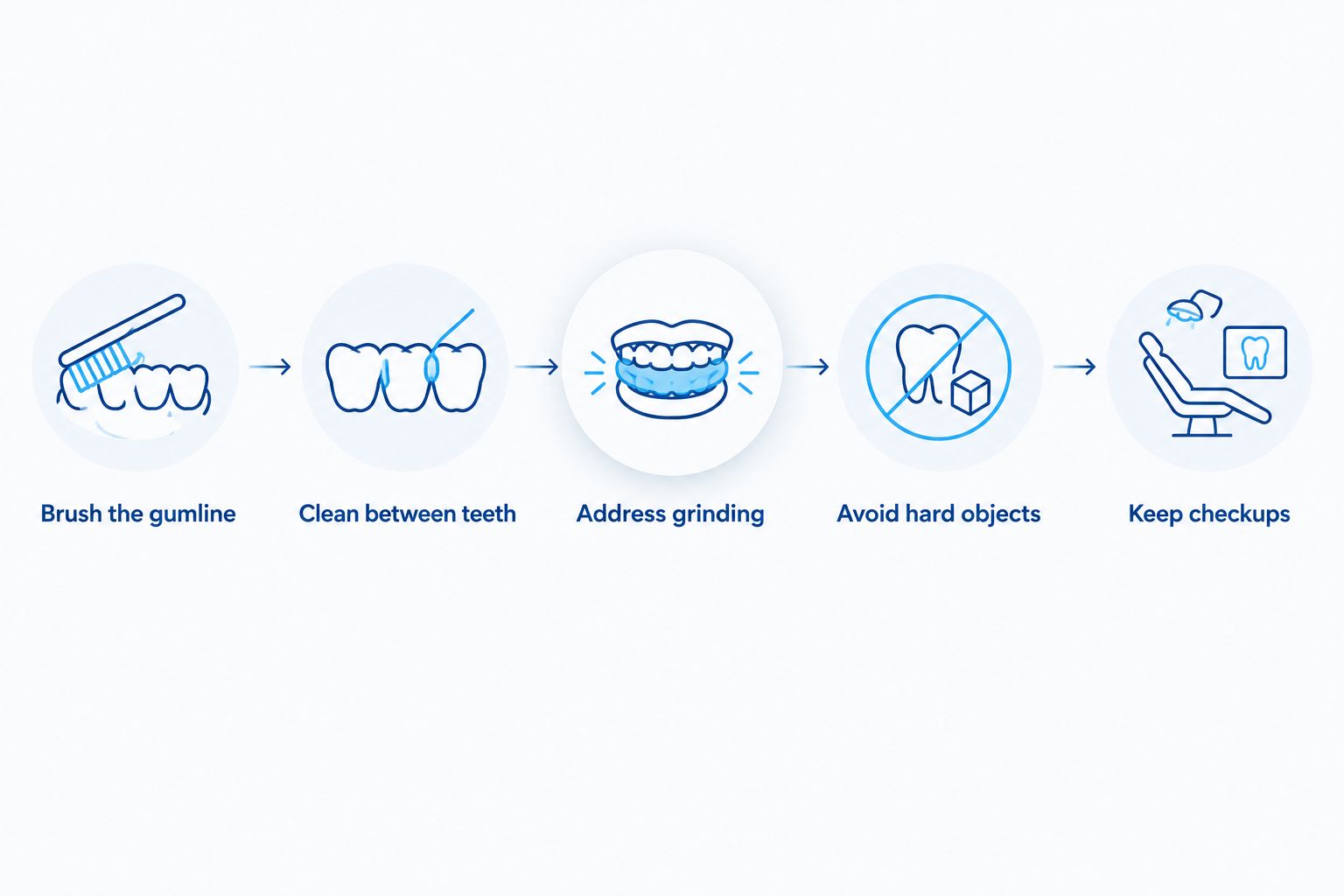
- Brush the gumline. Use a soft-bristled toothbrush and gentle pressure. Clean where the crown meets the tooth rather than scrubbing only the visible surface.
- Clean between teeth. Use floss or another interdental cleaner suited to the space. Ask for guidance if floss repeatedly catches, shreds, or will not pass comfortably.
- Address grinding. Tell your dentist about clenching, morning jaw soreness, or worn teeth. Wear a prescribed night guard as directed and have its fit checked when dental work changes.
- Avoid hard objects. Do not chew ice, open packaging with your teeth, or test a crown by biting something unusually hard.
- Keep checkups. Follow an examination schedule based on your cavity risk, gum health, and treatment history rather than assuming every crown needs the same interval.
Keep your routine realistic. Consistent cleaning is more useful than occasionally cleaning aggressively, and mouthwash does not replace brushing or cleaning between teeth.
Tell your dentist if medication leaves your mouth dry. Do not stop a prescribed medication on your own; discuss ways to manage dry mouth and whether you need additional cavity prevention.
What signs mean a crown needs attention?
A change in comfort, stability, or bite is a reason to contact your dentist. You do not need to wait until the crown breaks or comes off. Describe when the change started and whether it occurs with chewing, temperature, or no obvious trigger.
Watch for these problems:
- A crown that rocks, moves, or feels loose.
- New pain when biting or releasing pressure.
- Persistent or worsening sensitivity.
- A chip, crack, sharp edge, or changed bite.
- Swelling, drainage, or a recurring gum bump near the tooth.
- Food trapping that is new or difficult to clean.
These symptoms do not all lead to replacement. A dentist must identify whether the cause involves the crown, the tooth, the gums, or the bite before recommending treatment.
If a crown comes off, keep it and contact your dentist. Avoid chewing on the exposed tooth and do not use household glue to put it back. An intact crown is not proof that it is safe to recement without checking the tooth underneath.
Seek urgent dental care for swelling, fever, or severe dental pain. Trouble breathing or swallowing requires emergency medical care, not a wait for a routine dental appointment.
Can a crown last longer than 15 years?
A crown can last longer than 15 years when it remains functional and the supporting tooth stays healthy. The 5–15-year guideline describes a typical lifespan, not a mandatory replacement schedule.
At your 2026 checkup, ask whether the crown margins, tooth, gums, and bite remain sound. Keep placement records when possible, but do not treat a missing placement date as evidence that a crown has failed.
Does a crown need replacement after a root canal?
A root canal does not automatically shorten a crown’s 5–15-year general lifespan. The amount and condition of the remaining tooth structure, the seal, and the bite influence the outcome.
A root-canal-treated tooth still needs monitoring, even though it no longer has a living pulp inside. New swelling or pain with chewing deserves assessment rather than an assumption that the tooth cannot develop another problem.
Can a dentist repair a crown instead of replacing it?
The 5–15-year lifespan guideline does not determine whether a crown is repairable. A small chip sometimes allows repair, and a detached crown sometimes allows recementation, but both decisions require an examination.
Ask what the repair would address and what limitation would remain. If the tooth has decay, a fracture, or inadequate support, repairing the crown’s exterior alone does not solve the underlying problem.
FAQ
How long do dental crowns last on average?
Dental crowns typically last 5–15 years, according to Cleveland Clinic’s patient guidance. That range is not a precise average or a guarantee for an individual crown; some last longer, while others need treatment sooner.
Do I have to replace a crown after 10 years?
No, a crown does not need replacement simply because it is 10 years old. Your dentist checks its fit, condition, supporting tooth, gums, and bite to decide whether treatment is needed.
Which dental crown material lasts the longest?
No material guarantees the longest lifespan for every tooth. Metal resists fracture, and zirconia offers high strength, but fit, tooth structure, decay risk, and grinding also affect longevity.
Can I get a cavity underneath a crown?
Yes, the natural tooth underneath or beside a crown can develop decay. Clean the crown margin and between teeth, and keep dental examinations even when the crown feels comfortable.
Does teeth grinding shorten crown lifespan?
Teeth grinding places repeated stress on crowns and their supporting teeth. Ask your dentist whether a night guard is appropriate; it does not replace cleaning or treatment for decay.
What should I do if my crown falls off?
Keep the crown, avoid chewing on the exposed tooth, and contact your dentist promptly. Do not use household glue; the dentist needs to check the tooth and crown before deciding whether recementation is suitable.
Where can my family discuss dental care in Lake Worth?
Dental Arts of Atlantis provides general, cosmetic, pediatric, and implant dentistry for families in Lake Worth and the Palm Beach County area. Bring your crown history and describe any pain, looseness, or bite changes when discussing your dental needs.
One last thing
A crown can look unchanged while the tooth at its edge develops decay. Appearance alone is not a reliable home test of crown health, and lack of pain does not rule out a problem.
Before your next visit in 2026, write down when the crown was placed, what has changed, and whether you grind your teeth. Then ask a direct question: Is the crown itself failing, or is there a problem with the tooth underneath? The answer helps you understand why monitoring, repair, or replacement is being recommended.
Related guides
- Choosing a crown material for a back molar
- Choosing floss for tight contacts between teeth
- How often adults should get a dental checkup and cleaning