

Getting used to a night guard happens gradually, and there is no single adjustment deadline that applies to everyone. For your 2026 care plan, judge progress by whether the guard feels less distracting with use—not by tolerating pain, gum injury, or a changed bite, which need a dental check.
- How long does it take to adjust to a night guard? Comfort and fit matter more than a deadline.
- A teeth-grinding guard can feel unfamiliar; sharp pain, sores, or a changed bite need a dental check.
- Follow your dentist’s wear instructions instead of forcing a painful guard into place.
- Dental Arts of Atlantis provides family dental care for Lake Worth and Palm Beach County households.
How long does it take to adjust to a night guard?
Adjustment is a gradual reduction in awareness of the guard, not a period during which you must accept pain. You might notice its thickness, produce more saliva, or find your tongue repeatedly checking the edges. Those sensations are different from an appliance digging into your gums or making a particular tooth hurt.
The useful question is whether each wearing experience feels more manageable. A guard that remains uncomfortable, slips out, or makes your jaw feel worse needs assessment rather than a longer trial. The guide to night guards for teeth grinding and jaw pain explains the treatment’s purpose alongside the symptoms that bring people to the dentist.
Use this symptom comparison to decide what to discuss with your dental team:
| What you notice | What it means for adjustment | Your next move |
|---|---|---|
| Awareness of thickness without pain | An unfamiliar sensation can be part of getting accustomed to the appliance | Follow the prescribed wear routine and watch for improvement |
| Extra saliva without choking or difficulty swallowing | An oral appliance can initially stimulate saliva | Notice whether it becomes less distracting with use |
| A sharp edge, sore spot, or gum irritation | The appliance needs a fit and edge check | Contact your dentist; do not file it yourself |
| Pain focused on a particular tooth | This needs evaluation rather than an assumption that it is normal | Pause use and ask your dentist for instructions |
| New or worsening jaw pain | The appliance and your jaw symptoms need reassessment | Contact your dentist before continuing |
| A bite that feels different after removal | Your dentist needs to assess how your teeth meet | Report the change rather than forcing your bite together |
These observations help describe a problem; they do not diagnose its cause. Bring the appliance to the appointment so your dentist can assess it in your mouth.
Why this matters
A night guard is intended to protect teeth from the effects of grinding or clenching. It does not guarantee that grinding stops, and it is not a substitute for investigating ongoing pain. Comfortable wear matters because an appliance left in its case cannot protect your teeth while you sleep.
The opposite mistake is pushing through discomfort because you believe every guard requires a painful adjustment period. That approach can delay a needed correction. Your 2026 night-guard routine should include clear instructions about wearing, cleaning, and reporting problems—not just a reminder to use it.
You deserve to understand what you are feeling. Tell your dentist whether the issue is bulk, pressure, rubbing, tooth pain, or jaw stiffness; each description gives more useful information than simply saying the guard feels wrong.
How to get used to a night guard safely
Start with the instructions provided for your particular appliance. A dentist-prescribed guard and a self-molded guard do not necessarily have the same fitting, cleaning, or wearing directions.
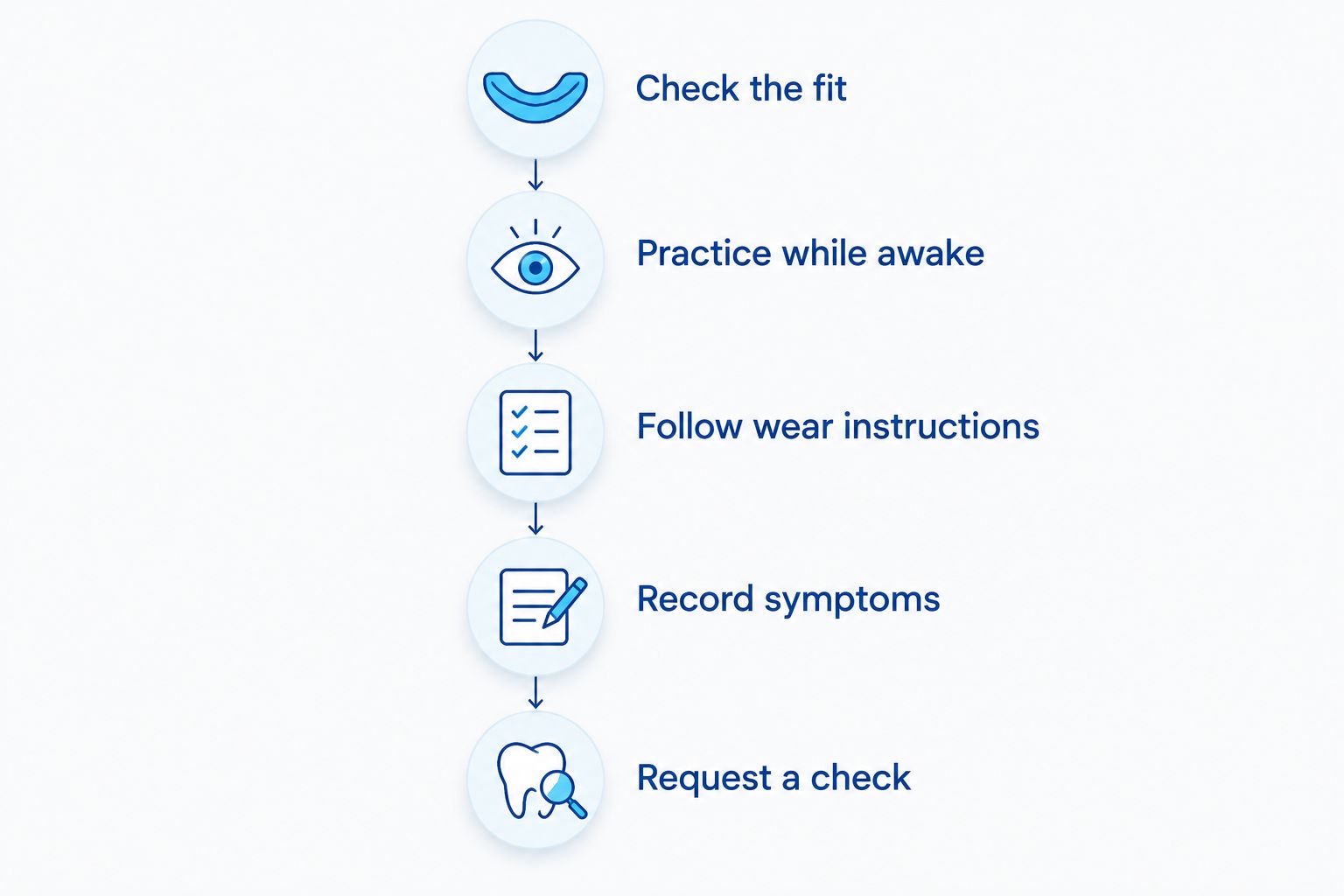
- Check the fit. Insert the guard as instructed. It should seat without being forced; do not repeatedly bite hard to push an appliance into position when it does not fit.
- Practice while awake. Ask your dentist whether brief awake practice is appropriate before bedtime. This lets you notice rubbing or swallowing difficulty while you can respond immediately.
- Follow wear instructions. Use the schedule your dentist recommends. Do not create your own extended daytime-wear routine or keep wearing a guard that causes pain.
- Record symptoms. Note where discomfort occurs, whether it starts during wear or after removal, and whether it is improving. Include any tooth or jaw symptoms you had before using the appliance.
- Request a check. Contact your dentist if the guard hurts, becomes loose, or leaves your bite feeling different. Bring the guard rather than trying to reshape it at home.
Prepare the guard before you are ready to fall asleep. Clean your teeth, check the appliance, and place its storage case somewhere easy to find. A predictable routine removes avoidable decisions at bedtime.
If you remove the guard during sleep, tell your dentist instead of treating that as a personal failure. Describe whether you remember discomfort, gagging, or waking with the appliance loose. That information helps determine the next step.
Why night-guard adjustment varies
There is no reliable way to predict your experience from appearance alone. A guard that looks thin can still have a troublesome edge, while a thicker appliance can fit comfortably.
These factors explain why comfort differs:
- Fit and retention: A loose guard can move, while an overly tight area can put uncomfortable pressure on a tooth. Both deserve a fit check.
- Thickness and coverage: The amount of material changes what your tongue and cheeks encounter. Familiarity with that sensation is separate from whether the appliance fits correctly.
- Bite contacts: How your teeth meet the guard matters. Report uneven pressure or new jaw symptoms instead of assuming the material will settle into place.
- Existing symptoms: Jaw pain, tooth sensitivity, and gum soreness that began before the guard still need attention. The appliance does not explain every symptom automatically.
- Consistent use: Following an appropriate wear routine helps you assess comfort. Irregular use makes it harder to describe whether your experience is changing.
- Appliance condition: Cracks, distortion, or rough areas can change the wearing experience. Check the guard before inserting it and follow its care instructions.
For a 2026 night-guard decision, prioritize fit and symptoms over promises of an exact adjustment time. No material choice removes the need to check how an appliance behaves in your mouth.
What should a night guard feel like?
A night guard should feel secure without causing injury or requiring you to hold it in place by clenching. You will notice an object between your teeth, but noticing it is not the same as having pain.
Describe pressure precisely. Is it spread across the appliance, or concentrated around a tooth? Does an edge rub your cheek, or does your jaw ache after removal? Those distinctions help your dentist assess the fit and identify whether another dental problem needs attention.
Do not assume that softer always means more suitable, or that harder always means more effective. Material selection depends on the appliance’s purpose and your dental assessment. The goal is a design you can use safely, not the material that sounds easiest to tolerate.
Also distinguish comfort from symptom relief. Becoming less aware of a guard does not prove that a headache or jaw problem has resolved. Report continuing symptoms separately, even when the appliance itself feels comfortable.
How should you care for it during adjustment?
Follow the cleaning directions for your appliance rather than using a routine intended for a different dental device. Materials and recommended cleaning products differ, so your dentist’s instructions and the manufacturer’s directions take priority.
Clean your teeth before inserting the guard. After removal, clean and store it as directed. Keep the storage case clean as well; placing a freshly cleaned appliance in a dirty case defeats part of that routine.
Avoid hot water unless the appliance’s specific instructions require it for a fitting step. Heat can distort dental appliance materials. Do not boil a dentist-made guard or repeatedly remold a self-molded appliance to solve unexplained pain.
Inspect for rough edges, cracks, and changes in shape. If a previously comfortable guard suddenly feels wrong, mention recent dental work, a new restoration, or damage to the appliance. A change in fit needs an explanation—not another adjustment countdown.
What should you tell your dentist at a fit check?
Bring both the appliance and a clear description of the problem. You do not need technical language; pointing to a sore area and explaining when it hurts is useful.
For your 2026 follow-up, prepare these details:
- Whether the discomfort starts during insertion, while wearing the guard, or after removal.
- Whether the sensation is bulk, rubbing, tooth pressure, jaw pain, or gagging.
- Whether the problem happens in the same location each time.
- Whether your bite feels different without the guard.
- Whether you have had dental work or damaged the appliance since it was fitted.
Dental Arts of Atlantis is a fit for Palm Beach County families seeking general dental care in Lake Worth. The practice’s family dental care is relevant when you need an examination rather than another home adjustment attempt. The limit is straightforward: an article cannot establish whether your guard fits or whether a painful tooth has another problem.
Is it normal for a night guard to hurt at first?
Pain is not a requirement for successful adjustment. An unfamiliar feeling or extra saliva is different from sharp pain, a sore gum, or increasing jaw discomfort.
Pause use and contact your dentist when the appliance causes pain or injury. Do not trim, sand, or heat it to correct the problem yourself.
Should I wear my night guard all day to adjust faster?
Do not extend wear beyond your dentist’s instructions to speed up adjustment. Ask whether brief awake practice is appropriate for your appliance, but keep that separate from wearing it throughout the day.
If daytime clenching is also a concern, describe it at your visit. Nighttime protection and management of awake clenching are related discussions, not interchangeable wearing schedules.
Can a night guard help if I also snore?
A standard grinding guard is not a sleep apnea treatment. Appliances designed for obstructive sleep apnea have a different purpose and require an appropriate evaluation.
Tell your dental and medical clinicians about loud snoring, witnessed breathing pauses, or significant daytime sleepiness. Do not assume that getting comfortable with a grinding guard addresses those symptoms.
FAQ
How long does it take to adjust to a night guard?
There is no single adjustment deadline that applies to everyone. Look for decreasing awareness of the appliance with use, and contact your dentist about pain, sores, looseness, or a changed bite.
Is extra saliva normal when I start wearing a night guard?
Extra saliva can occur when you first wear an oral appliance. Difficulty swallowing, choking, or an appliance that moves out of position needs prompt assessment rather than being treated as routine adjustment.
What if I keep taking my night guard out while sleeping?
Tell your dentist that you are removing the guard during sleep. Describe any discomfort, gagging, or looseness so the fit and wearing instructions can be reviewed.
Should I keep wearing a night guard if one tooth hurts?
Pause use and contact your dentist if a particular tooth hurts when you wear the guard. Localized pain needs an assessment of both the appliance and the tooth.
Can I trim my night guard at home if it rubs?
Do not trim or file a dentist-made night guard yourself. Ask your dentist to assess the rubbing area; for a self-molded appliance, follow its instructions and seek advice if discomfort continues.
What if my bite feels different after I remove my night guard?
Report a changed bite to your dentist. Do not keep using the appliance without advice or force your teeth together to try to restore their usual contact.
Can Dental Arts of Atlantis help with general dental concerns while I adjust?
Dental Arts of Atlantis offers general and family dental care in Lake Worth for Palm Beach County households. Bring your appliance and describe your symptoms when seeking a dental assessment.
One last thing
Describe the symptom before counting the nights. Saying that an edge rubs your lower gum or a tooth hurts after removal gives your dentist a clearer starting point than saying you still dislike the guard.
Your 2026 goal is comfortable, appropriate use—not winning an endurance test. Familiarity takes practice; pain needs attention.
Related guides
- Night-guard materials for teeth grinding compared
- How to relieve TMJ pain before your dentist visit
- How to know whether snoring means sleep apnea
- How to prepare for your first visit as a new patient