

A root canal’s appointment length depends on the tooth’s anatomy, whether it has been treated before, and whether your dentist can complete the treatment in one visit. For your 2026 appointment, confirm the reserved chair time directly with the treating office; a separate visit for a permanent filling or crown can add to the overall treatment schedule.
- How long does a root canal take? Your tooth’s anatomy and treatment plan determine the appointment length.
- Root canal treatment and the final crown or filling are separate parts of saving a tooth.
- Ask whether the reserved appointment includes examination, imaging, treatment, and restoration.
- Dental Arts of Atlantis provides family dental care for households in Lake Worth and Palm Beach County.
How long does a root canal take?
Ask for two estimates: the time reserved for your next appointment and the schedule for completing the tooth’s treatment. Those answers describe different things. Cleaning and sealing the root canals does not necessarily include placing the final restoration.
The American Association of Endodontists explains in its patient guidance that root canal treatment is commonly completed in one or two appointments, depending on the tooth and circumstances. That appointment count is not a guarantee for your case, and it does not establish how many minutes your visit will last.
For background on what the procedure addresses, read about root canal treatment for an infected tooth. The scheduling question becomes easier once you know which parts of treatment your dentist plans to complete at each visit.
| Part of your care | What happens | What to confirm before booking |
|---|---|---|
| Examination and planning | Your dentist evaluates the tooth, symptoms, and relevant imaging | Whether this happens before treatment or during the same appointment |
| Root canal treatment | The dentist removes affected pulp, cleans the canals, and seals them | Whether the planned visit completes the root canal or starts a staged treatment |
| Tooth restoration | A filling or crown seals and protects the remaining tooth structure | Whether this needs a separate appointment |
| Follow-up | Your dentist checks symptoms or healing when indicated | Whether a review visit is part of your plan |
Why this matters
A root canal appointment is not the same as the entire tooth-saving process. You need enough time for treatment, clear instructions for the period afterward, and a plan for protecting the tooth once the canals are sealed.
For a 2026 appointment, do not arrange work, school pickup, or travel around a generic online estimate. Use the treating office’s appointment length, and ask what remains unfinished when you leave. That prevents a common misunderstanding: assuming the tooth is fully restored because the root canal itself is complete.
You should also explain any scheduling limits before treatment starts. A deadline helps the office plan your visit, but it does not replace the clinical steps needed to treat the tooth safely.
What happens during a root canal appointment?
The treatment follows a sequence, although the dentist can divide that sequence across appointments. Knowing the steps helps you understand why the appointment includes more than cleaning the inside of a tooth.
- Assessment. Your dentist reviews symptoms, examines the tooth, and evaluates imaging. The examination also helps determine whether the tooth can be restored after treatment.
- Numbing. Local anesthetic numbs the treatment area. Tell the dentist if you still feel sharp pain rather than pressure before treatment continues.
- Isolation. A dental dam separates the tooth from the rest of your mouth. This helps keep saliva out of the treatment area and protects you while the canals are cleaned.
- Cleaning. The dentist opens the tooth, removes the affected pulp, and cleans and shapes the root canals. Canal anatomy influences how much work this step requires.
- Sealing. Once ready, the canals receive filling material, and the opening in the tooth is sealed. A temporary restoration is sometimes used before the permanent restoration.
- Restoration. Your dentist plans the filling or crown needed to protect the tooth. Whether this happens immediately or separately depends on the tooth and treatment plan.
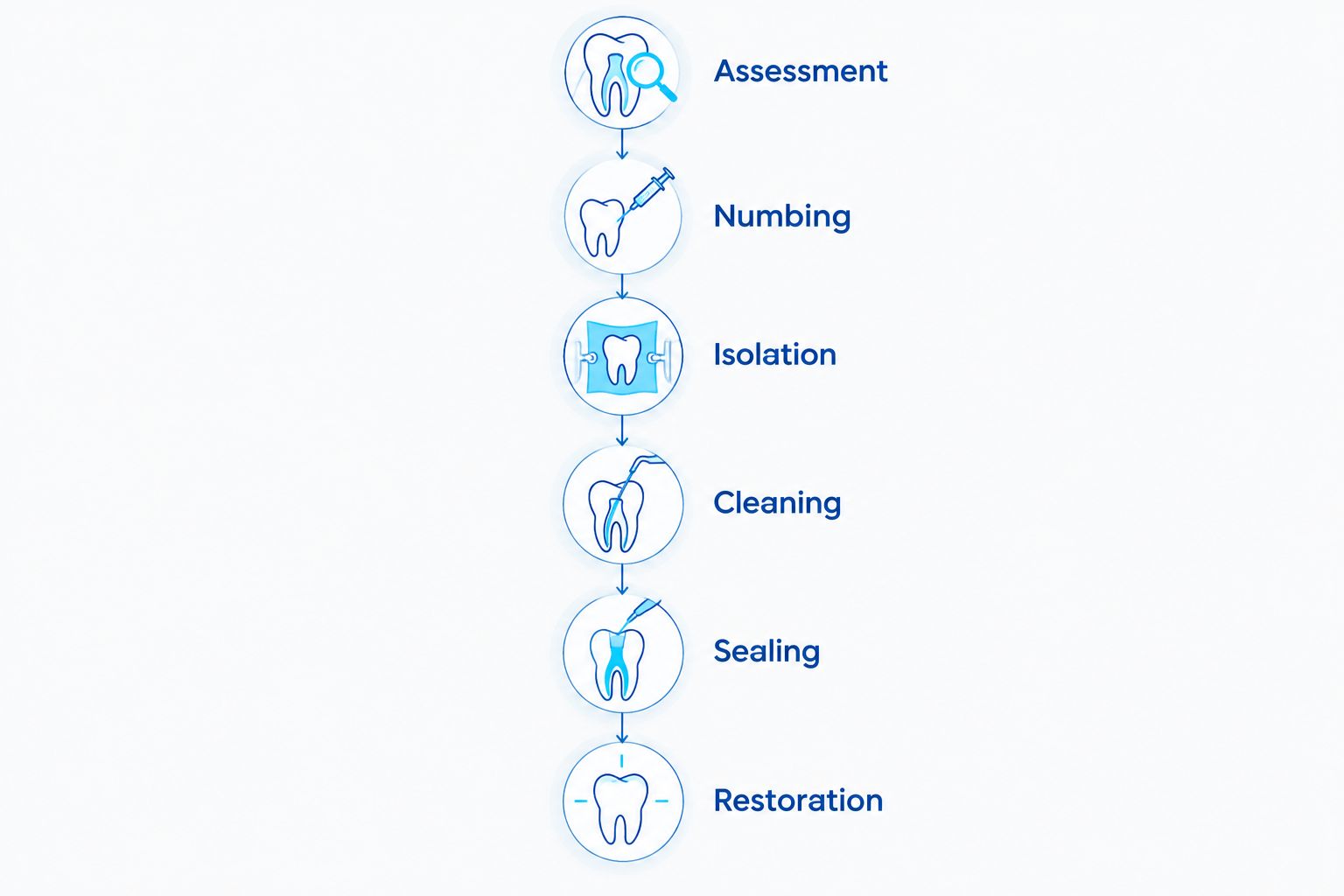
These steps explain the treatment process, not a fixed appointment duration. Your dentist must allow time for your tooth’s actual needs, including checking comfort and completing the planned clinical work.
Front teeth and back teeth: what changes the schedule?
Front teeth generally have simpler root canal anatomy than molars. Molars usually contain more canals, so treatment involves finding, cleaning, and sealing a more complex internal space.
That distinction does not make every front tooth quick or every molar difficult. Curved canals, calcification, trauma, and previous treatment can complicate either type of tooth. The tooth’s position is a starting point for estimating time, not the final answer.
Ask your dentist which tooth is being treated and whether its anatomy changes the expected visit. A tooth-specific explanation is more useful than an estimate based only on the words root canal.
One visit or staged treatment: which fits your tooth?
A single-visit root canal completes the canal treatment during one appointment. Staged treatment divides the work between visits, usually with a temporary seal protecting the tooth between appointments.
Neither approach is automatically better. The dentist chooses a schedule based on the clinical situation, the work required, and your ability to tolerate the appointment.
| Treatment approach | Best for | Main advantage | Main limitation |
|---|---|---|---|
| Single-visit treatment | Teeth that the clinician determines can be fully treated in one appointment | Fewer separate visits for the canal treatment | The appointment must accommodate all planned treatment steps |
| Staged treatment | Cases where the clinician determines treatment should be divided | Allows treatment to proceed in clinically appropriate stages | Requires return visits and care around a temporary restoration |
For your 2026 treatment plan, ask why the proposed schedule fits your tooth. The explanation should connect the appointment plan to the diagnosis, not simply describe how many visits the office usually books.
If treatment is staged, get clear instructions about chewing, cleaning, and what to do if the temporary filling comes loose. Keep the completion appointment. Feeling better does not establish that treatment is finished.
Why root canal appointment length varies
Your dentist’s estimate reflects the tooth and the treatment needed. These factors explain why another person’s appointment length is not a reliable guide for yours:
- Canal anatomy: Additional canals, curves, or narrow spaces make cleaning and sealing more involved.
- Previous treatment: Retreatment can require removing existing canal filling material before addressing the underlying problem.
- Calcification: A narrowed or calcified canal can be harder to locate and treat.
- Clinical findings: Examination and imaging determine the condition of the tooth and surrounding tissues, which informs the treatment plan.
- Comfort needs: Additional numbing, breaks, or an agreed anxiety-management approach affect how the visit is organized.
- Restoration needs: A temporary filling, permanent filling, or crown changes what is completed during the appointment and what happens afterward.
Tell your dentist about trouble staying reclined, jaw discomfort, medical conditions, and previous difficulty getting numb. Those details help the team plan your care rather than discover your concerns halfway through treatment.
What should you ask before booking?
Before reserving time off in 2026, ask the office to explain the appointment in plain language. You do not need dental terminology to get a useful answer.
Use these questions:
- Is this appointment for the examination, the root canal, or both?
- How much time should I reserve at the office?
- Do you expect to complete the canal treatment at this visit?
- Will I leave with a temporary filling or a permanent restoration?
- Does the tooth need a crown, and when should that happen?
- Will my comfort plan affect transportation or activities afterward?
- Who should I contact if symptoms worsen or the temporary filling comes out?
Bring your current medication list and relevant medical history. Follow the office’s preparation instructions, especially if your care includes sedation; do not use generic internet advice to decide whether to eat, drive, or change medication.
Dental Arts of Atlantis provides family dental care for households in Lake Worth and Palm Beach County. Its general, cosmetic, pediatric, and implant dentistry services make the practice relevant to families seeking care across different stages of life; your root canal appointment length still requires an individual assessment.
Does getting a crown add another appointment?
A crown can add another appointment to the overall schedule, even when the root canal is completed in one visit. Your dentist determines the restoration based on the tooth’s location, remaining structure, and biting forces.
Back teeth often need crowns after root canal treatment because they handle substantial chewing forces. A front tooth’s restoration depends on how much tooth structure remains and other clinical findings. Not every root-treated tooth receives the same restoration.
Ask when the tooth will be permanently sealed and protected, not only when the root canal will finish. Until then, follow the dentist’s chewing instructions and avoid treating a temporary filling as the end of care.
Can I go back to work after a root canal?
Returning to work depends on your comfort, the treatment you receive, and the demands of your job. Local anesthetic and sedation have different implications, so confirm your instructions before making transportation or work arrangements.
If your plan includes sedation, follow the office’s requirements for an escort, driving, and activities afterward. Do not assume you can drive yourself simply because the dental treatment is complete.
For appointments using local anesthetic alone, consider lingering numbness and tenderness when planning meals, speaking-heavy work, or physically demanding tasks. Your treating clinician should provide the instructions that apply to you.
How long does soreness last after a root canal?
Tenderness for a few days after root canal treatment is described in American Association of Endodontists patient guidance. The surrounding tissues can remain sensitive even after the affected pulp has been removed.
Symptoms should guide your next action. Contact the treating dentist about severe pain, visible swelling, an uneven bite, a lost temporary restoration, or symptoms that return or worsen.
Seek emergency medical care for difficulty breathing or swallowing, especially with spreading swelling. Do not wait for a scheduled dental follow-up when those symptoms occur.
FAQ
How long does a root canal take from start to finish?
The full schedule depends on the tooth, the number of treatment visits, and the permanent restoration. Ask for the reserved appointment length and the separate timeline for completing the filling or crown.
Can a root canal be finished in one visit?
A root canal can be completed in one visit when the treating clinician determines that the tooth is suitable. Other cases need staged treatment, and the final restoration can require a separate appointment.
Does a molar root canal take longer than a front tooth root canal?
Molars generally involve more complex canal anatomy than front teeth. Your dentist must evaluate the actual tooth because curves, calcification, and previous treatment also affect the work required.
Does a longer root canal appointment mean something is wrong?
Appointment length alone does not show that something is wrong. More involved anatomy, retreatment, or additional comfort measures can change how much time the dentist needs.
Should I eat before my root canal appointment?
Follow the treating office’s instructions about eating before your appointment. Preparation differs when sedation is part of the plan, so confirm the instructions rather than assuming they are the same for every patient.
Can I chew normally after a root canal?
Follow your dentist’s chewing restrictions until the tooth has the protection it needs. Avoid chewing while numb, and protect a temporarily restored tooth according to the instructions you receive.
Can Dental Arts of Atlantis tell me how much time to reserve?
Ask Dental Arts of Atlantis for the appointment length assigned to your treatment plan. Confirm whether that time includes examination and treatment, and whether restoration requires another visit.
One last thing
Pain relief is not the same as completed tooth protection. Before leaving your 2026 appointment, ask what restoration is in place, what you should avoid chewing, and which appointment completes your care.
For families considering Dental Arts of Atlantis for dental care, that final conversation helps connect the immediate treatment with the next step. Leave knowing what is finished and what still needs attention.
Related guides
- How to know if you need a root canal
- Managing dental anxiety before a procedure
- How to save a tooth instead of getting it extracted