
Yes—mild sensitivity after a new filling can be normal, especially when cold, heat, or pressure briefly triggers it and the discomfort is improving. Pain that worsens, lingers after the trigger stops, wakes you up, or comes with swelling needs a dental assessment rather than reassurance alone. If your new filling hurts when your teeth meet, contact your dentist to check whether the filling is affecting your bite.
- If your new filling hurts, improving sensitivity is different from worsening, lingering, or spontaneous tooth pain.
- Pain when your teeth meet warrants a bite check; do not try to reshape the filling yourself.
- Swelling, fever, or severe pain requires prompt dental attention; trouble swallowing or breathing requires emergency care.
- Dental Arts of Atlantis offers general dentistry for Lake Worth families seeking local dental care.
Is it normal for a new filling to hurt?
Brief, improving sensitivity can follow a filling; persistent or worsening pain deserves a check. Removing decay and restoring a tooth can irritate the living tissue inside it. The surrounding gum or injection area can also feel tender after treatment.
What matters is the pattern, not simply whether the tooth hurts. Notice what starts the pain, whether it stops when the trigger ends, and whether normal eating is becoming easier or harder. For more on temperature triggers, read about how to stop tooth sensitivity to hot and cold.
| Symptom pattern | What it can indicate | What to do |
|---|---|---|
| Brief sensitivity that is steadily improving | Temporary irritation after treatment | Follow aftercare instructions and monitor the trend |
| The filled tooth touches first or hurts when you close | An uneven bite or another pressure-related problem | Contact your dentist for a bite assessment |
| Pain continues after hot or cold is gone | Inflammation inside the tooth | Arrange a prompt dental assessment |
| Pain starts without eating or drinking, or interrupts sleep | A problem needing further investigation | Contact your dentist promptly |
| Swelling, fever, drainage, or a bad taste | Possible infection | Seek urgent dental care |
| Trouble breathing or swallowing, or rapidly spreading swelling | A potentially serious emergency | Seek emergency medical care immediately |
These patterns help you describe symptoms; they do not establish a diagnosis. A dentist needs to examine the tooth before deciding whether you need observation, a bite adjustment, or further treatment.
Why this matters
A filling repairs damaged tooth structure, but it does not guarantee that every irritated tooth will settle without further care. Equally, sensitivity does not automatically mean the filling failed or that you need a root canal.
The practical goal of this 2026 guide is to help you separate improving discomfort from symptoms that should change your next step. Do not wait for a particular deadline if pain is escalating or your bite feels wrong. Your dentist's individual aftercare instructions take priority over a general timeline.
Why pain after a filling varies
Several different tissues and forces can produce discomfort around a recently filled tooth. These factors explain why another person's recovery is not a reliable comparison for yours:
- Cavity depth: Decay closer to the pulp—the tissue containing nerves and blood vessels—can leave the tooth more irritated.
- Bite contact: A filling that contacts the opposing tooth too early can put extra pressure on the restored tooth.
- Previous symptoms: Pain before treatment helps the dentist assess whether the pulp was already inflamed.
- Gum irritation: Instruments, an injection, or work near the gumline can leave nearby soft tissue sore.
- Clenching or grinding: Repeated pressure can aggravate a sensitive tooth and surrounding supporting tissues.
- Cracks or other tooth problems: Pain near a filling can come from a crack, an adjacent tooth, or another condition requiring examination.
Do not assume that the filling material is responsible just because symptoms started after treatment. The location, triggers, and examination findings matter more than guessing at a cause.
What should you do when your new filling hurts?
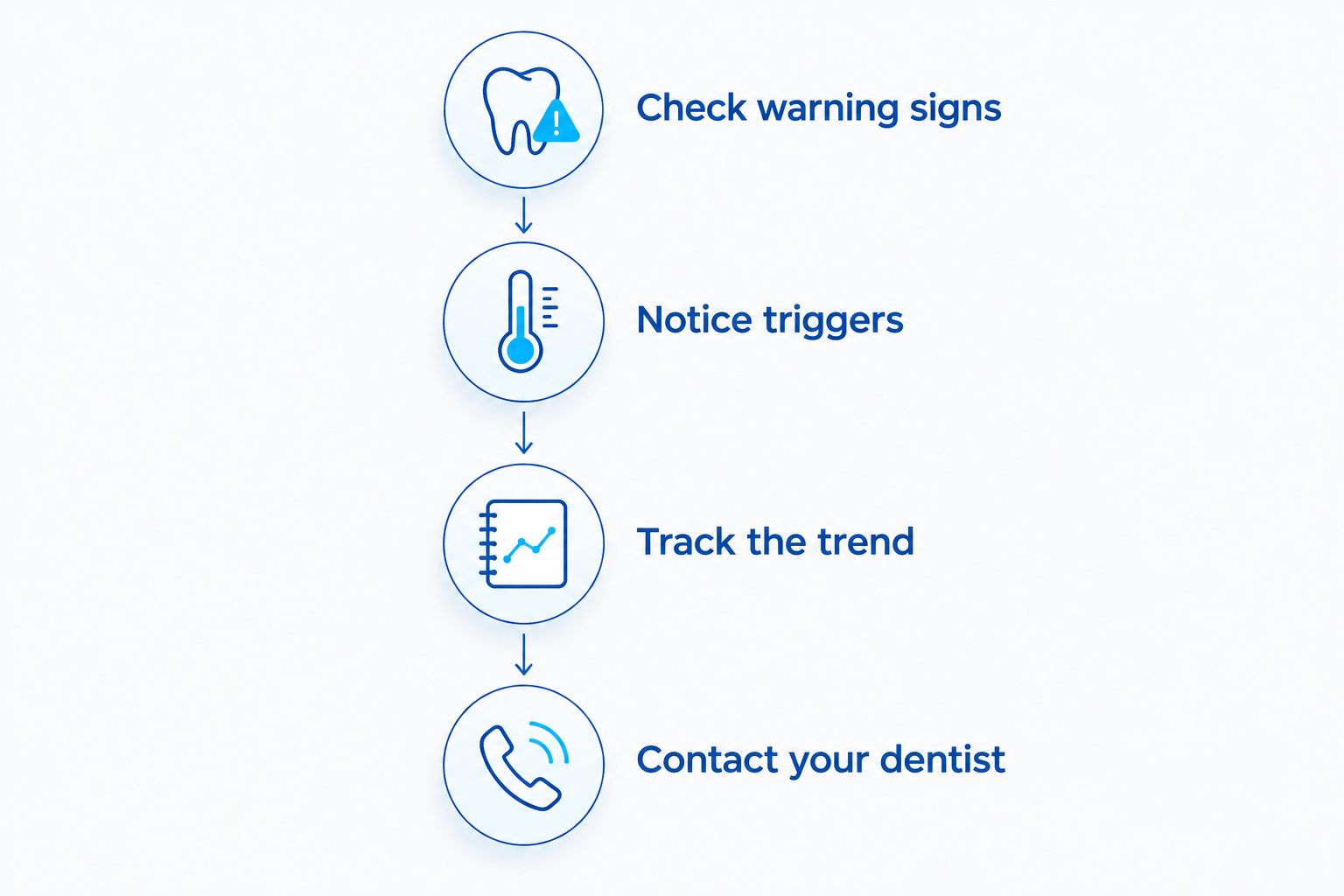
Use this sequence to decide what to report and how urgently to seek help. You do not need to provoke pain to collect useful information.
- Check warning signs. Look for swelling, fever, drainage, severe pain, or trouble swallowing or breathing. Escalate care immediately when emergency symptoms are present.
- Notice triggers. Record whether discomfort happens with cold, heat, chewing, closing your teeth, or without an obvious trigger.
- Track the trend. Note whether episodes are becoming milder, staying unchanged, or getting worse. Include whether pain continues after the trigger ends.
- Contact your dentist. Describe the pattern and follow the office's advice about an examination. Do not keep testing the tooth while you wait.
A useful description is specific: which tooth was treated, what brings on the pain, whether the tooth feels higher than its neighbors, and whether symptoms interrupt sleep. Mention medicines you have taken and any change since treatment.
For a follow-up in 2026, a short symptom note is more helpful than repeatedly biting down to see whether the tooth still hurts. Bring your questions as well as your observations.
What if the filling feels too high?
A high filling can make the restored tooth meet its opposing tooth before the rest of your teeth fit together. You might notice pain when closing, chewing, or clenching after the numbness wears off.
A bite that feels uneven deserves a dental check, not an attempt to wear the filling down yourself. Your dentist can assess contact points and determine whether an adjustment is appropriate. Never file, sand, or pick at the restoration.
A bite adjustment addresses an uneven contact; it does not treat every cause of tooth pain. If symptoms persist after an adjustment, report that change rather than assuming the tooth simply needs more pressure or chewing practice.
What can you do safely at home?
Home care supports comfort while you follow your dentist's advice. Its limitation is straightforward: it cannot correct a high filling, repair a crack, or treat an infection inside a tooth.
| Approach | Best for | Benefit | Limit or caution |
|---|---|---|---|
| Softer foods and avoiding temperature extremes | Reducing obvious triggers temporarily | Makes eating more comfortable | Does not address the underlying cause |
| Desensitizing toothpaste | Sensitivity your dentist considers suitable for home care | Can reduce certain types of sensitivity | Does not correct bite problems or infection |
| Nonprescription pain medicine, when safe for you | Temporary pain control | Helps manage discomfort | Requires label precautions and does not replace assessment |
| Dental examination | Persistent, worsening, or bite-related pain | Identifies the cause and guides treatment | Requires an appointment and sometimes additional testing |
Eat without repeatedly testing the tooth
Choose foods that do not trigger discomfort, and avoid chewing hard foods on the sore tooth until you have advice. Wait until numbness has worn off before chewing so you do not injure your cheek, tongue, or lip.
Do not use ice, very hot drinks, or hard bites as a home diagnostic test. Repeatedly triggering pain adds discomfort without telling you whether the pulp is healthy.
Keep cleaning gently
Keep brushing and cleaning between your teeth unless your dentist gives different instructions. American Dental Association home-care guidance recommends brushing for 2 minutes, 2 times a day, using fluoride toothpaste, and cleaning between teeth 1 time daily.
For your 2026 aftercare routine, use a soft-bristled toothbrush and gentle pressure rather than scrubbing the sore area. Tell your dentist if floss consistently catches, shreds, or cannot pass beside the new filling; do not force it through.
Use medicine cautiously
Ask a dentist or pharmacist which nonprescription pain medicine is appropriate for your health history and current medicines. Follow the package directions, and check combination products to avoid taking the same active ingredient twice.
Do not place aspirin directly against the tooth or gum, and do not take leftover antibiotics. Pain relief is not proof that the cause has resolved; persistent symptoms still need evaluation.
What will the dentist check?
A follow-up starts with your symptoms and the treated tooth, not an automatic decision to replace the filling. The dentist can assess your bite, examine the restoration and surrounding gum, and check how the tooth responds to appropriate tests.
X-rays help answer some questions, but they do not replace the examination or reveal every source of pain. Depending on the findings, the next step can include monitoring, adjusting a contact, repairing a restoration, or evaluating the pulp more closely.
Further treatment should follow a diagnosis, not pain alone. Ask what the examination shows, what each proposed treatment addresses, and which symptoms should prompt another call.
Dental Arts of Atlantis provides general and family dentistry for Lake Worth and Palm Beach County families. An in-person dental examination can assess bite contacts and tooth responses that an article cannot evaluate.
If you need to discuss symptoms with Dental Arts of Atlantis, contact the practice and explain that the pain followed a filling. Describe urgent symptoms at the start of the conversation rather than leaving them until the end.
Ask about your filling symptoms
Describe your pain triggers, bite changes, and any swelling when you contact the practice.
Does pain after a filling mean I need a root canal?
Pain after a filling does not automatically mean you need a root canal. Temporary irritation and uneven bite contact are different problems from pulp damage that cannot recover.
Lingering temperature pain, spontaneous pain, and pain that interrupts sleep deserve assessment. Your dentist uses the history, examination, and testing together to decide whether the pulp can recover or needs treatment.
Should I wait if my new filling hurts only when I chew?
Pain only when chewing still warrants contacting your dentist, particularly if the tooth touches first or normal meals hurt. Pressure-related pain can involve bite contact, a crack, or inflammation around the tooth.
Avoid repeatedly biting hard objects to locate the pain. Explain whether discomfort happens as you bite down, release your bite, or bring your teeth together without food.
Is it different if my child's new filling hurts?
A child's new filling can cause temporary sensitivity, but swelling, worsening pain, or difficulty eating needs a dental call. Children do not always distinguish tooth pain from gum soreness or a numb lip they have accidentally bitten.
Watch eating, drinking, sleep, and facial swelling rather than relying only on a pain rating. For parents reading in 2026, the same safety rule applies: do not dismiss a worsening pattern as a normal part of getting a filling.
FAQ
How long is it normal for a new filling to hurt?
There is no single normal duration for every filled tooth. Brief sensitivity that improves is different from worsening, lingering, or spontaneous pain; contact your dentist if symptoms persist or concern you.
Why does my new filling hurt when I drink cold water?
Cold sensitivity can follow temporary irritation after a filling. Tell your dentist if the pain lingers after the drink is gone, becomes stronger, or begins without a trigger.
Can a high filling settle down on its own?
Do not rely on a high-feeling filling to settle on its own. Contact your dentist for a bite check rather than trying to wear it down by chewing.
Should I take antibiotics if my new filling hurts?
Do not take antibiotics for filling pain unless a clinician prescribes them for a diagnosed reason. Antibiotics do not correct an uneven bite, and pain alone does not establish an infection.
Is swelling after a filling an emergency?
Swelling after a filling needs prompt assessment, especially with fever, drainage, or worsening pain. Trouble swallowing or breathing, or rapidly spreading swelling, requires emergency medical care.
Can Dental Arts of Atlantis help me understand pain after a filling?
Dental Arts of Atlantis offers general dentistry in Lake Worth. Contact the practice to describe your symptoms and ask about an assessment; an examination is needed to identify the cause.
One last thing
Being able to tolerate the pain is not the same as having a healthy bite or a recovering tooth. A mild symptom that keeps worsening deserves more attention than a sharper sensation that is steadily fading.
For your 2026 follow-up, write down what changed rather than deciding whether the pain is bad enough to deserve a call. You do not need to diagnose yourself before asking your dentist for help.
Related guides
- How to know if you need a root canal
- Can a cracked tooth heal on its own?
- How to handle a dental emergency until you reach the dentist