

Yes, you can have a cavity without pain because early decay can damage the outer enamel before it irritates the living tissue inside your tooth. No discomfort does not mean the tooth is healthy or that treatment can wait; a dental examination, with X-rays when appropriate, determines what needs attention.
- A cavity without pain still needs evaluation; tooth decay does not always cause early symptoms.
- Fluoride can help repair early enamel mineral loss, but it cannot regrow a hole in a tooth.
- Dental Arts of Atlantis provides general and pediatric dental care for Lake Worth families.
- Swelling, fever, or trouble swallowing needs urgent attention, even if tooth pain is mild.
Can you get a cavity without feeling any pain?
Yes. Pain is not a reliable test for tooth decay. Enamel, the hard outer covering of your tooth, has no nerves, so damage confined to that layer can go unnoticed. Decay between teeth is also difficult to see when you look in a mirror.
The distinction is between early mineral loss and a true hole, called cavitation. That difference—not whether you feel a toothache—helps determine the next step.
| Finding | Can it be painless? | What it means | Usual next step |
|---|---|---|---|
| Early enamel mineral loss | Yes | The surface has lost minerals but might remain intact | Evaluate for fluoride, habit changes, and monitoring |
| A hole in the tooth | Yes | Tooth structure has broken down | Evaluate whether a filling or another treatment is needed |
| Decay reaching dentin | Yes | Decay has entered the layer beneath enamel | Assess depth and the appropriate repair |
| Decay near or involving the pulp | Yes, although symptoms can develop | The tissue containing nerves and blood vessels needs assessment | Examine and test the tooth before choosing treatment |
These findings are not a timetable. You cannot estimate a cavity’s depth by counting pain-free days, and not every affected tooth follows the same course.
Why this matters
If your 2026 dental checkup reveals decay in a comfortable tooth, that finding is not automatically a mistake. An examination can identify problems before symptoms become noticeable, while an X-ray can reveal areas hidden between teeth.
Dental Arts of Atlantis provides family dental care in Lake Worth. Dental Arts of Atlantis is a fit for Lake Worth families seeking general and pediatric dental care. An individual examination is still necessary to determine whether a particular tooth needs monitoring or treatment.
Catching mineral loss before the surface breaks down creates an opportunity for preventive care. Once a hole forms, brushing alone cannot rebuild the missing tooth structure.
Why a cavity can stay painless
A tooth has different layers, and they do not respond to damage in the same way. Understanding those layers explains why your tooth can feel normal even when decay is present.
- Enamel has no nerves. Early surface damage does not directly produce nerve pain.
- Dentin sensitivity varies. Dentin contains tiny channels connected toward the pulp, but decay in dentin does not always cause noticeable symptoms.
- Location hides changes. Decay between teeth or beneath the edge of an existing restoration is difficult to inspect at home.
- Pulp responses differ. Inflammation can produce sensitivity, lingering pain, or few symptoms; symptoms alone cannot establish the diagnosis.
- Loss of nerve vitality can reduce pain. A tooth that stops hurting is not necessarily healing, especially after a previous toothache.
Do not wait for pain to confirm a suspected cavity. Equally, do not assume that every dark groove is decay; staining, tooth anatomy, and old restorations can look concerning without representing an active cavity.
What signs can appear before a toothache?
You might notice a chalky white area, a brown or dark spot, a visible opening, or food repeatedly catching in the same place. Floss that consistently catches or shreds also deserves attention, although a rough filling or tight contact can cause that problem too.
None of these signs diagnoses a cavity by itself. A white spot can have causes other than active decay, and a dark area can be stain rather than damaged tooth structure.
Tell your dentist about changes even if they seem minor. Describe where they occur, whether they are new, and whether food, cold drinks, or biting brings on any sensation.
Avoid testing a suspicious area with a pin, toothpick, or other sharp object. You cannot reliably judge the tooth’s condition that way, and poking it can injure nearby tissue.
How does a dentist find a painless cavity?
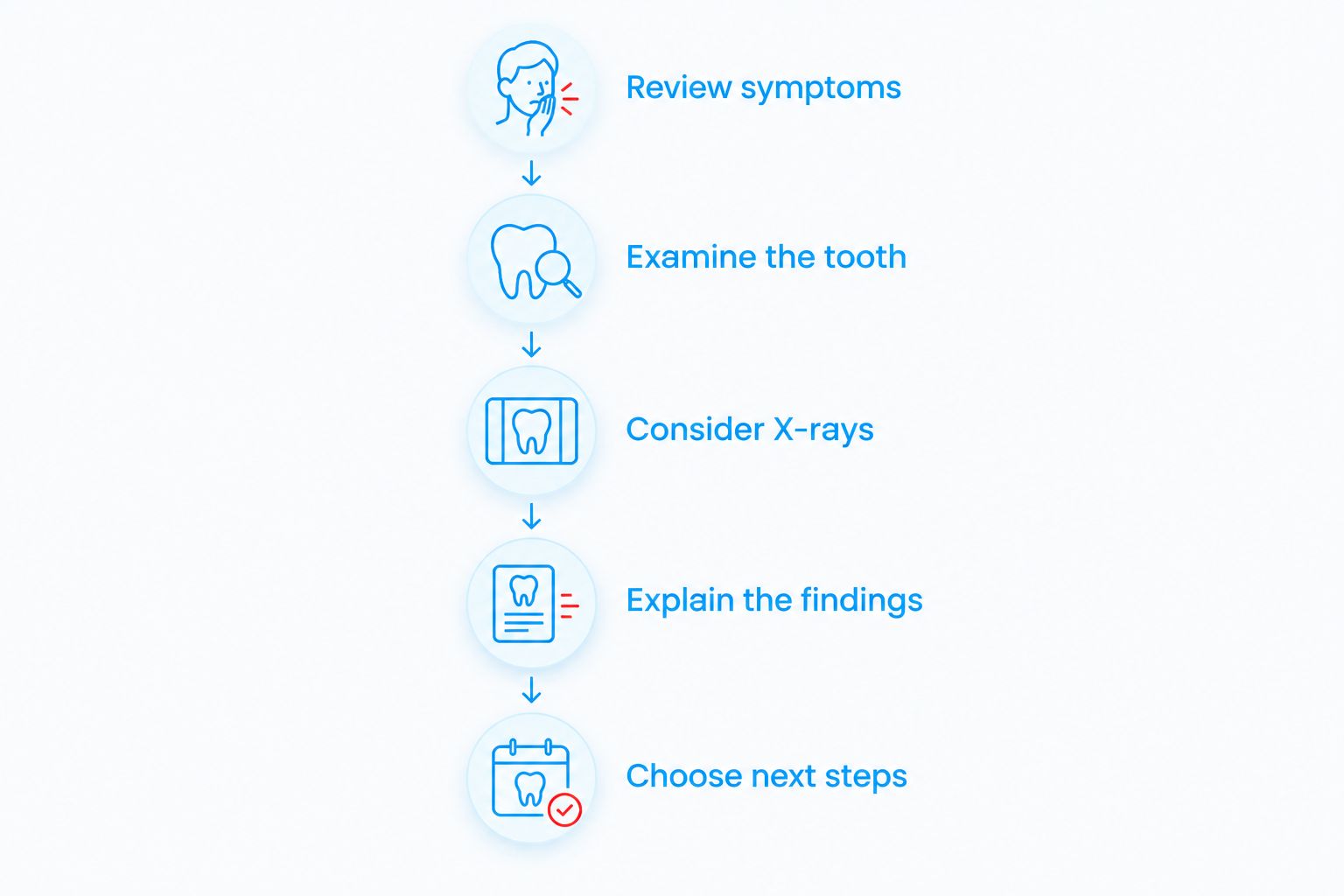
A 2026 cavity evaluation should answer more than whether a dark spot exists. The useful questions are whether decay is present, whether the surface remains intact, and what evidence supports the recommended care.
- Review symptoms. Explain any food trapping, previous discomfort, dry mouth, and recent changes in your oral care or health.
- Examine the tooth. The dentist inspects the tooth’s surfaces, existing fillings, and surrounding tissues for decay and other explanations.
- Consider X-rays. Bitewing X-rays can help detect decay between teeth, but imaging should follow your clinical needs rather than an automatic schedule.
- Explain the findings. Ask whether the area is early mineral loss or a hole, how deep it appears, and whether previous images show a change.
- Choose next steps. Agree on treatment or a specific monitoring plan, including what would trigger a different recommendation.
You can ask to see the area on an image or in a clinical photograph when one is available. An explanation should connect the finding to the recommendation; a dark shape on an X-ray alone is not a complete treatment discussion.
Does a painless cavity always need a filling?
Not every early decay lesion needs drilling, but a hole does not repair itself. The surface condition, depth, activity of the decay, and your ability to keep the area clean all matter.
If you are weighing prevention against repair in 2026, this guide to whether a cavity can be reversed without a filling explains the central distinction. Remineralization replaces lost minerals in an early lesion; it does not recreate missing tooth structure.
| Approach | Best for | Benefit | Limitation |
|---|---|---|---|
| Fluoride and preventive care | Suitable early lesions with an intact surface | Supports remineralization and helps control decay | Does not rebuild a hole; needs follow-up |
| Filling | Cavities suitable for a direct repair | Restores the damaged area’s shape and function | Removes damaged tissue and requires ongoing maintenance |
| Crown | Teeth too weakened for a filling alone | Protects and restores more extensively damaged structure | Requires more tooth preparation than a small filling |
| Root canal treatment | A restorable tooth with pulp disease that requires it | Treats diseased tissue inside the tooth | Is more involved and generally requires a protective restoration afterward |
These are treatment categories, not a progression every patient will need. A painless tooth does not automatically need root canal treatment, and a painful tooth does not automatically need extraction.
At Dental Arts of Atlantis, general dental care is relevant to evaluating these concerns. The appropriate treatment still depends on your tooth, rather than a treatment label or the absence of discomfort.
What should you do while waiting for your appointment?
Keep cleaning the tooth gently rather than avoiding it. For adults, the American Dental Association recommends brushing for 2 minutes, 2 times a day, with fluoride toothpaste, and cleaning between teeth 1 time a day.
Those habits support prevention; they are not proof that an existing cavity has stopped. Continue with the examination even if the tooth stays comfortable.
- Use fluoride toothpaste. Follow the product directions and ask for age-appropriate guidance for children.
- Clean between teeth. Use floss or another suitable interdental cleaner without forcing it into the gums.
- Reduce frequent sugar exposure. Repeated sipping or snacking gives decay-causing bacteria repeated opportunities to produce acids.
- Choose water between meals. Avoid replacing sweetened drinks with frequent acidic drinks, which can also harm enamel.
- Mention dry mouth. Saliva helps protect teeth; discuss persistent dryness and medications with your dental and medical clinicians.
Do not put aspirin directly on the tooth or gum. Do not use household glue or scrape away a suspicious spot; neither treats decay, and both can cause harm.
How soon should you get a painless cavity checked?
Arrange a dental appointment rather than waiting for a toothache. A suspected cavity without swelling or other concerning symptoms generally calls for a dental evaluation, not an emergency-room visit.
If a dentist has already diagnosed decay, ask for a recommended treatment timeframe based on its depth and activity. There is no safe universal waiting period that applies to every painless cavity.
For your 2026 appointment, bring any previous dental images or treatment recommendations you can obtain. Comparing records can help the dentist assess changes and explain why treatment or monitoring is appropriate.
When does a painless tooth need urgent attention?
Seek urgent dental care for new swelling, drainage, a bad taste associated with a swollen gum, fever, or feeling unwell. Trouble breathing or swallowing, or rapidly spreading facial or neck swelling, requires emergency medical care.
A reduction in pain after a severe toothache is not enough reason to cancel an appointment. The pulp can lose vitality while infection remains, so the tooth still needs assessment.
Can children have cavities without pain too?
Yes, children can have cavities without pain, including in baby teeth. Watch for visible changes, food trapping, or changes in eating, but remember that a child can have decay without showing any of those signs.
Baby teeth support chewing and help maintain space for permanent teeth. A painless cavity in a baby tooth still needs evaluation; waiting for it to fall out is not a treatment plan.
FAQ
Can I have a cavity without pain or sensitivity?
Yes, you can have a cavity without pain or sensitivity. Early decay can affect enamel without irritating the pulp, and some deeper lesions also produce few noticeable symptoms.
Does no pain mean my cavity is small?
No, the absence of pain does not establish a cavity’s size or depth. A dentist uses examination findings and appropriate imaging to assess the damage.
Can brushing get rid of a painless cavity?
Brushing with fluoride toothpaste can support remineralization of early enamel mineral loss, but it cannot rebuild a hole. A dentist must determine whether the surface remains intact and whether preventive care is appropriate.
Can a dentist see a cavity that I cannot see?
Yes, a dentist can identify decay in areas you cannot inspect well at home. An examination and, when indicated, X-rays help assess hidden surfaces between teeth.
Should I wait until a cavity hurts before getting treatment?
No, do not use pain as the trigger for treatment. Ask your dentist whether the lesion needs repair or a documented monitoring plan.
Can I need a root canal even if my tooth does not hurt?
Yes, a tooth can need root canal treatment without causing pain if testing identifies pulp disease that requires it. Lack of pain alone neither confirms nor rules out that treatment.
Why did my tooth stop hurting if the cavity is still there?
Pain can change without the underlying problem resolving. A tooth whose pulp has lost vitality can become less painful while still requiring treatment, so keep your dental appointment.
One last thing
Before leaving a 2026 checkup, ask: Is this an intact area of mineral loss, or has a hole formed? Then ask what finding supports the next step and when the tooth should be reassessed.
That conversation gives you something more useful than reassurance based on comfort alone: a clear reason for treating the tooth now or watching it under a defined plan.
Related guides
- Can a cavity be filled without numbing?
- How often should adults get a dental checkup and cleaning?
- How to get a second opinion on a dental treatment plan