
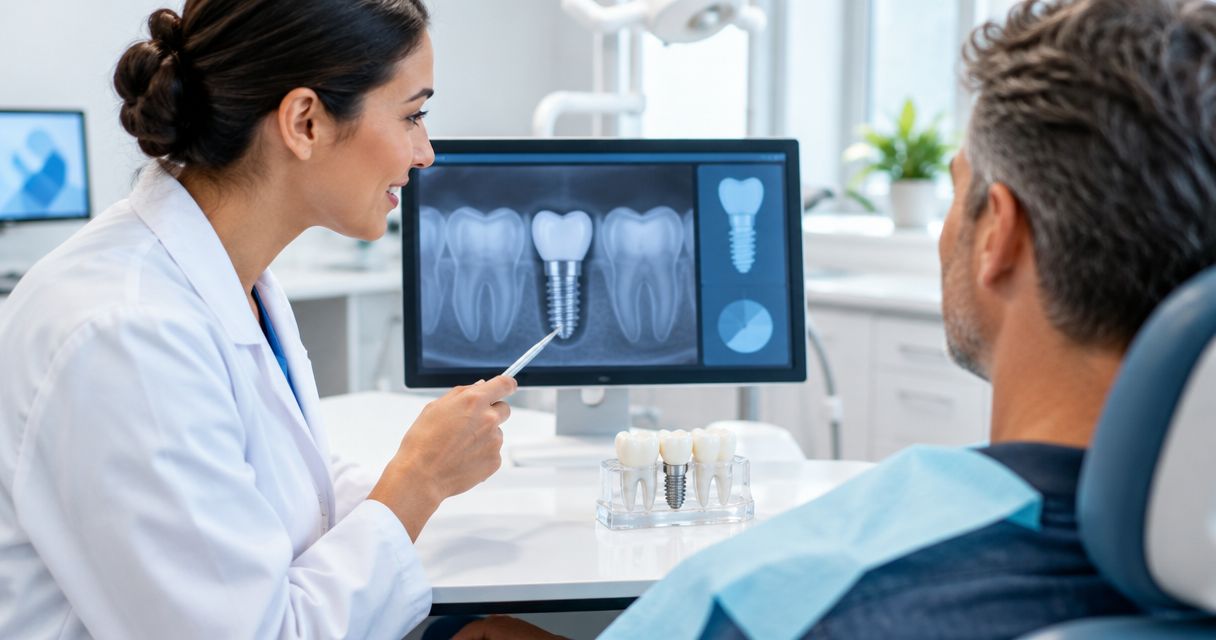
You can get a dental implant on the same day as a tooth extraction if the socket and surrounding bone support it; other treatment paths allow healing before placement. The extraction to implant timeline depends on infection, bone support, and gum healing—not simply how long you have waited. Placing the implant is not the same as receiving your final tooth: the implant usually needs additional healing before it supports the finished crown.
- The extraction to implant timeline separates socket healing, implant placement, and final crown delivery.
- Immediate dental implants suit selected extraction sites; same-day placement does not guarantee a same-day final tooth.
- Bone grafting, infection, and implant stability determine whether treatment needs additional healing stages.
- Dental Arts of Atlantis offers implant dentistry for families in Lake Worth and Palm Beach County.
Why this matters
A treatment date only helps if you know what happens on that date. Extraction, implant surgery, and crown placement are different milestones, even when your dentist combines some of them.
For your 2026 treatment plan, ask for those milestones separately. Planning dental implants for one missing tooth means deciding both when the implant belongs in the bone and how to protect the space while you heal.
How long after a tooth extraction can you get a dental implant?
Implant placement follows several recognized timing pathways. The International Team for Implantology classifies placement according to whether it occurs immediately, after soft-tissue healing, after partial bone healing, or in a fully healed site.
These are clinical timing categories, not promised appointment dates. Your dentist selects a pathway after examining the extraction site and reviewing appropriate imaging.
| Placement pathway | Timing after extraction | Best suited to | Main advantage | Main limitation |
|---|---|---|---|---|
| Immediate placement | Same day | Selected sites with enough supporting bone for implant stability | Combines extraction and implant placement | Requires suitable anatomy and careful case selection |
| Early placement after gum healing | About 4–8 weeks | Sites that benefit from soft-tissue healing first | Allows the gum to heal before surgery | Adds a separate healing interval |
| Early placement after partial bone healing | About 12–16 weeks | Sites needing more socket healing before placement | Allows additional bone healing | Extends the period before implant surgery |
| Late placement | More than 6 months | Fully healed sites, including teeth lost previously | Allows placement after socket healing | Bone changes can make additional treatment necessary |
The categories do not mean everyone must choose between immediate placement and waiting more than 6 months. The intermediate pathways exist because different extraction sites need different preparation.
Immediate placement: the same day as extraction
Best suited to: an extraction site that allows stable, correctly positioned implant placement. Your dentist removes the tooth and places the implant during the same procedure when the anatomy and clinical findings support that approach.
The implant must gain stability in supporting bone. An empty socket alone does not establish that the site is ready, and the implant should sit where the future crown needs it—not simply follow the old root's position.
Immediate placement reduces the number of separate surgical appointments when extraction and implant surgery occur together. Its limitation is case selection: damaged socket walls, insufficient supporting bone, or other findings can require a different plan.
A same-day implant does not automatically mean a same-day final crown. A temporary tooth, when appropriate, has a different role from the finished restoration and can carry restrictions on biting.
Early placement after gum healing: about 4–8 weeks
Best suited to: sites where healing of the soft tissue helps prepare for implant surgery. In this pathway, the dentist removes the tooth first and reassesses the area after the gum has had time to heal.
The advantage is a healed soft-tissue environment before implant placement. The trade-off is another procedure and a waiting period between extraction and implant surgery.
About 4–8 weeks is a placement category, not proof that your socket is ready on a particular day. Your dentist still needs to assess bone support, tissue condition, and the planned implant position.
If you are organizing treatment in 2026 around travel or work, leave room for that reassessment. Booking surgery before the healing check does not make the site heal faster.
Early placement after partial bone healing: about 12–16 weeks
Best suited to: sites that need more socket healing before an implant is placed. This approach allows partial bone healing after extraction rather than proceeding as soon as the gum closes.
The benefit is additional healing before the next operation. The limitation is a longer interval without the final replacement tooth, so discuss a temporary replacement if the gap affects your appearance or daily activities.
About 12–16 weeks does not include every later treatment stage. Implant healing, impressions or scans, and crown fabrication still follow according to your individual plan.
Gum closure and bone readiness are not interchangeable. A socket that looks closed from above still needs a clinical assessment before implant placement.
Late placement: more than 6 months after extraction
Best suited to: a fully healed extraction site or a tooth that has been missing for some time. Late placement remains an established treatment pathway; missing the immediate-placement window does not automatically rule out an implant.
The benefit is that the extraction socket has healed before implant surgery. The limitation is that the jaw ridge changes after tooth loss, which can leave less bone in the position needed for an implant.
More than 6 months describes this timing category, not a recommended waiting period for every patient. If your tooth is already missing, arrange an assessment rather than waiting longer without a plan.
Ask whether the site supports the intended implant or needs bone augmentation. The answer comes from examination and imaging, not the age of the gap alone.
Why the extraction to implant timeline varies
The calendar is only one part of implant planning. These factors explain why two people having the same tooth removed can receive different recommendations:
- Bone support: The implant needs enough bone in an appropriate position to achieve stability.
- Socket condition: Damage to the bone around the extracted root changes the placement plan.
- Infection and inflammation: Your dentist must assess and manage disease at the site before deciding how to proceed.
- Grafting needs: Some grafts accompany implant placement; others require a separate healing stage.
- Gum condition: Soft-tissue thickness, recession, and the gumline matter, particularly for visible teeth.
- Health and healing: Smoking, diabetes control, medications, and other health factors belong in the surgical assessment.
Dental Arts of Atlantis provides implant dentistry in Lake Worth. Bring an updated medication list and describe any previous healing problems so your discussion addresses your health as well as the missing tooth.
What happens between extraction and your final tooth?
For 2026 scheduling, request a staged plan rather than a single completion date. The sequence below shows where an individual plan can change.
- Site assessment: Your dentist examines the tooth or gap, reviews your health history, and determines what imaging is needed.
- Tooth removal: If the tooth remains present, the extraction and socket findings help determine the next step.
- Site healing: The area heals, with grafting when indicated. Selected sites move directly from extraction to implant placement.
- Implant placement: Your dentist places the implant and checks its stability before deciding how to protect it during healing.
- Final restoration: After the implant is ready to support the restoration, the dentist completes the connecting components and crown.
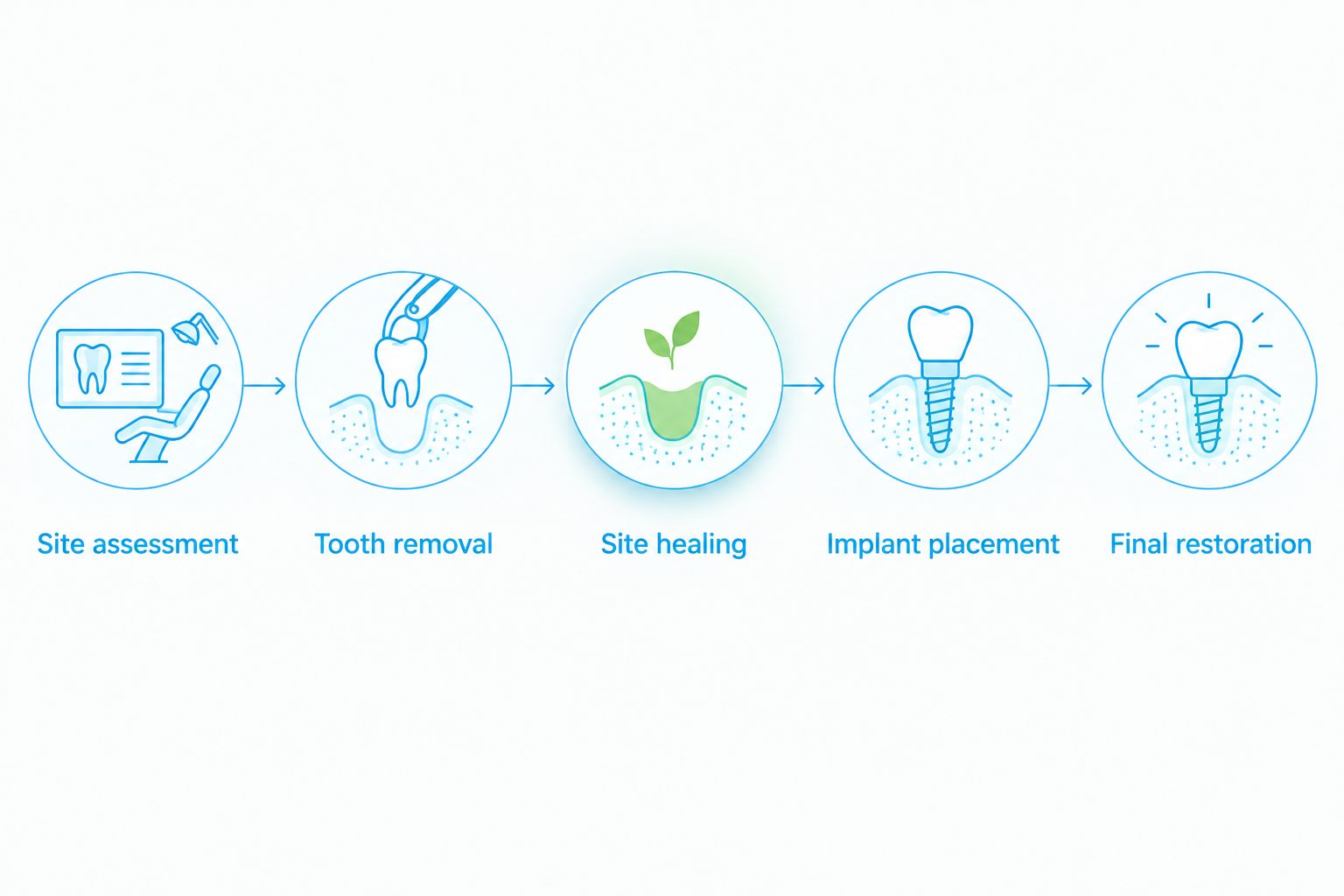
Ask what finding allows you to move from one stage to the next. A healing check is a treatment decision, not just an appointment on the calendar.
Does bone grafting mean you have to wait longer?
Bone grafting adds a separate waiting stage when the site needs to heal before it can support an implant. When conditions allow grafting and implant placement together, the sequence is different.
Ask whether the graft is staged or simultaneous. That distinction tells you more about your schedule than the word “graft” by itself.
Socket preservation at extraction aims to manage the ridge after tooth removal; it does not guarantee that no additional grafting will be needed. The eventual implant position and the amount of supporting bone still determine the next step.
For a 2026 plan involving grafting, ask which appointment reassesses the graft and what clinical findings must be present before implant surgery. Avoid treating an estimated healing interval as surgical clearance.
Will you have to go without a tooth while you heal?
Not every healing period requires a visible gap, but a temporary replacement must protect the surgical site. Ask about an appropriate temporary tooth before extraction, particularly when the tooth shows when you smile.
The design matters. A temporary restoration should not place unwanted pressure on a healing graft or load an implant before the dentist approves it.
When several or all teeth need replacement, the restoration changes the treatment discussion. The distinction between All-on-4 implants versus snap-in dentures includes whether the replacement stays fixed or is removable, so clarify the intended restoration before interpreting a surgery date as the date treatment ends.
For any temporary tooth, get written instructions covering eating, cleaning, and wearing it. Looking finished does not mean the underlying implant has finished healing.
What should you ask at your implant consultation?
Bring your schedule, but start with the clinical questions. These help separate a reasonable estimate from a promise that overlooks healing:
- Which placement pathway fits my extraction site, and why?
- Do I need grafting, and would it happen before or during implant placement?
- What temporary replacement is appropriate while I heal?
- Which appointment checks whether the implant is ready for the crown?
- What would change the treatment schedule?
- Who should I contact if symptoms worsen between visits?
Dental Arts of Atlantis is best suited to Lake Worth families seeking implant and family dentistry in one practice. The practice offers general, pediatric, cosmetic, and implant care; your examination determines the treatment sequence appropriate for you.
Discuss your implant timeline
Ask about extraction timing, healing stages, and the plan for your replacement tooth.
When should you call instead of waiting?
Contact your treating dentist if pain or swelling worsens rather than improves, if you develop fever or drainage, or if a temporary tooth presses on the surgical area. These symptoms need assessment rather than a decision to continue waiting for the next planned milestone.
Seek emergency care for difficulty breathing or swallowing, rapidly spreading swelling, or bleeding that does not stop with the instructions your clinician provided. Do not try to test implant stability by pushing or wiggling it.
FAQ
Can I get an implant immediately after a tooth is pulled?
Same-day implant placement is possible when the extraction site permits stable, correctly positioned placement. Your dentist must assess the socket, supporting bone, and other clinical findings before choosing this pathway.
Is 4–8 weeks enough time to wait after an extraction?
About 4–8 weeks is a recognized early-placement interval after soft-tissue healing. It is not automatic clearance for surgery; the dentist still needs to assess the site.
Why would my dentist recommend waiting 12–16 weeks?
About 12–16 weeks allows partial bone healing before implant placement. Your dentist selects this pathway when the site’s condition supports waiting for that stage of healing.
Can I still get an implant more than 6 months after extraction?
More than 6 months after extraction falls within the late-placement category, and an implant can still be an option. An examination and imaging establish whether the healed ridge needs additional treatment.
Does getting an implant mean I get the final tooth that day?
Implant placement does not automatically include a same-day final tooth. The implant’s stability and treatment plan determine whether a temporary restoration is appropriate and when the final crown can follow.
Does an infected tooth always prevent immediate implant placement?
An infected tooth requires an individual assessment rather than an automatic same-day decision. Infection control, socket condition, and the ability to achieve implant stability all affect placement timing.
How do I get an extraction to implant timeline for my own tooth?
An individualized extraction to implant timeline starts with an examination, health-history review, and appropriate imaging. Dental Arts of Atlantis offers implant dentistry in Lake Worth for patients discussing those treatment stages.
One last thing
Plan the replacement before the extraction whenever circumstances allow. Decisions about preserving the socket, positioning the future implant, and providing a temporary tooth belong in that early conversation.
If your tooth has already been removed, the next step in 2026 is still an assessment—not guessing how many more weeks to wait. Ask what your site needs now and which finding will make it ready for the next stage.
Related guides
- How long a dental implant takes from start to finish
- Bone grafting for dental implants with low bone density
- How to care for dental implants after surgery