
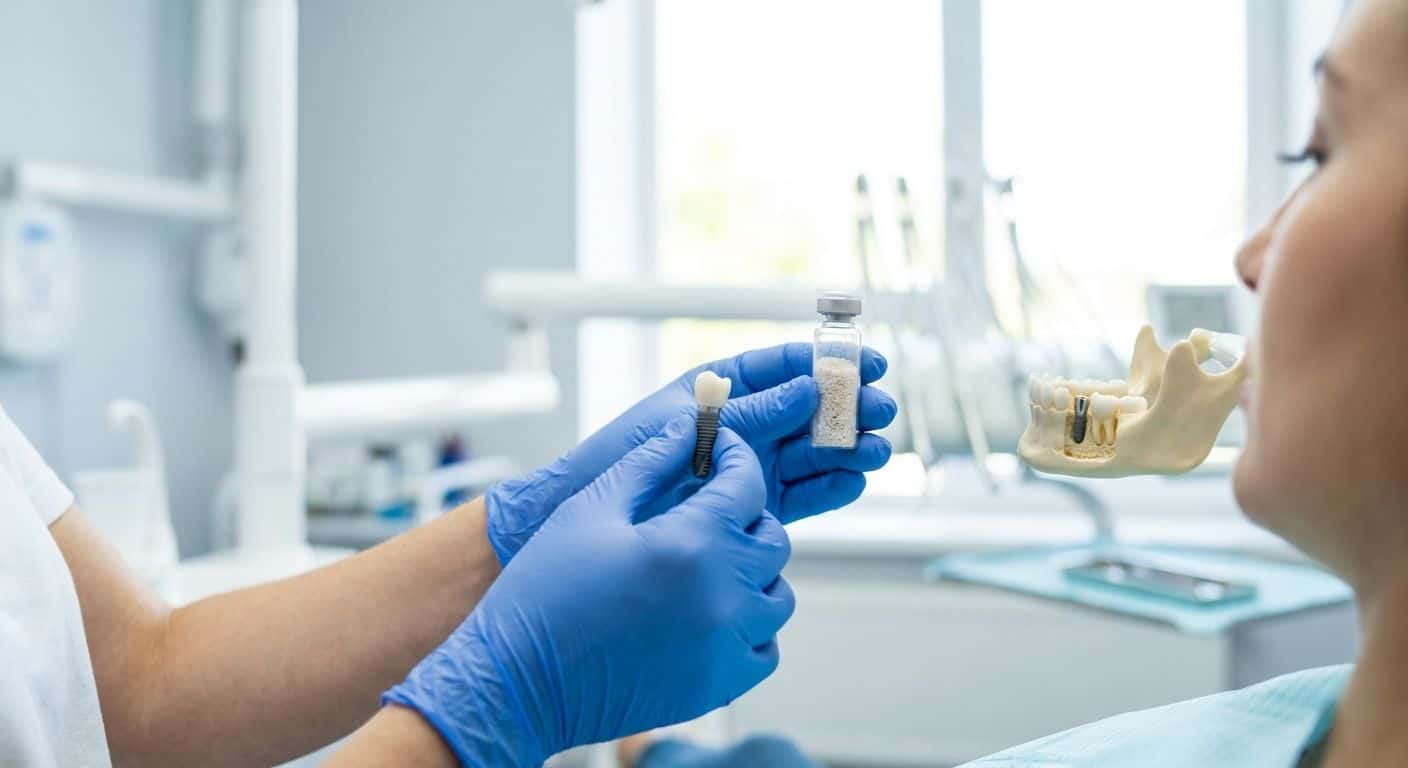
Low bone density in the jaw doesn't rule out dental implants, but it changes the plan: most patients need a bone graft first to rebuild the ridge before an implant can anchor securely. This guide breaks down which graft type fits which situation, what recovery actually looks like, and where patients waste money on the wrong approach.
- Autograft bone (your own) heals fastest for implant readiness but adds a second surgical site.
- Allograft and xenograft material work for most low-density cases and skip the second incision.
- A bone graft for dental implants typically needs 4-6 months to integrate before placement.
- Sinus lifts and ridge augmentation are graft variations for the upper back jaw and full-arch cases, not separate treatments.
- Skipping grafting on thin bone raises implant failure risk and shortens the fixture’s lifespan.
Why this matters
Bone doesn't sit idle waiting for a tooth to grow back. Dental literature has long documented that the jaw can lose up to 25% of its width in the first 12 months after a tooth is extracted, and that loss accelerates the longer the gap stays empty. By the time many patients in 2026 book an implant consultation, the ridge is too thin or too short to hold a standard fixture without help.
A bone graft for dental implants isn't an upsell — it's what turns a compromised ridge into a stable foundation. Ignore it and the implant either fails outright or slowly loosens as the surrounding bone continues to shrink. Get it right and you're looking at an implant that functions like a natural tooth root for decades.
Who this is for
This guide is for anyone told at a consultation that their jawbone is "too thin," "too soft," or shows "insufficient density" on a 3-D scan — patients who lost a tooth years ago, wear dentures that have caused ridge resorption, or have osteoporosis affecting jaw density. It's also for anyone comparing implant clinics and trying to understand why one practice quotes a straightforward implant and another recommends grafting first.
What to look for in a bone graft for dental implants
3-D imaging before any recommendation
A flat 2-D X-ray can't measure ridge width or sinus proximity accurately. Look for a practice that uses 3-D cone-beam imaging to measure actual bone volume in millimeters before recommending a graft — guessing here means either over-grafting healthy bone or under-grafting a site that later fails.
Graft material matched to your defect size
A small socket preservation graft after extraction needs different material than a full sinus lift. Practices that default to one material for every case usually aren't tailoring treatment to the actual bone loss shown on the scan.
A realistic healing timeline, not a rushed one
Graft integration runs 4 to 6 months for most ridge grafts and 6 to 9 months for sinus lifts before the site can support an implant. Any provider promising implant placement within weeks of a major graft on a low-density jaw is skipping a step that determines whether the implant holds.
A documented plan for combining grafting with placement or staging it
Some sites qualify for a graft and implant placed the same day; most low-density cases need the graft to heal first, then implant placement as a second procedure. Your first dental implant consultation should include a clear answer on which path applies to you, not a one-size-fits-all script.
Sedation options if anxiety is part of the picture
Grafting adds a procedure most patients haven't done before, and anxiety about a second surgical step is common. Ask what sedation options are available before the day of surgery, not after you're already in the chair.
Post-op support that matches the complexity
A graft site needs more careful aftercare than a simple filling — swelling management, diet restrictions, and follow-up imaging to confirm integration. A practice that hands you a generic printout instead of a specific care plan is a red flag for a procedure this technique-sensitive.
Top picks: which graft type fits your case
Autograft — the gold standard, if you can handle a second site
Autograft bone comes from your own body, usually the chin, jaw, or hip, and carries zero rejection risk because it's your own tissue. It integrates faster than donor material in many cases and is the strongest option for patients with severe bone loss needing structural rebuilding. The tradeoff is a second surgical site with its own recovery. Verdict: Buy if you have significant bone loss and want the fastest, most predictable integration, and you're comfortable with the added procedure.
Allograft — the practical default for most low-density cases
Allograft material comes from a screened human tissue bank, processed to remove cellular material while keeping the mineral scaffold that encourages your own bone to grow into it. It skips the second surgical site entirely and covers the majority of ridge and socket grafts performed in 2026. Integration typically runs 4 to 6 months. Verdict: Buy for most patients with moderate bone loss who want a single-site procedure.
Xenograft — the sinus lift workhorse
Xenograft material, most commonly bovine-derived and processed to be biocompatible, is a mainstay for sinus lift procedures because it resorbs slowly and holds volume well in the upper jaw where bone quality is naturally thinner. It's a strong fit when the defect is in the back upper jaw near the sinus cavity. Verdict: Consider if your low-density area is specifically in the posterior maxilla.
Alloplast — the synthetic option for smaller defects
Alloplast grafts use synthetic, biocompatible material (typically calcium phosphate–based) rather than human or animal tissue. They work well for smaller socket preservation grafts and for patients who prefer to avoid donor tissue for personal reasons. They generally aren't the first choice for large ridge rebuilds. Verdict: Consider for smaller, contained defects; Skip for major ridge reconstruction.
Ridge augmentation and sinus lift — the full-arch and posterior-maxilla fix
These aren't separate graft materials but specific techniques: ridge augmentation widens a narrow ridge, and a sinus lift raises the sinus floor to create vertical bone height in the upper back jaw. Both are common prerequisites when a patient is planning full-arch implant restoration and the existing bone won't support the number of fixtures needed. Verdict: Buy when the scan confirms insufficient height or width for the planned implant count.
Find out which graft your jaw needs
A 3-D scan shows exactly how much bone you have before any procedure is planned.
What to avoid
- Skipping the graft to save time. Placing an implant into bone that's too thin often leads to exposed threads, gum recession around the fixture, or early failure within the first year.
- Choosing a graft material based on cost alone without a volume measurement. The cheapest option might be under-sized for your specific defect, meaning a second graft procedure later.
- Assuming all bone loss needs a major graft. Small socket-preservation cases sometimes need only a minor graft at the time of extraction — over-treating adds cost and healing time without benefit.
Verdict comparison
| Graft type | Best for | Healing time | Verdict |
|---|---|---|---|
| Autograft | Severe bone loss, fastest integration | 3-5 months | Buy (if comfortable with second site) |
| Allograft | Most moderate ridge/socket defects | 4-6 months | Buy |
| Xenograft | Sinus lift, posterior upper jaw | 6-9 months | Consider |
| Alloplast | Small, contained defects | 4-6 months | Consider |
| Ridge augmentation/sinus lift | Full-arch planning, low vertical/width bone | 6-9 months | Buy (when scan confirms need) |
FAQ
What is a bone graft for dental implants?
It’s a procedure that adds bone material to a jaw site that’s too thin or soft to support an implant on its own. The graft integrates with existing bone over several months, creating a stable base for the implant fixture.
How long does bone graft healing take before implant placement?
Most ridge and socket grafts need 4 to 6 months to integrate; sinus lifts typically need 6 to 9 months. Placement is usually scheduled only after a follow-up scan confirms the graft has taken.
Does insurance cover bone grafting for dental implants?
Coverage varies widely by plan and is often partial rather than full. Financing options exist for patients paying out of pocket for the graft, implant, or both.
Can you get dental implants without a bone graft?
Yes, if a 3-D scan shows enough bone width and height at the site. Many patients with long-standing tooth loss or denture wear don’t qualify without grafting first.
What’s the difference between autograft and allograft bone for implants?
Autograft uses your own bone from another site in your body, while allograft uses processed donor bone from a tissue bank. Autograft often integrates faster but requires a second surgical site; allograft avoids that but takes slightly longer to integrate.
Is a sinus lift the same as a bone graft?
A sinus lift is a specific bone grafting technique used in the upper back jaw, where the sinus floor is raised to add vertical bone height. It uses graft material just like other bone grafts, but it’s named for the anatomical technique rather than the material itself.
How much bone loss is too much for a dental implant?
There’s no single cutoff — it depends on implant size, location, and the type of restoration planned. A 3-D scan measuring actual ridge width and height is the only reliable way to determine if grafting is needed.
What happens if you skip bone grafting with low bone density?
The implant may lack enough surrounding bone to stay stable, raising the risk of early failure, exposed threads, or gum recession around the fixture. Some cases fail within the first year without adequate bone support.
One last thing
The scan matters more than the material. Two patients with the same "low bone density" label on paper can need completely different grafts once a 3-D image measures the actual defect in millimeters — the label alone tells you almost nothing about which procedure fits.
Related guides