
Yes, Invisalign can correct some crossbites when the problem comes from tooth position rather than a major mismatch between the jaws. Treatment sometimes requires attachments, elastics, or another appliance; clear aligners alone cannot correct every crossbite, so an examination must establish what is causing yours.
- Can Invisalign fix a crossbite? Yes, for suitable tooth-position problems; major jaw discrepancies need a different treatment plan.
- Invisalign moves teeth; correcting tooth position is not the same as correcting a skeletal jaw mismatch.
- Dental Arts of Atlantis offers Invisalign and family dental care in Lake Worth, Florida.
- Choose treatment after a bite examination, not from the appearance of your front teeth alone.
Why this matters
A crossbite is not only a cosmetic concern. When upper and lower teeth meet in the wrong relationship, some teeth experience unfavorable contact, and a growing child sometimes shifts the jaw to close comfortably. Your dentist needs to check the bite in motion, not just how your smile looks in a photograph.
For your 2026 treatment decision, start with a diagnosis rather than an appliance preference. Dental Arts of Atlantis provides Invisalign alongside general and pediatric dental services, giving Lake Worth families a place to discuss tooth alignment within their wider dental care.
Can Invisalign fix a crossbite?
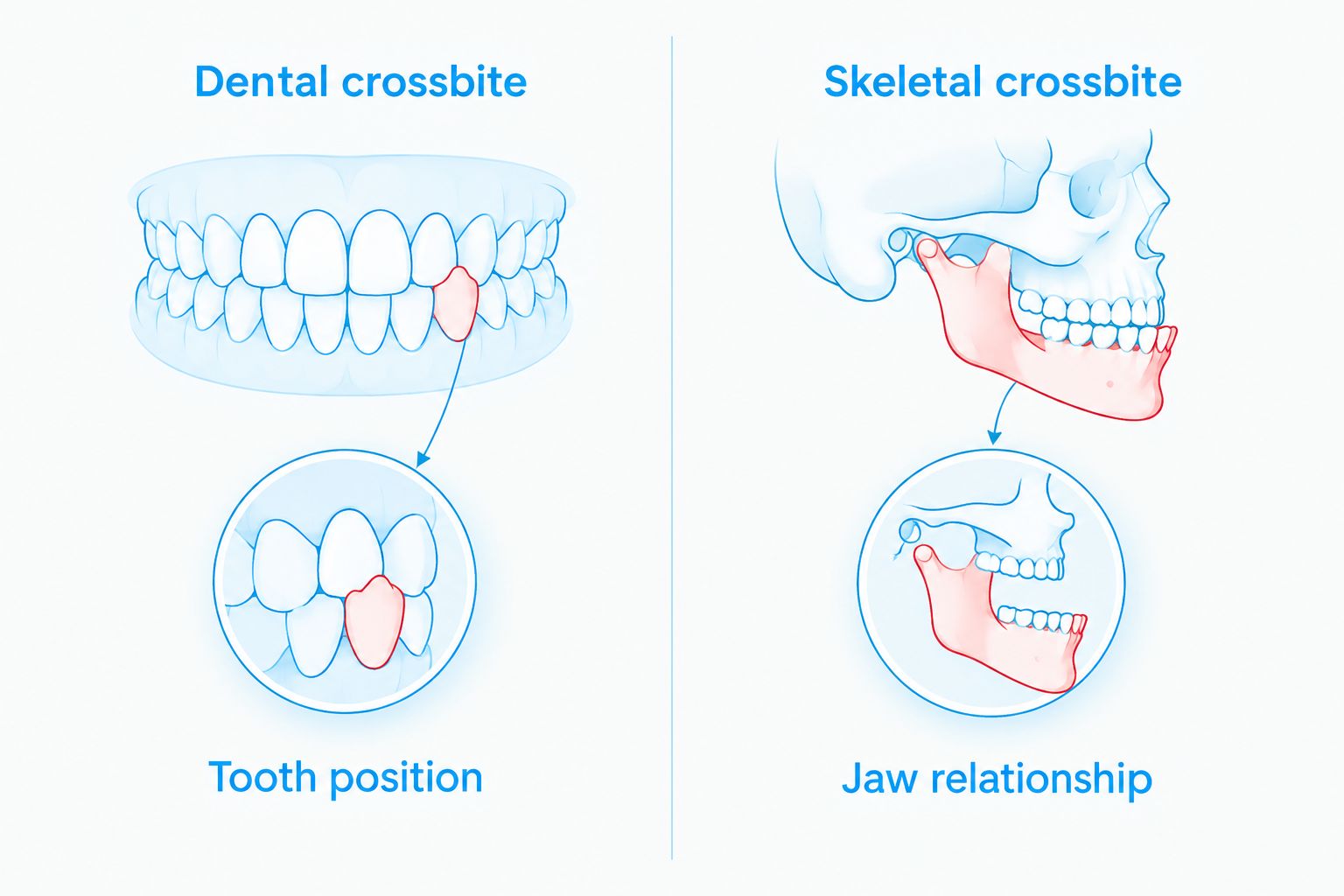
Invisalign is an option for selected dental crossbites, but it is not a universal treatment for skeletal crossbites. The important distinction is whether teeth are tilted or positioned incorrectly, whether the jaws differ in width or position, or whether both problems are present.
| Crossbite cause | What needs to change | Where Invisalign fits | Main limitation |
|---|---|---|---|
| Dental crossbite | Tooth position or inclination | Can move suitable teeth into a better bite relationship | Available space, root position, and gum support limit movement |
| Skeletal crossbite | Jaw width or jaw relationship | Sometimes forms part of a broader treatment plan | Tooth movement alone does not correct a major skeletal discrepancy |
A crossbite involving a front tooth is an anterior crossbite. A crossbite involving back teeth is a posterior crossbite; it can affect either side or both sides of your mouth. Location helps describe the problem, but it does not establish the cause.
Your dentist also checks for a functional shift: a change in jaw position as you close because a tooth contact gets in the way. That finding changes treatment planning, especially for a growing child.
When Invisalign is a suitable crossbite option
Invisalign deserves consideration when planned tooth movements can improve the bite without moving teeth beyond healthy supporting bone and gums. You also need a realistic daily wear routine. Removable aligners only apply their planned forces while you wear them.
Your clinician assesses the following before recommending treatment:
- Whether the crossbite is primarily dental or skeletal.
- Whether there is enough space to move the affected teeth.
- Whether the upper and lower teeth can meet comfortably after movement.
- Whether your gums, bone support, and teeth are healthy enough for treatment.
- Whether you can follow wear instructions and attend progress checks.
Invisalign's patient guidance generally calls for 20–22 hours of aligner wear per day. Follow your treating clinician's instructions for your own case; removing trays frequently or leaving them out for long stretches disrupts the planned sequence.
Attachments are small tooth-colored shapes bonded to selected teeth to help aligners apply particular movements. Elastics sometimes help coordinate the bite. Neither addition means treatment has failed, but both make the daily routine more involved than simply inserting clear trays.
When Invisalign alone is not enough
A narrow upper jaw, a substantial jaw-position discrepancy, or movements outside safe dental limits require a broader assessment. In a growing patient, an expansion appliance sometimes addresses a width problem. In an adult with a significant skeletal discrepancy, an orthodontist sometimes recommends a combined orthodontic and jaw-surgery assessment.
That does not mean every crossbite needs surgery. It means the treatment must match the cause, rather than asking aligners to solve a problem that tooth movement alone cannot resolve.
Braces are another way to move teeth. They provide fixed appliances that do not depend on remembering to reinsert trays, although elastics, cleaning, and appointments still require cooperation. Braces do not automatically solve a skeletal problem either.
For a 2026 consultation, ask whether the proposed correction treats the underlying jaw relationship or compensates for it by changing tooth position. Both approaches have specific uses, but they are not interchangeable.
Invisalign versus other crossbite treatments
The best treatment is the one that corrects your diagnosed problem within healthy limits. The table below describes general treatment roles, not a recommendation for your individual bite or a list of services available at any particular office.
| Option | Best for | Main advantage | Main limitation |
|---|---|---|---|
| Invisalign | Suitable dental crossbites in patients who can follow a wear routine | Removable for meals and oral hygiene | Depends on wear consistency and the movements required |
| Braces | Cases where fixed appliances suit the planned tooth movements | Appliances remain attached to teeth | Cleaning around brackets takes extra attention |
| Expansion appliance | Selected upper-jaw width problems, particularly during growth | Addresses width when expansion is indicated | Suitability depends on growth, anatomy, and appliance type |
| Combined orthodontic and surgical treatment | Significant skeletal discrepancies requiring specialist care | Addresses jaw structure as well as tooth alignment | Requires surgery, recovery, and coordinated treatment |
Do not choose between Invisalign and braces on visibility alone. Ask which option gives your clinician appropriate control over the teeth involved in the crossbite, and whether either option needs an additional appliance.
Removability is a practical advantage only if it fits your habits. If you routinely misplace appliances or cannot maintain wear time, discuss that before treatment begins rather than after progress falls behind.
Why crossbite treatment varies
Crossbites that look similar in photographs can require different plans. These factors explain why a friend's experience is not a reliable forecast for yours:
- Underlying cause: Tooth-position problems and jaw-width problems require different approaches.
- Growth stage: A child's developing jaws create treatment considerations that differ from an adult's.
- Movement required: Changing tooth inclination differs from controlling the position of an entire tooth and its root.
- Available space: Crowding affects how the clinician creates room for correction.
- Supporting tissues: Gum health, bone support, and recession influence safe movement limits.
- Treatment cooperation: Aligner wear, prescribed elastics, and follow-up visits affect whether treatment follows the plan.
Your 2026 plan should explain which of these factors matter in your mouth. Ask the clinician to point them out on your examination records rather than accepting a general statement that your case is simple or complex.
What happens at a crossbite consultation?
A useful consultation answers more than whether you qualify for clear aligners. You should leave understanding the cause of your crossbite, the intended bite correction, and what treatment requires from you.
- Discuss your concerns. Explain where teeth catch, whether chewing feels uneven, and whether your jaw shifts when you close. Mention previous orthodontic treatment and any current retainers.
- Examine teeth and gums. The clinician checks dental health, wear, supporting tissues, and the contacts between upper and lower teeth.
- Collect appropriate records. Photographs, scans or impressions, and clinically indicated imaging help assess tooth positions and supporting structures.
- Compare treatment approaches. Ask whether Invisalign alone is suitable, whether additional appliances are needed, and whether an orthodontic referral is appropriate.
- Review follow-up and retention. Establish how progress will be checked, what happens if movement differs from the plan, and how the result will be maintained.
A digital preview illustrates planned movement; it does not guarantee the biological response of your teeth. Ask how the clinician will check the actual bite during treatment, not only whether the teeth resemble the preview.
Dental Arts of Atlantis is best for Lake Worth families seeking Invisalign alongside general and pediatric dental care. An examination establishes whether your crossbite belongs within that treatment approach or needs specialist assessment.
Discuss your crossbite concerns
Ask whether your bite needs tooth movement, a broader orthodontic assessment, or another approach.
How long does Invisalign take to fix a crossbite?
Crossbite treatment time depends on the movements required and whether additional treatment is necessary. A small visible overlap does not establish a short treatment course, because root position, space, and the rest of the bite also matter.
Ask for an individualized estimate after examination and records. Clarify whether that estimate includes additional aligners if needed, bite finishing, and the transition to retainers.
For your 2026 schedule, plan around the required daily routine rather than a promised finish date. Keep follow-up visits even when your front teeth already look straighter; the bite still needs assessment.
Can adults and children use the same crossbite treatment?
Adults and children need different assessments because jaw growth affects treatment choices. An adult can have successful tooth movement, but adult aligner treatment does not recreate childhood jaw growth.
The American Association of Orthodontists recommends an orthodontic check by age 7 years. That recommendation does not mean every child needs treatment then; it helps identify developing bite problems and decide whether monitoring or early intervention is appropriate.
If your child shifts the jaw to close, bites unusually, or has teeth that meet in reverse, arrange an assessment rather than waiting for all permanent teeth. Do not choose an appliance from age alone.
Will the crossbite stay corrected after Invisalign?
Retainers help maintain tooth positions after Invisalign, and your clinician must prescribe the retention plan. Teeth can move after active treatment, so finishing your last aligner is not the end of follow-up care.
Wear retainers as instructed and report a retainer that no longer fits. Do not force an old appliance onto teeth that have shifted or use it as a do-it-yourself crossbite treatment.
Caring for your teeth during crossbite treatment
Remove aligners for meals and clean your teeth before reinserting them as directed. Trapping food and sugary drinks against teeth creates a different problem while you are trying to improve your bite.
Keep the standard home-care foundation: brush with fluoride toothpaste for 2 minutes per session, twice a day, and clean between your teeth daily. Clean the aligners using the method your clinician recommends; hot water can distort plastic appliances.
During treatment, report a tray that stops seating fully, a broken attachment, persistent pain, or a sudden change in how your teeth meet. Do not advance through trays faster to make up for missed wear.
FAQ
Can Invisalign fix a crossbite in adults?
Yes, Invisalign can correct selected adult crossbites caused by tooth position. A significant skeletal jaw mismatch requires a broader orthodontic assessment because aligners do not correct every structural problem.
Is Invisalign better than braces for a crossbite?
Neither Invisalign nor braces is better for every crossbite. The choice depends on the required movements, jaw relationship, oral health, and your ability to follow treatment instructions.
Can Invisalign fix a back-tooth crossbite?
Invisalign can treat some posterior, or back-tooth, crossbites. Your clinician must determine whether the problem comes from tooth position, jaw width, or both before recommending aligners.
Will I need rubber bands with Invisalign for a crossbite?
Some Invisalign crossbite plans include elastics to help coordinate the bite. Your clinician decides whether they are needed and gives specific instructions for wearing them.
Does a crossbite always need jaw surgery?
No, a crossbite does not always need jaw surgery. Surgery is considered for selected skeletal discrepancies, while other crossbites are treated through tooth movement or an appropriate expansion approach.
Can I fix a crossbite by wearing an old retainer?
No, you should not use an old retainer to attempt crossbite correction yourself. A retainer that no longer fits needs professional assessment rather than force.
Should I wait until my child loses every baby tooth?
No, you do not need to wait until every baby tooth is gone to seek a crossbite assessment. The American Association of Orthodontists recommends an orthodontic check by age 7 years, with treatment timing based on the findings.
One last thing
Ask to see what a successful bite looks like, not just what straight front teeth look like. Before starting treatment in 2026, ask which tooth contacts should change, whether a jaw shift should improve, and how the final bite will be checked.
Straight-looking teeth and a well-functioning bite are related goals, not identical ones. Understanding that distinction helps you judge the plan before committing to an appliance.
Related guides
- Invisalign vs. braces for adults: which is right for you?
- How long does Invisalign treatment take?
- Can you get Invisalign with dental crowns?
- How to care for your retainer after Invisalign treatment