
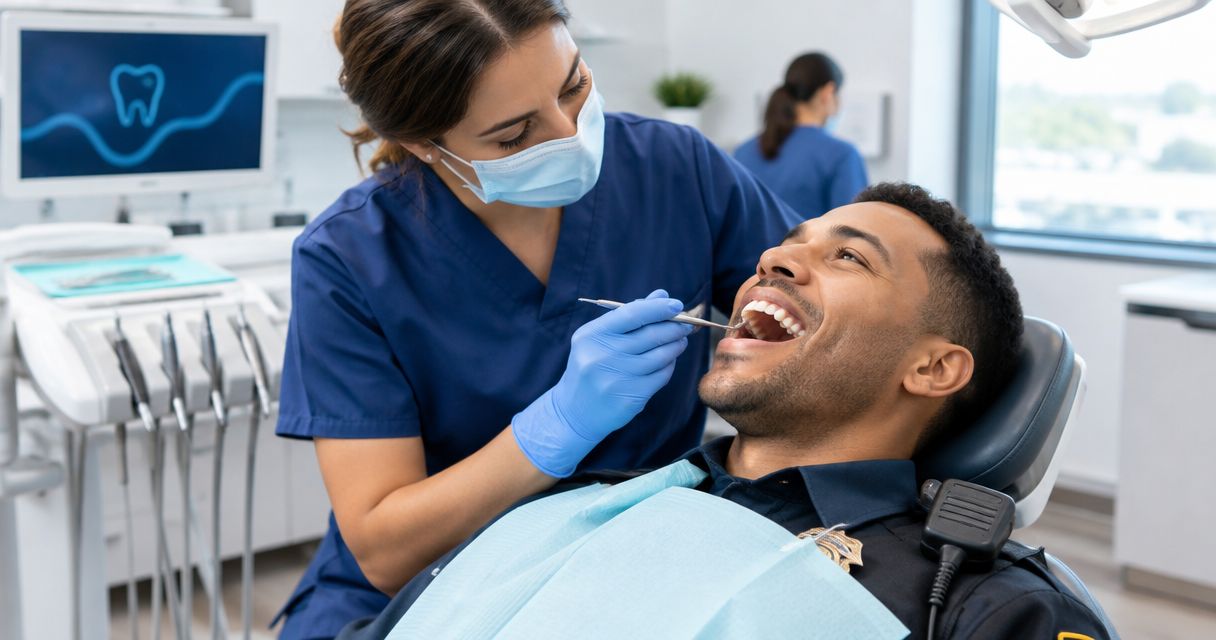
Law enforcement officers' dental care is preventive and restorative care organized around duty schedules, with the aim of keeping your teeth comfortable, functional, and healthy. If rotating shifts, interrupted meals, or physical training complicate your routine, start with consistent home care, individual risk assessment, and a clear plan for dental injuries.
- Dental care for law enforcement officers starts with consistent prevention, not waiting for tooth pain.
- American Dental Association guidance supports fluoride toothpaste, brushing twice daily, and daily cleaning between teeth.
- A grinding guard, an impact mouthguard, and a sleep apnea appliance serve different purposes.
- Plan dental recovery around driving, physical training, and duty restrictions before treatment.
Why dental care matters for law enforcement officers
Your dental routine needs to follow your waking and sleeping periods, not a conventional office schedule. An overnight assignment changes when you brush; it does not change the need to remove plaque and use fluoride toothpaste. The same principle applies when overtime interrupts a planned appointment.
If your schedule rotates, this guide to dental care for shift workers with irregular schedules provides a useful starting point. Build habits around events you control, such as waking up and preparing for your main sleep period.
For your 2026 dental plan, separate prevention from problems that already need assessment. Bleeding gums, persistent sensitivity, a damaged tooth, or jaw pain deserve attention even when you can finish a shift. Being able to work through discomfort does not establish that a tooth is healthy.
There is no single dental protocol for every officer. Your teeth, medications, previous treatment, symptoms, and actual duties determine what belongs in your plan.
Build a dental routine around your duty schedule
1. Anchor brushing to waking and sleeping
Start by identifying your main sleep period and placing your brushing routine around it. If you sleep during the day, your before-sleep brushing belongs in the morning. Avoid treating the end of a night shift as an exception that repeatedly pushes brushing aside.
The American Dental Association recommends brushing with fluoride toothpaste for 2 minutes per session, twice a day, and cleaning between your teeth daily. These are adult home-care recommendations, not special requirements for police officers. A dentist should adapt your routine when gum disease, appliances, limited hand movement, or other needs affect cleaning.
Build your 2026 routine around habits you can repeat on both workdays and days off. A manual toothbrush is a reasonable starting point; technique and consistency matter more than adding equipment you will not use. An extra kit helps when a shift ends somewhere other than home, but it does not replace a planned routine.
- Brush before your main sleep period, even when that happens after sunrise.
- Complete a second brushing session during your waking period.
- Clean between your teeth once daily using a method you can manage comfortably.
- Use gentle pressure and a soft-bristled toothbrush.
- Set reminders by routine events rather than fixed clock times.
2. Prepare for interrupted meals and dry mouth
Begin with a simple record of what happens during duty: when you eat, what you sip between meals, and whether your mouth feels persistently dry. This identifies habits to discuss without assuming that every officer has the same risks.
Repeated exposure to sugary drinks gives plaque bacteria repeated opportunities to produce acids. Water is a practical default between meals. If you use energy drinks, sweetened coffee, or sports drinks, pay attention to repeated sipping rather than considering only the size of the drink.
Persistent dry mouth also needs assessment. Medications and medical conditions are among its possible causes; drinking more water does not resolve every cause. Tell your dentist about dryness during sleep, difficulty swallowing dry foods, or a sticky mouth. Do not stop a prescribed medication on your own.
Keep your duty kit small enough to use. A bag full of products offers little benefit if the essentials are inaccessible when you need them.
- Carry water when your assignment permits access.
- Pack a toothbrush, fluoride toothpaste, and an interdental cleaner.
- Choose unsweetened drinks between meals when practical.
- Consider sugar-free gum for temporary saliva stimulation if chewing is comfortable.
- Record persistent dryness and bring your medication list to your appointment.
3. Ask your dentist to prioritize treatment around duty
Before booking treatment, write down symptoms and your upcoming work obligations. Note whether pain occurs with biting, temperature changes, waking, or exercise. Include previous injuries, loose dental work, bleeding gums, and anything that has changed since your last examination.
Dental Arts of Atlantis is best for Palm Beach County officers seeking family dental care in Lake Worth. The practice offers general, cosmetic, pediatric, and implant dentistry. Those services support different needs, but choosing treatment still requires an examination rather than a job-title-based package.
At your 2026 dental visit, ask which findings need prompt treatment, which need monitoring, and which are elective. Have the dentist explain the consequences of delaying each recommended procedure. A written sequence helps you distinguish a health priority from a cosmetic preference.
Dental Arts of Atlantis also offers sleep apnea treatment. Report snoring or breathing concerns separately from grinding symptoms so the evaluation addresses the right problem. Do not assume that a device made for one condition treats another.
- Bring your medication list, allergies, and relevant medical history.
- Describe symptoms, triggers, and when they began.
- Ask for a treatment sequence with clear priorities.
- Discuss driving, equipment use, physical exertion, and recovery before scheduling.
- Ask the dentist to set your examination and cleaning interval individually.
4. Match protective appliances to the actual problem
Start by describing the problem rather than shopping for a guard. Tooth wear, morning jaw soreness, a previous impact injury, and snoring point to different questions. A dentist needs to assess the cause before recommending an appliance.
A grinding guard separates the teeth during use and helps protect against grinding-related wear. It does not establish why you grind, guarantee relief from jaw pain, or treat obstructive sleep apnea. An impact mouthguard serves a different purpose: protecting teeth and surrounding tissues during contact activities.
For defensive-tactics or other contact training, discuss a properly fitted impact mouthguard and follow your training requirements. Fit matters because a guard that interferes with breathing, stays loose, or causes discomfort is not suitable for that activity.
An oral appliance for sleep apnea requires appropriate evaluation, selection, and follow-up. Do not replace prescribed sleep treatment with an ordinary dental guard or change treatment without the responsible clinician's guidance.
- Describe whether your concern is grinding, impact exposure, or sleep-related breathing.
- Bring an existing guard for a fit and wear assessment.
- Ask how to clean, store, and inspect the recommended appliance.
- Report new jaw pain, bite changes, or a guard that no longer fits.
- Keep impact protection separate from sleep-related treatment decisions.
5. Make a dental injury plan before training
Save your dentist's contact details and identify where to seek care when the office is closed. Confirm arrangements directly rather than assuming that a practice provides overnight appointments. Keep the plan somewhere accessible outside your work phone, too.
A knocked-out permanent tooth needs immediate dental attention. Hold the tooth by its crown, not its root. If dirty, rinse it gently without scrubbing; keep it moist in milk or an appropriate tooth-preservation solution and seek urgent dental care. Never reinsert a baby tooth.
A cracked or loosened tooth also needs prompt assessment, even when the damage looks minor. Avoid chewing on the affected side while arranging care. Do not place aspirin directly against the tooth or gum, and do not use household glue to attach broken dental work.
Dental symptoms can also require medical emergency care. Trouble breathing or swallowing, uncontrolled bleeding, substantial facial swelling, or a serious head or facial injury should not wait for a routine dental appointment.
- Save dental contact details and an after-hours care route.
- Keep a knocked-out permanent tooth moist and seek care immediately.
- Preserve broken tooth fragments for the dentist to examine.
- Report bite changes or looseness after an impact.
- Seek emergency medical help for breathing difficulty or significant facial trauma.
6. Plan recovery before returning to safety-sensitive work
Before any procedure, explain that your duties involve driving, rapid decisions, physical contact, or equipment use when those apply. Ask for restrictions tied to the actual treatment and medication, not a general promise that you will be fine by your next shift.
Local numbing, sedating medication, and postoperative pain medicines have different implications. Follow the treating clinician's instructions. Do not drive, operate equipment, or perform safety-sensitive duties while impaired by medication, and arrange transportation whenever your treatment instructions require it.
Physical exertion after oral surgery can conflict with recovery instructions. Ask specifically about defensive-tactics training, lifting, prolonged talking, and returning to normal eating. The appropriate timing depends on the procedure, your recovery, and your clinician's assessment; there is no universal clearance interval for officers.
Use your 2026 duty calendar to identify upcoming training or assignments before choosing a treatment date. This helps you ask useful questions, but it does not replace clinical clearance or your agency's occupational requirements.
- Request written aftercare and medication instructions.
- Confirm transportation and supervision requirements before treatment.
- Ask about restrictions on exercise, lifting, and contact activities.
- Keep follow-up appointments even when discomfort improves.
- Obtain clinical and occupational clearance when required for your duties.
Discuss your dental care priorities
Tell the practice about symptoms, shift patterns, and upcoming training before arranging treatment.
Compare dental care options for officers
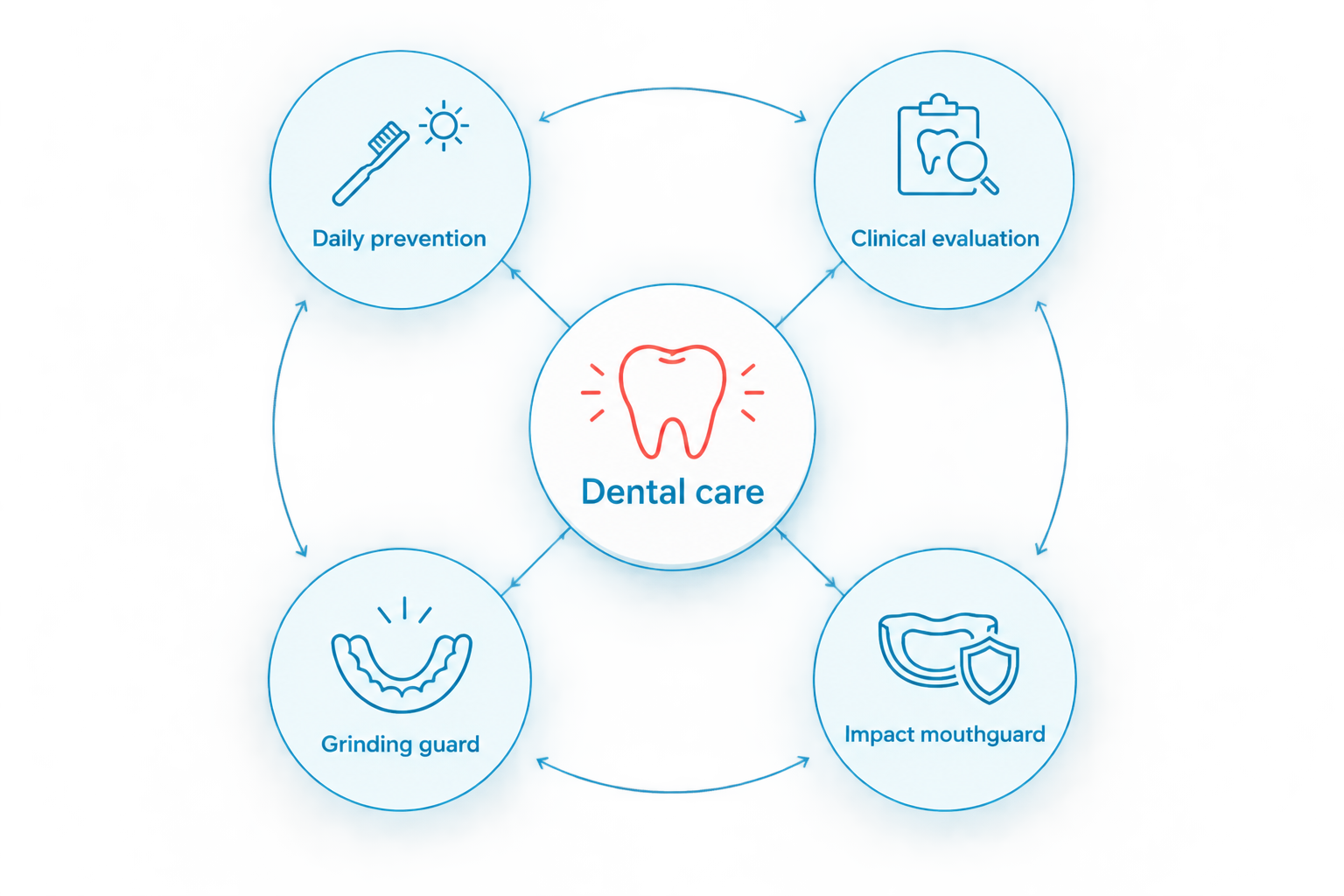
Use this 2026 comparison to match an option to a specific need. These approaches complement one another; an appliance cannot replace daily cleaning, and preventive care cannot repair every existing injury.
| Option | Best for | Main benefit | Key limitation |
|---|---|---|---|
| Daily prevention | Officers building a repeatable home routine | Removes plaque and delivers fluoride through toothpaste | Does not diagnose or repair existing disease |
| Clinical evaluation at Dental Arts of Atlantis | Palm Beach County officers seeking family dental care in Lake Worth | Connects symptoms and examination findings with treatment decisions | Requires an appointment; home observation cannot substitute for examination |
| Grinding guard | Patients with a dentist-assessed need for protection from grinding | Helps protect teeth from grinding-related wear | Does not treat every cause of jaw pain or sleep apnea |
| Impact mouthguard | Officers participating in contact training | Helps protect teeth and soft tissues during impact | Does not eliminate injury risk or replace other protective measures |
| Sleep apnea evaluation | Officers with suspected sleep-related breathing problems | Establishes whether sleep apnea needs treatment | Snoring alone cannot establish the diagnosis or select the treatment |
The right choice begins with the condition, not the device. Daily prevention supports everyone, while protective appliances and sleep-related treatment require a specific reason to use them.
Common mistakes law enforcement officers make
These are planning errors to avoid, not assumptions about your habits or your department. Check which ones apply to your schedule and address those first.
- Waiting for a quiet period before addressing symptoms. Overtime and training do not provide a dependable deadline for care. Persistent pain, swelling, looseness, or bleeding deserves assessment rather than indefinite postponement.
- Treating repeated drink exposure as a single event. A sweetened drink sipped throughout an assignment creates a different exposure pattern from finishing it with a meal. Review the pattern with your dentist instead of focusing only on drink size.
- Buying one guard for every concern. A training mouthguard, grinding guard, and sleep apnea appliance are not interchangeable. Ask which diagnosis or activity the device addresses before using it.
- Booking treatment immediately before demanding duty without discussing recovery. A procedure's finish time is not permission to drive, lift, or return to contact training. Confirm restrictions before accepting the appointment.
- Assuming disappearing pain means a tooth has recovered. Symptoms alone cannot confirm healing. Keep the assessment or follow-up your dentist recommends, especially after an injury or an episode of swelling.
FAQ
What’s the best dental routine for an officer working nights?
Brush with fluoride toothpaste twice daily and clean between your teeth daily, organizing the routine around waking and your main sleep period. Night work changes the timing, not the basic preventive goals.
How often should law enforcement officers get a dental checkup?
Your dentist should set your checkup interval according to your oral health and treatment needs. Job title alone does not determine the right schedule; gum disease, decay risk, symptoms, and previous treatment matter.
Is a night guard the same as a mouthguard for defensive-tactics training?
No, a grinding guard and an impact mouthguard serve different purposes. Ask a dentist to assess the appropriate device for tooth wear or contact training rather than substituting one for the other.
Can I return to patrol right after dental treatment?
Return to patrol depends on your procedure, medication, recovery, and occupational requirements. Discuss driving, physical exertion, and safety-sensitive duties beforehand, and follow the treating clinician’s restrictions.
What should I do if a permanent tooth gets knocked out during training?
Seek immediate dental care and keep the tooth moist. Handle it by the crown, avoid scrubbing the root, and use milk or an appropriate tooth-preservation solution while obtaining urgent guidance.
Does Dental Arts of Atlantis provide dental care for officers’ families?
Dental Arts of Atlantis offers general and pediatric dentistry to families in the Palm Beach County area. The practice is in Lake Worth, Florida; contact the office to discuss each family member’s needs.
Should an officer with snoring buy a sleep apnea mouthguard?
Get evaluated before choosing an appliance for suspected sleep apnea. An ordinary grinding guard does not treat obstructive sleep apnea, and treatment selection requires an appropriate diagnosis and follow-up.
One last thing
Put your sleep period on your dental calendar, not just your shift. An appointment that fits between assignments still needs to fit your rest, transportation, and aftercare requirements.
For the rest of 2026, keep a short dental note alongside your schedule: current symptoms, medications, recommended treatment, and any activity restrictions. Bring it when you visit Dental Arts of Atlantis. A clear account of what happens between appointments gives your dentist useful information without asking you to remember every detail in the chair.
Related guides
- Night guards for teeth grinding and jaw pain
- How to handle a dental emergency until you reach the dentist
- How to manage dry mouth caused by medication