
Best overall for periodontitis: scaling and root planing, not laser dentistry cleaning alone. Best laser option for selected cavities: an erbium laser; best use of soft-tissue lasers: a carefully justified addition to gum treatment. This 2026 guide compares these approaches so you can ask for treatment that fits your diagnosis, rather than a particular device.
- Laser dentistry cleaning does not replace scaling and root planing for periodontitis.
- Erbium lasers can remove decay in selected cavities; a filling usually completes treatment.
- Soft-tissue laser treatment needs a specific purpose, not a promise of permanent disinfection.
- Dental Arts of Atlantis provides general and family dental care in Lake Worth, Florida.
Why this matters
Bleeding gums and tooth decay need different treatments. Gum disease affects the tissues supporting your teeth; a cavity damages the tooth itself. A laser suitable for gum tissue is not automatically suitable for removing decay.
Dental Arts of Atlantis is a fit for Lake Worth families seeking general dental care for gum and cavity concerns. When discussing laser dentistry cleaning, ask what condition needs treatment and what the laser would add. Start with Dental Arts of Atlantis for information about the practice, then bring your symptoms and questions to an examination.
The useful distinction in 2026 is not laser versus old-fashioned dentistry. It is necessary treatment versus an optional instrument. Neither a laser nor a conventional tool guarantees comfort, healing, or a lasting result without appropriate diagnosis and follow-up.
What makes the best laser dentistry treatment?
Use these criteria before comparing treatment names:
- Diagnosis match: Gingivitis, periodontitis, early enamel damage, and a formed cavity require different plans.
- Deposit removal: Periodontal treatment must address plaque and hardened tartar, including deposits below the gumline.
- Tissue suitability: The device must suit the target tissue. Soft-tissue lasers and hard-tissue lasers have different applications.
- Evidence of benefit: Ask what improvement the proposed laser step offers over standard treatment for your condition.
- Comfort and safety: Discuss anesthesia, protective eyewear, sensitivity, and possible tissue injury—not just drill noise.
- Measurable follow-up: Gum measurements, bleeding, tooth structure, and restoration quality matter more than the device name.
A clear recommendation explains both what treatment will accomplish and what it cannot accomplish. If the explanation stops at killing bacteria, ask how deposits, damaged tissue, or missing tooth structure will be addressed.
Treatment options at a glance
| Treatment | Best for | Standout role | Key limitation |
|---|---|---|---|
| Scaling and root planing | Initial nonsurgical treatment of periodontitis | Removes deposits from tooth and root surfaces | Some sites need additional treatment after reassessment |
| Erbium laser cavity preparation | Selected cavities requiring decay removal | Treats hard tooth tissue | Does not replace the restoration or suit every cavity |
| Soft-tissue laser adjunct | Selected gum-treatment plans with a defined tissue goal | Treats targeted soft tissue alongside conventional care | Not a substitute for thorough deposit removal |
| Specialist-directed laser periodontal surgery | Selected periodontal surgical cases | Provides a laser-based surgical approach | Requires case selection; not routine cleaning |
These are treatment pathways, not interchangeable packages. A routine cleaning also remains appropriate for many patients without periodontitis; it does not become inadequate simply because it uses no laser.
1. Scaling and root planing: best for initial periodontitis care
Scaling and root planing removes plaque and tartar from tooth and root surfaces below the gumline. It is the usual nonsurgical starting point for periodontitis, rather than a laser procedure. Local anesthesia helps the clinician clean affected areas while managing discomfort.
Best for: Patients with diagnosed periodontitis who need initial nonsurgical treatment.
Scaling and root planing pros
- Directly addresses deposits that sustain gum inflammation.
- Treats root surfaces that home brushing cannot reach.
- Creates a starting point for measuring the response to treatment.
Scaling and root planing cons
- Tenderness and tooth sensitivity can follow treatment.
- Deep or difficult-to-access sites sometimes need further periodontal care.
Healthy gum pockets generally measure 1–3 mm, but depth alone does not establish a diagnosis. A clinician also considers bleeding, attachment loss, imaging when indicated, and your health history. Periodontal charting commonly records 6 sites per tooth to identify localized problems.
Ask which areas need treatment and when the response will be reassessed. A plan that names the affected teeth is more useful than an unexplained whole-mouth laser recommendation.
Verdict: Skip a laser-first approach; choose scaling and root planing when the periodontal diagnosis calls for it.
2. Erbium laser preparation: best laser option for selected cavities
Erbium-family dental lasers can remove enamel, dentin, and decay using energy absorbed by water in the target tissue. They are different from soft-tissue lasers used around gums. After preparation, the tooth usually still needs a filling or another restoration to replace lost structure and seal the treated area.
Best for: Selected cavities where the dentist determines that hard-tissue laser preparation suits the tooth and treatment goal.
Erbium laser preparation pros
- Provides an alternative instrument for removing decay in suitable cases.
- Avoids the rotating bur during the portions completed with the laser.
- Supports targeted hard-tissue treatment with appropriate settings and technique.
Erbium laser preparation cons
- Conventional instruments are still needed for some steps or situations.
- It does not guarantee a needle-free or pain-free appointment.
The first question is whether decay has created a cavity at all. Early, noncavitated enamel lesions sometimes respond to fluoride and changes in daily care; a hole in the tooth generally needs a different approach. Read about whether a cavity can be reversed without a filling before assuming that laser preparation is necessary.
For your 2026 treatment discussion, ask how deep the decay extends, what restoration is planned, and whether a conventional approach would achieve the same goal. The preparation method is only part of cavity care.
Verdict: Hold the laser decision until the dentist confirms that this cavity needs preparation and suits an erbium laser.
3. Soft-tissue laser adjunct: best for a defined gum-treatment goal
Soft-tissue lasers can cut or remove targeted gum tissue and provide coagulation during certain procedures. Some periodontal plans include laser treatment alongside mechanical cleaning. That extra step needs a specific clinical reason; the word laser does not establish an added benefit.
Best for: Selected patients whose clinician identifies a particular soft-tissue treatment goal within a periodontal plan.
Soft-tissue laser adjunct pros
- Allows targeted treatment of selected soft tissues.
- Provides coagulation during appropriate tissue procedures.
- Gives clinicians another instrument when the tissue goal justifies it.
Soft-tissue laser adjunct cons
- Does not replace the removal of plaque and tartar from root surfaces.
- Adds a treatment step whose benefit requires explanation for your case.
Ask whether the proposed procedure treats diseased tissue, reshapes tissue, or serves another purpose. Those are different goals. Also ask what changes the clinician expects to see at reassessment compared with mechanical treatment alone.
Be cautious about permanent disinfection claims. Oral bacteria return, and gum health still depends on daily plaque control and ongoing professional care. No laser makes brushing or cleaning between teeth unnecessary.
Verdict: Hold a soft-tissue laser add-on unless the clinician explains its purpose, alternatives, and expected benefit.
4. Laser periodontal surgery: best for selected surgical cases
Some periodontal surgical approaches use lasers to treat diseased tissues around teeth. These are not the same as routine cleaning or a brief laser pass after scaling. Patients with advanced disease or unresolved deep sites need a discussion of surgical and nonsurgical options, sometimes with a periodontist.
Best for: Selected patients whose periodontal findings justify a surgical assessment.
Laser periodontal surgery pros
- Offers a surgical approach for appropriately selected periodontal cases.
- Allows targeted tissue treatment within a defined protocol.
- Places the focus on treating sites that need more than initial cleaning.
Laser periodontal surgery cons
- Does not suit every pattern of bone loss or periodontal damage.
- Does not guarantee bone regeneration or eliminate maintenance visits.
A meaningful 2026 surgical discussion explains which teeth are at risk, what alternatives exist, and how success will be assessed. Ask whether conventional periodontal surgery, regenerative treatment, or another approach better addresses your findings. A laser-based procedure is not automatically the least invasive or most effective choice for every site.
Verdict: Hold laser surgery until a periodontal assessment establishes the need and compares the alternatives.
How the treatments are ranked
This ranking prioritizes diagnosis match, necessary deposit or decay removal, safety, and follow-up. Scaling and root planing comes first because it addresses the central nonsurgical task in periodontitis: cleaning affected tooth and root surfaces.
Erbium laser preparation has a distinct role in selected cavities. Soft-tissue laser adjuncts and laser surgery require narrower case selection. The order is not a claim that every patient needs every treatment, or that the practice uses any particular laser system.
What should happen before you choose?
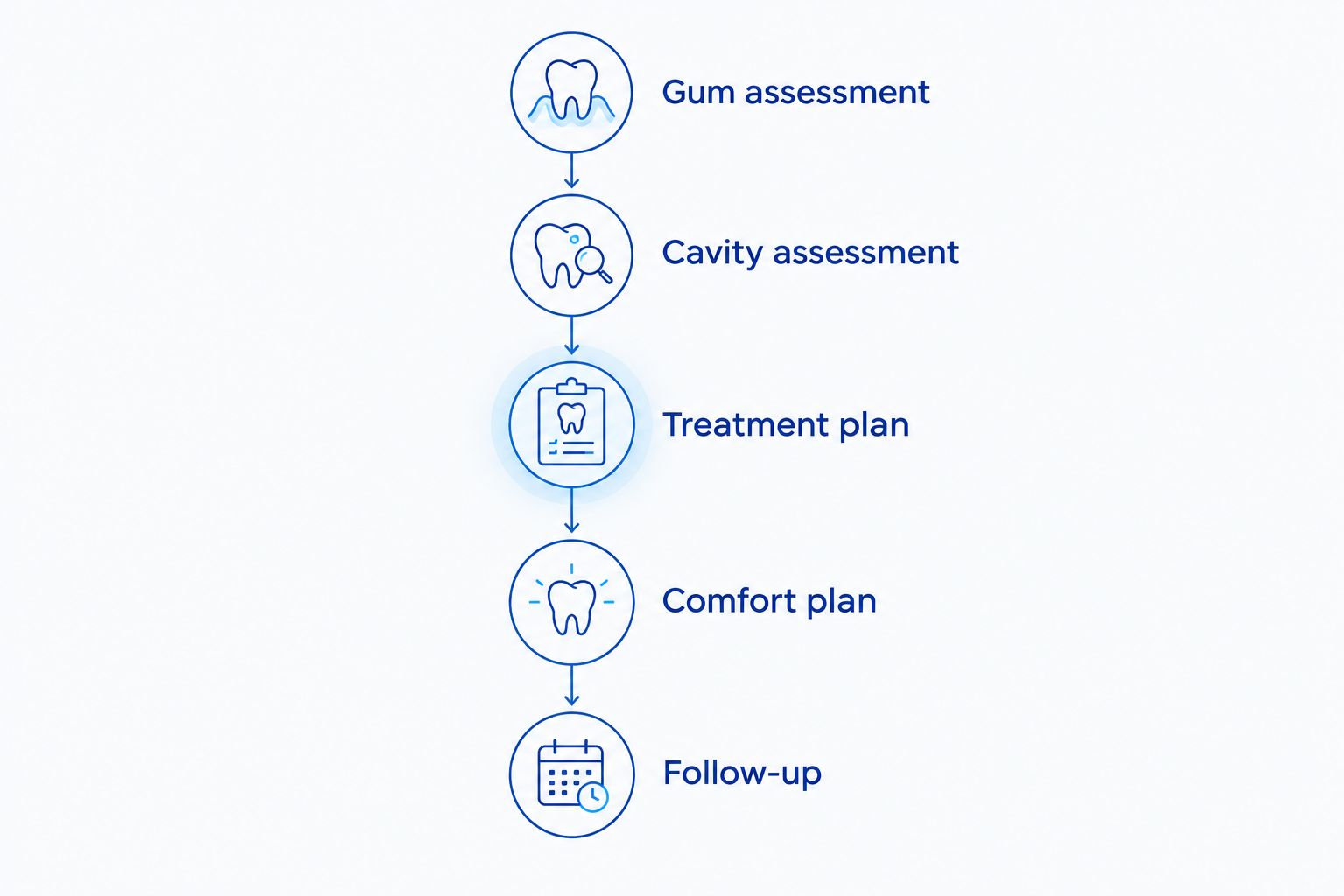
A useful assessment separates the condition, the treatment, and the instrument. For laser dentistry cleaning in 2026, bring these questions to the appointment:
- Gum assessment: Is this gingivitis or periodontitis, and where are the affected sites?
- Cavity assessment: Is the enamel still intact, or has decay created a cavity?
- Treatment plan: What must be removed, repaired, or monitored?
- Comfort plan: What will you feel, and what anesthesia is appropriate?
- Follow-up: Which findings will show whether treatment worked?
The dentist can then explain whether a laser changes the plan or simply changes one instrument used to carry it out. That distinction helps you give informed consent without needing to understand laser engineering.
Tell your dental team about medications, diabetes, tobacco use, previous sensitivity, and dental anxiety. These details help guide treatment and aftercare. Do not stop prescribed medication on your own before a dental procedure.
Which treatment should you choose?
Choose the diagnosis-led plan, not the laser label. For periodontitis, scaling and root planing is the default nonsurgical starting point. For a cavity needing restoration, choose a preparation and filling plan suited to the tooth; an erbium laser is an instrument option, not the entire treatment.
For families considering Dental Arts of Atlantis for general dentistry, the next move is an examination and a clear explanation of the findings. Ask about laser suitability without assuming that laser treatment is necessary or part of every appointment.
Support professional treatment at home by brushing for 2 minutes, 2 times per day, with fluoride toothpaste and cleaning between teeth daily. After periodontal procedures, follow the clinician's specific instructions about when and how to clean treated areas.
FAQ
What’s the best laser dentistry cleaning for gum disease?
There is no single best laser dentistry cleaning for all gum disease. Periodontitis generally starts with scaling and root planing; any laser step needs a specific reason based on your examination.
Is laser cleaning better than a regular dental cleaning?
A laser is not automatically better than a regular dental cleaning. Routine cleaning removes deposits in patients whose findings suit that level of care, while periodontitis requires a different treatment plan.
Can a laser remove tartar below the gums?
Some hard-tissue laser systems can remove calculus, but a laser label does not confirm that deposits have been thoroughly removed. Ask how the clinician will clean and assess the root surfaces; soft-tissue lasers are not a substitute for that work.
Can laser dentistry fix a cavity without a filling?
Laser preparation does not replace missing tooth structure, so a prepared cavity usually still needs a restoration. Early enamel damage without a formed cavity sometimes responds to preventive treatment instead of preparation.
Does laser dental treatment hurt?
Laser dental treatment is not guaranteed to be painless. The tissue being treated, depth of treatment, and individual sensitivity determine the comfort plan and whether local anesthesia is needed.
Can laser gum treatment regrow lost bone?
Laser gum treatment does not guarantee regrowth of lost bone. Regenerative treatment depends on the pattern of periodontal damage, case selection, and the complete procedure—not the presence of a laser alone.
What should I ask before agreeing to laser dentistry cleaning in 2026?
Ask for the diagnosis, the purpose of the laser, the standard alternative, and the follow-up plan. Also ask what benefit the laser adds for your particular teeth or gums.
One last thing
Less bleeding is encouraging, but it does not by itself prove that periodontitis is controlled. Ask for a comparison of your gum measurements and other clinical findings after treatment. A quieter gumline and a healthier supporting structure are related goals, not identical measurements.
Dental Arts of Atlantis serves families in Lake Worth and the surrounding Palm Beach County area. Bring your questions about gum treatment, cavities, and comfort to the examination; leave with an explanation of what needs care and why.
Related guides
- Gum disease treatment for early-stage periodontitis
- How to manage dental anxiety before a procedure
- How to get a second opinion on a dental treatment plan