
Best overall: check for medical danger signs before treating the tooth. Best for a knocked-out permanent tooth: immediate dental care with the tooth protected; best for a knocked-out baby tooth: leave it out and contact a dentist. This 2026 guide explains which first-aid steps match your child’s injury and what to avoid while getting help.
- Searching for an emergency pediatrics dentist? Check breathing, bleeding, facial swelling, and head-injury symptoms first.
- Never replant a knocked-out baby tooth; a knocked-out permanent tooth needs immediate dental attention.
- Hold a permanent tooth by its crown, not its root; keep it moist while seeking care.
- Dental Arts of Atlantis provides pediatric dental care for families in Lake Worth and Palm Beach County.
Why this matters
A chipped baby tooth, an infected molar, and a knocked-out permanent tooth need different responses. First aid protects your child until a clinician can assess the injury; it does not repair damage or treat an infection.
Dental Arts of Atlantis provides pediatric dental care for Lake Worth and Palm Beach County families. Contact a dental office for instructions about the specific injury, but use emergency medical services when breathing, consciousness, or serious bleeding is involved.
If you are searching for an emergency pediatrics dentist in 2026, describe the symptoms before asking about treatment. Tell the office whether the tooth is missing, broken, loose, or painful, and whether your child has swelling or fever.
What makes the best dental first-aid response?
Choose an action by what it protects, not by what is easiest to find at home.
- Medical safety: breathing problems and serious head injuries take priority over teeth.
- Tooth identification: baby teeth and permanent teeth require different handling.
- Time sensitivity: a knocked-out permanent tooth needs immediate attention.
- Gentle handling: avoid scrubbing roots, probing wounds, or forcing displaced teeth.
- Clear limits: comfort measures must not delay assessment of trauma or infection.
Child dental emergency first aid at a glance
These are situation-specific recommendations, not steps you must complete in order. For this 2026 guide, the ranking puts medical safety first, followed by tooth preservation and symptom control.
| First-aid option | Best for | Main benefit | Key limitation |
|---|---|---|---|
| Emergency medical assessment | Breathing trouble or serious trauma | Prioritizes immediate safety | Dental follow-up can still be necessary |
| Permanent-tooth preservation | A knocked-out adult tooth | Protects the tooth during urgent travel | Replantation is not appropriate for every situation |
| Direct pressure | A bleeding lip, tongue, or gum | Helps control accessible bleeding | Does not repair a deep wound |
| Comfort measures and dental assessment | Toothache or localized swelling | Reduces discomfort while arranging care | Does not treat infection |
| Fragment protection | A chipped, broken, or displaced tooth | Limits further injury | Hidden damage needs an examination |
| Leaving the tooth out | A knocked-out baby tooth | Avoids harmful replantation | The injury still needs dental assessment |
1. Emergency assessment: best for medical danger signs
Best for: a child with breathing trouble, major trauma, or rapidly worsening symptoms. A dental injury does not rule out a more serious injury elsewhere. Check your child’s breathing and responsiveness before examining individual teeth.
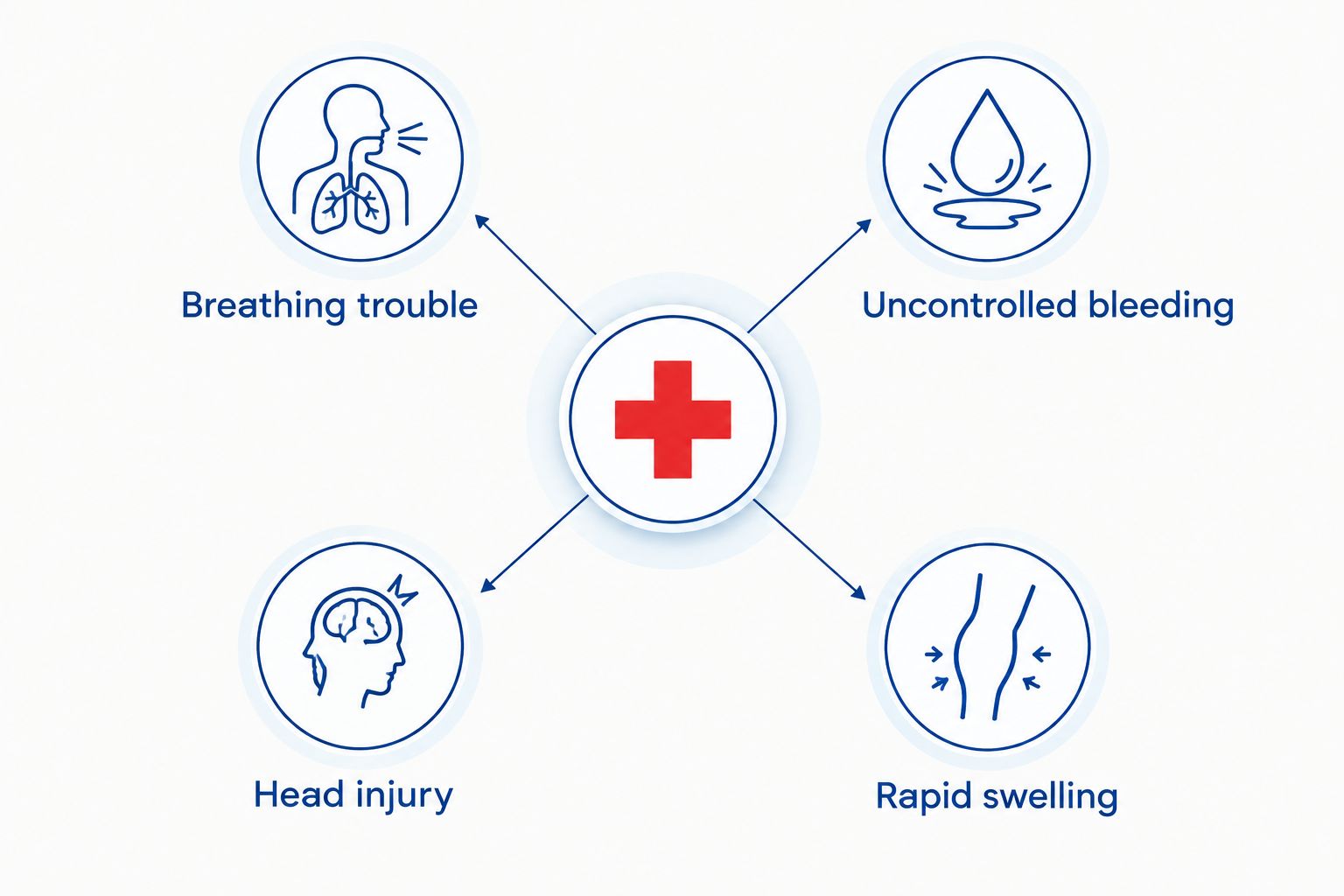
Get emergency medical help for these warning signs:
- Breathing trouble: difficulty breathing or swallowing, choking, or inability to handle saliva.
- Uncontrolled bleeding: heavy bleeding that does not stop with firm pressure.
- Head injury: loss of consciousness, repeated vomiting, confusion, or unusual drowsiness after a blow.
- Rapid swelling: spreading facial or neck swelling, particularly with fever or a child who looks very ill.
Call 911 for life-threatening symptoms. Do not put a tooth, medicine, food, or drink into the mouth of a child who is unconscious or cannot swallow safely.
Emergency assessment pros:
- Addresses threats beyond the injured tooth.
- Avoids delaying care for a serious infection or head injury.
- Gives parents a clear reason to stop home treatment.
Emergency assessment limits:
- Medical stabilization does not necessarily complete dental treatment.
- A reassuring-looking tooth does not exclude other injuries.
Verdict: Skip waiting for a dental callback when life-threatening symptoms appear.
2. Permanent-tooth preservation: best for an adult tooth knocked out
Best for: a permanent tooth completely knocked out of its socket. Act immediately. The American Dental Association’s dental-emergency guidance emphasizes keeping the tooth moist and reaching a dentist promptly.
Pick up the tooth by the crown—the part normally visible above the gum. Do not touch or scrub the root, remove attached tissue, or wrap the tooth in a dry tissue.
If the tooth is dirty, rinse it briefly and gently without scrubbing. For a cooperative, alert child with a clearly identified permanent tooth, immediate gentle replacement in the socket is recommended when it can be done safely; never force it.
If replacement is not safe or you are uncertain, place the tooth in milk or a tooth-preservation solution and leave for urgent dental care. Do not store it in plain water or inside a young child’s mouth.
Aim to reach a dentist within 30 minutes if possible, but seek care even if more time has passed. Do not spend valuable time shopping for supplies.
Permanent-tooth preservation pros:
- Keeps the tooth from drying out.
- Avoids unnecessary root handling.
- Supports urgent professional assessment.
Permanent-tooth preservation limits:
- Saving the tooth is not guaranteed.
- Home replantation is unsafe when tooth type or cooperation is uncertain.
Verdict: Skip dry storage and delays; protect the tooth and seek care immediately.
3. Direct pressure: best for a bleeding lip, tongue, or gum
Best for: an accessible soft-tissue wound in an alert child who is breathing normally. Wash your hands, then hold clean gauze or a clean cloth firmly against the bleeding area. Keep loose gauze out of a young child’s mouth unless you are directly holding it.
Maintain pressure for about 10 minutes without repeatedly lifting the cloth to check. For heavy bleeding, worsening symptoms, or concern about a deep injury, seek emergency help rather than waiting through a home-care timer.
A wrapped cold pack against the outside of the cheek can help with discomfort. Use it for about 10 minutes at a time, with breaks; never place bare ice directly against skin.
Direct pressure pros:
- Uses simple, clean supplies.
- Helps control visible bleeding.
- Avoids poking or repeatedly disturbing the wound.
Direct pressure limits:
- Deep or gaping cuts need professional assessment.
- Bleeding control does not rule out a broken or displaced tooth.
Look for a missing tooth fragment, but do not dig into a lip or cheek to retrieve one. Tell the clinician if a fragment cannot be found.
Verdict: Skip repeated checking and wound probing; use steady pressure and assess severity.
4. Comfort measures: best for toothache while arranging dental care
Best for: tooth pain without medical danger signs. Have a child who can reliably spit rinse gently with warm water. If food is visibly caught between teeth, use floss gently; stop if it catches or worsens pain.
For pain medicine, follow the product’s age- and weight-based directions and your child’s clinician’s advice. Check with a pharmacist or pediatrician when you are unsure, especially if your child has medical conditions, dehydration, or other medicines.
Do not give aspirin to a child unless a clinician specifically directs it. Never place aspirin, alcohol, or concentrated essential oils on a tooth or gum.
Comfort-measure pros:
- Helps your child cope while care is arranged.
- Removes trapped food without sharp tools.
- Avoids irritating home remedies.
Comfort-measure limits:
- Pain relief does not treat a cavity or abscess.
- Reduced pain does not prove an infection has resolved.
Contact a dentist promptly for persistent pain, gum swelling, pus, fever, or pain that interrupts sleep. Facial swelling needs urgent assessment; spreading swelling or swallowing difficulty needs emergency medical care.
Verdict: Skip home-only treatment for swelling, fever, or persistent toothache.
5. Fragment protection: best for a chipped or displaced tooth
Best for: a tooth that is broken, pushed out of position, or suddenly loose after an injury. Collect any broken pieces and keep them moist in milk in a clean container. A dentist will determine whether a fragment can be used.
Do not wiggle, pull, file, glue, or push an injured tooth into place yourself. Have your child avoid chewing on that side and contact a dentist for instructions.
A visible pink or red area inside a fracture, strong pain, a changed bite, or significant movement needs urgent dental assessment. Read more about emergency dentistry for a cracked or broken tooth after arranging immediate care.
Fragment protection pros:
- Preserves pieces for the dentist to evaluate.
- Reduces further pressure on an injured tooth.
- Keeps home repairs from complicating treatment.
Fragment protection limits:
- Small chips can hide deeper injuries.
- A displaced tooth requires more than comfort measures.
Verdict: Skip household glue and do-it-yourself repositioning; let a dentist assess the damage.
6. Leaving the tooth out: best for a knocked-out baby tooth
Best for: a primary tooth knocked completely out. Never put a baby tooth back into its socket. Replantation can harm the developing permanent tooth underneath.
Apply gentle pressure for bleeding and contact a dentist promptly. Bring the tooth in a container if you have it, and report how the injury happened.
If a tooth appears missing but you cannot find it, do not assume it fell out. It can be pushed into the gum or lost elsewhere; a dental examination helps establish what happened. Breathing symptoms after a missing tooth require emergency medical attention.
Leaving the baby tooth out pros:
- Avoids inappropriate replantation.
- Protects the developing permanent tooth.
- Keeps the focus on bleeding control and assessment.
Leaving the baby tooth out limits:
- The surrounding gum or bone can still be injured.
- A missing tooth cannot always be explained without examination.
Verdict: Skip replantation of a baby tooth, even when the socket looks empty.
How these first-aid options are ranked
This 2026 ranking follows a safety-first order: protect breathing and consciousness, preserve a knocked-out permanent tooth, then manage bleeding and discomfort. The American Dental Association’s MouthHealthy dental-emergency guidance and International Association of Dental Traumatology guidelines support the critical distinction between primary and permanent tooth injuries.
The best action depends on the injury. These options are not competing treatments, and no home-care method replaces diagnosis.
Which first-aid step should you choose?
When uncertain, check medical danger signs, call for professional guidance, and avoid moving the injured tooth. If a permanent tooth is completely out, keeping it moist is an immediate priority alongside urgent dental care.
For a 2026 family emergency checklist, save your dentist’s contact details and after-hours instructions before an injury happens. Keep clean gauze and a small clean container accessible.
When contacting Dental Arts of Atlantis about pediatric dental care, report:
- Your child’s age and the time of injury.
- Whether the tooth is baby or permanent, if known.
- Bleeding, swelling, fever, pain, or a changed bite.
- Where a missing tooth or fragment is stored.
- Medicines already given, including the amount and time.
FAQ
What’s the first thing I should do if my child hurts a tooth?
Check breathing, responsiveness, serious bleeding, and head-injury symptoms first. Call 911 for life-threatening symptoms; otherwise contact a dentist and describe the injury.
Should I put my child’s knocked-out baby tooth back in?
No—never replant a knocked-out baby tooth. Control bleeding gently and contact a dentist because the gum, bone, or developing permanent tooth can also be affected.
What should I put a knocked-out permanent tooth in?
Use milk or a tooth-preservation solution if safe immediate replantation is not possible. Handle only the crown, avoid dry storage, and seek dental care immediately.
Can my child sleep after hitting their mouth?
Assess possible head injury before treating the incident as only a dental problem. Loss of consciousness, repeated vomiting, confusion, or unusual drowsiness requires emergency medical assessment.
Can I wait until morning if my child’s tooth stops hurting?
Pain relief alone does not establish that waiting is safe. A knocked-out permanent tooth, displaced tooth, swelling, or significant trauma needs prompt professional guidance even if pain decreases.
How do I find an emergency pediatrics dentist near Lake Worth?
Contact a dental office that treats children and describe the injury before requesting an appointment. Dental Arts of Atlantis provides pediatric dental care in Lake Worth; confirm urgent-care arrangements directly rather than assuming walk-in treatment.
Does a small chip in a baby tooth need a dentist?
Yes—a dentist should assess a traumatically chipped baby tooth. Arrange prompt guidance, especially if there is pain, bleeding around the tooth, looseness, a changed bite, or a visible pink area inside the fracture.
One last thing
A tooth that looks shorter after an accident is not necessarily broken—it can be pushed into the gum. Do not pull on it to check. Report the changed position to a dentist, and arrange any follow-up recommended after the initial assessment because some injury-related changes develop later.
Related guides
- How to handle a dental emergency until you reach the dentist
- How to choose a family dentist for kids and adults together
- Mouthguards for young athletes and contact sports