
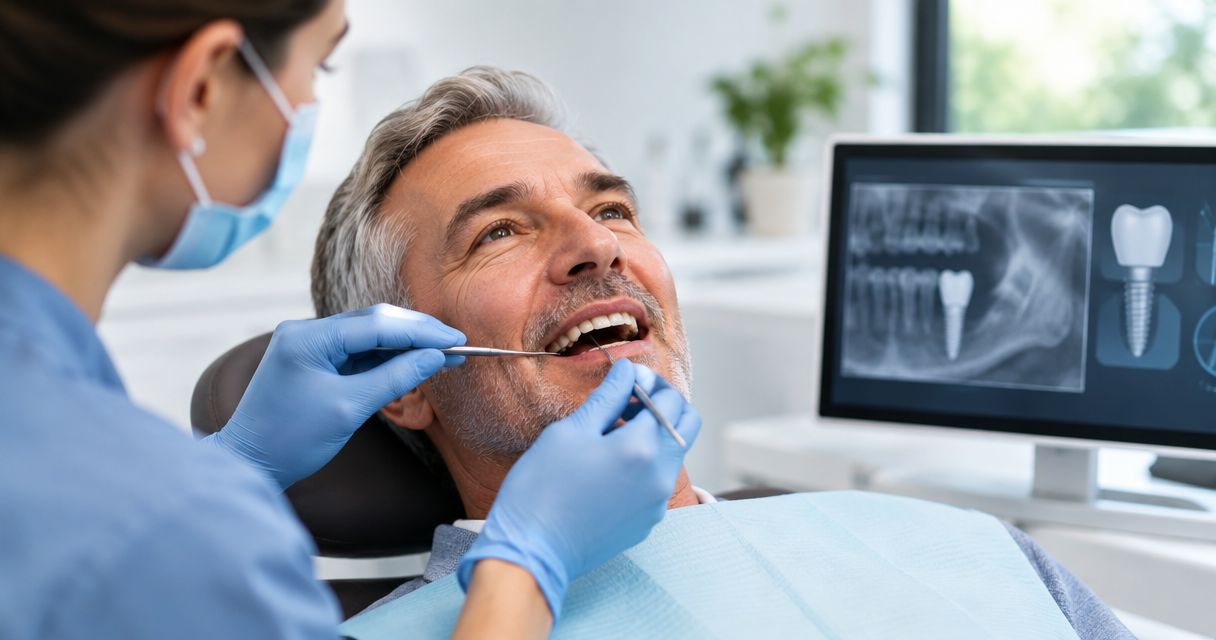
Yes, dental implants can fail years after placement, even after they have healed and worked comfortably. Late problems include inflammation with bone loss, implant fracture, or damage to the attached crown or connecting parts; a loose crown does not automatically mean the implant itself has failed.
- Can dental implants fail years after placement? Yes, but crown problems and implant failure require different treatment.
- Bleeding, swelling, pus, or movement around a dental implant needs a dental examination.
- A painless implant can still have inflammation or bone loss; keep maintenance visits in 2026.
- Dental Arts of Atlantis provides dental implant care for families in Lake Worth and Palm Beach County.
Why this matters: You cannot tell at home whether movement comes from a loose connection or lost bone support. Understanding how to care for dental implants after surgery gives you a starting point, but new symptoms years later need their own examination. Do not wait for pain before asking for help.
Can dental implants fail years after placement?
Yes. An implant that initially joined with the jawbone can later lose supporting bone or develop a mechanical problem. Successful healing is not a lifetime guarantee, and the visible tooth is only one part of the restoration.
The implant body sits in the bone, a connector called an abutment joins it to the restoration, and the crown forms the chewing surface. Trouble in one part does not prove that every part needs replacement.
| Problem | What it involves | What it means for treatment |
|---|---|---|
| Loose crown or connection | Movement in the restoration or connecting components | Repair can preserve a stable implant; examination must confirm the source |
| Peri-implant mucositis | Inflamed soft tissue without progressive supporting bone loss | Professional care and effective cleaning target the inflammation |
| Peri-implantitis | Inflammation with progressive loss of supporting bone | Treatment must address both infection-related inflammation and the affected implant surface |
| Implant fracture or lost integration | A broken implant body or loss of its stable attachment to bone | Removal is sometimes necessary; crown repair alone cannot solve the problem |
These conditions can feel similar. Your dentist distinguishes them through an examination, appropriate imaging, and comparison with earlier records when available.
What warning signs should you take seriously?
New movement, bleeding, swelling, or drainage deserves attention, even when the implant has been comfortable for years. Pain is not a reliable measure of how much supporting tissue has been affected.
Contact a dentist if you notice:
- Bleeding around the implant during brushing or cleaning between teeth.
- Redness, swelling, tenderness, or pus near the gumline.
- A persistent bad taste or odor coming from the area.
- Gum recession that exposes more of the implant or its components.
- Clicking, rocking, or a change in how your teeth meet.
- Pain when biting or chewing.
Food trapping is also worth discussing, particularly when it is new or difficult to clean. It can reflect changes in the gums, contact between teeth, or the restoration's shape.
For your 2026 dental visit, describe what changed rather than simply saying the implant feels wrong. Tell the dentist whether movement happens during chewing, whether bleeding is recurring, and whether symptoms began after an injury or biting something hard.
A loose crown is not the same as a loose implant
A crown that rocks or clicks can have a loose screw or another connection problem while the implant body remains stable. That is different from an implant body moving within the jawbone.
Do not repeatedly wiggle the restoration to test it. Avoid chewing hard foods on that side and arrange an assessment. Continuing to load a loose component can damage it or other parts of the restoration.
If the crown comes off, keep it in a clean container and bring it with you. Do not use household glue or try to tighten an implant screw yourself.
A repairable crown problem still needs professional attention. The dentist must check the component, the fit, the bite, and the implant's supporting tissues before returning it to function.
Why late dental implant problems vary
Late implant complications do not have a single cause. Your dentist assesses the tissues, the restoration, your cleaning access, and your health history together.
- Plaque and cleaning access: Bacterial buildup around an implant can inflame the surrounding tissue. A restoration that is difficult to clean adds a practical barrier to daily care.
- History of periodontitis: Previous gum disease is a recognized risk factor for peri-implant disease. Treating disease around natural teeth remains part of protecting the whole mouth.
- Smoking: Smoking is associated with poorer implant outcomes and peri-implant disease. Include current tobacco use in your health history.
- Diabetes control: Poorly controlled diabetes can affect healing and infection risk. Share changes in your condition and treatment with your dental team.
- Biting forces and component wear: Clenching, grinding, and an uneven bite can contribute to mechanical complications. The dentist checks for these rather than assuming every problem is an infection.
- Maintenance and health changes: Missed reviews can leave changes undetected. New medications, medical treatment, or difficulty cleaning also deserve a fresh care plan.
These factors are not a diagnosis. Having one does not establish that an implant is failing, and lacking them does not rule out a problem.
How does a dentist check an implant years later?
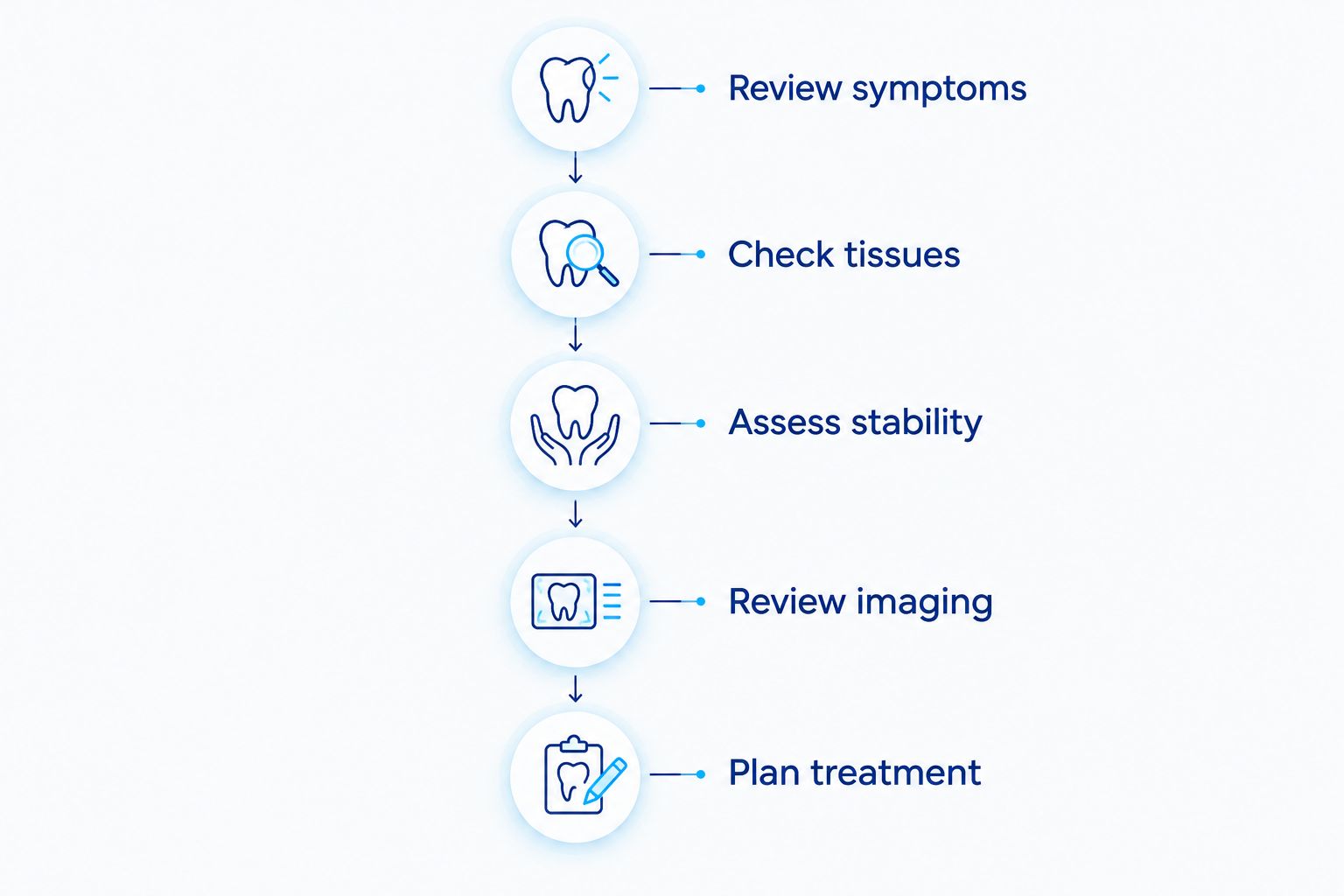
An implant review in 2026 should answer a practical question: Is the problem in the gum tissue, supporting bone, restoration, or implant body? Treatment follows that distinction, not the age of the implant alone.
- Review symptoms. Explain when the change began, what triggers discomfort, and whether the restoration moves. Bring implant records if you have them.
- Check tissues. The dentist looks for inflammation, bleeding, drainage, recession, and changes in the depth of the space around the implant.
- Assess stability. The dentist evaluates the crown, connector, and implant body to identify where movement or damage originates.
- Review imaging. Appropriate X-rays help assess supporting bone. Earlier images provide a useful comparison; additional imaging depends on the clinical question.
- Plan treatment. The dentist explains what can be repaired, what needs disease treatment, and whether specialist care or removal is necessary.
An X-ray alone does not explain every loose restoration, and a photograph cannot establish implant stability. An in-person examination connects the symptoms with the findings.
Can a failing implant be saved?
Some implant complications can be treated without removing the implant. The deciding factors include stability, the pattern of bone loss, access for cleaning, component condition, and whether the cause can be controlled.
| Treatment approach | Best for | Benefit | Limitation |
|---|---|---|---|
| Crown or connection repair | A mechanical problem above a stable implant | Preserves the implant when its support is healthy | Does not treat underlying peri-implant disease |
| Professional cleaning and home-care changes | Soft-tissue inflammation and maintenance needs | Targets plaque and improves daily cleaning | Established bone loss requires further assessment |
| Surgical peri-implant treatment | Selected cases of peri-implantitis | Provides access to affected surfaces; some defects are candidates for regeneration | Surgery does not guarantee disease resolution or bone recovery |
| Implant removal | An implant that is fractured, unstable, or not maintainable | Removes a problem that cannot be predictably retained | Creates a need to plan healing and tooth replacement |
The goal is a healthy, maintainable result—not keeping an implant at any cost. Ask what supports the recommendation and what would count as successful treatment.
Antibiotics are not a substitute for identifying and treating the cause. Do not take leftover antibiotics or assume a rinse can correct a loose component or restore lost support.
Does implant failure always mean another implant?
No. After removal, your dentist evaluates the remaining bone, gum tissue, health factors, and reason for failure before recommending replacement. Another implant is not an automatic next step.
A replacement plan can involve healing, bone grafting, a different restoration design, or a non-implant tooth replacement. Each has benefits and limitations that depend on your mouth and treatment goals.
Before agreeing to a new implant plan in 2026, ask how the original problem will be addressed. Replacing an implant without controlling active disease, cleaning difficulties, or damaging forces leaves important issues unresolved.
Also ask how you will manage the missing tooth during treatment. That discussion helps you understand the practical effect on eating, appearance, and daily life without assuming a particular temporary option is suitable.
How do you reduce the risk of late implant problems?
Implants do not develop tooth decay, but the tissues supporting them still need care. Use a maintenance plan based on your needs, not a promise that implants last forever.
For your 2026 home-care routine:
- Brush 2 times daily for 2 minutes with a soft-bristled brush, following standard American Dental Association guidance.
- Clean between teeth and around the restoration 1 time daily, using the method your dental team demonstrates.
- Ask whether you can reach every surface beneath a bridge or around an implant crown.
- Keep the review and professional-cleaning schedule recommended for your disease risk.
- Report bleeding, movement, or a changed bite rather than waiting for a routine appointment.
- Discuss smoking cessation and management of relevant health conditions.
If you grind your teeth, ask whether a professionally fitted protective appliance belongs in your plan. It can help manage mechanical forces, but it does not treat peri-implant inflammation or replace cleaning.
Review your routine when your hands, vision, mobility, or caregiving needs change. A method that worked previously is not useful if you can no longer perform it comfortably.
Where should Lake Worth families start?
Dental Arts of Atlantis is a local option for Lake Worth families seeking dental implant care. The practice offers general and implant dentistry for patients in the Palm Beach County area.
When discussing dental implant care with Dental Arts of Atlantis, bring any available implant records, earlier X-rays, and an updated medication list. Those details support an informed conversation; they do not replace an examination.
Whether you choose Dental Arts of Atlantis or another practice, confirm who will assess the problem and coordinate any needed referral. A practice description alone cannot establish whether your implant is repairable.
FAQ
Can dental implants fail years after placement without pain?
Yes, dental implants can develop inflammation and supporting bone loss without significant pain. Bleeding, swelling, drainage, or changes found during dental reviews can reveal a problem before it hurts.
Does a loose implant crown mean the implant has failed?
No, a loose crown does not automatically mean the implant body has failed. A loose screw or damaged connection can cause movement above an otherwise stable implant, but an examination must establish the source.
Can I stop implant gum bleeding by brushing harder?
No, harder brushing is not the answer to bleeding around an implant. Use gentle cleaning and arrange a dental assessment, because inflammation, cleaning difficulties, or another local problem needs attention.
Can antibiotics save an infected dental implant?
Antibiotics alone do not reliably resolve peri-implant disease. Your dentist must assess the implant, clean or treat affected areas as indicated, and address contributing factors; medication is used only when clinically appropriate.
Should I go to the emergency room for swelling around an implant?
Seek emergency medical care for difficulty breathing or swallowing, or rapidly spreading facial or neck swelling. Localized swelling, pus, pain, or implant movement needs prompt dental assessment, even without those emergency symptoms.
Can I get another implant after one fails?
Another implant is possible in some cases, but it requires a new assessment of bone, gum tissue, health, and the cause of failure. Healing or additional treatment can be necessary before replacement is considered.
How often should an older dental implant be checked in 2026?
Dental implant review frequency in 2026 should follow your dentist’s assessment of tissue health, cleaning access, and disease risk. Do not wait for the next scheduled visit if you develop bleeding, swelling, drainage, pain, or movement.
One last thing
An implant that does not hurt is not necessarily healthy, and a crown that moves is not necessarily a failed implant. Those distinctions prevent both false reassurance and unnecessary alarm.
At your next assessment, ask: Which part is affected, and what finding proves it? A clear answer gives you a better basis for choosing treatment than the implant's age alone.
Related guides
- Night guards for teeth grinding and jaw pain
- How to prepare for your first dental implant consultation
- How to get a second opinion on a dental treatment plan