

Adjusting to new dentures usually takes several weeks, with eating and speaking becoming more comfortable through practice and professional fit adjustments. Dentures placed immediately after extractions also involve healing gums, so getting used to the appliance and reaching a stable fit are different processes. This 2026 guide explains what should improve, what needs a dentist’s attention, and how to make the transition easier.
- How long does it take to adjust to new dentures? Usually several weeks; persistent pain needs a fit check.
- Dental Arts of Atlantis provides family dental care in Lake Worth; discuss denture concerns with your treating dentist.
- Start with soft foods, practice speaking, and follow your dentist’s instructions for wearing and removing dentures.
- Worsening sores, repeated slipping, or an uneven bite need professional attention—not more effort to tolerate them.
Why this matters
Getting used to dentures should mean learning new movements, not learning to ignore pain. Your tongue, cheeks, and lips need practice working around an unfamiliar shape. A pressure spot or an uneven bite needs a different response: a professional assessment.
Dental Arts of Atlantis provides general, cosmetic, pediatric, and implant dental care for Lake Worth families. Its guide to denture options for Lake Worth patients provides related reading when you are discussing tooth replacement with your dentist.
For your 2026 treatment plan, separate comfort, function, and healing. Speech can improve while a sore area still needs attention, and easier chewing does not mean you should miss a scheduled follow-up.
How long does it take to adjust to new dentures?
Expect several weeks of adjustment rather than immediate comfort. Early fullness, extra saliva, and unfamiliar speech are common experiences; improvement should be gradual, not dependent on enduring worsening symptoms.
The most useful measure is what you can do more comfortably. Can you speak with less effort, manage soft meals, and wear the dentures according to your dentist’s instructions without developing new painful spots?
| Experience | What often improves with practice | What needs a dental assessment |
|---|---|---|
| Speaking | Learning where your tongue touches the denture | Persistent clicking, movement, or speech difficulty that does not improve |
| Eating | Coordinating small bites and balanced chewing | Rocking, sharp pain, or inability to manage soft foods |
| Mouth feel | Becoming familiar with fullness and extra saliva | Persistent gagging or difficulty keeping the denture seated |
| Gum comfort | Mild initial tenderness that settles | Ulcers, worsening soreness, or bleeding from rubbing |
| Bite | Learning a different chewing pattern | Teeth meeting unevenly or the denture tipping when you close |
There is no single finish line for every task. Saying a familiar sentence comfortably and biting into a firm food require different movements, so progress does not always happen evenly.
A denture that repeatedly injures your mouth needs assessment, not a longer adjustment deadline. Keep your follow-up appointments even when your confidence is improving.
What should you expect as dentures become familiar?
At first: fullness and unfamiliar movements
New dentures take up space your mouth is not used to. Your tongue searches for its usual positions, and saliva production can increase while your mouth responds to the appliance.
Start with manageable tasks rather than testing everything at once. Speak at a comfortable pace, choose soft foods, and follow the wearing schedule your dentist gave you.
With practice: better speech and meal confidence
Repeated everyday movements help your lips, cheeks, and tongue coordinate. Reading aloud makes it easier to notice which words need practice without the pressure of a conversation.
Eating also becomes more familiar through repetition. Increase texture gradually, but step back and call your dentist if a food consistently causes pain or makes the denture rock.
After extractions: healing changes the fit
Immediate dentures are placed while extraction sites are beginning to heal. As swelling settles and the tissues change shape, a denture that initially felt secure can become looser.
That change is not simply a failure to adapt. Your dentist assesses whether adjustments, a reline, or another planned treatment step is appropriate as healing progresses.
Why denture adjustment time varies
Your adjustment period depends on both the appliance and the mouth supporting it. These factors help explain why another person’s experience is not a reliable deadline for yours:
- Previous experience: First-time wearers are learning unfamiliar movements; replacement dentures still introduce changes in shape and bite.
- Recent extractions: Healing tissues change beneath immediate dentures, affecting comfort and fit.
- Fit and bite: A pressure point, unstable base, or uneven tooth contact interferes with practice.
- Saliva and dryness: Saliva helps lubricate tissues; dry mouth increases friction and discomfort.
- Denture position: Upper and lower dentures have different supporting anatomy, and the lower denture shares space with a moving tongue.
- Follow-up and home care: Professional adjustments address fit problems, while cleaning and prescribed tissue-rest periods support oral health.
Tell your dentist about medication-related dryness, difficulty handling the appliance, or trouble following the cleaning routine. Those details help shape practical instructions for your situation.
How can you make adjusting to dentures easier?
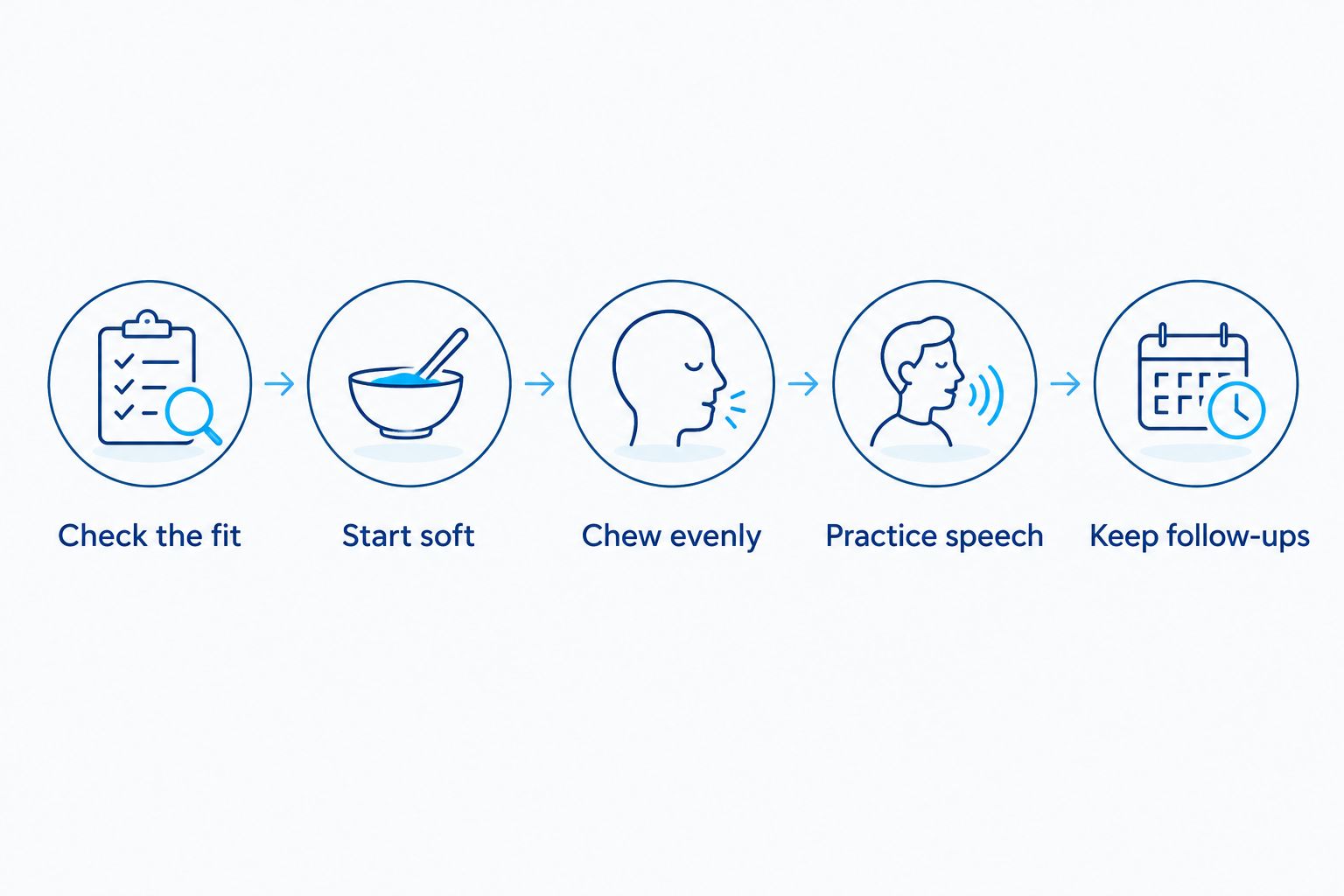
Use this sequence as a practical 2026 home-care plan, alongside your dentist’s individual instructions. The aim is steady practice without repeatedly irritating the same area.
- Check the fit. Notice where pressure occurs, whether the denture rocks, and whether your teeth meet evenly. Report specific symptoms instead of trying to identify the repair yourself.
- Start soft. Choose foods such as scrambled eggs, mashed vegetables, or tender fish. Cut food into small pieces and avoid beginning with hard, sticky, or tough foods.
- Chew evenly. Distribute food across both sides rather than loading one side heavily. Avoid testing the denture by biting forcefully into food with the front teeth.
- Practice speech. Read familiar passages aloud and repeat troublesome words slowly. Pause and swallow before continuing if extra saliva interrupts your speech.
- Keep follow-ups. Bring a clear description of what hurts, slips, or clicks. Follow the office’s instructions about wearing the denture before an adjustment visit.
Do not use discomfort as a training target. A manageable meal without rubbing is more useful than forcing yourself through a difficult food and leaving the gums sore.
If the denture continues moving despite careful chewing, read about a denture that keeps slipping and arrange a fit assessment. Adhesive is not a substitute for identifying the cause of repeated instability.
What should your daily denture routine include?
Remove food debris and clean removable dentures daily using a denture brush or soft brush with a suitable denture cleanser. Ordinary toothpaste can be abrasive, and hot water can distort the appliance.
Clean your gums, tongue, and palate gently as well. If you have natural teeth, brush them for 2 minutes per session, 2 times per day, using fluoride toothpaste, and clean between them daily.
Unless your dentist gives different instructions, remove removable dentures overnight so the supporting tissues can rest. Immediate dentures after extractions are an important exception: your dentist can direct you to leave them in during the first 24 hours and provide a specific removal schedule afterward.
Store the appliance as directed for its material, and rinse off cleaning solution before putting it back in your mouth. Denture cleanser belongs on the appliance, not directly in your mouth.
A useful 2026 habit is to check your mouth when you clean the denture. Look for a recurring rubbed area, redness, swelling, or a sore that is not healing, and report changes rather than covering them with adhesive.
How do you know whether discomfort needs an adjustment?
Mild unfamiliarity and a localized injury are not the same thing. Fullness that gradually bothers you less fits an adaptation pattern; a spot that hurts every time you chew deserves a call.
Contact your dentist if you notice:
- A sore area that keeps returning in the same location.
- Pain that becomes worse rather than settling.
- A denture that lifts, rocks, or falls out during ordinary use.
- Teeth that seem to meet unevenly.
- Persistent gagging or inability to eat enough comfortably.
- A crack, sharp edge, or damaged clasp.
Do not file, bend, glue, or reshape a denture yourself. Small changes affect how forces reach your gums and any remaining teeth, and household repairs can make professional correction harder.
Seek urgent dental care for severe pain, pus, fever, or spreading swelling. Difficulty breathing or swallowing requires emergency medical attention, not another attempt to seat the denture.
An oral sore that persists for 2 weeks needs evaluation, even if you believe rubbing caused it. Do not assume every mouth change comes from the appliance.
Should you keep wearing dentures if they hurt?
You should not force yourself through significant pain. Contact your dentist for instructions, particularly if you recently had extractions or received immediate dentures.
For a sore removable denture without recent surgery, your dentist can tell you whether to leave it out temporarily and when to wear it before the appointment. Wearing it beforehand sometimes helps reveal pressure areas, but the office should set those instructions.
At Dental Arts of Atlantis, family dental care includes general and implant dentistry. For denture discomfort, explain when the pain starts and whether it occurs during insertion, speaking, chewing, or removal; that history helps your treating dentist assess the problem.
Can denture adhesive shorten the adjustment period?
Denture adhesive does not replace the process of learning to eat and speak with dentures. Used as directed, it can help retention in an appropriately fitting appliance, but it does not correct a damaged denture, an uneven bite, or a base that no longer matches the gums.
Ask your dentist whether adhesive is appropriate, especially after extractions. Follow the product instructions, remove residue daily, and do not keep increasing the amount to compensate for looseness.
A denture that needs progressively more adhesive deserves a fit review. The next step is finding the reason for movement, not assuming your mouth needs more practice.
What should you tell your dentist at the follow-up?
Bring the denture, describe the problem in ordinary words, and identify the activity that triggers it. You do not need to know dental terminology to give useful information.
Instead of saying only that the denture feels wrong, explain whether the back lifts during chewing, the front rubs during speech, or one side touches first when you close. Mention whether symptoms are improving, unchanged, or worsening.
For your next 2026 appointment, write down questions about the wearing schedule, food progression, cleaning, and the next fit check. Leave with a clear next step, not a promise to tolerate pain longer.
FAQ
How long does it take to adjust to new dentures in 2026?
Adjusting to new dentures usually takes several weeks. Eating and speaking improve with practice, while persistent pain, rubbing, or instability needs a dental assessment rather than simply more time.
Is it normal for new dentures to feel bulky?
An unfamiliar or bulky feeling is common when you first wear dentures. Persistent gagging, painful pressure, or difficulty keeping the appliance seated should be assessed by your dentist.
When can I eat regular food with new dentures?
Advance toward your usual foods as chewing becomes comfortable and your dentist permits. Begin with soft foods and small pieces; stop testing harder textures if the denture rocks or causes pain.
Should I sleep with my new dentures in?
Removable dentures generally come out overnight unless your dentist gives different instructions. Immediate dentures after extractions can require a different initial wearing schedule, so follow your surgical instructions.
Why do my lower dentures feel harder to control?
Lower dentures share space with the tongue and have different supporting anatomy from upper dentures. Practice helps coordination, but repeated lifting or rubbing needs a professional fit check.
Can I adjust a painful denture myself?
Do not file, bend, glue, or reshape a painful denture yourself. Contact your dentist so the pressure area, bite, and appliance can be assessed together.
Can I discuss denture concerns with Dental Arts of Atlantis?
Dental Arts of Atlantis provides family dental care in Lake Worth, including general and implant dentistry. Contact the practice to discuss your concerns and arrange an appropriate evaluation; bring your dentures and explain what triggers the symptoms.
One last thing
Getting used to dentures and getting a denture adjusted solve different problems. Practice helps your muscles learn; it does not remove a sharp edge or correct an uneven bite.
Before your next meal, choose one manageable goal: speaking comfortably, chewing a soft food evenly, or identifying exactly where rubbing starts. That observation gives you something useful to practice—or something specific to tell your dentist.
Related guides
- How to clean and maintain dentures at home
- Denture relines for long-term denture wearers
- How to manage dry mouth caused by medication