
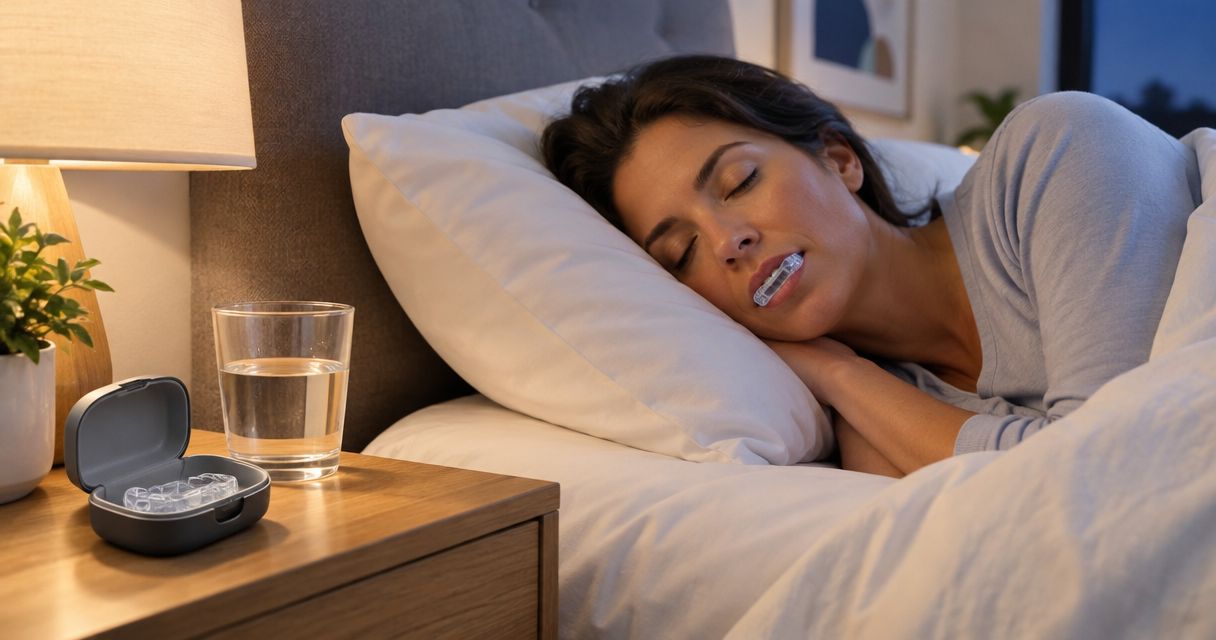
A sleep apnea oral appliance starts changing your jaw position when you wear it, but there is no fixed number of nights until it controls your sleep apnea. Comfort, symptom improvement, and effective treatment are separate milestones; adjustments and follow-up sleep testing establish whether the appliance is working. This 2026 guide explains what to watch for and when to contact your treatment team.
- How long does it take for a sleep apnea oral appliance to work? Timing depends on adjustment and testing.
- Less snoring is encouraging, but follow-up sleep testing confirms whether an oral appliance controls obstructive sleep apnea.
- Dental Arts of Atlantis offers sleep apnea treatment for families in the Palm Beach County area.
- Report persistent jaw pain, bite changes, or daytime sleepiness rather than advancing the appliance yourself.
Why this matters
A quieter night does not prove that sleep apnea is controlled. An appliance can reduce snoring while breathing interruptions remain. Feeling comfortable with the device also does not establish that its position is effective.
Understanding how a mandibular advancement device works helps you separate getting used to the appliance from treating the breathing problem. The device holds your lower jaw forward during sleep to help keep the upper airway open.
Your dentist assesses the fit, teeth, jaw, and bite. Your sleep clinician assesses the breathing disorder and treatment response. Both parts matter when deciding whether to continue adjusting the appliance or reconsider treatment.
How long does it take for a sleep apnea oral appliance to work?
There is no universal deadline. A properly fitted appliance acts while you wear it, but the starting position is not automatically the final therapeutic position. Your treatment team evaluates comfort, adjusts the device when appropriate, and checks breathing during sleep.
Use these milestones rather than treating an early improvement as the finish line:
| Milestone | What it tells you | What it does not prove |
|---|---|---|
| Comfortable wear | You can tolerate the fit and prescribed position | That breathing interruptions are controlled |
| Symptom improvement | Snoring, awakenings, or sleepiness are changing | That oxygen levels and breathing events have normalized |
| Adjustment review | Your dentist can assess fit, jaw response, and the next setting | That further advancement is always beneficial |
| Follow-up sleep testing | Your sleep clinician can measure treatment response | That future reassessment will never be necessary |
The practical answer in 2026 is to ask for an individualized follow-up plan, not a promised completion date. Before you leave the fitting visit, know whom to contact about discomfort, who authorizes adjustments, and who arranges the effectiveness test.
Comfort is a reason to keep following the plan, not a reason to skip confirmation testing.
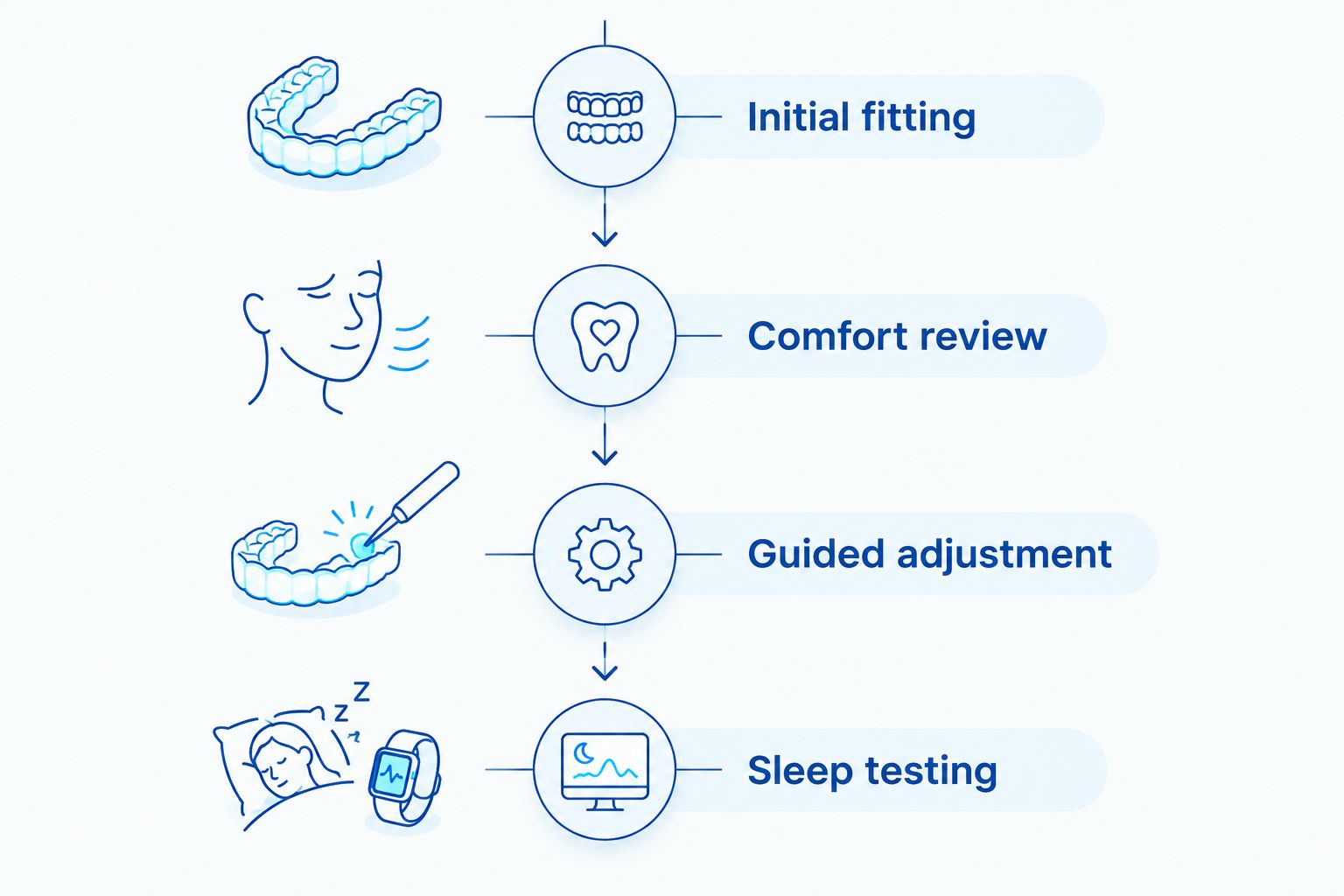
What happens between fitting and confirmed treatment?
The sequence matters more than a calendar estimate. Moving the jaw farther forward without supervision does not guarantee better treatment and can increase discomfort.
Initial fitting
At the fitting appointment, your dentist checks how the appliance seats and explains insertion, removal, cleaning, and use. Ask the dentist to watch you put it in and take it out. A device that looks straightforward in the office can feel unfamiliar at bedtime.
Confirm the starting setting and any written adjustment instructions. Do not borrow an adjustment schedule from another patient or an online discussion.
Comfort review
Pay attention to whether the appliance stays seated, whether pressure is concentrated on a tooth, and how your jaw feels after removal. Saliva changes, mouth dryness, and jaw discomfort can occur with oral appliance therapy.
Describe the problem precisely rather than simply saying the device feels wrong. A loose fit, a sore tooth, and muscle aching need different assessments. Persistent symptoms deserve a call rather than an unsupervised change.
Guided adjustment
Your dentist can change the mandibular position according to the treatment plan and your response. This process is often called titration. The aim is an effective, tolerable position—not the farthest possible setting.
Tell the dentist about changes in snoring, daytime alertness, comfort, and the amount of sleep you actually spend wearing the device. Those observations help guide care, but they do not replace sleep testing.
Sleep testing
Follow-up testing checks breathing while you wear the appliance at the prescribed position. Your sleep clinician determines the appropriate test and interprets the results.
Testing can show that treatment is effective, that further adjustment needs consideration, or that another approach is necessary. The result—not quieter snoring alone—guides the next treatment decision.
Why the time to an effective setting varies
Your treatment timeline depends on more than willingness to wear the appliance. These factors explain why a promised number of nights is not a reliable treatment plan:
- Starting severity: The breathing disorder documented on your diagnostic study affects treatment selection and the importance of confirming the response.
- Fit and retention: An appliance that loosens or creates concentrated pressure needs assessment before you can use it as intended.
- Jaw and dental health: Joint symptoms, sensitive teeth, gum problems, and bite changes can affect tolerability and adjustment decisions.
- Actual wear: An appliance cannot provide its intended mechanical effect while it sits outside your mouth. Report removal during sleep or difficulty keeping it in.
- Response to adjustment: A position that reduces symptoms still needs evaluation for comfort and breathing control.
- Follow-up arrangements: Fitting, adjustment review, and sleep testing are separate appointments or care steps that need coordination.
For a 2026 treatment plan, ask your team to describe the next decision point. Knowing what must happen before the next adjustment is more useful than comparing your progress with someone else's experience.
How do you measure whether the appliance is working?
Your observations and your sleep-study results answer different questions. Track both. You want treatment that you can use and that controls the diagnosed breathing problem.
Track what happens at home
Keep a simple record of the prescribed setting, whether you wore the appliance throughout sleep, and any symptoms after removal. If a bed partner notices snoring or breathing pauses, include those observations without treating them as a diagnosis.
Useful details include:
- Whether snoring or gasping continues while the appliance is in place.
- Whether you wake with jaw pain, tooth soreness, or a changed bite.
- Whether the device comes loose or you remove it during sleep.
- Whether daytime sleepiness affects work, concentration, or driving.
- Whether symptoms changed after an authorized adjustment.
Bring the appliance and your notes to the review. Avoid relying on memory alone, especially when several adjustments have occurred.
Understand the sleep-study measurements
The apnea-hypopnea index, or AHI, describes the number of apneas and hypopneas per hour of sleep. In standard adult severity categories, mild obstructive sleep apnea corresponds to 5 to fewer than 15 events per hour, moderate disease to 15 to fewer than 30 events per hour, and severe disease to 30 or more events per hour.
These categories describe severity; they are not a self-adjustment guide or a personal treatment target. Your sleep clinician interprets breathing events alongside oxygen measurements, symptoms, medical history, and the type of test performed. A home sleep test can report a respiratory event index rather than an AHI, so ask which measurement appears on your report.
The American Academy of Sleep Medicine and American Academy of Dental Sleep Medicine joint clinical practice guideline for adult oral appliance therapy recommends follow-up sleep testing to confirm treatment efficacy. That distinction remains central to this 2026 guide: symptom reports help, but objective testing checks the treatment response.
What should you do if the appliance hurts or your bite changes?
Do not push through persistent pain to reach a setting faster. Contact the prescribing dentist about worsening jaw pain, tooth pain, gum injury, difficulty opening your mouth, or a bite that remains different after removal.
Your dentist needs to distinguish fit problems from joint or muscle symptoms and tooth-related concerns. Explain where the discomfort occurs, when it starts, and whether it followed an adjustment. Follow the clinician's instructions about wearing or pausing the device while the problem is assessed.
Ask whether your plan includes morning jaw exercises or another prescribed approach to managing bite changes. Use only the instructions provided for your situation. An online exercise routine is not a substitute for assessing a persistent bite change.
Dental Arts of Atlantis offers sleep apnea treatment in Lake Worth, Florida. For Palm Beach County families seeking local dental sleep apnea care, Dental Arts of Atlantis is an option for discussing treatment alongside dental and jaw health. Treatment suitability still requires an individual assessment; a practice description cannot establish whether an appliance is right for you.
Can you stop CPAP when you receive an oral appliance?
Receiving an appliance is not, by itself, permission to stop prescribed CPAP. Ask your sleep clinician how to manage treatment during fitting, adjustment, and confirmation testing.
An oral appliance and CPAP have different practical strengths and limitations. An appliance avoids a mask and hose but requires suitable dental support, tolerable jaw positioning, and verification of its effect. CPAP avoids advancing the jaw but requires using the prescribed equipment during sleep.
If CPAP has been difficult, explain the specific problem rather than assuming every alternative will solve it. Your sleep clinician can assess an appropriate transition. Dental Arts of Atlantis patients considering sleep apnea treatment should bring their existing sleep-study report and current treatment information to the discussion.
What should your 2026 follow-up plan include?
Leave with a plan you can explain in plain language. These questions identify responsibilities without requiring you to manage treatment yourself:
- Who manages adjustments? Confirm whether you make any changes at home and exactly which written instructions apply.
- What requires a call? Ask about pain, loose fit, bite changes, continued gasping, and persistent sleepiness.
- When is the next review? Arrange the follow-up your clinician recommends rather than waiting for discomfort.
- Who orders sleep testing? Identify the clinician responsible for measuring and explaining treatment effectiveness.
- What happens if testing shows remaining apnea? Understand that the next step requires clinical review, not simply more advancement.
If you become sleepy while driving, stop driving and seek prompt medical advice. Do not wait for a routine appliance adjustment to address a safety problem.
You can review the practice's dental care information through Dental Arts of Atlantis before discussing your sleep apnea concerns.
Does less snoring mean the appliance is working?
Less snoring is encouraging, but it does not confirm that an oral appliance controls obstructive sleep apnea. Continue the prescribed follow-up process even when your bedroom becomes quieter.
Ask your sleep clinician how the treatment study compares with your diagnostic study. That comparison answers a different question from whether a bed partner sleeps better.
What if you still feel tired after adjustments?
Persistent tiredness needs review rather than an automatic increase in jaw advancement. Your clinician needs to check appliance use, treatment effectiveness, sleep duration, and other possible reasons for sleepiness.
Bring your symptom record to the appointment. If sleep testing confirms adequate breathing control but tiredness continues, your sleep clinician can investigate beyond the appliance.
FAQ
Can a sleep apnea oral appliance help on the first night?
An oral appliance changes jaw position while you wear it, but an early change in snoring does not establish effective apnea treatment. Adjustment and follow-up sleep testing determine the response.
How long should I wait before saying my oral appliance does not work?
Use your clinician’s review schedule rather than a fixed waiting period. Report ongoing gasping, significant sleepiness, poor fit, or pain so the team can assess the problem.
Should I tighten my sleep apnea appliance until I stop snoring?
Do not advance the appliance beyond your prescribed instructions. Less snoring does not prove breathing control, and excessive advancement can increase discomfort.
Do I need another sleep test if I feel better?
Follow-up sleep testing is recommended to confirm oral appliance treatment efficacy. Feeling better and sleeping more quietly are useful observations, not substitutes for measuring breathing.
Is a teeth-grinding night guard the same as a sleep apnea appliance?
A standard teeth-grinding night guard is not interchangeable with a prescribed sleep apnea appliance. The devices have different treatment purposes, so ask your dentist which device you need.
Will an oral appliance cure my sleep apnea permanently?
An oral appliance treats obstructive sleep apnea while it is worn; it does not establish a permanent cure. Continue prescribed use and follow-up unless your treatment team changes the plan.
Can I use my smartwatch to confirm the appliance works?
A smartwatch cannot replace clinician-directed testing to confirm oral appliance effectiveness. Share wearable observations with your sleep clinician, but do not use them alone to change treatment.
One last thing
Before starting or adjusting treatment in 2026, write down this question: Who will confirm that my breathing is controlled, and how? A clear answer connects the dental fitting to the sleep-medicine result.
Quieter sleep is welcome. Verified treatment is the goal.
Related guides
- Connecting a home sleep study to oral appliance therapy
- Oral appliances for CPAP-intolerant sleep apnea patients
- How to know if your snoring means sleep apnea