
Yes, Invisalign can correct many overbites by moving teeth into a better bite relationship, especially when tooth position is the main cause. A significant difference in jaw size or position needs a different assessment; aligners alone cannot correct every skeletal problem. This 2026 guide explains what makes treatment suitable, what attachments and elastics do, and which questions to ask before starting.
- Can Invisalign fix an overbite? Yes, for suitable cases; a significant jaw mismatch can require treatment beyond aligners.
- Invisalign overbite correction depends on the cause, planned tooth movements, and consistent aligner wear.
- Dental Arts of Atlantis offers Invisalign care for families in Lake Worth and the Palm Beach County area.
- Ask whether your treatment plan corrects the bite, not just the appearance of your front teeth.
Can Invisalign fix an overbite?
Invisalign can treat a dental overbite, but the diagnosis determines whether aligners are the right tool. Your clinician checks how your upper and lower teeth overlap, how your back teeth meet, and whether jaw structure contributes to the problem.
Dental Arts of Atlantis offers Invisalign as part of its dental care in Lake Worth. Before choosing treatment, ask for an explanation of both the intended improvement and any limits.
| Treatment approach | Best for | Main advantage | Main limitation |
|---|---|---|---|
| Invisalign | Suitable tooth-position problems in patients who can follow a removable-aligner routine | Removable for meals and cleaning | Depends on consistent wear; some movements need added features or a different approach |
| Fixed braces | Cases where fixed appliances suit the required movements or daily routine | Appliances stay attached to the teeth | Cleaning around brackets takes extra care; some foods need to be avoided |
| Orthodontics with jaw surgery | Selected significant skeletal discrepancies, usually after growth is complete | Addresses jaw position as well as tooth alignment | Involves surgery, recovery, and coordinated specialist care |
No appliance is the best choice for every overbite. A useful recommendation explains why that approach fits your bite, rather than simply naming a brand.
Why this matters
A straight-looking smile does not necessarily mean the teeth meet well. An excessive vertical overlap can contribute to tooth wear or contact with the gums, although not every overbite causes symptoms or needs the same correction.
Your 2026 treatment decision should separate appearance from function. Tell your clinician about gum contact, difficulty biting food, worn edges, or jaw discomfort; those concerns need examination rather than a promise that aligners will solve them.
A tooth-position overbite: often suitable for Invisalign
A dental overbite is mainly related to the positions and inclinations of the teeth. Invisalign treatment uses a planned sequence of aligners to move those teeth, with the exact movements chosen for your bite.
Treatment can involve changing the angle of front teeth, moving selected teeth vertically, or coordinating the upper and lower arches. These are different tasks, so two smiles that look similar in a photograph can need different plans.
Attachments are small tooth-colored shapes bonded to selected teeth to help aligners apply the intended forces. Some plans also use elastics, which connect the upper and lower teeth to help manage the bite relationship.
Best for: a patient whose required tooth movements are suitable for aligners and who can follow the prescribed routine. The trade-off is that removable treatment puts more day-to-day responsibility on you.
A jaw-related overbite: aligners alone have limits
A skeletal discrepancy involves the relationship between the jaws, not just the teeth. Moving teeth can improve selected cases, but it does not reposition an adult's jaw bones in the same way that jaw surgery does.
An orthodontic assessment determines whether tooth movement can achieve an acceptable result or whether another approach needs discussion. The distinction matters when you have a large bite discrepancy, difficulty bringing the teeth together, or concerns about your facial profile.
For growing children, remaining growth can affect the available treatment choices. For adults with a significant skeletal discrepancy, specialist planning can include orthodontics and jaw surgery; that does not mean every pronounced overbite requires surgery.
Best for: specialist assessment when jaw structure substantially affects the bite. The benefit is a plan that addresses the underlying problem; the limitation is that treatment can be more involved than aligners alone.
Why Invisalign overbite correction varies
The answer to “can Invisalign fix an overbite?” depends on more than how much lower tooth you can see. These factors shape suitability and the treatment plan:
- Tooth position versus jaw structure: moving teeth and correcting a skeletal discrepancy are different treatment goals.
- Bite depth and contact: the clinician checks the overlap and whether teeth touch gum tissue or show wear.
- Required movements: some tooth movements are more demanding and need additional features or a different appliance.
- Growth stage: treatment planning differs between a growing child and an adult.
- Gum and bone health: the tissues supporting the teeth must be assessed before orthodontic movement.
- Daily wear: aligners cannot deliver their planned forces while they are out of your mouth.
Avoid choosing treatment from an online photograph comparison alone. Photos do not show root positions, supporting bone, or every contact between your teeth.
What happens before and during treatment?
A sound 2026 Invisalign plan starts with a diagnosis, not a delivery date. You should understand what is being corrected and how progress will be checked.
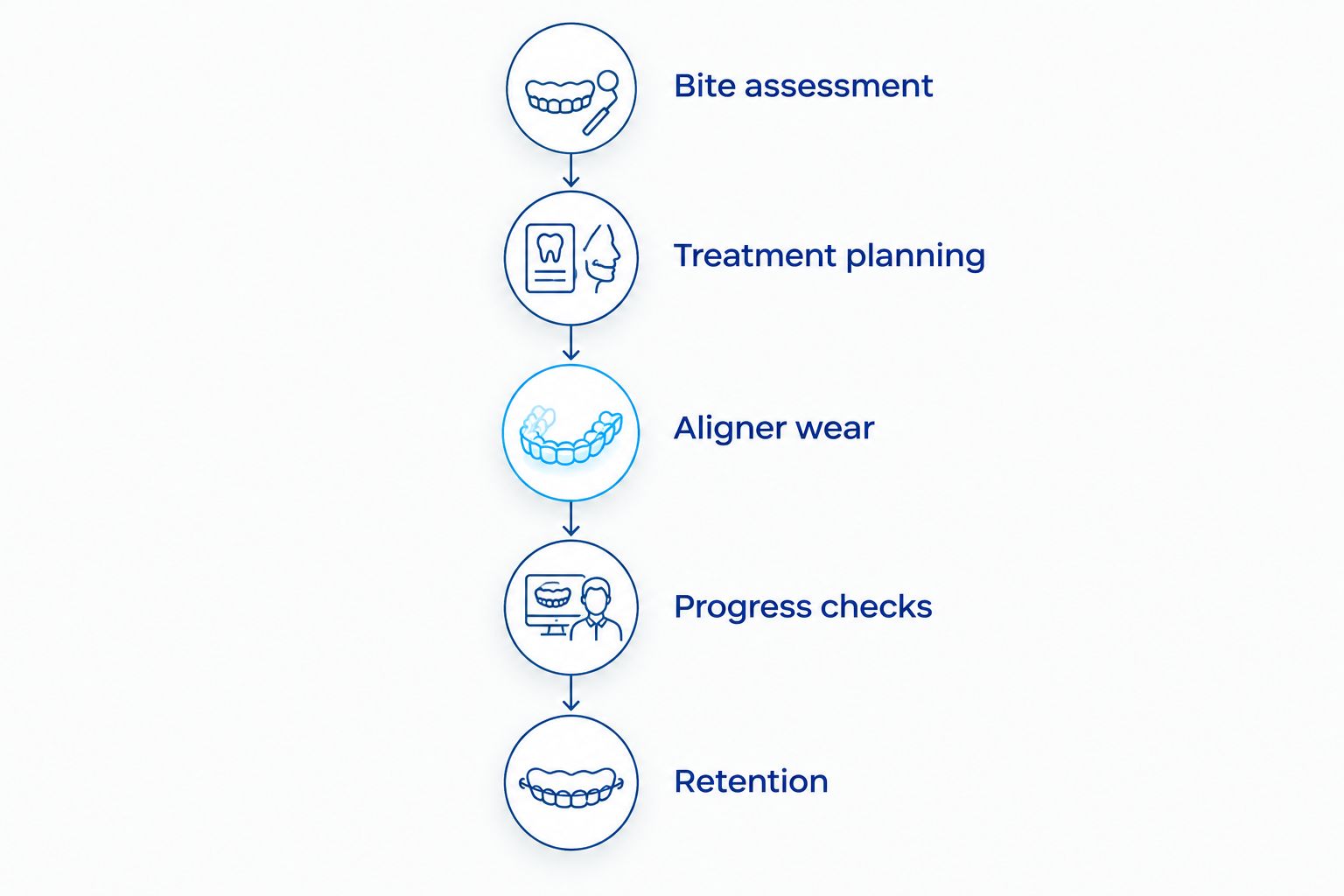
- Bite assessment. Your clinician examines the teeth, gums, jaw relationship, and relevant symptoms. Records can include photographs, scans or impressions, and X-rays when indicated.
- Treatment planning. You discuss the intended tooth movements, alternatives, and limits. Ask whether the plan addresses the overbite, overjet, or both.
- Aligner wear. You follow the prescribed sequence and instructions for attachments or elastics. Do not change elastic placement or advance trays on your own.
- Progress checks. Your clinician checks aligner fit and tooth movement. If progress differs from the plan, adjustments or additional aligners can be needed.
- Retention. After active movement, retainers help maintain the corrected tooth positions. Your clinician sets the wearing schedule and follow-up plan.
A digital preview is a planning aid, not a guarantee of the final result. Ask how your clinician will assess actual bite contacts during treatment, rather than judging progress only by whether your front teeth look straighter.
What does your daily routine need to include?
Invisalign's patient guidance generally calls for 20–22 hours of aligner wear per day. Follow your treating clinician's instructions, including when to remove aligners and how to handle meals, drinks, and cleaning.
Remove aligners for eating, and avoid trapping sugary or acidic drinks against your teeth. Plain water is the simplest drink while wearing them; follow the care instructions for cleaning the aligners themselves.
Brush for 2 minutes, 2 times a day, using fluoride toothpaste, and clean between your teeth daily. An orthodontic routine does not replace regular dental care, and aligners should not become a reason to skip meals or rush cleaning.
If frequent snacking, long meals, or forgetting trays will make wear difficult, say so before starting. The guide to Invisalign for adults: how it works and what to expect explains the broader treatment routine.
Is an overbite the same as an overjet?
No. Overbite describes the vertical overlap of the upper front teeth over the lower front teeth; overjet describes how far the upper front teeth sit ahead horizontally.
People often use “overbite” for both. Ask your clinician to show you which measurement is outside the desired relationship, because the movements needed to change vertical overlap differ from those needed to reduce horizontal projection.
Can Invisalign fix an overbite in adults?
Yes, Invisalign can correct suitable tooth-position overbites in adults. Adult treatment does not rely on remaining jaw growth, so a significant skeletal discrepancy needs a separate discussion about realistic limits and alternatives.
Existing dental work and gum health also affect planning. Bring a list of crowns, implants, previous orthodontic treatment, and any history of loose teeth or gum treatment to your assessment.
Can Invisalign fix a severe overbite?
Sometimes, but “severe” is not enough information to choose an appliance. The cause, required movements, supporting tissues, and jaw relationship determine whether Invisalign, braces, or coordinated specialist treatment is appropriate.
Ask what the proposed treatment will leave unchanged. That question is especially useful when a plan improves the front teeth but cannot fully address the underlying jaw relationship.
Questions to bring to your consultation
For a 2026 consultation, bring your priorities rather than trying to diagnose yourself. You can want a less noticeable appliance and still ask for a clear explanation of its limits.
Useful questions include:
- Is my problem mainly vertical overlap, horizontal projection, or both?
- Is the cause mainly tooth position, jaw structure, or a combination?
- What result can aligners reasonably achieve in my case?
- Will I need attachments, elastics, or another appliance?
- What would make you recommend braces or a specialist opinion instead?
- How will you check that my bite is improving, not just my tooth alignment?
- What happens if my teeth do not move as planned?
- What retention will I need afterward?
Dental Arts of Atlantis is a local Invisalign option for Lake Worth families seeking dental care. Choose treatment based on a bite diagnosis and an achievable goal, not the appliance name alone.
If you feel uncertain after the explanation, ask for clarification before committing. You should leave knowing the main benefit, the main limitation, and the next clinical step.
FAQ
Can Invisalign fix an overbite without braces?
Yes, Invisalign can correct suitable overbites without fixed braces. Some cases need attachments or elastics, while others are better suited to braces or specialist treatment.
How many hours a day do I wear Invisalign for an overbite?
Invisalign’s patient guidance generally calls for 20–22 hours of wear per day. Follow your treating clinician’s instructions, and report difficulty meeting the prescribed schedule before advancing through aligners.
Will Invisalign change my jaw shape?
Invisalign primarily moves teeth; it does not surgically reposition adult jaw bones. Tooth movement can affect your smile and lip support, but a facial-profile change should not be promised without an individual assessment.
Do I need rubber bands with Invisalign for an overbite?
Some Invisalign bite-correction plans use elastics, but not every patient needs them. Your clinician decides whether elastics are appropriate and gives you specific placement and wearing instructions.
Is Invisalign better than braces for an overbite?
Neither Invisalign nor braces is better for every overbite. The required movements, bite diagnosis, oral health, and ability to follow the treatment routine determine which approach fits.
Will fixing my overbite stop my jaw pain?
Overbite correction is not a guaranteed treatment for jaw pain. Jaw discomfort has several possible causes and needs its own assessment before treatment is chosen.
Can my teeth move back after Invisalign fixes my overbite?
Teeth can shift after orthodontic treatment, which is why retainers matter. Follow your clinician’s retention instructions and report a retainer that no longer fits rather than forcing it into place.
Where can I discuss Invisalign in Lake Worth?
Dental Arts of Atlantis offers Invisalign care in Lake Worth for families in the Palm Beach County area. An individual assessment is needed to determine whether aligners suit your overbite.
One last thing
Some vertical overlap between your front teeth is normal. The goal of overbite treatment is not automatically to make the front teeth meet edge to edge; it is to achieve an appropriate, stable relationship for your mouth.
Before starting Invisalign in 2026, ask your clinician to show you the target bite from the side as well as the front. That view helps you understand a correction that a straight-on smile photograph cannot fully show.
Related guides
- How long does Invisalign treatment take?
- Can you get Invisalign with dental crowns?
- How to care for your retainer after Invisalign treatment