

Best overall for stain resistance: porcelain veneers. Best for modest changes and easier repairs: composite veneers. This 2026 guide compares composite veneers vs porcelain veneers by treatment scope, appearance, preparation, and maintenance so you can choose a suitable option—not just compare estimates.
- Composite veneers vs porcelain veneers: choose by tooth health, preparation, appearance, and repair needs—not material alone.
- Porcelain veneers are best for patients prioritizing stain resistance and coordinated changes across visible teeth.
- Composite veneers are best for modest shape changes when repairability matters.
- Dental Arts of Atlantis offers cosmetic dentistry for Lake Worth families seeking a personalized treatment discussion.
Why this matters
Veneers cover the front surfaces of teeth, but composite and porcelain involve different treatment decisions. The material affects how your dentist shapes the restoration, handles future damage, and preserves healthy tooth structure.
Dental Arts of Atlantis provides cosmetic and general dentistry for families in Lake Worth and the Palm Beach County area. The right veneer choice starts with healthy teeth and a comfortable bite—not a shade chart.
For a 2026 treatment decision, compare written plans covering the same teeth and the same goals. A small composite correction and a coordinated porcelain treatment are not equivalent procedures, even when both are described as veneers.
What makes the best veneer option?
Use these criteria before comparing materials or accepting a treatment plan:
- Tooth preservation: How much healthy enamel must be changed to achieve your goal?
- Appearance: Does the material suit the color, translucency, and shape you want?
- Stain resistance: How will the surface respond to coffee, tea, tobacco, and normal wear?
- Repairability: Can a damaged area be repaired, or will the restoration need replacement?
- Bite compatibility: Will the veneers tolerate the way your teeth meet and move?
- Maintenance: What polishing, monitoring, protection, and eventual replacement should you expect?
No material wins every category. Porcelain's stain resistance does not cancel out the importance of enamel preservation, and composite's repairability does not make it suitable for every cosmetic change.
Composite and porcelain veneers at a glance
| Rank and material | Best for | Standout feature | Preparation | Key limitation |
|---|---|---|---|---|
| 1. Porcelain veneers | Coordinated cosmetic changes with stain resistance | Ceramic surface resists staining better than composite | Usually involves enamel preparation; requirements vary by tooth | Significant damage can require replacement |
| 2. Direct composite veneers | Modest shape changes with easier repair | Resin can often be added to or repaired directly | Conservative preparation is possible in selected cases | More susceptible to staining and surface wear |
This ranking prioritizes stain resistance for broader cosmetic changes. If your main goal is a small, repairable correction, direct composite moves into the first position for your needs.
1. Porcelain veneers: best veneers for stain-resistant changes
Porcelain veneers are thin ceramic coverings bonded to the front surfaces of teeth. A dentist plans their shape and shade before bonding them, with the aim of matching your smile and bite.
Porcelain veneers are best for patients seeking coordinated changes to tooth color and shape while prioritizing stain resistance. They are not automatically the best choice for a tiny defect or an otherwise healthy tooth that needs only a limited correction.
Porcelain veneer pros
- Stain resistance: Porcelain resists surface discoloration better than composite resin.
- Appearance control: Ceramic can reproduce translucency and other features of natural enamel.
- Coordinated results: Planning several restorations together helps create consistent proportions and shade.
- Surface finish: A properly finished ceramic surface retains its smooth appearance with appropriate care.
Porcelain veneer cons
- Irreversible preparation: When enamel is removed, it does not grow back; the tooth will need ongoing restorative care.
- Replacement concerns: A substantial fracture or other significant problem can require a new veneer rather than a simple repair.
- Bite limitations: Grinding, clenching, and unfavorable tooth contacts need assessment before treatment.
What to understand before choosing porcelain
Ask your dentist where enamel will be removed and why. Teeth that project forward, have large existing restorations, or need major color changes present different planning challenges from teeth needing a small shape adjustment.
For your 2026 consultation, ask how the proposed shade will relate to neighboring teeth. Porcelain does not whiten like natural enamel, so future whitening plans belong in the discussion before the final shade is selected.
Porcelain veneers best for: Patients with suitable teeth and gums who want broader cosmetic changes and place a high priority on stain resistance.
Verdict: Hold until your dentist confirms that the cosmetic benefit justifies the required preparation.
2. Composite veneers: best veneers for modest, repairable changes
Direct composite veneers use tooth-colored resin shaped onto the front of a tooth and hardened with a curing light. Your dentist then contours and polishes the material to create the planned appearance.
Composite is useful when you want a limited shape correction or want repairability to remain a priority. Depending on the tooth and desired result, treatment can preserve more existing tooth structure than a ceramic approach requiring greater preparation.
Composite veneer pros
- Repairability: A dentist can often repair a localized chip by adding resin.
- Conservative possibilities: Selected cases need little or no removal of healthy enamel.
- Direct shaping: The dentist adjusts the material's contour on the tooth during placement.
- Targeted changes: Resin can address a specific contour concern without automatically involving neighboring teeth.
Composite veneer cons
- Staining: Composite is more susceptible to discoloration than porcelain.
- Surface maintenance: Wear or loss of polish can require professional refinishing.
- Technique sensitivity: The final shape, texture, and color depend on careful placement and finishing.
When a full composite veneer is more than you need
A small chip does not necessarily require resin across the whole front surface. Limited bonding might address the defect while leaving more of the natural surface untouched.
Read about the best cosmetic fix for a small chip without a veneer before assuming a veneer is the only option. The distinction matters: repairing a small area and covering the entire visible surface are different treatment scopes.
Composite is not automatically reversible. If placement involves removing enamel or changing the tooth's shape, removing the resin later will not restore the original tooth untouched.
Composite veneers best for: Patients seeking modest cosmetic changes who accept more surface maintenance in exchange for easier repair.
Verdict: Hold until your dentist establishes whether limited bonding would meet your goal instead.
How to compare veneer treatment estimates in 2026
Compare the work included, not just the material named. An estimate becomes useful when you understand what is being treated, what preparation is involved, and what happens after placement.
Ask for these parts of the plan in writing:
- Treatment scope: Which teeth need treatment, and why is each included?
- Preparation: What tooth structure will change, and are conservative alternatives suitable?
- Supporting care: Do decay, gum inflammation, or existing restorations need attention first?
- Treatment stages: Will you need records, a preview, temporary restorations, or separate placement appointments?
- Follow-up: What bite checks, polishing, and maintenance are recommended?
- Future repairs: What would happen if a veneer chipped, detached, or needed replacement?
A plan involving fewer teeth is not automatically better. Nor is a larger treatment automatically more complete: every treated tooth needs a clear reason.
Bring your priorities to Dental Arts of Atlantis when discussing cosmetic dentistry. Explain whether your main concern is a chipped edge, uneven shape, discoloration, or a combination; that distinction helps make the treatment discussion specific.
Check your teeth before choosing a material
Veneers change appearance; they do not cure decay, gum disease, or an unstable bite. Covering a tooth without addressing those problems does not make them disappear.
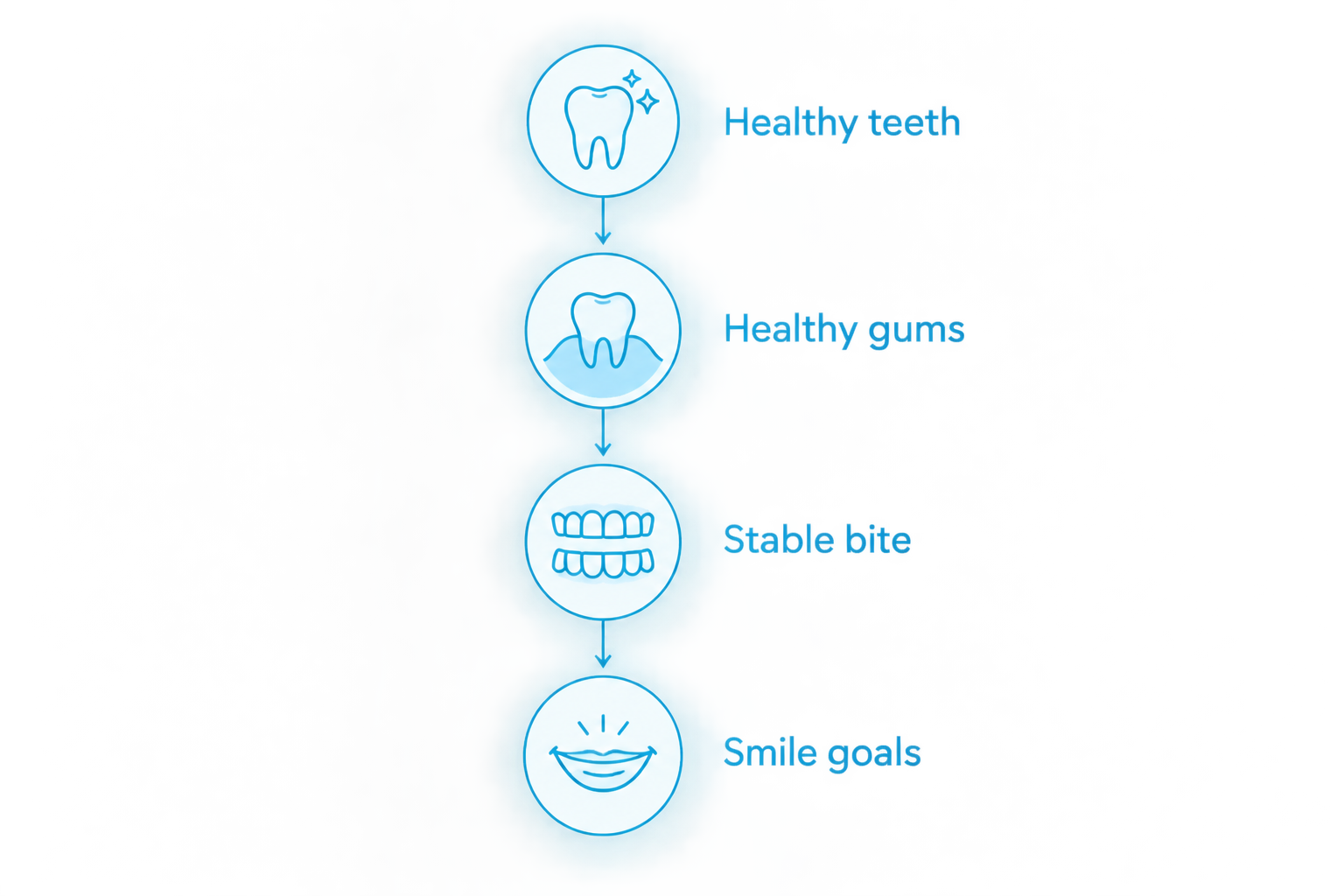
Use this order when planning treatment:
- Healthy teeth: Identify decay, cracks, existing restorations, and any symptoms requiring investigation.
- Healthy gums: Address inflammation and establish a gum condition that supports reliable planning.
- Stable bite: Check tooth contacts, grinding, and clenching before adding restorative material.
- Smile goals: Decide which changes matter and whether veneers are necessary to achieve them.
The order protects your treatment decision. For example, a tooth that hurts when biting needs a diagnosis before anyone treats it as a purely cosmetic concern.
Tell your dentist if you wake with jaw soreness, notice worn edges, or have broken previous dental work. These details help determine whether veneers are appropriate and whether protection against grinding belongs in your plan.
Maintenance matters whichever material you choose
Neither composite nor porcelain makes a tooth immune to decay. The natural tooth remains vulnerable, especially where the restoration meets the tooth and gumline.
Brush for 2 minutes per session, 2 times per day, using fluoride toothpaste and a soft-bristled toothbrush. Clean between teeth 1 time per day, and ask your dentist which interdental cleaning method suits your restorations.
Avoid biting fingernails, chewing ice, or using your teeth to open packaging. Both materials can chip, and porcelain's stain resistance is not protection against excessive force.
For your 2026 maintenance plan, discuss professional monitoring rather than assuming veneers can be left alone until something breaks. Report a rough edge, changed bite, looseness, or persistent sensitivity so your dentist can assess the cause.
Composite maintenance: Expect your dentist to assess staining, surface wear, and whether polishing or repair is needed.
Porcelain maintenance: Expect checks of the restoration margins, surrounding gums, bite contacts, and any signs of cracking or detachment.
How the veneer options were ranked
Porcelain ranks first for coordinated cosmetic changes because it combines appearance control with greater stain resistance than composite. Composite ranks first for modest corrections when direct repair and conservative treatment are the priorities.
This is a material-based decision guide, not a claim that every patient should receive veneers. The ranking gives tooth preservation, bite suitability, and maintenance as much weight as the appearance of the finished restoration.
Which veneer option should you choose?
Choose porcelain for broader cosmetic changes when stain resistance is a priority and your dentist confirms suitable tooth structure and bite conditions. Choose composite for modest changes when repairability and conservative treatment are more important.
If you remain undecided in 2026, start with the least extensive treatment that can reasonably meet your goal. Ask what happens if you do nothing, choose a limited correction, or proceed with veneers.
Dental Arts of Atlantis is a cosmetic dentistry option for Lake Worth families seeking care within a general dental practice. Bring photos of your own smile, describe what bothers you, and ask for an explanation of the trade-offs before agreeing to tooth preparation.
Discuss your smile goals
Ask which treatment fits your teeth, bite, and cosmetic priorities.
FAQ
What’s better, composite veneers or porcelain veneers?
Porcelain veneers are better for stain resistance, while composite veneers are better for easier localized repairs. Your tooth structure, bite, and desired changes determine which material is suitable.
How do I compare composite and porcelain veneer estimates?
Compare estimates covering the same teeth, treatment goals, preparation, and follow-up. Ask each dentist to explain supporting treatment and what happens if a restoration needs repair or replacement.
Do composite veneers ruin your natural teeth?
Composite veneers do not automatically require extensive tooth preparation, but placement can involve changes to enamel. Ask exactly what will be removed; conservative treatment is not the same as guaranteed reversibility.
Are porcelain veneers permanent?
Porcelain veneers are not lifetime restorations, but treatment involving enamel removal creates an ongoing restorative commitment. Veneers eventually need assessment for repair or replacement, and removed enamel does not grow back.
Can I whiten composite or porcelain veneers?
Whitening treatment does not lighten veneer material the way it lightens natural teeth. Discuss whitening before selecting a veneer shade, and have discoloration assessed rather than using abrasive products.
Can I get veneers if I grind my teeth?
Teeth grinding requires evaluation before veneer treatment because excessive forces can damage either material. Your dentist should assess your bite and discuss whether a protective appliance or other treatment is appropriate.
Should I get a veneer for a small chipped tooth?
A small chip does not automatically need a veneer. Limited bonding or another conservative approach might meet your goal, depending on the chip’s depth, location, and effect on your bite.
One last thing
The most useful veneer question is: “What healthy tooth structure would change, and why?” A material comparison cannot answer that for your mouth. Ask your dentist to explain the proposed changes tooth by tooth before you commit.
Related guides
- How to care for veneers to keep them looking new
- Can veneers be removed once they're placed?
- Best veneer material for a natural-looking smile