
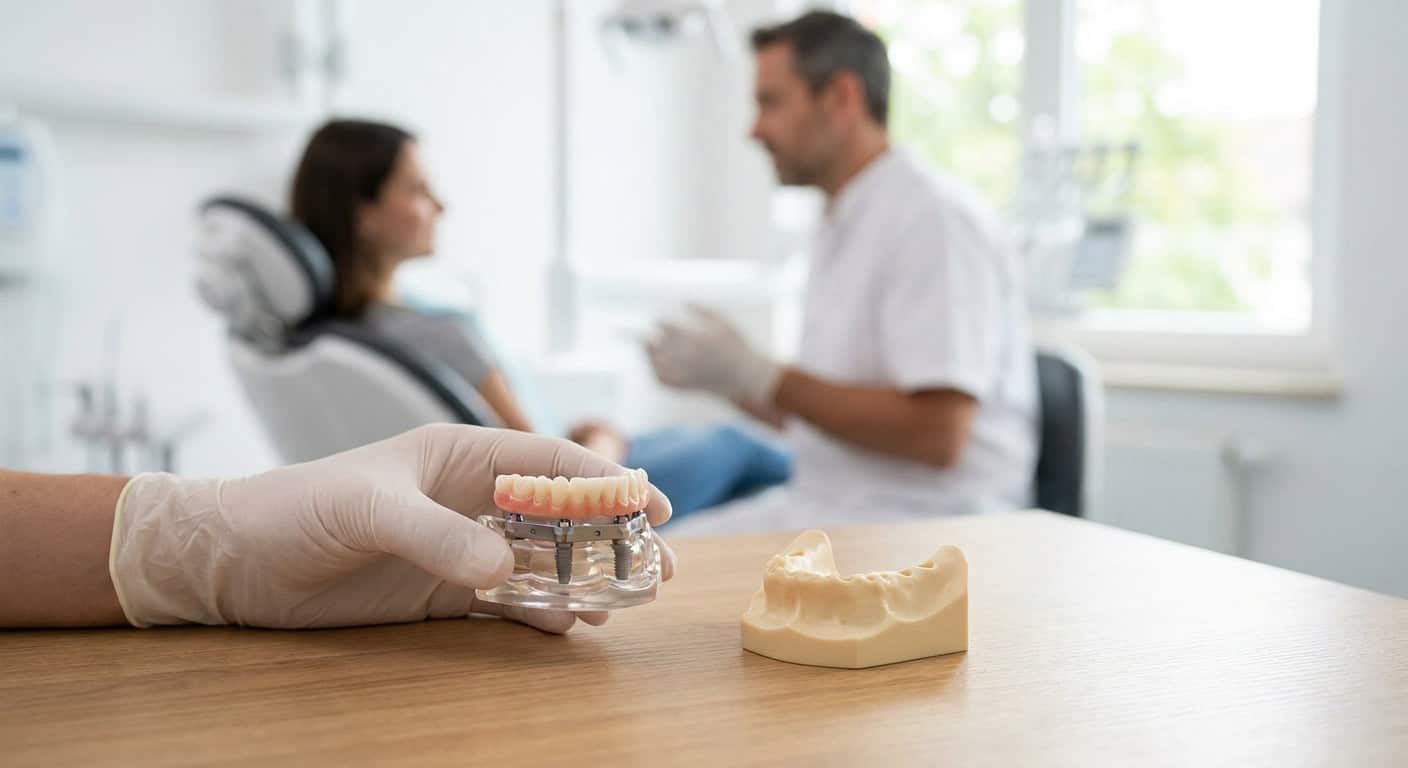
Losing every tooth in an arch changes how you chew, speak, and smile — and the fix isn't one-size-fits-all. This guide ranks the six real options for full-arch tooth replacement in 2026, from the standard All-on-4 fixed bridge to traditional dentures, with a verdict on each.
- All-on-4 implant-supported fixed bridges are the best implant for a full arch of missing teeth for most patients with adequate jawbone — Buy.
- All-on-6 adds two implants for softer bone and heavier bite force — Buy for reinforced support.
- Implant-supported overdentures cost less upfront but need nightly removal — Consider, not a first choice.
- Zirconia hybrid bridges outlast acrylic versions and resist staining through 2026 and beyond — Buy for durability.
- Traditional dentures without implants remain the fallback only when implants aren’t medically feasible — Wait or Skip.
Why this matters
An arch has roughly 14 teeth, and losing all of them shifts bone density, bite alignment, and facial support within months, not years. Waiting to decide makes every option below more complicated because bone resorbs fastest in the first year after extraction.
Patients coming in for patients missing all their teeth solutions often assume dentures are the only route. They're not — implant-supported fixed bridges have become the standard recommendation for full-arch cases at Dental Arts of Atlantis when bone volume allows it, because they restore close to natural bite force instead of the 20-25% of natural chewing power dentures typically provide.
How we ranked these options
The ranking below weighs four factors dentists evaluate during a full-arch consultation: how many implants the design requires, whether the final prosthesis is fixed or removable, daily maintenance burden, and long-term durability of the materials involved. Options that restore near-normal chewing function with the fewest implants and the least daily upkeep rank highest. Options that require more surgery, more maintenance, or offer less bite strength rank lower — that's not a knock on removable dentures, it's a reflection of what full-arch implant dentistry can now do that wasn't standard a decade ago.
The ranked list
1. All-on-4 Implant-Supported Fixed Bridge — the standard pick
Four implants per arch, angled to use available bone without grafting in most cases, support a full fixed bridge placed the same day as surgery. Healing before the final prosthesis typically runs 3 to 4 months. This design restores chewing function closest to natural teeth among full-arch options that don't require bone grafting.
Verdict: Buy — the default recommendation for patients with adequate jawbone and no interest in a removable appliance.
2. All-on-6 Implant-Supported Fixed Bridge — the reinforced pick
Six implants spread bite force across two more anchor points than All-on-4, which matters for patients with softer bone or a heavier bite. The extra implants can add 4 to 6 weeks to planning if any grafting is needed at additional sites, but the fixed result functions the same way day to day.
Verdict: Buy for patients whose CBCT scan shows lower bone density.
3. Implant-Supported Overdenture — the removable middle ground
Two to four implants anchor a denture that snaps in with locator attachments, giving more stability than a traditional plate while staying removable for nightly cleaning. It costs less than a fixed bridge because it uses fewer implants and a simpler prosthesis, but patients trade the fixed feel for a removable one.
Verdict: Consider if budget or bone volume rules out a fixed bridge — this is a real upgrade from replacing several missing teeth in a row with a partial denture, but it's not the top pick for someone who wants zero daily maintenance.
4. Zirconia Full-Arch Fixed Bridge — the premium long-term pick
Milled from a single block of zirconia instead of layered acrylic over a metal frame, this hybrid prosthesis resists staining and chipping far better than acrylic full-arch bridges. It sits on the same 4-6 implant foundation as options above but costs more because of the material and lab work involved.
Verdict: Buy for patients prioritizing a bridge that looks and holds up the same in 2030 as it does in 2026.
5. Individual Implants Across the Arch — the rarely recommended route
Placing 10 to 14 separate implants, one per missing tooth, requires adequate bone at every single site and multiple surgical stages. It's the most invasive and most expensive path to full-arch replacement, and it rarely offers a functional advantage over All-on-4 or All-on-6 for most patients.
Verdict: Skip unless a specific clinical reason rules out the fixed-bridge designs above.
6. Traditional Full Denture, No Implants — the non-implant baseline
A conventional denture rests on the gum ridge with no anchoring at all, relying on suction and adhesive. It's the least invasive option and the one with the least bite strength — most patients report chewing capacity well below what a natural arch or an implant-supported design provides.
Verdict: Wait or Skip on this as a first choice — it's worth discussing only when implants aren't medically feasible right now.
“If a patient still has enough bone to hold four implants, a fixed bridge almost always beats a removable one for daily function.”
Comparison table
| Option | Implants Needed | Fixed or Removable | Typical Healing | Verdict |
|---|---|---|---|---|
| All-on-4 Fixed Bridge | 4 | Fixed | 3-4 months | Buy |
| All-on-6 Fixed Bridge | 6 | Fixed | 3-4 months + grafting time | Buy |
| Implant-Supported Overdenture | 2-4 | Removable | 3-4 months | Consider |
| Zirconia Full-Arch Bridge | 4-6 | Fixed | 3-4 months | Buy |
| Individual Implants (full arch) | 10-14 | Fixed | 4-8 months | Skip |
| Traditional Denture | 0 | Removable | Weeks | Wait/Skip |
How to choose a provider
- Confirm the practice uses 3-D imaging to plan implant placement before surgery — this is what determines whether All-on-4 or All-on-6 fits your bone volume, not a guess from a 2-D X-ray.
- Ask about anxiety and comfort options up front if a full day of surgery worries you; a sedation option for dental anxiety should be part of the conversation, not an afterthought.
- Get the full treatment plan in writing, including how many implants, what material the final bridge uses, and what the maintenance schedule looks like for years two through ten.
Talk through your full-arch options
A consultation with 3-D imaging shows exactly which implant design fits your bone.
FAQ
What is the best implant for a full arch of missing teeth?
For most patients with adequate jawbone, an All-on-4 implant-supported fixed bridge is the best implant for a full arch of missing teeth in 2026 because it restores near-natural chewing with just four implants and no grafting in most cases. Patients with softer bone often move to All-on-6 for extra support.
Is All-on-4 better than All-on-6?
All-on-4 works for most patients with sufficient bone density, while All-on-6 spreads bite force across two extra implants for patients with softer bone or a heavier bite. Neither is universally better — it depends on what a CBCT scan shows.
How many implants does a full arch need?
A full arch typically needs 4 to 6 implants for a fixed bridge, or 2 to 4 implants for a removable overdenture. Individual implants for every tooth would require 10 to 14 implants, which is rarely necessary.
How long does healing take after full-arch implants?
Healing before the final fixed bridge typically takes 3 to 4 months, though additional grafting can extend that timeline by 4 to 6 weeks. A temporary fixed bridge is usually placed the same day as surgery.
Are implant-supported dentures removable?
Yes — implant-supported overdentures snap onto 2 to 4 implants using locator attachments and come out nightly for cleaning, unlike a fixed bridge which stays in place permanently.
Is zirconia better than acrylic for a full-arch bridge?
Zirconia full-arch bridges resist staining and chipping better than acrylic hybrid bridges over time, making them the stronger long-term pick for patients who want to avoid replacing the prosthesis every few years.
Can I get full-arch implants if I’ve worn dentures for years?
Yes, though long-term denture wear often reduces bone volume, which may require a bone graft before implant placement. A 3-D imaging scan during consultation shows exactly what’s available to work with.
What happens if I’m not a candidate for implants?
A traditional full denture remains the fallback when implants aren’t medically feasible, though it provides less chewing strength than any implant-supported option on this list.
One last thing
The detail most patients miss: the temporary fixed bridge placed on surgery day isn't cosmetic filler — it's a functional prosthesis you'll chew on for 3 to 4 months while the implants integrate, so ask exactly what that interim bridge looks and feels like before you commit to a surgery date.
Related guides