
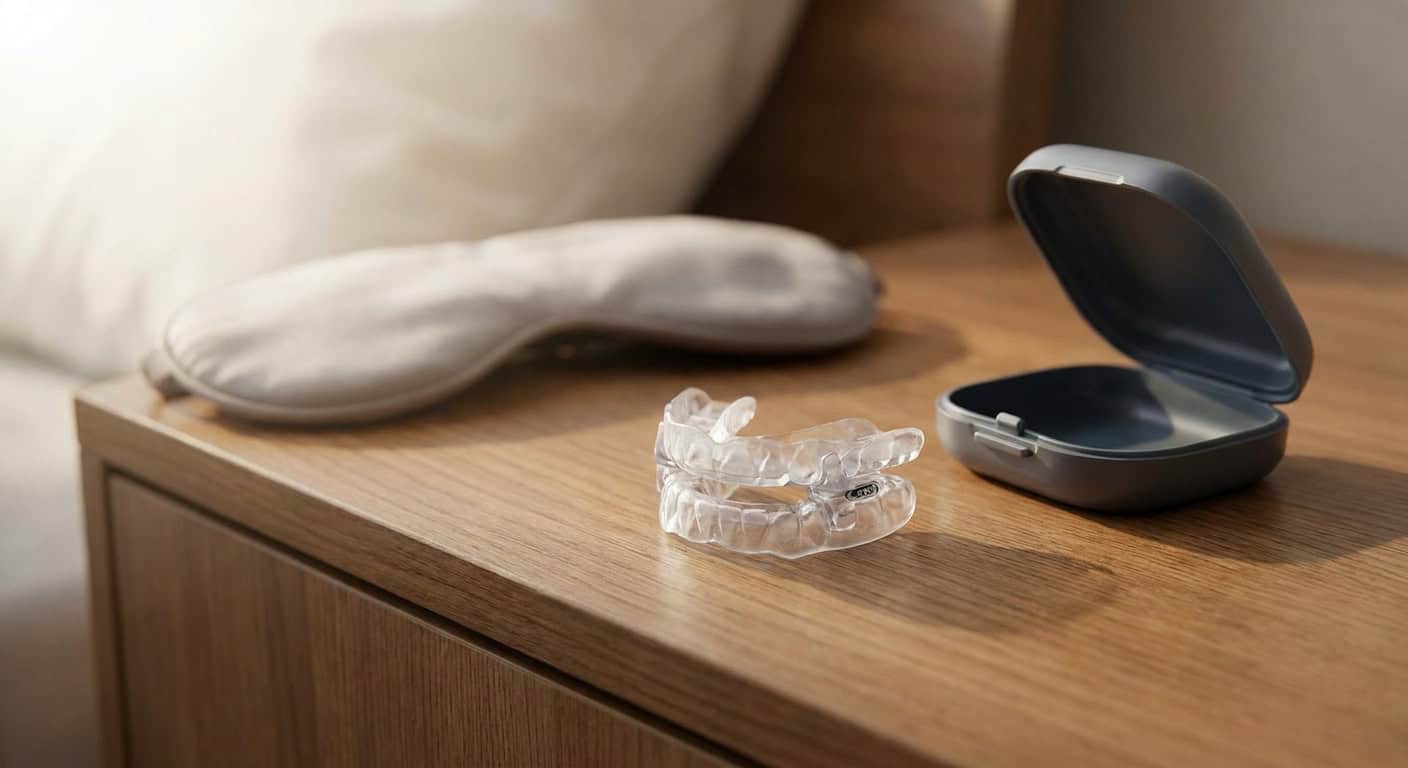
CPAP failure doesn't mean you're stuck with sleep apnea untreated — it means you need a different delivery system, and the best oral appliance for sleep apnea without CPAP is a custom-fit, titratable mandibular advancement device fitted by a dentist trained in dental sleep medicine, not a boil-and-bite gadget from a drugstore shelf.
- A custom titratable mandibular advancement device (MAD) is the best oral appliance for sleep apnea without CPAP for most mild-to-moderate cases in 2026 — Buy.
- Tongue-retaining devices are the backup pick when jaw movement is limited or a patient grinds heavily — Consider.
- Boil-and-bite anti-snoring guards are not medical devices and should be skipped for diagnosed sleep apnea.
- AHI classification (mild 5-15, moderate 15-30, severe 30+) determines which appliance category is even appropriate.
- Combination therapy with positional training adds value for supine-dependent apnea but isn’t a standalone fix.
Why this matters
CPAP is still the gold-standard first-line therapy for obstructive sleep apnea, but a large share of patients stop using it within the first year — mask discomfort, claustrophobia, dry mouth, and travel hassle are the usual reasons. When CPAP compliance fails, the airway problem doesn't disappear. Oral appliance therapy repositions the lower jaw or tongue to keep the airway open mechanically, and by 2026 it's a well-established second-line option recognized by sleep medicine guidelines for mild-to-moderate cases.
The catch: not every oral appliance is built the same, and picking the wrong one wastes money and leaves apnea untreated. A device sized for snoring alone won't manage a documented AHI of 20. This guide ranks the appliance categories that actually matter for CPAP-intolerant patients, not brand-name products, because the category and the fit determine whether the device works.
How this list was built
The ranking below weighs three things: how well each appliance category is documented in sleep medicine practice, how it performs across mild, moderate, and severe classifications, and how often it shows up as a durable long-term fix versus a stopgap. Custom, dentist-fitted devices consistently outrank over-the-counter options because they're titratable — the jaw position adjusts in small increments after a follow-up sleep study confirms the setting is working. Off-the-shelf devices skip that verification step entirely, which is why they land near the bottom regardless of price.
The ranked list
1. Custom titratable mandibular advancement device (MAD) — the workhorse
This is the most-prescribed alternative to CPAP in 2026, and for good reason: it's adjustable in increments as small as 0.25mm, so a dentist can fine-tune jaw position after a follow-up sleep study instead of guessing at a single fixed setting. It holds the lower jaw slightly forward, which pulls the tongue and soft tissue away from the back of the throat.
What it does: two custom-molded trays connect with a hinge or strap mechanism, letting the dentist advance the mandible gradually over several weeks. For patients with mild to moderate OSA who can't tolerate a CPAP mask, this is usually the first appliance tried because it's reversible, well-tolerated, and backed by the longest track record in dental sleep medicine. Dental Arts of Atlantis fits this category as part of its mild sleep apnea solution protocol, starting with a bite registration and airway assessment.
Why now: if you've already tried and abandoned CPAP in 2026, a titratable MAD gets you a working device within two to three fitting visits rather than restarting mask trials. Verdict: Buy for mild-to-moderate OSA with a confirmed AHI under 30.
2. Tongue-retaining device (TRD) — the backup pick
A TRD doesn't touch the jaw at all — it uses a suction bulb to hold the tongue forward, which matters for patients with limited jaw mobility, TMJ sensitivity, or a bite that makes mandibular advancement uncomfortable. It's bulkier in the mouth than a MAD and takes longer to adapt to, typically two to four weeks of nightly wear before it feels normal.
What it does: because it doesn't rely on the teeth or jaw joint, it's a reasonable option for edentulous patients or anyone who can't tolerate the clenching sensation of a two-piece device. It's also useful for people whose apnea is worse when sleeping on their back. Dental Arts of Atlantis evaluates TRD candidacy under the same chronic snorers sleep apnea treatment intake.
Verdict: Consider if jaw advancement is contraindicated or poorly tolerated.
3. Dual-block adjustable appliance with lab-verified fit — the premium pick
This is a step up from a standard MAD: a dental lab fabricates the trays from a digital or physical impression, and the mechanism allows lateral jaw movement so patients aren't locked rigidly in one position all night. That reduces the jaw soreness that causes some patients to abandon MAD therapy in the first month.
What it does: the added flexibility matters most for side sleepers and anyone with a history of jaw clenching, since a rigid device can aggravate the joint. It costs more than a basic MAD because of the lab fabrication step and the extra material.
Verdict: Buy for patients who tried a basic MAD and found it too restrictive.
4. Combination therapy: oral appliance plus positional training — the add-on
When apnea events cluster while sleeping on the back (positional or supine-dependent OSA), pairing an oral appliance with a positional trainer that discourages back-sleeping can lower the overall event count more than either approach alone. This isn't a standalone appliance — it's a layer added on top of a MAD or TRD.
What it does: a vibration-based positional device nudges the sleeper onto their side, where airway collapse is less likely, while the oral appliance handles the mechanical repositioning of the jaw or tongue. Worth discussing at a follow-up visit if a sleep study shows most events happen supine.
Verdict: Hold — add it after confirming positional dependence on a sleep study, not as a first move.
5. Boil-and-bite or one-size anti-snoring guard — the skip
These are the devices sold online and in drugstores as generic snore stoppers. They're not fitted to an individual bite, they're not titratable, and they're not classified as a medical device for diagnosed obstructive sleep apnea in most cases. A patient with a documented AHI of 15 or higher wearing one of these has no way to know whether it's doing anything.
What it does: at best, it reduces soft-tissue vibration that causes snoring noise. It does nothing to verify airway patency and offers no adjustment path if it doesn't work.
Verdict: Skip for anyone with a diagnosed sleep apnea condition, CPAP-intolerant or not.
Get evaluated for oral appliance therapy
Bite assessment and airway evaluation before any device is fitted.
What to avoid
- Skipping the sleep study. An appliance fitted without a current AHI number is a guess, not a treatment.
- Confusing a night guard with an apnea appliance. A device built for teeth grinding and jaw pain protects enamel, but it doesn't reposition the airway the way a MAD does — different problem, different device.
- Ignoring jaw pain as a break-in symptom. Persistent soreness after four weeks can point toward TMJ strain from an over-advanced setting, not normal adjustment.
Comparison table
| Appliance | Best for | Jaw movement required | 2026 verdict |
|---|---|---|---|
| Custom titratable MAD | Mild-moderate OSA, first-time CPAP failures | Yes, gradual advancement | Buy |
| Tongue-retaining device | Limited jaw mobility, edentulous patients | No | Consider |
| Dual-block lab-fitted MAD | Side sleepers, jaw-sensitive patients | Yes, with lateral give | Buy |
| Combination + positional trainer | Supine-dependent apnea | Depends on base appliance | Hold, add after diagnosis |
| Boil-and-bite guard | Simple snoring only | No | Skip |
Where to get fitted
- Start with a sleep study, not a dental appointment. The AHI number determines whether an oral appliance is even appropriate or whether a specialist referral comes first.
- Choose a dentist trained in dental sleep medicine, not a general dentist offering a side-menu appliance — titration and follow-up matter more than the initial mold.
- Budget for at least one adjustment visit. A single fitting rarely lands the correct jaw position on the first try in 2026 practice patterns; expect a follow-up sleep study after the initial titration period.
FAQ
What is the best oral appliance for sleep apnea without CPAP?
A custom titratable mandibular advancement device is the best oral appliance for sleep apnea without CPAP for most mild-to-moderate cases in 2026. It’s adjustable after fitting, unlike boil-and-bite options.
Can an oral appliance replace CPAP completely?
For mild to moderate obstructive sleep apnea, an oral appliance can serve as a full CPAP replacement when fitted and titrated correctly. Severe cases often still need CPAP or a combination approach.
How long does it take to adjust to a mandibular advancement device?
Most patients adapt within two to four weeks of nightly wear. Persistent jaw soreness past that window usually means the advancement setting needs adjusting.
Are boil-and-bite anti-snoring devices safe for sleep apnea?
Boil-and-bite devices aren’t fitted or titrated to an individual airway, so they’re not a reliable treatment for diagnosed sleep apnea. They may reduce snoring noise without addressing airway collapse.
Is a tongue-retaining device better than a mandibular advancement device?
A tongue-retaining device is better only when jaw advancement is uncomfortable or contraindicated, such as with TMJ sensitivity. A MAD remains the more common first choice for mild-to-moderate OSA.
Do I need a sleep study before getting an oral appliance?
Yes, a current AHI reading from a sleep study is needed to confirm the diagnosis and severity before any oral appliance is fitted. Without it, there’s no way to verify the device is working.
How much jaw movement does an oral appliance require?
A standard mandibular advancement device requires gradual forward jaw movement in small increments, often as little as 0.25mm per adjustment. Tongue-retaining devices require none.
Can oral appliance therapy cause TMJ pain?
An over-advanced or poorly fitted device can strain the jaw joint and cause TMJ-like soreness. Adjustment appointments exist specifically to catch and correct that before it becomes chronic.
One last thing
The detail most patients miss: the appliance that works isn't the one that feels the most comfortable on night one — it's the one with a documented follow-up sleep study confirming the AHI actually dropped. Comfort without verification is just a mouthguard with a nicer name.
Related guides