
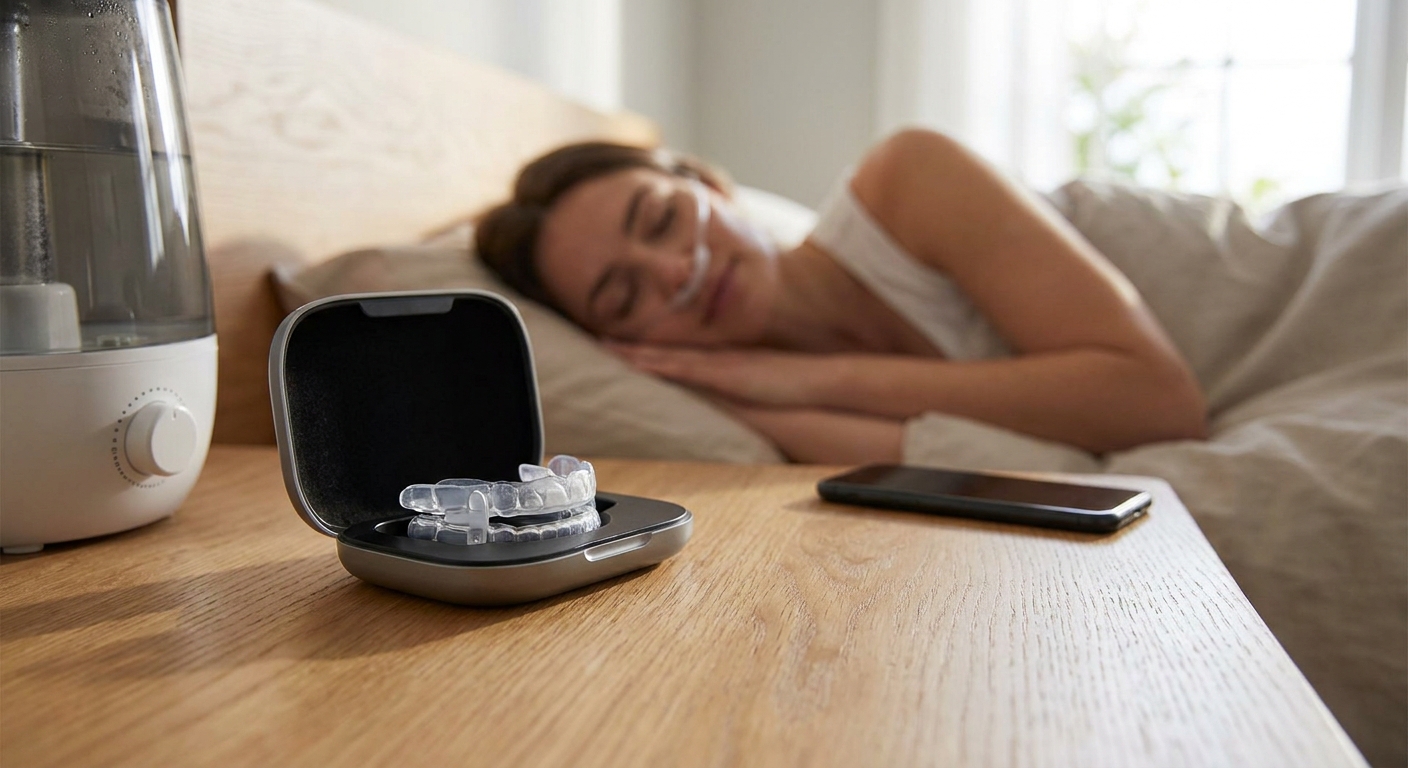
Chronic snoring and mild sleep apnea both start with the same problem — a collapsing airway — but they don't call for the same fix. This guide ranks the treatment options dentists and sleep physicians actually use in 2026, from custom oral appliances to CPAP to free lifestyle changes, and tells you which one to try first.
- Custom oral appliance therapy is the best treatment for snoring and sleep apnea when AHI stays under 15 to 30 — Buy.
- CPAP is still the gold standard for severe sleep apnea (AHI over 30) but has a well-documented adherence problem — Hold for severe cases only.
- Positional therapy and modest weight loss cost nothing and reduce snoring for a real subset of patients — Buy as a first step.
- Nasal strips quiet the noise but do nothing for the airway collapse behind diagnosed sleep apnea — Skip once apnea is confirmed.
- Surgery is a last resort in 2026, reserved for anatomical blockages that don’t respond to appliances or CPAP — Wait.
Why this matters
Snoring is annoying. Untreated sleep apnea is a health problem — it's tied to daytime fatigue, high blood pressure, and a partner who hasn't slept through the night in years. The two conditions overlap, but they're diagnosed differently and treated differently, and picking the wrong first move wastes months.
Sleep apnea severity is measured by AHI — the number of breathing pauses per hour of sleep. Mild sleep apnea is 5 to 15 events per hour, moderate is 15 to 30, and severe is anything above 30. That number, not how loud you snore, decides which treatment actually makes sense.
How we ranked these
The ranking below follows the joint 2015 clinical practice guideline from the American Academy of Sleep Medicine and the American Academy of Dental Sleep Medicine, which remains the reference point dentists and sleep physicians use in 2026 for deciding between oral appliances, CPAP, and surgery. Rankings weigh three things: which AHI range a treatment is actually indicated for, how well patients stick with it long-term, and how much it does for snoring specifically versus airway collapse. A treatment that looks effective on paper but sits unused in a drawer isn't a good treatment — that distinction moves a few options up and down this list.
The ranked list
1. Custom Oral Appliance Therapy — the dental fix
A custom-fitted mandibular advancement device holds the lower jaw slightly forward during sleep, which keeps the tongue and soft tissue from collapsing into the airway. It's fitted and adjusted by a dentist, not a physician, which surprises a lot of first-time patients.
The 2015 AASM/AADSM guideline recommends oral appliances for mild-to-moderate obstructive sleep apnea and for primary snoring without apnea. It's the option most people can actually wear every single night — no mask, no hose, no machine noise. Get fitted through sleep apnea treatment for chronic snorers if your sleep study puts you in the mild-to-moderate range.
Verdict: Buy for mild-to-moderate sleep apnea and for snoring without a diagnosed breathing pause problem.
2. CPAP — the gold standard, when you actually wear it
A CPAP machine pushes pressurized air through a mask to keep the airway physically open all night. For severe sleep apnea — AHI above 30 — it's still the first-line recommendation in 2026, and nothing else on this list matches its effectiveness at that severity.
The catch is adherence. A meaningful share of patients stop using CPAP within the first year because of mask discomfort, noise, or travel hassle. If you already know you can't tolerate a mask, that's worth telling your provider before you invest months trying to make it work.
Verdict: Hold — first-line for severe cases, unnecessary for mild snoring alone.
3. Positional Therapy — the free fix
Some mild sleep apnea is position-dependent: it gets worse specifically when someone sleeps on their back, because gravity lets the tongue fall into the throat. Training yourself to stay off your back — a wedge pillow, a shirt with a tennis ball sewn into the back, or a positional sleep tracker — reduces events for that subset of patients without any device.
It costs nothing and carries zero downside, which makes it worth trying before anything else, even if it isn't the whole answer.
Verdict: Buy as a first step, especially before scheduling a sleep study.
4. Weight Loss and Lifestyle Changes — the underrated multiplier
Excess soft tissue around the neck and throat narrows the airway, and alcohol or sedatives before bed relax throat muscles further, both of which make snoring and apnea worse. Even a modest reduction in body weight is commonly cited in sleep medicine as enough to meaningfully lower AHI in overweight patients.
This one doesn't replace an oral appliance or CPAP for moderate-to-severe cases, but it stacks with either one.
Verdict: Buy — do this regardless of which device or appliance you choose.
5. Nasal Dilators and Strips — the drugstore stopgap
External strips and internal nasal dilators widen the nostrils, which can reduce snoring volume for people whose noise comes from nasal restriction. What they don't do is touch the soft palate or tongue collapse that actually causes obstructive sleep apnea.
They're fine for a partner's peace of mind if a sleep study rules out apnea. They're not a treatment for a diagnosed breathing problem.
Verdict: Skip if apnea is confirmed; Consider only for pure snoring with no diagnosis.
6. Myofunctional Therapy — the emerging option
Daily tongue and throat muscle exercises aim to firm up the tissue tone that collapses during sleep. As of 2026, it's used mainly as an add-on alongside an oral appliance or CPAP rather than as a stand-alone fix, since the evidence for it working alone is thinner than for appliances or CPAP.
Verdict: Wait — reasonable as a supplement, not proven enough to carry the load by itself yet.
7. Combination Care for Grinders — the overlap nobody mentions
Patients who clench or grind their teeth at night often also snore, and the two conditions need to be evaluated together. A standard night guard protects enamel but doesn't move the jaw forward enough to help an airway problem, and a sleep appliance alone won't address the wear pattern from bruxism.
If a dentist flags visible wear during a night guard fitting for teeth grinding and you also snore, ask about a combined evaluation — chronic jaw pain and headaches from clenching often trace back through TMJ treatment for chronic jaw pain as well.
Verdict: Buy — get evaluated for both together rather than treating one and ignoring the other.
8. Surgery (UPPP and similar procedures) — the last resort
Surgical procedures remove or tighten excess throat tissue to open a physically blocked airway. They involve real recovery time and are reserved in 2026 for anatomical blockages — like an oversized soft palate or enlarged tonsils — that don't respond to appliances or CPAP.
Verdict: Skip until oral appliance therapy and CPAP have both been tried and documented as ineffective.
Comparison at a glance
| Treatment | Best For | Nightly Effort | Verdict |
|---|---|---|---|
| Custom oral appliance | Mild-to-moderate OSA, primary snoring | Low — wear like a mouthguard | Buy |
| CPAP | Severe OSA (AHI 30+) | High — mask and machine | Hold |
| Positional therapy | Position-dependent mild OSA | Low — habit-based | Buy |
| Weight loss/lifestyle | Any severity, as an add-on | Ongoing | Buy |
| Nasal strips/dilators | Snoring without diagnosed apnea | Low | Skip if apnea confirmed |
| Myofunctional therapy | Add-on to another treatment | Daily exercises | Wait |
| Combination appliance care | Snorers who also grind | Low | Buy |
| Surgery | Anatomical blockage, other options failed | One-time procedure | Skip until tried elsewhere |
Find out which option fits your case
Get evaluated for oral appliance therapy at Dental Arts of Atlantis in Lake Worth.
Where to get treatment
- Get a sleep study before committing to any device. AHI, not how loud you snore, decides whether an appliance, CPAP, or nothing beyond lifestyle changes is the right call.
- Choose a dentist trained specifically in dental sleep medicine for appliance fitting, not just any general dentist — the fit and jaw positioning matter for effectiveness.
- Recheck AHI 3 to 6 months after starting treatment. Comfort doesn't equal effectiveness, and a follow-up sleep study confirms the appliance or machine is actually working, not just tolerable.
FAQ
What’s the best treatment for snoring and sleep apnea in 2026?
For mild-to-moderate obstructive sleep apnea and primary snoring, a custom oral appliance is the best treatment for snoring and sleep apnea based on the 2015 AASM/AADSM guideline still in use in 2026. CPAP remains first-line for severe cases with an AHI above 30.
Is a custom oral appliance better than CPAP for mild sleep apnea?
For mild-to-moderate sleep apnea, an oral appliance is generally the better first choice because patients wear it more consistently than a CPAP mask. CPAP still outperforms appliances for severe cases, where AHI exceeds 30 events per hour.
How much does an oral appliance for sleep apnea cost?
Cost varies by case complexity, insurance coverage, and whether a sleep study is needed first, so check current pricing directly with your dentist and insurance provider. Many dental insurance plans and medical plans cover part of the cost when apnea is medically diagnosed.
Can snoring be cured without a sleep study?
Simple snoring without apnea can often improve with positional therapy, weight loss, or a nasal strip, but you won’t know if apnea is present without a sleep study. Loud, chronic snoring paired with daytime fatigue is reason enough to get tested before assuming it’s harmless.
Does losing weight actually stop snoring?
Weight loss reduces soft tissue around the airway and can meaningfully lower AHI for overweight patients, though it rarely eliminates moderate-to-severe apnea on its own. It works best paired with an oral appliance or CPAP rather than as a stand-alone fix.
Are nasal strips effective for sleep apnea?
Nasal strips reduce snoring volume caused by nasal restriction but do nothing for the tongue and soft-palate collapse that causes obstructive sleep apnea. They’re a reasonable option for pure snoring once a sleep study has ruled out apnea, not a treatment for diagnosed apnea.
How do I know if my snoring is actually sleep apnea?
Signs pointing toward apnea rather than simple snoring include witnessed breathing pauses, gasping awake, and daytime fatigue despite a full night in bed. A home or in-lab sleep study measuring AHI is the only way to confirm it.
Is TMJ related to snoring and sleep apnea?
Nighttime teeth grinding and jaw clenching often occur alongside snoring, and both can be worsened by the same airway and jaw positioning issues. Patients with both problems typically need a combined evaluation rather than treating one and ignoring the other.
One last thing
Most people assume an oral appliance is a downgrade from CPAP. In practice it's often the opposite: a well-fitted appliance gets worn every single night, while a CPAP machine that never got comfortable ends up in a nightstand drawer. The treatment that actually gets used every night beats the one with the better spec sheet that sits unused.
Related guides