
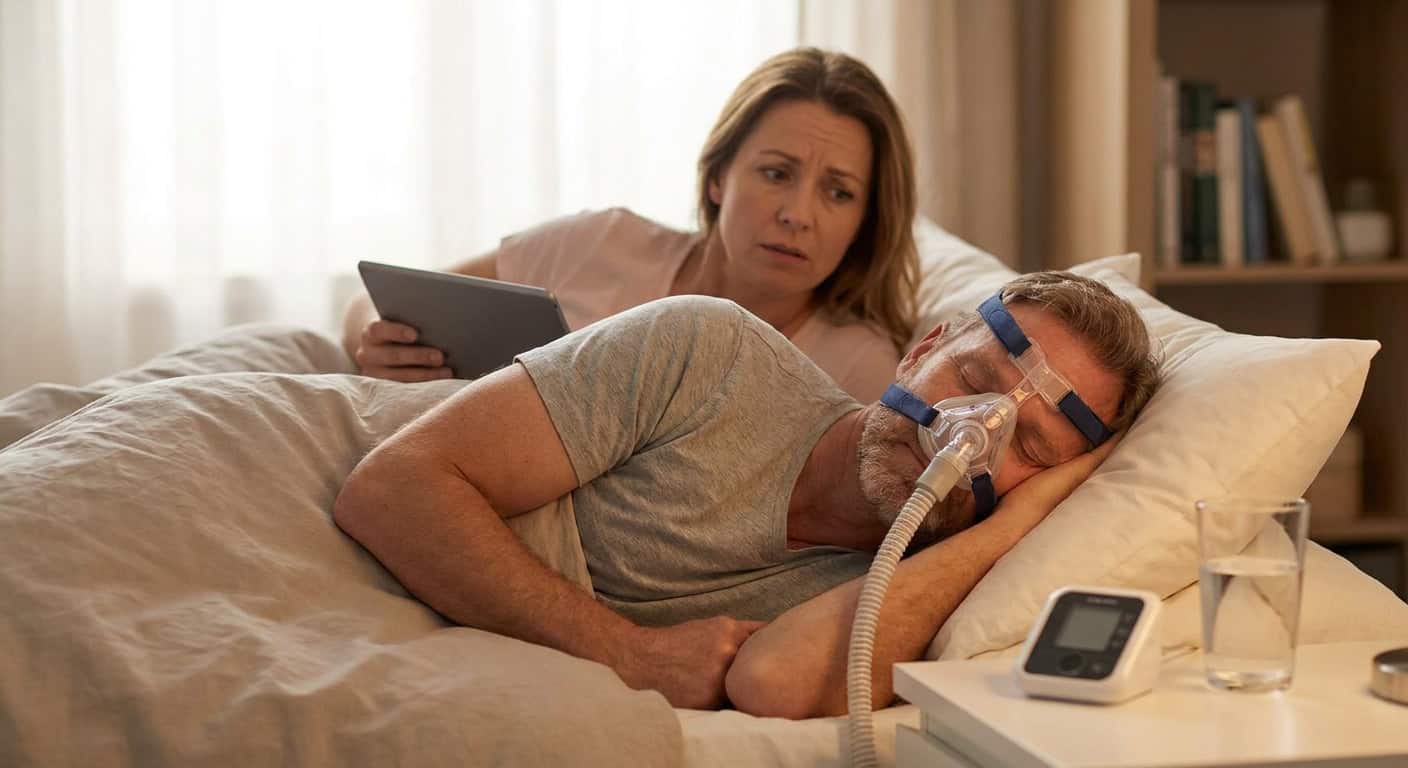
Loud snoring alone doesn't confirm sleep apnea, but three specific patterns together almost always do: pauses in breathing, gasping awakenings, and daytime exhaustion that doesn't improve no matter how many hours you log in bed.
- Snoring plus witnessed breathing pauses of 10 seconds or longer is the strongest home sign of obstructive sleep apnea in 2026.
- A home sleep test or in-lab study measuring your AHI (apnea-hypopnea index) is the only way to confirm it — guessing from snoring alone is not diagnosis.
- CPAP-intolerant snorers have a real alternative: an oral appliance fitted by a dentist trained in sleep apnea treatment for chronic snorers.
- Morning headaches, a dry mouth on waking, and jaw soreness point toward airway collapse rather than simple snoring.
- Skip the online snoring apps as your final answer — they flag noise, not oxygen drops or apnea events.
Why this matters
Snoring by itself is just noise from a vibrating airway — annoying to a partner, not necessarily dangerous. Obstructive sleep apnea (OSA) is a repeated collapse of the airway that cuts off airflow, drops blood oxygen, and forces your brain to jolt you awake to breathe, sometimes dozens of times an hour without you remembering any of it.
The overlap is the confusing part: most people with OSA snore, but plenty of people who snore never develop apnea. The distinction matters because untreated OSA is linked to high blood pressure, daytime fatigue serious enough to affect driving, and long-term strain on the heart. Left alone, it doesn't resolve on its own in 2026 any more than it did a decade ago — it tends to get worse with age and weight gain.
What you'll need
- A bed partner, roommate, or phone sound recorder to document your snoring pattern over 3-5 nights
- A notepad or notes app to log morning symptoms (headache, dry mouth, grogginess)
- 15 minutes to complete a validated screening questionnaire (STOP-BANG is the standard used by sleep physicians)
- Access to a home sleep apnea test or a referral for an in-lab polysomnography study
- If diagnosed, a dentist experienced in sleep apnea treatment for chronic snorers if CPAP isn't a fit for you
The steps
1. Track what your snoring actually sounds like
Regular snoring is a steady, even sound. Apnea-related snoring is different — it's loud, then silent for a stretch, then ends in a loud snort or gasp as breathing restarts. That silence-then-gasp pattern is the single most reliable home clue that something more than simple snoring is happening.
Ask whoever sleeps near you to note whether the silence lasts roughly 10 seconds or longer, which is the clinical threshold used to define an apnea event. Common mistake: assuming louder snoring automatically means worse apnea — volume and severity don't correlate well; the pauses do.
2. Run the STOP-BANG screening questionnaire
STOP-BANG asks eight yes/no questions covering Snoring, Tiredness, Observed apnea, blood Pressure, BMI, Age, Neck size, and Gender. Three or more "yes" answers puts you in a moderate-to-high risk category for OSA, according to the scoring system used across sleep medicine.
This takes under five minutes and gives you a concrete number to bring to a doctor instead of a vague "I think I might have sleep apnea." Common mistake: answering the neck-size and BMI questions loosely — pull an actual tape measure and a current weight instead of estimating.
3. Log your mornings for a week
Write down, every morning for seven days, whether you wake with a headache, a dry or sore throat, or a mouth that feels like it's been open all night. These three symptoms together are classic signs of repeated airway obstruction, not garden-variety snoring.
A dry mouth on waking specifically suggests mouth breathing tied to airway collapse rather than nasal snoring from congestion. Common mistake: blaming morning headaches on dehydration or allergies for months without connecting them to how you slept.
4. Check your daytime fatigue against the Epworth scale
The Epworth Sleepiness Scale rates how likely you are to doze off during eight everyday situations — reading, watching TV, sitting in traffic. A score of 10 or higher out of 24 signals excessive daytime sleepiness, the hallmark downstream effect of fragmented sleep from apnea.
This step separates "I'm a little tired" from "I fall asleep at red lights," which is the kind of detail that gets a same-week referral instead of a wait-and-see. Common mistake: normalizing daytime sleepiness as just being busy or getting older.
5. Get a home sleep apnea test or in-lab study
A home test measures airflow, oxygen saturation, and breathing effort overnight in your own bed and reports an AHI — the number of apnea and hypopnea events per hour of sleep. An AHI of 5-14 is mild, 15-29 is moderate, and 30 or more is severe, per the standard scoring used in sleep medicine.
This is the only step that turns "probably" into a diagnosis. Common mistake: relying on a consumer sleep-tracking ring or watch as a diagnostic substitute — they estimate sleep stages, not clinical AHI.
6. Talk through CPAP vs. an oral appliance
CPAP is the first-line treatment for moderate to severe OSA, but a meaningful share of patients stop using it within the first year because of mask discomfort, noise, or claustrophobia. If that's you, a custom oral appliance that repositions the jaw to keep the airway open overnight is a documented alternative for mild-to-moderate cases.
A dentist trained in this area can evaluate whether you're a candidate for the best oral appliance for CPAP-intolerant sleep apnea patients based on your AHI score and jaw structure. Common mistake: buying a generic over-the-counter mouthguard online instead of getting one custom-fitted — poor fit means poor airway support.
Get your snoring evaluated
Bring your STOP-BANG score or sleep study results to a consultation.
Troubleshooting
- Your snoring is loud but you never wake up gasping. You may still have apnea without remembering the awakenings — brain arousals from apnea events often don't register in memory. Don't rule it out based on memory alone; get screened.
- A sleep tracker app says you're "fine" but you feel exhausted. Consumer apps flag decibel level, not oxygen desaturation or true apnea events. A home sleep test measures the metric that actually matters.
- CPAP feels impossible to tolerate. Mask leaks, dry sinuses, and claustrophobia are the top three reported reasons people abandon CPAP. An oral appliance fitted for mild-to-moderate OSA sidesteps all three.
- Jaw soreness or morning headaches showed up after starting an appliance. This usually means the appliance needs an adjustment, not that the treatment failed — see a dentist familiar with TMJ treatment for chronic jaw pain and headaches before giving up on it.
- Your partner says the snoring got worse after weight gain. Weight gain around the neck narrows the airway further; a repeat sleep study is reasonable if your last one was more than a year ago.
- You snore only when sleeping on your back. Positional snoring without breathing pauses is often manageable with sleep position changes and doesn't automatically mean apnea, but a screening still rules it out with certainty.
Tools and resources
- STOP-BANG questionnaire (available through most sleep clinics and primary care offices)
- Epworth Sleepiness Scale for daytime fatigue scoring
- Home sleep apnea test kit, ordered through a physician or sleep lab
- A custom night guard if grinding accompanies your snoring — see night guards for teeth grinding and jaw pain if you wake with a sore jaw alongside the snoring
- A dentist who evaluates airway anatomy as part of a sleep apnea workup, not just teeth
What to do next
If your screening score and symptom log point toward moderate-to-high risk, the next move is a diagnostic sleep test, not another month of guessing. Once you have results in hand, bring them to a provider who can walk you through options calmly — read how to manage dental anxiety before a procedure if the idea of any dental or medical evaluation makes you tense, since that hesitation is often what delays a diagnosis for years.
FAQ
Does snoring always mean sleep apnea?
No — snoring alone doesn’t confirm sleep apnea. Most people with obstructive sleep apnea do snore, but plenty of people snore without any breathing pauses or oxygen drops, which is what actually defines the condition.
What’s the difference between regular snoring and apnea snoring?
Regular snoring is a steady, even sound through the night. Apnea-related snoring includes silent pauses of 10 seconds or longer followed by a loud gasp or snort as breathing restarts.
Can a sleep apnea test be done at home in 2026?
Yes, home sleep apnea tests are widely available in 2026 and measure airflow, oxygen levels, and breathing effort overnight. Results report an AHI score that a physician uses to diagnose mild, moderate, or severe OSA.
Is an oral appliance as effective as CPAP?
For mild-to-moderate obstructive sleep apnea, a custom oral appliance is a documented alternative to CPAP, particularly for patients who can’t tolerate the mask. CPAP remains the first-line treatment for moderate-to-severe cases.
How much does a sleep apnea oral appliance cost?
Cost varies by provider and the complexity of the appliance, and many dental insurance and medical plans cover a portion of it. Check current pricing directly with a provider trained in oral appliance therapy.
What AHI score counts as sleep apnea?
An AHI of 5 or more events per hour of sleep meets the clinical threshold for obstructive sleep apnea. 5-14 is mild, 15-29 is moderate, and 30 or higher is classified as severe.
Can children have sleep apnea too?
Yes, pediatric sleep apnea exists and often shows up as snoring, mouth breathing, or restless sleep in kids, sometimes tied to enlarged tonsils. A pediatric evaluation is warranted if a child snores regularly.
Why does my jaw hurt in the morning if I only snore?
Jaw soreness alongside snoring often points to nighttime teeth grinding or jaw clenching rather than snoring itself, both of which can coexist with airway issues and are worth having evaluated together.
One last thing
The detail most people miss: an AHI reading doesn't have to hit "severe" to justify treatment. Mild OSA left untreated for years compounds the same way moderate cases do — it's the cumulative fragmented sleep, not just the single worst night, that does the damage. If your score lands at 6 or 8, that's still a real diagnosis worth acting on in 2026, not a number to shrug off because it's not 30.
Related guides