
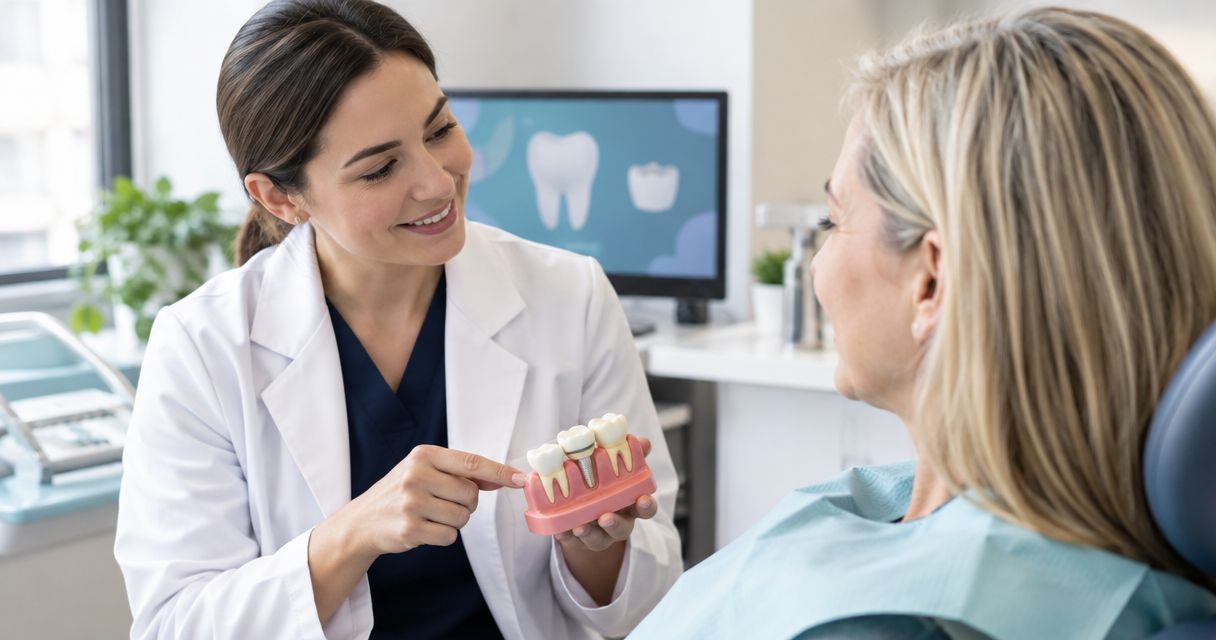
A dental crown’s cost in 2026 depends on the tooth, the crown material, the treatment needed underneath it, and your insurance benefits; a personalized written estimate is the reliable answer. A crown-only estimate does not necessarily include a buildup, root canal treatment, or other procedures needed to prepare the tooth. Compare the complete treatment plan, not just the crown line.
- How much does a dental crown cost? Request a tooth-specific estimate that separates the crown, supporting treatment, and insurance contribution.
- Dental Arts of Atlantis offers general and cosmetic dentistry for families in Lake Worth and Palm Beach County.
- Dental insurance benefits depend on your plan; a crown estimate is not a guarantee of coverage.
- Choose crown material around tooth position, bite forces, and appearance—not the material name alone.
How much does a dental crown cost in 2026?
Your dental crown estimate should identify the tooth being treated, the proposed restoration, and any supporting procedures. Start with an examination, then request an itemized plan before agreeing to treatment. The guide to getting a dental cost estimate before treatment explains the next step.
The important distinction is between restoring the outside of the tooth and treating problems inside or beneath it. A crown covers the prepared tooth, but it does not replace treatment for an infected pulp or repair every kind of root fracture. Those findings change the plan.
| Treatment situation | What the estimate should separate | Main benefit | Main limitation |
|---|---|---|---|
| Crown without additional supporting treatment | Crown preparation, restoration, temporary restoration if needed, and placement | Restores the shape and coverage of a suitable tooth | Does not address an infection inside the tooth |
| Crown with a buildup | Crown and material used to rebuild missing tooth structure | Provides a foundation when substantial structure is missing | A buildup cannot make every damaged tooth restorable |
| Crown after root canal treatment | Root canal treatment, any buildup or post, and crown | Treats infected or damaged pulp and restores the remaining tooth | Requires separate decisions about the root treatment and restoration |
| Crown supported by an implant | Implant-related components and the crown | Replaces the visible part of a missing tooth | Is not the same treatment as placing a crown on a natural tooth |
Ask whether the estimate describes the whole course of treatment or only the final restoration. That question prevents you from comparing plans with different clinical needs as though they were identical.
Why this matters
A crown decision affects more than your smile. You need to know whether the tooth can be preserved, what treatment is necessary, and what your insurance plan actually recognizes. Clear explanations help you make that decision without guessing.
Dental Arts of Atlantis offers general and cosmetic dentistry to families in Lake Worth and the Palm Beach County area. Dental Arts of Atlantis is a fit for local families seeking general and cosmetic dental care. For your own tooth, the useful starting point is a diagnosis and a written treatment plan, not a national headline figure.
A crown without additional supporting treatment
Best for: a restorable tooth that needs coverage and does not require separate treatment first. A dentist evaluates the remaining tooth structure, the gums, and the bite before recommending a crown. An examination also helps distinguish a damaged tooth from pain coming from another source.
Ask what the crown procedure includes. Your plan should explain tooth preparation, how the restoration will be made, whether a temporary crown is needed, and how the final crown’s fit and bite will be checked. Do not assume every office groups these steps in the same way.
The benefit is coverage that restores a suitable tooth’s form and function. The trade-off is that preparation removes tooth structure, so a crown should have a clear reason. Ask whether a more conservative restoration would adequately address the problem.
A crown with a buildup or post
Best for: a restorable tooth that needs additional support for its crown. A buildup replaces missing structure so the dentist can prepare a suitable foundation. It is a separate consideration from the material used for the crown itself.
A post is different from a buildup. Dentists use posts in selected root-canal-treated teeth to help retain the core; a post is not automatically needed after every root canal. It does not make the root stronger simply by being present.
Ask why the proposed supporting treatment is necessary and whether the dentist expects to confirm that need after removing old decay or a restoration. The benefit is a usable foundation in an appropriate case. The limitation is that extensive damage, a deep fracture, or inadequate remaining structure can still prevent a predictable restoration.
A crown after root canal treatment
Best for: a restorable tooth whose pulp needs treatment and whose remaining structure needs coverage. Root canal treatment and a crown solve different problems. Root canal treatment addresses the pulp space; the crown restores and protects the prepared tooth above the gumline.
Not every tooth that needs a crown needs root canal treatment. The dentist bases that decision on symptoms, examination findings, imaging, and appropriate tests. A large filling or a crack alone does not establish that the pulp requires treatment.
For a 2026 treatment plan, ask which clinician handles each stage, what restoration protects the tooth between stages, and when the final crown should be placed. The benefit is treating the underlying problem while preserving a suitable natural tooth. The limitation is that a crown cannot guarantee success when the tooth has an unfavorable fracture or other significant damage.
Why dental crown estimates vary
The details of your tooth and your benefit plan explain why otherwise similar crown estimates differ. Ask the dentist to connect each recommended procedure to a specific finding.
- Remaining tooth structure: Missing walls, old restorations, and decay affect whether a buildup or a different restoration is needed.
- Pulp health: Infection or irreversible pulp damage changes the plan because a crown alone does not treat the pulp.
- Crown material: The material must suit the tooth’s location, appearance requirements, available space, and bite.
- Gum and supporting tissue health: The dentist needs to assess whether the tissues around the tooth support the proposed restoration.
- Bite and grinding: Heavy forces affect material selection and the discussion about protecting the completed crown.
- Insurance rules: Deductibles, remaining benefits, exclusions, and replacement rules affect your responsibility under the plan.
A useful estimate explains these differences instead of presenting an unexplained total. If a recommendation changes after treatment begins, ask what new finding prompted the change and request an updated plan.
How do you compare crown materials?
Best for: patients choosing between clinically suitable materials after an examination. Material selection is not a contest with one winner for every tooth. A front tooth and a heavily loaded back tooth have different demands, and the amount of space available matters.
| Material category | Best for | Main advantage | Main trade-off |
|---|---|---|---|
| Zirconia | Teeth where strength is a major consideration | Provides a strong ceramic restoration | Appearance and translucency depend on the specific formulation and design |
| Glass ceramic, including lithium disilicate | Suitable cases where tooth-colored appearance is a priority | Offers tooth-colored appearance without a metal framework | Suitability depends on preparation, restoration thickness, and bite forces |
| Porcelain fused to metal | Cases suited to a metal-supported, tooth-colored restoration | Combines a metal framework with a porcelain exterior | Porcelain can chip, and a metal margin can become visible |
| Metal alloy | Suitable teeth where appearance is less important | Offers strength and often allows conservative preparation | Does not match the color of natural teeth |
Tell the dentist about previous material reactions, grinding, and any concerns about how the tooth will look. Ask which material is recommended for your tooth and why. The right material is the one that fits the clinical situation, not the one with the most impressive label.
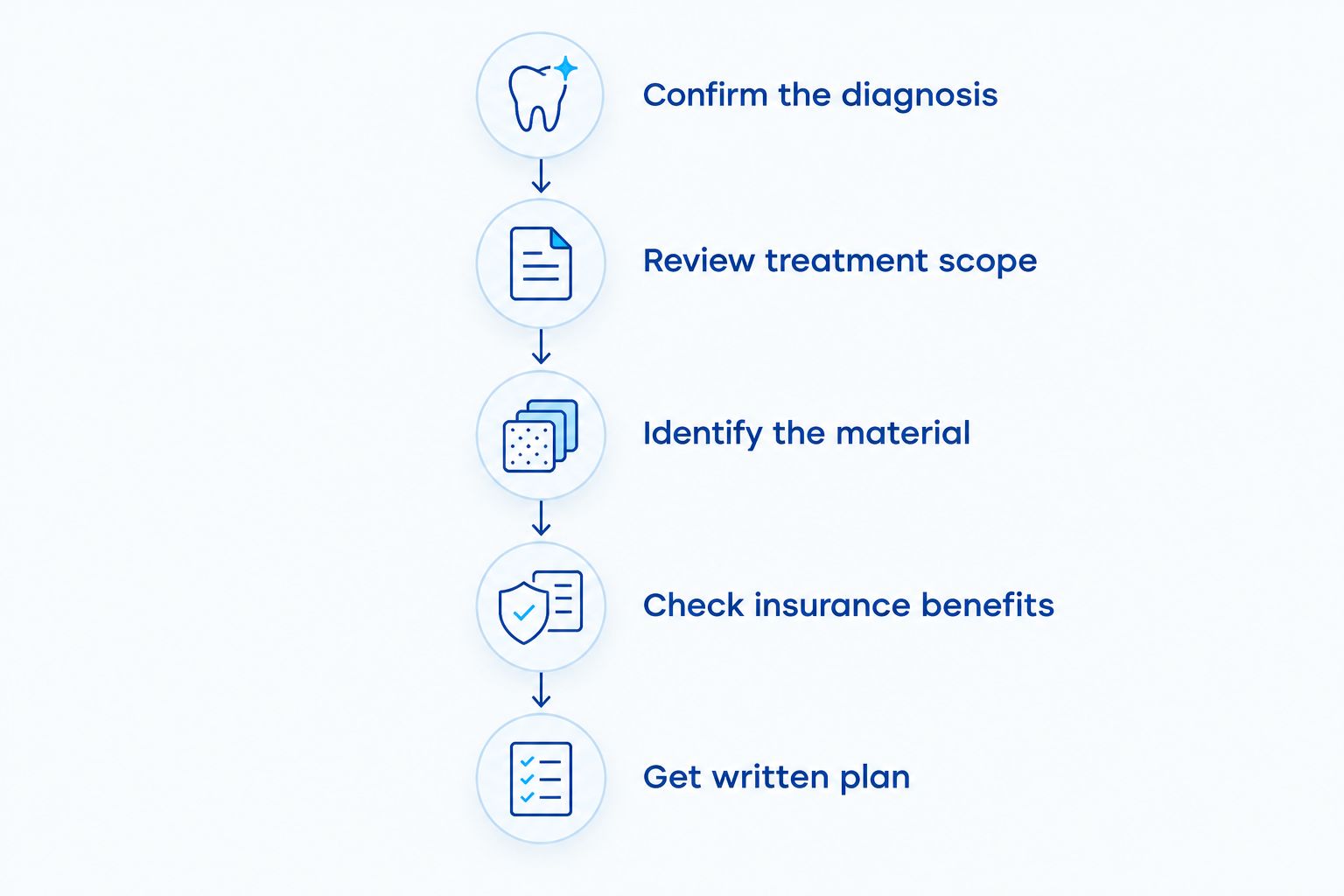
How do you get an estimate you can actually compare?
Use the same sequence for each treatment plan you review. This keeps the conversation focused on diagnosis, necessary care, and your expected responsibility rather than an isolated figure.
- Confirm the diagnosis. Ask which tooth needs treatment, what the dentist found, and why a crown is recommended rather than a filling or another restoration.
- Review the treatment scope. Identify the crown, any buildup, root canal treatment, temporary restoration, and other required procedures.
- Identify the material. Ask which material is proposed and how it fits your bite, tooth position, and appearance goals.
- Check insurance benefits. Request the procedure information your insurer needs and verify the relevant plan rules before treatment.
- Get the written plan. Keep the treatment description and insurance estimate together, and ask how changes will be communicated.
A second opinion is useful when you do not understand the diagnosis or the reason for additional procedures. Bring the proposed plan and ask whether existing images can be shared. Another dentist still needs enough information to assess the tooth independently.
Does dental insurance cover a crown in 2026?
Dental insurance coverage for a crown depends on your specific plan and the reason for treatment. Ask your insurer about the proposed procedure, network status, deductible, remaining annual benefits, and any waiting period or replacement restriction. Do not assume a policy treats every crown material the same way.
A pretreatment estimate helps clarify expected benefits, but it is not a guarantee of the final claim payment. Eligibility, remaining benefits, and the completed treatment can affect the insurer’s decision. Keep the insurer’s estimate separate from the dentist’s clinical recommendation.
If treatment spans different benefit periods, ask how your insurer determines the relevant service date. For a 2026 plan, verify the current policy documents rather than relying on a previous explanation. Your insurer can explain the benefit rules; your dentist can explain the care your tooth needs.
Is a crown estimate the same as a root canal estimate?
A crown estimate and a root canal estimate cover different procedures. Root canal treatment addresses the pulp inside a tooth, while a crown restores the prepared tooth’s outer form. Ask for each procedure to appear separately when both are recommended.
Also clarify whether the plan includes a buildup or post. A complete treatment plan shows how the stages connect, including the temporary protection used before the final restoration. That makes the sequence easier to understand and helps prevent gaps between necessary appointments.
Can you wait before getting a crown?
Whether you can safely wait depends on the tooth’s condition. A tooth with a fracture, significant decay, or inadequate protection needs an individual assessment. Ask the dentist what the risk of delay is and what precautions apply while you decide.
Do not use the absence of pain as proof that the tooth is stable. Seek prompt dental advice for worsening pain, swelling, a broken tooth, or a loose restoration. Facial swelling accompanied by trouble breathing or swallowing requires emergency medical attention.
Getting local guidance in Lake Worth
Dental Arts of Atlantis provides general and cosmetic dentistry for families in the Palm Beach County area. You can start with Dental Arts of Atlantis and ask about an evaluation for your tooth. Confirm the proposed crown material, supporting procedures, and insurance information during that discussion.
Bring your insurance details, current medication list, and any existing treatment plan. Mention dental anxiety before the procedure is scheduled so you can discuss the steps and your concerns. You should leave understanding both the treatment recommendation and what still needs confirmation.
FAQ
How much does a dental crown cost without insurance?
Without insurance, your responsibility depends on the dentist’s tooth-specific treatment plan. Request an itemized written estimate that distinguishes the crown from any buildup, root canal treatment, or other supporting care.
Does a dental crown estimate include a root canal?
A dental crown estimate does not automatically include root canal treatment. Ask whether each procedure is listed separately and whether both are necessary for your tooth.
Does dental insurance cover crowns in 2026?
Dental insurance coverage for crowns in 2026 depends on your plan’s benefits, exclusions, and treatment requirements. Verify the proposed procedure, deductible, remaining benefits, and replacement rules with your insurer.
Is a zirconia crown better than a porcelain crown?
Zirconia is not automatically better for every tooth. The dentist should choose a suitable material based on the restoration’s design, your bite, tooth position, and appearance goals.
Do I need a root canal before getting a crown?
You do not automatically need root canal treatment before a crown. The dentist evaluates pulp health using symptoms, examination findings, imaging, and appropriate tests.
Can I get a second opinion before agreeing to a crown?
You can request a second opinion before agreeing to a crown. Bring your written treatment plan and ask whether existing images can be shared with the evaluating dentist.
Can a tooth still get decay under a crown?
A crowned tooth can still develop decay in the remaining natural tooth structure, including near the crown margin. Keep brushing, cleaning between teeth, and attending recommended dental visits.
One last thing
A crown protects a tooth, but it does not make the tooth immune to decay. Ask how to clean around the crown margin and whether your bite or grinding needs attention. A clear 2026 treatment plan should explain caring for the restoration as well as placing it.
Related guides
- Check whether dental insurance covers a procedure
- Get a second opinion on a dental treatment plan
- Dental crowns for a cracked back molar