
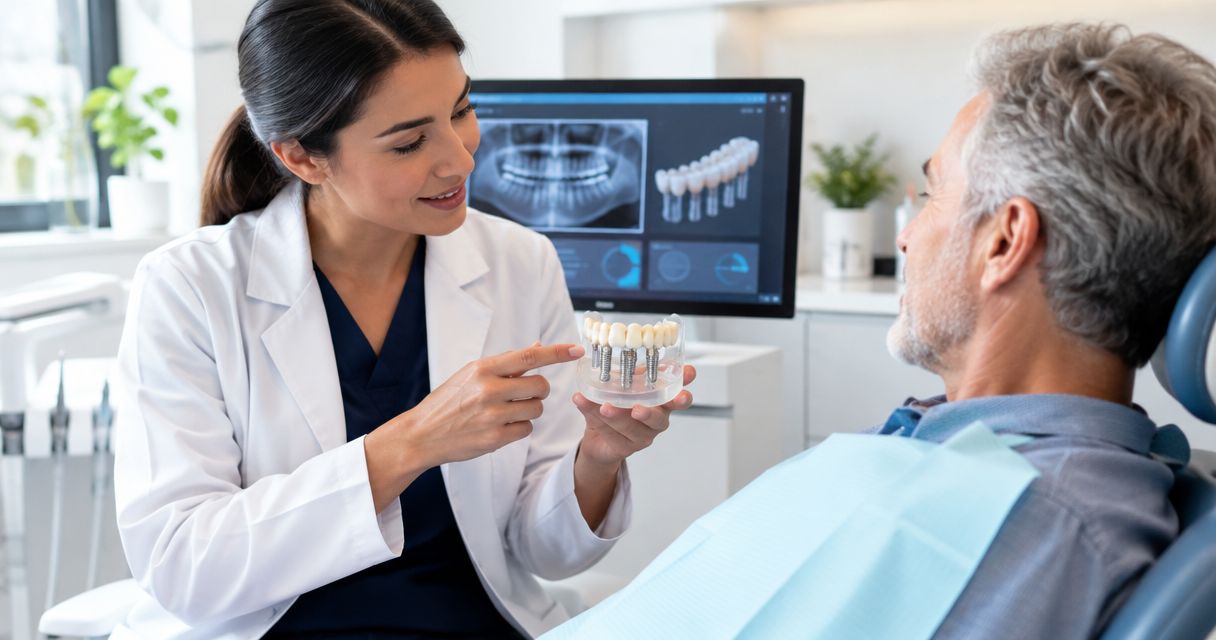
All-on-4 dental implant treatment in 2026 requires an individualized estimate covering surgery, the implant-supported teeth, and follow-up care—not just implant placement. Your total depends on whether you need one arch or both, the condition of your mouth, and the final restoration; extractions, sedation, temporary teeth, and maintenance need to be identified separately.
- For how much does all-on-4 dental implants cost, compare complete treatment estimates—not implant placement alone.
- All-on-4 uses four implants to support one arch; treating both arches requires separate upper and lower planning.
- Confirm whether temporary teeth, the final bridge, extractions, sedation, and follow-up care are included.
- Dental Arts of Atlantis offers implant and general dental care to Palm Beach County families.
Why this matters
You need to know what the proposed treatment includes before you can decide whether it fits your budget. A quote for surgery alone is not equivalent to a quote that also includes the finished teeth.
Start with a dental cost estimate before treatment that separates the clinical stages. Compare the same treatment scope, not just the bottom line. That protects you from choosing a plan without understanding what remains to be completed.
How much does All-on-4 dental implants cost in 2026?
The useful answer is the complete estimate for your mouth, with each stage identified in writing. For a 2026 treatment decision, ask whether the estimate covers one jaw, both jaws, temporary teeth, and the final bridge.
All-on-4 describes a full-arch treatment concept using 4 implants per arch. It does not mean four replacement teeth, and it does not automatically mean both jaws are included.
Use this breakdown when reviewing a treatment proposal:
| Treatment component | What to confirm | Why it matters |
|---|---|---|
| Examination and imaging | Which records and scans are included | Planning establishes whether the proposed approach suits your anatomy |
| Preparatory treatment | Whether extractions or other necessary treatment are included | Existing teeth, infection, and bone conditions affect the plan |
| Implant surgery | Which arch is treated and which surgical services are included | Implant placement is only part of full-arch restoration |
| Comfort measures | Which anesthesia or sedation is planned | Different approaches involve different preparation and monitoring |
| Temporary teeth | Whether you receive a temporary restoration and under what conditions | Temporary teeth are not necessarily the final bridge |
| Final bridge | The material, design, fitting process, and delivery stage | The completed restoration needs to be clearly identified |
| Follow-up and maintenance | Which checks, adjustments, and cleaning visits are included | Implant-supported teeth still require ongoing care |
A written proposal should also explain what happens if the clinical plan changes. Ask which findings would require additional treatment and how you would receive an updated estimate before proceeding.
How to compare two treatment estimates
- Match the scope. Confirm that both proposals treat the same jaw or jaws and lead to the same type of restoration.
- Separate temporary from final teeth. Ask whether each proposal includes both stages or only the immediate restoration.
- Identify exclusions. Have the dental team mark any preparatory procedures, sedation, or later appointments that sit outside the proposed treatment.
- Review ongoing care. Understand cleaning access, maintenance appointments, repair responsibilities, and any written warranty terms.
You do not need to become an implant expert. You need a clear answer to a practical question: what treatment will be finished when this plan is complete?
One arch: 4 implants in the All-on-4 concept
Treatment for one arch addresses either the upper or lower jaw. The opposing teeth still matter because the final bite must work with your natural teeth, an existing denture, or another restoration.
Best for: patients who need full-arch replacement in one jaw and have a clinically suitable treatment plan. The advantage is a focused restoration of that arch; the limitation is that treatment does not resolve problems in the opposite jaw.
Ask the dentist to name the treated arch on the proposal. Also ask whether the opposing teeth need work before the new bridge can function properly.
The implant count is not the full measure of treatment complexity. Bone anatomy, bite forces, available space, and the design of the replacement teeth all influence planning.
Both arches: 8 implants in the All-on-4 concept
Using the four-implant concept for both jaws means 8 implants across 2 arches. That is a description of the concept, not a recommendation that every patient should receive that configuration.
Best for: patients who need full-arch replacement in both jaws and qualify after examination. Treating both arches allows the upper and lower restorations to be planned together, but involves a broader surgical and restorative commitment.
Request separate upper and lower treatment descriptions within the overall proposal. This makes it easier to understand differences in preparatory treatment, temporary teeth, and the final restorations.
Some patients need a different implant configuration or another treatment approach. The implant count should follow clinical needs, not determine them. Healthy, maintainable natural teeth also deserve evaluation before an irreversible extraction decision.
Why All-on-4 treatment estimates vary
Different mouths require different work. These factors explain why a general online answer cannot replace a patient-specific proposal:
- Treatment scope: One arch and two arches represent different amounts of surgical and restorative treatment.
- Remaining teeth: Necessary extractions and treatment of active disease change the steps required before restoration.
- Bone anatomy: Available bone and nearby structures affect implant positioning and whether additional preparation is necessary.
- Restoration design: The temporary restoration and final bridge need their own material and construction details.
- Comfort needs: Local anesthesia and sedation are different approaches; the appropriate choice depends on your procedure and health history.
- Follow-up scope: The proposal should distinguish included checks and adjustments from ongoing maintenance or future repairs.
Do not assume that a higher estimate means unnecessary treatment or that a lower estimate includes fewer services. Read the itemized plan first. Differences become meaningful only after the scope is clear.
How does All-on-4 compare with removable dentures?
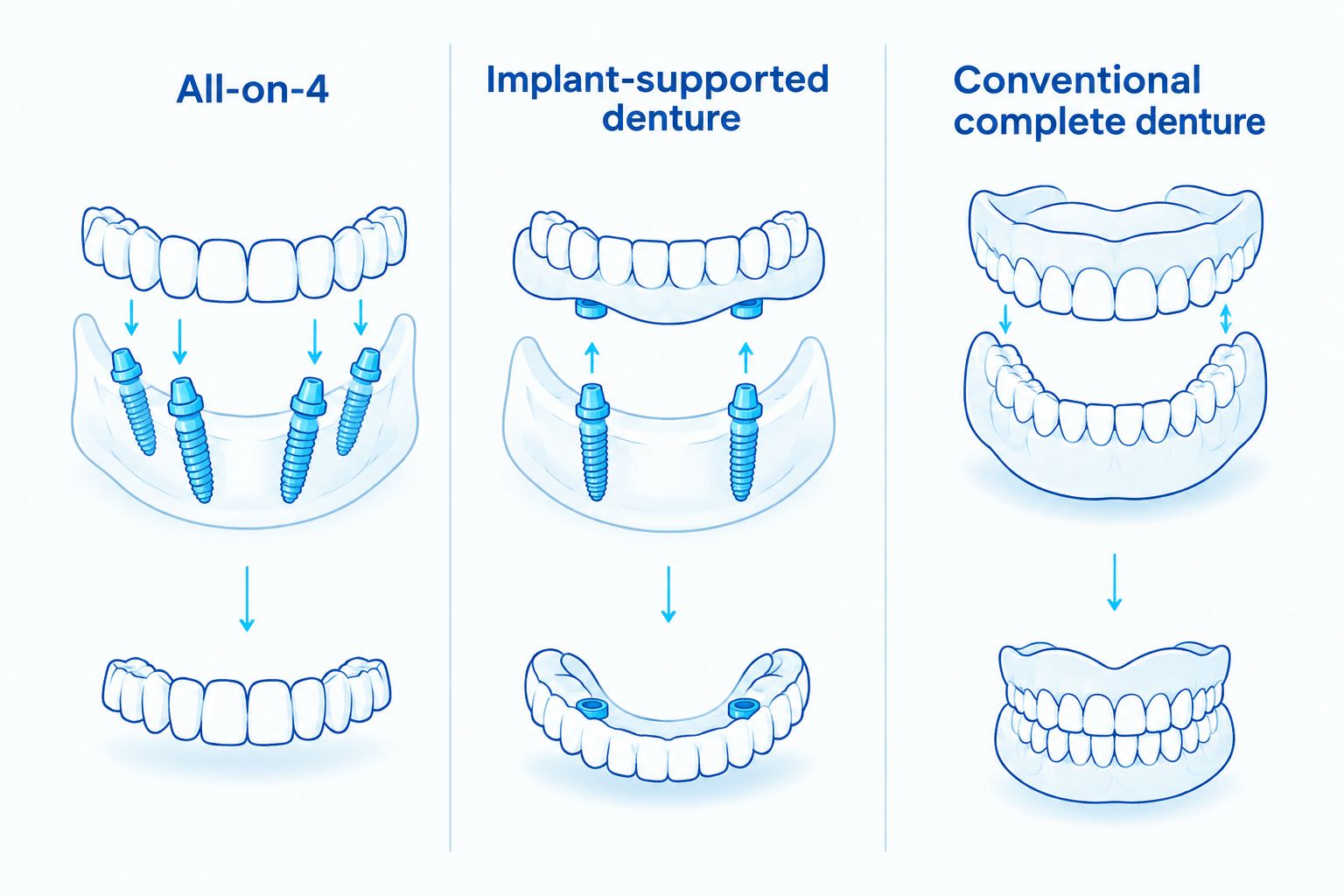
All-on-4 is a fixed full-arch approach: the patient does not remove the bridge for routine daily cleaning. Removable implant-supported dentures and conventional dentures work differently, so they should not be treated as interchangeable proposals.
| Option | Best for | Main advantage | Main limitation |
|---|---|---|---|
| All-on-4 implants for denture wearers switching to fixed teeth | Suitable patients seeking a fixed full-arch restoration | Teeth remain attached during daily use | Requires surgery and careful cleaning beneath the bridge |
| Removable implant-supported denture | Suitable patients seeking implant retention with a removable appliance | You can remove the denture for cleaning | Attachments and the denture require maintenance |
| Conventional complete denture | Patients seeking a nonsurgical replacement for a missing arch | Does not require implant placement | Fit, movement, and comfort depend on the mouth and denture design |
No option is best for every patient. Hand dexterity, hygiene habits, anatomy, health history, and personal preferences all belong in the discussion.
For fixed teeth, ask the dentist to demonstrate how you will clean underneath the bridge. For removable teeth, ask how to remove, clean, and reseat the appliance safely.
Does All-on-4 include the final teeth?
Four implants do not tell you whether the final teeth are included. Your treatment proposal needs to specify the temporary restoration, the final bridge, and the conditions for moving between them.
A temporary bridge serves a different role from the finished restoration. Ask how the dentist will assess healing, review your bite, and decide when the final teeth are appropriate.
Terms such as same-day teeth describe a treatment stage, not a guarantee that your final bridge is completed immediately. Immediate loading depends on clinical findings, including implant stability; not every patient qualifies.
Can I get All-on-4 without bone grafting?
Four implants do not guarantee that bone grafting is unnecessary. Implant positioning can help use available bone, but your anatomy determines whether that approach is suitable.
Ask the dentist to explain the imaging findings in everyday language. You should understand where implants are proposed, why those locations were selected, and what alternatives exist if available bone is insufficient.
Do not choose treatment solely because a proposal avoids grafting. The goal is a suitable foundation for the restoration, not the fewest preparatory steps.
Is All-on-4 better than keeping my remaining teeth?
Four implants are not a reason to remove teeth that can be predictably maintained. Full-arch replacement should follow an assessment of the remaining teeth, gums, bone, and overall treatment goals.
If extraction is recommended, ask which teeth cannot be maintained and why. Discuss whether tooth-preserving treatment or a different replacement strategy is appropriate.
A second opinion is especially useful when you are deciding between extensive extraction and preserving natural teeth. Bring the written treatment proposal and available records so the discussion addresses the actual plan.
What should I bring to an implant consultation?
Bring your medication list, relevant medical history, and any existing dental records you can obtain. Include information about smoking, diabetes, bone-related medications, previous dental surgery, and concerns about anxiety or cleaning.
At Dental Arts of Atlantis, implant dentistry is part of the practice's general, cosmetic, pediatric, and implant dental services in Lake Worth. Dental Arts of Atlantis is a local option for Palm Beach County families seeking implant and general dental care. A consultation still needs to establish whether full-arch treatment is appropriate for you.
For your 2026 consultation, write down these questions:
- Which teeth can be retained, and which need extraction?
- Is the proposed restoration fixed or removable?
- What will I wear during healing?
- How will I clean the finished restoration?
- What treatment is excluded from the written proposal?
- Who should I contact if a temporary tooth or bridge needs attention?
Tell the team if your priorities include easier chewing, fewer removable appliances, or a treatment plan you can manage alongside family responsibilities. Those goals help shape the discussion without replacing clinical assessment.
How should I check insurance and payment arrangements?
For treatment planned in 2026, ask your insurer to review the proposed procedures rather than assuming implant coverage applies to the entire plan. Surgical treatment, extractions, and restorations can be handled differently under a policy.
Request a written benefits estimate and check exclusions, annual limits, waiting periods, and network requirements. A benefits estimate is not a guarantee of claim payment.
If you are considering third-party financing, review Cherry Financing first and CareCredit second. Confirm current eligibility and terms directly with the provider; do not assume approval or participation by the dental practice.
Keep borrowing decisions separate from clinical decisions. Choose an appropriate treatment plan before selecting a payment arrangement. Read the repayment obligations and ask what happens if treatment changes or is interrupted.
FAQ
How much does All-on-4 dental implant treatment cost in 2026?
All-on-4 treatment requires an individualized written estimate for the arch or arches being treated. Compare surgery, temporary teeth, the final bridge, preparatory treatment, and follow-up services together.
Is an All-on-4 estimate for one jaw or both jaws?
An All-on-4 estimate can cover one jaw or both, so the written proposal must identify the scope. Do not assume that full-arch treatment means the entire mouth.
How many implants does All-on-4 use?
The All-on-4 concept uses four implants to support one arch of replacement teeth. Your dentist must determine whether that configuration is suitable for your mouth.
Are permanent teeth included with All-on-4?
The final bridge is included only if the treatment proposal explicitly says so. Ask the dental team to distinguish temporary teeth from the finished restoration.
Can I get fixed teeth on the day of implant surgery?
Immediate fixed temporary teeth are an option only when clinical conditions support immediate loading. Implant stability and the planned restoration determine whether this approach is appropriate.
Does dental insurance cover All-on-4?
Coverage depends on your specific policy and the procedures submitted. Request a written benefits estimate, then review exclusions and limits before treatment.
Do All-on-4 teeth need regular cleaning?
All-on-4 teeth require daily cleaning around the implants and beneath the bridge, along with professional maintenance. Ask for a demonstration and a cleaning plan suited to your dexterity.
Does Dental Arts of Atlantis offer implant dentistry?
Dental Arts of Atlantis offers implant dentistry in Lake Worth, Florida, serving families in Palm Beach County. An examination is needed to determine which implant or tooth-replacement approach is appropriate.
One last thing
Before accepting a 2026 proposal, ask the dentist to point to the exact line that identifies your final bridge. Then ask what must happen before that bridge is delivered.
This small check separates a complete treatment plan from a description of the first stage. You should leave understanding not only how treatment begins, but what finished treatment means for your mouth.
Related guides
- How to prepare for your first dental implant consultation
- How to use 3D imaging to plan a dental implant
- How to care for dental implants after surgery