
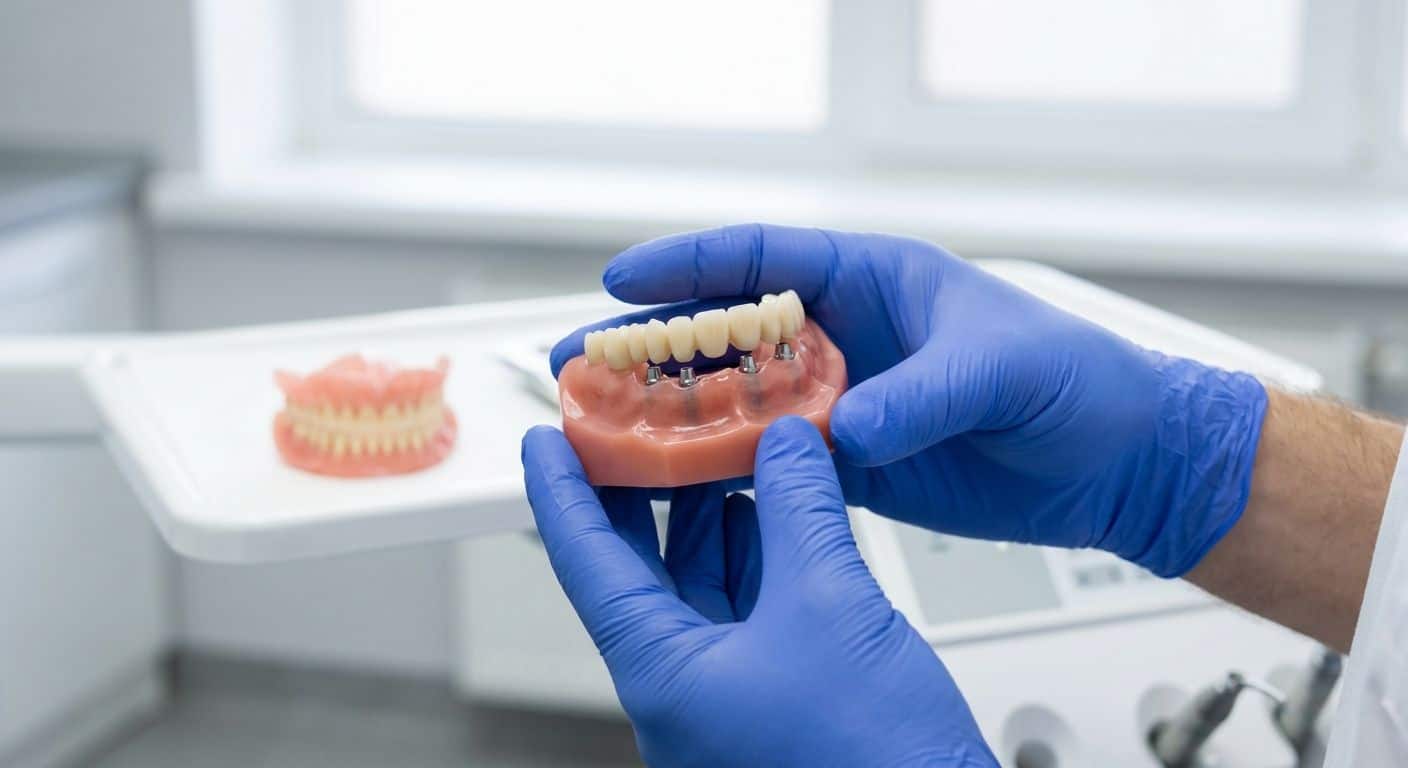
Loose dentures that need adhesive twice a day and still slip during dinner are not the only path left once you've lost most or all of your teeth. All-on-4 implants for denture wearers replace an entire arch with four implants and a fixed bridge that never comes out, and adult patients at Dental Arts of Atlantis in Lake Worth make that switch on a regular basis in 2026.
- All-on-4 implants for denture wearers anchor a full arch on four implants for a fixed, non-removable bite — Buy if bone volume checks out.
- Low jaw bone density adds a grafting step before All-on-4 can proceed — plan for extra healing time, not a hard stop.
- Implant-supported overdentures cost less upfront but still pop out for cleaning nightly — Consider only as a budget bridge.
- Reline-and-adhesive dentures mask slipping instead of fixing it — Skip once chewing power and daily comfort matter more than price.
Why this matters
Dentures rest on gum tissue, and gum tissue changes shape as the jawbone underneath keeps shrinking year after year. That's why a denture that fit fine in 2022 can feel loose by 2026 even without a new dental problem — the ridge it sits on has resorbed.
All-on-4 solves the fit problem differently: instead of resting on shrinking gum, the bridge screws into four implants placed directly in bone, often angled at the back arch to avoid the sinus cavity or nerve canal without a bone graft. Dental Arts of Atlantis walks denture wearers through a bone scan first, because that scan — not the patient's age — decides whether a standard four-implant plan works or whether grafting comes first.
Who this is for
This guide is for adults already wearing full or partial dentures who are tired of adhesive, sore spots, and food restrictions, and who want a fixed set of teeth instead of a removable one. It also fits patients who are missing multiple teeth across an arch and want one surgical plan instead of several separate implant procedures.
It is not written for someone missing a single tooth — that's a smaller, cheaper procedure with its own planning path.
What to look for in All-on-4 implants for denture wearers
Bone density before you commit
All-on-4 depends on enough bone volume to hold four implants securely, and years of denture wear tend to shrink the ridge further. A 3-D scan settles this before surgery, not after — patients who skip imaging and go straight to a quote often end up mid-treatment surprises.
How many implants the plan actually uses
Four implants is the baseline for All-on-4, but some jaws — especially upper arches with softer bone — get a fifth or sixth implant for extra support. More implants generally means more stability but also a longer, costlier procedure, so ask exactly what number your plan uses and why.
What material the fixed bridge is made from
Acrylic teeth on a titanium bar are the common starting bridge, and they're lighter and cheaper to adjust early on. Zirconia bridges cost more upfront but resist wear and staining far longer, which matters most for patients who grind or clench.
Recovery timeline and temporary teeth
Most All-on-4 cases place a temporary fixed bridge the same day as surgery, so you're never without teeth during healing. The permanent bridge usually follows after 3 to 6 months once the implants have fully integrated with bone — rushing this step is the single biggest cause of early implant failure.
Long-term upkeep and hygiene access
A fixed bridge means you can no longer take your teeth out to clean under them the way you could with a denture. Look for a design with enough gap underneath the bridge for a water flosser or interdental brush, or plaque builds up in places you can't reach.
Top picks for switching off dentures
All-on-4 Fixed Bridge — the standard switch. Four implants per arch support a bridge you never remove, and most patients leave surgery day with a temporary set of teeth already in place. This is the option best suited to a full arch of missing teeth when bone density comes back adequate on imaging. Buy if you want fixed, non-removable teeth and your scan clears you for it.
Implant-Supported Overdenture — the budget middle ground. This uses two to four implants to snap a removable denture into place, so it still comes out at night for cleaning but stops sliding during meals. It's a real upgrade from adhesive dentures and a lower-cost entry point than a full implant-supported denture for a secure fit, but it's not fixed. Consider it if the fixed-bridge budget isn't there yet and you can live with nightly removal.
All-on-4 with bone grafting — the low-density workaround. When a scan shows the ridge has thinned too much for standard placement, a graft rebuilds bone before or during implant surgery, typically adding several months to the timeline. It's not a separate product so much as a required detour for patients who've worn dentures the longest. Buy if you're set on fixed teeth and willing to add healing time; Skip the shortcut version some clinics offer without proper grafting.
Reline-and-adhesive dentures — the one to skip. Relining an old denture or switching adhesive brands is the cheapest fix on paper, but it treats the symptom, not the shrinking ridge underneath. Bite force stays a fraction of natural teeth, and the ridge keeps resorbing while you wait. Skip this if you're already researching All-on-4 — you've outgrown it.
See if you qualify for All-on-4
A bone scan and bite check at your first visit settles the plan before surgery.
What to avoid
- Skipping the 3-D scan. A price quote without imaging isn't a real treatment plan — it's a guess about bone that hasn't been measured yet.
- Choosing acrylic teeth purely on price for a heavy grinder. Acrylic bridges wear down faster under grinding forces than zirconia, and replacing a worn bridge early costs more over time than paying for zirconia up front.
- Assuming any dentist who places single implants can plan a full arch. Full-arch surgery involves nerve and sinus positioning that single-tooth implant cases never touch.
Verdict comparison
| Option | Implants used | Removable? | Typical recovery | Verdict |
|---|---|---|---|---|
| All-on-4 fixed bridge | 4 per arch | No | 3-6 months to final bridge | Buy |
| Implant-supported overdenture | 2-4 per arch | Yes, nightly | 3-5 months | Consider |
| All-on-4 with bone graft | 4+ per arch | No | 6-9 months total | Buy (plan for time) |
| Reline/adhesive denture | 0 | Yes, daily | None | Skip |
FAQ
How much does All-on-4 cost compared to dentures?
All-on-4 costs more upfront than a standard denture because it involves implant surgery and a custom fixed bridge, though it eliminates the recurring cost of adhesives, relines, and denture replacements over time. Financing options can spread the cost into monthly payments.
Can denture wearers switch to All-on-4 at any age?
Age alone doesn’t rule out All-on-4 — bone density and overall health are what matter most, and both get checked with imaging before treatment starts. Many patients making this switch are in their 60s and 70s.
Do I need a bone graft to get All-on-4 implants?
Not always. All-on-4 was designed to use angled posterior implants that often avoid the need for grafting, but patients who’ve worn dentures for many years sometimes need a graft first if the ridge has thinned significantly.
How long do All-on-4 implants last once placed?
The titanium implants themselves are designed to integrate permanently with the jawbone, while the bridge on top may need adjustment or replacement after years of wear depending on material and bite force. Zirconia bridges tend to hold up longer than acrylic ones.
Is All-on-4 better than an implant-supported overdenture?
All-on-4 wins on stability and bite force because the bridge is fixed and never removed, while an overdenture costs less but still comes out nightly for cleaning. The better choice depends on budget and how much you want the teeth to feel permanent.
Will I be without teeth during All-on-4 recovery?
No — most All-on-4 cases place a temporary fixed bridge the same day as implant surgery, so you leave with teeth in place while the permanent bridge is finalized months later.
Can I eat normally right after switching to All-on-4?
You’ll follow a softer-food diet for several weeks while implants integrate, then gradually return to normal chewing as the temporary bridge is replaced with the final one. Bite force builds back closer to natural teeth than a denture ever provided.
One last thing
All-on-4 was originally developed in Portugal in the 1990s specifically to avoid bone grafting by angling the back two implants around the sinus and nerve — the technique denture wearers benefit from most is decades old, not a 2026 trend. If you've been told grafting is mandatory before you've had imaging, get a second look; it isn't always true.
Related guides
- Bone grafting for dental implants with low bone density
- How to finance dental implants without insurance