
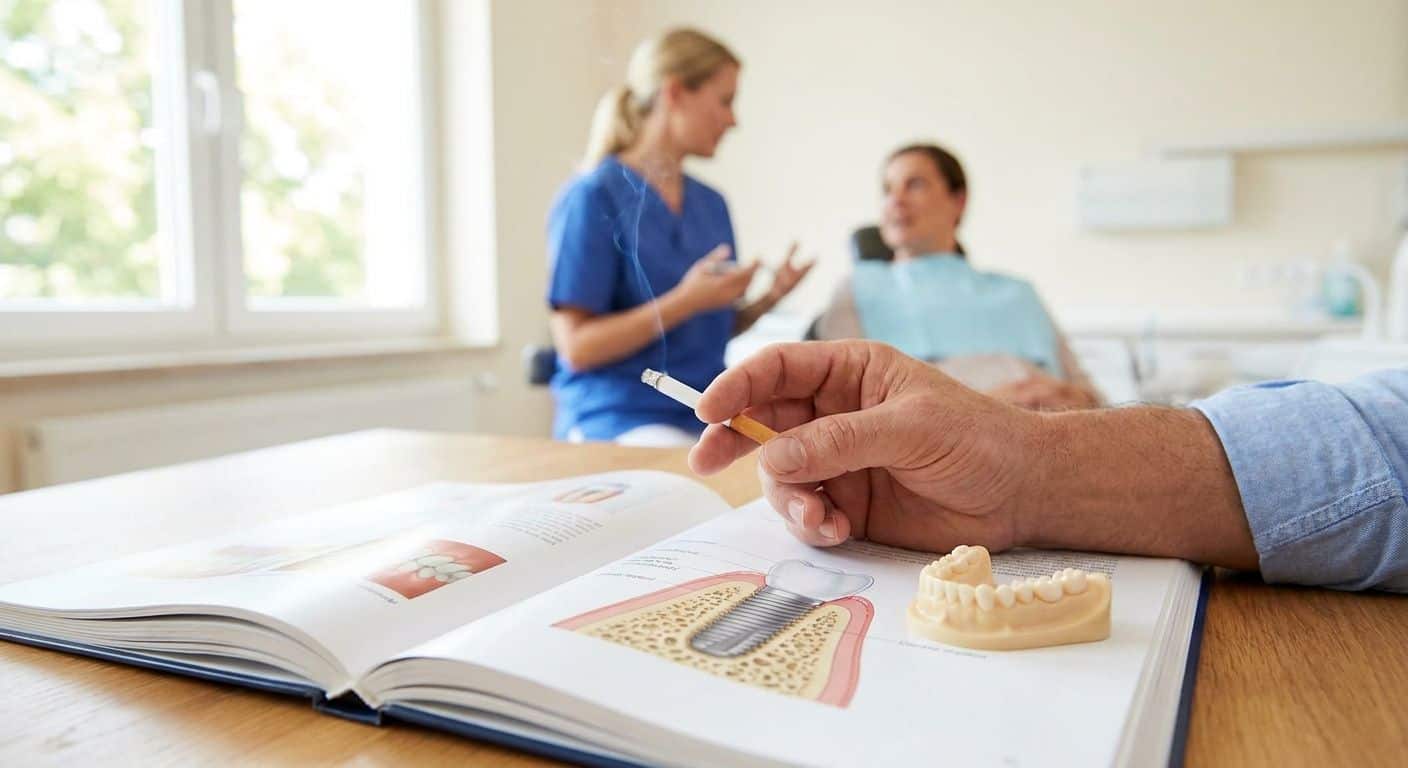
Smokers can get dental implants, but the success rate depends on how much you smoke, how long you're willing to quit around surgery, and which implant type your dentist recommends for your bone density. This guide breaks down what actually works for smokers weighing dental implants in 2026, not the generic pitch you'll get from a chain that doesn't ask about your habit.
- Smokers face roughly 2-3x higher implant failure risk than non-smokers, mainly from reduced blood flow to healing bone.
- A single-tooth implant is still the standard pick for smokers with adequate bone density — Buy.
- Heavy smokers with bone loss usually need a graft before the implant goes in — Consider, not skip.
- Full-arch fixed bridges and implant-supported dentures both work for smokers who commit to a quit window around surgery.
- The 10 days after surgery, not the procedure itself, is when nicotine does the most damage to healing.
Why this matters
Nicotine constricts blood vessels. That's the entire problem in one sentence. Dental implants fuse to your jawbone through a process called osseointegration, and that process runs on blood supply — less blood flow means slower, weaker bone fusion around the titanium post.
The research on this isn't ambiguous: smokers consistently show implant failure rates two to three times higher than non-smokers, concentrated heavily in the upper jaw where bone is naturally softer. That doesn't mean implants are off the table. It means the plan has to account for your habit instead of ignoring it, which is exactly what should happen at your first implant consultation at Dental Arts of Atlantis.
Who this is for
This guide is for adults in Palm Beach County who smoke or vape regularly, have one or more missing teeth, and want a straight answer on whether implants are realistic before they book a consultation. It's also for former smokers still worried their history affects candidacy, and for heavy smokers who've been told "no" elsewhere without an actual bone density evaluation.
What to look for in dental implants for smokers
Bone density evaluation before anything else
Long-term smoking accelerates bone loss in the jaw, and that determines whether you need grafting before an implant can even be placed. Skip this step and you're gambling on a foundation nobody actually checked.
A quit-smoking window your dentist enforces, not suggests
The standard recommendation is at least two weeks of abstinence before surgery and eight weeks after, covering the critical early healing phase. A practice that doesn't bring this up before scheduling surgery isn't managing your risk — it's ignoring it.
Implant surface and material built for compromised healing
Modern implants use roughened titanium or titanium-zirconium surfaces designed to encourage faster bone attachment, which matters more for smokers than for anyone else in the chair. Ask what surface technology is being used and why.
Follow-up visit frequency during healing
Smokers need closer monitoring in the first three months, since early signs of peri-implantitis or failed integration show up faster than symptoms do. More check-ins early beats a surprise failure at month four.
Sedation options if smoking is tied to anxiety
A lot of smokers use nicotine to manage stress, which makes quitting around a surgical date genuinely hard. A practice offering sedation options for anxious patients makes that quit window easier to survive.
Financing that accounts for a longer timeline
Grafting adds months to the process, and a payment structure that assumes a straightforward single-visit case won't fit. Ask how financing adjusts when your treatment plan runs longer than average.
Top picks for smokers
1. Single-tooth implant — the standard pick
One missing tooth, adequate bone density, no grafting needed. This is the most predictable outcome for a smoker with a shorter habit history or someone who's already quit. Healing typically runs 3 to 6 months before the crown goes on.
A dental implant for one missing tooth is the right starting point if your bone scan comes back clean. Verdict: Buy if bone density checks out.
2. Bone graft first, implant second — the necessary add-on
Heavy, long-term smokers frequently show enough bone loss that an implant placed directly would have nothing solid to fuse to. Grafting adds bulk material and buys the healing time bone needs before the implant post goes in.
Bone grafting for low bone density extends the timeline to 4-8 months total, but it turns a marginal candidate into a viable one. Verdict: Consider — this is the step that separates a failed implant from a successful one in heavy smokers.
3. Full-arch fixed bridge — the full-mouth option
For smokers missing most or all teeth in one jaw, a fixed full-arch solution anchored on a handful of implants avoids placing a post for every missing tooth. Fewer implant sites means fewer places for smoking-related complications to show up.
The best implant type for a full arch of missing teeth still requires the same quit-window discipline, and healing runs roughly 4-6 months per arch. Verdict: Consider for smokers ready to commit to the abstinence window twice as long as a single implant case.
4. Implant-supported dentures — the secure-fit alternative
For smokers with significant bone loss who don't want the cost or timeline of a full fixed bridge, implant-supported dentures use fewer implants to anchor a removable denture securely in place. It's a middle ground between traditional dentures and a full fixed arch.
Implant-supported dentures for a secure fit work well for smokers because fewer surgical sites means less overall healing risk. Verdict: Buy for budget-conscious smokers missing most teeth in an arch.
What to avoid
- "Implant in a day" marketing that skips the smoking conversation. If nobody asks about your habit before quoting a same-day timeline, they're not planning for your actual healing risk.
- Skipping grafting because it adds cost and time. Placing an implant into bone that's already too thin from years of smoking is how you end up paying for the surgery twice.
- Assuming vaping is a safe substitute. Nicotine is nicotine — the vasoconstriction effect that slows healing doesn't disappear because the delivery method changed.
Find out if you’re a candidate
A bone density check and honest quit-window plan before you commit to surgery.
Verdict comparison
| Option | Bone graft usually needed | Typical healing timeline | Best for | Verdict |
|---|---|---|---|---|
| Single-tooth implant | Sometimes | 3-6 months | One missing tooth, adequate bone | Buy |
| Bone graft + implant | Yes | 4-8 months | Heavy or long-term smokers with bone loss | Consider |
| Full-arch fixed bridge | Often | 4-6 months per arch | Multiple missing teeth in one jaw | Consider |
| Implant-supported dentures | Sometimes | 3-6 months | Full arch, budget-conscious | Buy |
FAQ
Can smokers get dental implants?
Yes, smokers can get dental implants, but failure risk runs roughly 2-3x higher than non-smokers due to reduced blood flow during healing. A bone density check and a quit-smoking window around surgery close most of that gap.
How much does smoking increase the risk of implant failure?
Studies consistently show implant failure rates 2-3x higher in smokers compared to non-smokers, concentrated most heavily in the upper jaw. Quitting even temporarily around surgery meaningfully reduces that risk.
How long do I need to quit smoking before implant surgery?
Most oral surgeons recommend at least two weeks of abstinence before surgery and eight weeks after, covering the critical early bone-fusion period. Longer abstinence improves odds further.
Is vaping safer than smoking for implant healing?
No, vaping delivers the same nicotine that causes vasoconstriction and slows healing, so it carries similar implant failure risk as smoking. Treat a vaping habit the same as smoking when planning your quit window.
Do I need a bone graft if I smoke?
Not always — it depends on how much bone density you’ve lost, which a scan at your consultation will show. Long-term heavy smokers are far more likely to need grafting before an implant can be placed.
How much do dental implants cost for a smoker in 2026?
Cost depends on whether grafting is needed, how many implants you require, and which restoration type you choose, so pricing varies case by case in 2026. A consultation with a cost estimate is the only reliable way to know your number.
What happens if I smoke right after implant surgery?
Smoking in the days after surgery restricts blood flow to the healing site and raises the risk of implant failure or infection significantly. The first 10 days after surgery carry the highest risk window.
Are implant-supported dentures better than single implants for smokers?
Neither is universally better — implant-supported dentures fit smokers missing most teeth in an arch, while single implants suit smokers missing one tooth with good bone density. The right choice depends on how many teeth are missing and what your bone scan shows.
One last thing
The surgery itself isn't the risky part. The riskiest window is the 10 days right after, when nicotine's vasoconstriction effect blocks the blood supply new bone needs to fuse to the titanium post. Smokers who can white-knuckle just those 10 days, even if they go back to smoking afterward, see meaningfully better outcomes than smokers who light up the same evening. If quitting cold for two weeks before and eight weeks after feels unrealistic, say that out loud at your consultation at Dental Arts of Atlantis — a shorter, enforced abstinence window around surgery still beats no plan at all.