
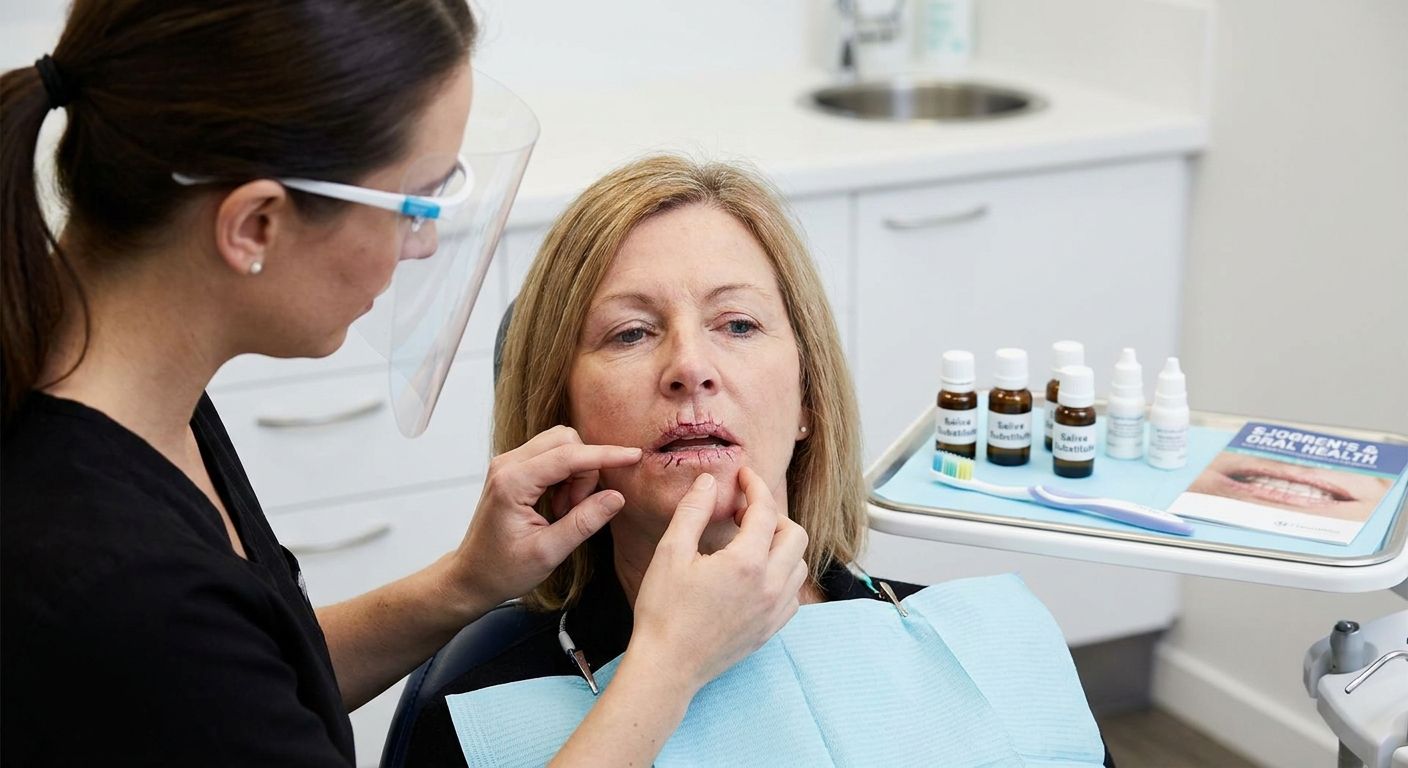
Sjogren's syndrome dental care is a modified prevention and maintenance plan built around chronic dry mouth, designed to stop the rapid tooth decay, gum breakdown, and oral infections that severe xerostomia causes. Standard six-month checkups and a soft-bristle brush aren't enough here — saliva does most of the work protecting teeth, and when an autoimmune condition shuts down the salivary glands, decay can move fast enough to destroy a healthy tooth in under a year.
Patients with Sjogren's syndrome need a different baseline: more frequent cleanings, prescription-strength fluoride, and a dentist who checks for oral thrush and root-surface cavities at every visit, not just when something hurts.
- Dental care for Sjogren’s syndrome patients centers on managing chronic dry mouth, not just brushing harder.
- Cleanings every 3-4 months beat the standard six-month schedule once xerostomia sets in.
- Prescription fluoride and saliva substitutes cut cavity risk more than any over-the-counter product.
- Root-surface and gumline decay is the pattern to watch, not typical pit-and-fissure cavities.
- Dental Arts of Atlantis builds Sjogren’s dry-mouth management into routine visits, not as an add-on.
Why dental care matters more for Sjogren's syndrome patients
Sjogren's syndrome affects an estimated 4 million people in the United States, according to the Sjogren's Foundation, and roughly 9 out of 10 of them are women, most diagnosed in their 40s through 60s. The disease attacks moisture-producing glands, and the mouth takes the hit first: saliva flow can drop to a fraction of normal output.
Saliva isn't just lubrication. It neutralizes acid, washes away food debris, and delivers minerals that re-harden enamel after every meal. Take that away and the mouth environment shifts toward constant demineralization. That's why Sjogren's patients see cavities form at the gumline and on root surfaces — areas that rarely decay in patients with normal saliva flow.
Regular dental care has to account for this shift, and by 2026 most dental practices treating autoimmune patients have moved away from the one-size-fits-all cleaning schedule toward a risk-based model built specifically for chronic dry mouth.
Update your dentist on your Sjogren's diagnosis and medications
Your dental team can't build a dry-mouth protection plan around a condition they don't know you have. Sjogren's often overlaps with rheumatoid arthritis or lupus, and many of the medications used to treat those conditions worsen dry mouth further.
- List every current medication, including over-the-counter antihistamines
- Note whether you have overlapping autoimmune diagnoses
- Mention any recent flare-ups affecting your eyes or joints
- Bring your rheumatologist's contact information for care coordination
- Ask your dentist to flag your chart for accelerated recall scheduling
Dentists managing patients on daily medications that dry the mouth also see this pattern with managing dry mouth caused by medication — the underlying fix (saliva stimulation, frequent fluoride) overlaps heavily with Sjogren's care even though the cause is different.
Increase your cleaning frequency
A six-month cleaning schedule assumes normal saliva flow. Sjogren's patients don't have that buffer, so plaque and acid sit on the teeth far longer between visits.
- Move to cleanings every 3-4 months instead of every 6
- Ask for bitewing X-rays more often to catch root decay early
- Request a full soft-tissue exam at every visit, not just a cleaning
- Track any new white patches, cracked corners of the mouth, or sores
- Keep a symptom log if dry mouth severity fluctuates with disease flares
Manage dry mouth every day, not just at the dentist
Daily habits do more for Sjogren's-related decay than any single office visit. This is the step most patients underestimate.
- Sip water constantly throughout the day, not just with meals
- Use xylitol gum or lozenges to stimulate whatever saliva flow remains
- Try an over-the-counter saliva substitute spray or gel before bed
- Avoid alcohol-based mouthwash, which dries tissue further
- Run a humidifier at night to reduce overnight mouth dryness
- Cut back on caffeine and carbonated drinks, both of which worsen dryness
Use high-fluoride protection at home and in the office
Standard toothpaste fluoride levels (around 1,000-1,500 ppm) aren't strong enough once saliva's natural remineralizing effect is gone.
- Ask about a prescription-strength fluoride toothpaste (5,000 ppm)
- Get in-office fluoride varnish applied at every cleaning visit
- Consider a custom fluoride tray for nightly use if decay risk is high
- Avoid whitening toothpaste with abrasive silica, which can wear thin enamel faster
- Skip acidic mouth rinses marketed for freshness — they undo fluoride's benefit
Screen for oral thrush and mucosal changes regularly
Dry, low-saliva environments are ideal for candida overgrowth. Sjogren's patients get oral thrush more often than the general population, and it can look like harmless white coating on the tongue or cheeks.
- Check the tongue and inner cheeks weekly for white patches that wipe away
- Report any burning sensation on the tongue or roof of the mouth
- Watch for cracking at the corners of the mouth (angular cheilitis)
- Ask about antifungal rinses if thrush recurs more than once a year
- Rinse and clean dentures nightly if you wear a partial or full plate
Protect the gumline and root surfaces specifically
Because Sjogren's decay concentrates at the gumline rather than the chewing surfaces, your home care needs to target that zone directly.
- Use a soft-bristle or electric brush angled toward the gumline
- Add an interdental brush or floss pick for the area just below the gum
- Ask your hygienist to demonstrate proper technique for root-surface cleaning
- Watch for gum recession, which exposes more root surface to acid
- Learn to spot early signs of gum disease at home — Sjogren's patients develop gum problems faster than average
An accelerated recall schedule, prescription fluoride, and a dentist who already understands Sjogren's-pattern decay is the fastest path to fewer emergency visits. That's the plan Dental Arts of Atlantis builds for autoimmune dry-mouth patients rather than treating each cavity as an isolated event.
Talk to a dentist about Sjogren’s care
Get a dry-mouth prevention plan built around your diagnosis, not a generic cleaning schedule.
Comparison: dry-mouth management options for Sjogren's patients
| Option | Best For | Key Limitation |
|---|---|---|
| Over-the-counter saliva substitute | Mild-to-moderate dryness, daily comfort | Short-lasting; needs reapplication every few hours |
| Prescription-strength fluoride toothpaste | Anyone with confirmed root or gumline decay | Requires a prescription and consistent nightly use |
| In-office fluoride varnish | Patients on a 3-4 month recall schedule | Only effective when applied on schedule, not as a one-time fix |
| Xylitol gum or lozenges | Patients with some remaining salivary function | Does little for patients with near-total salivary shutdown |
| Custom fluoride trays | Severe, fast-progressing decay | Takes an extra appointment to fabricate and fit |
Verdict: prescription-strength fluoride combined with a 3-4 month cleaning schedule is the single most effective combination for slowing Sjogren's-related decay. Saliva substitutes and xylitol help with comfort but don't replace the mineral protection fluoride provides.
Common mistakes Sjogren's syndrome patients make
- Sticking to a six-month cleaning schedule. Sjogren's decay moves faster than that interval allows a dentist to catch it early.
- Treating dry mouth as a comfort issue only. It's a decay-risk factor first, comfort second — the two need separate solutions.
- Using alcohol-based mouthwash for fresh breath. It strips what little moisture remains and worsens the underlying problem.
- Waiting for pain before mentioning new symptoms. Root-surface cavities often don't hurt until they're already deep.
- Skipping antifungal follow-up after one thrush episode. Recurrent candida is common with Sjogren's and needs ongoing monitoring, not a single treatment.
FAQ
What is the best dental care approach for Sjogren’s syndrome?
The best approach combines cleanings every 3-4 months, prescription-strength fluoride, and daily saliva management with water, xylitol, or saliva substitutes. Standard six-month dental care doesn’t catch Sjogren’s-related decay early enough.
Why do Sjogren’s syndrome patients get more cavities?
Sjogren’s syndrome reduces saliva flow, and saliva normally neutralizes acid and delivers minerals that protect enamel. Without it, cavities form faster and concentrate at the gumline and root surfaces rather than the chewing surfaces.
How often should Sjogren’s patients see the dentist?
Every 3-4 months is the standard recommendation for Sjogren’s syndrome patients, compared to the typical six-month interval. More frequent visits catch root-surface decay and oral thrush before they progress.
Is dry mouth from Sjogren’s syndrome treatable?
Dry mouth from Sjogren’s syndrome can be managed but not cured. Saliva substitutes, prescription fluoride, hydration habits, and xylitol products reduce the daily impact even though salivary gland function doesn’t return to normal.
Can Sjogren’s syndrome cause oral thrush?
Yes, low saliva flow creates an environment where candida overgrowth happens more easily. Sjogren’s patients should check for white patches on the tongue and cheeks regularly and report any burning sensation to their dentist.
Does Sjogren’s syndrome affect dentures or implants?
Dry mouth makes dentures less comfortable and more prone to sores from friction, since saliva normally acts as a cushioning layer. Implant patients need extra attention to gum tissue health around the implant site due to reduced natural moisture.
What toothpaste should Sjogren’s syndrome patients use?
A prescription-strength fluoride toothpaste around 5,000 ppm offers more protection than standard over-the-counter toothpaste at 1,000-1,500 ppm. Ask your dentist whether your decay risk justifies the prescription strength.
Is Sjogren’s syndrome linked to gum disease?
Chronic dry mouth reduces the natural rinsing action that helps control plaque, which raises gum disease risk for Sjogren’s patients. Watching for early signs like bleeding gums or recession catches problems before they need deep cleaning or surgery.
One last thing
Most Sjogren's syndrome patients focus on the front teeth because that's where dryness feels worst, but the real damage tends to happen at the back molars and along the gumline where root surfaces sit exposed. A hygienist checking those spots with a mirror and explorer at every 3-4 month visit catches decay while it's still a small filling — not a root canal. That single scheduling change, more than any product on a shelf, is what separates Sjogren's patients who keep their natural teeth into their 70s from those who don't.
Related guides
- How often adults should get a dental checkup and cleaning
- Dental care for patients on blood thinners
- Dental implants for seniors missing multiple teeth