
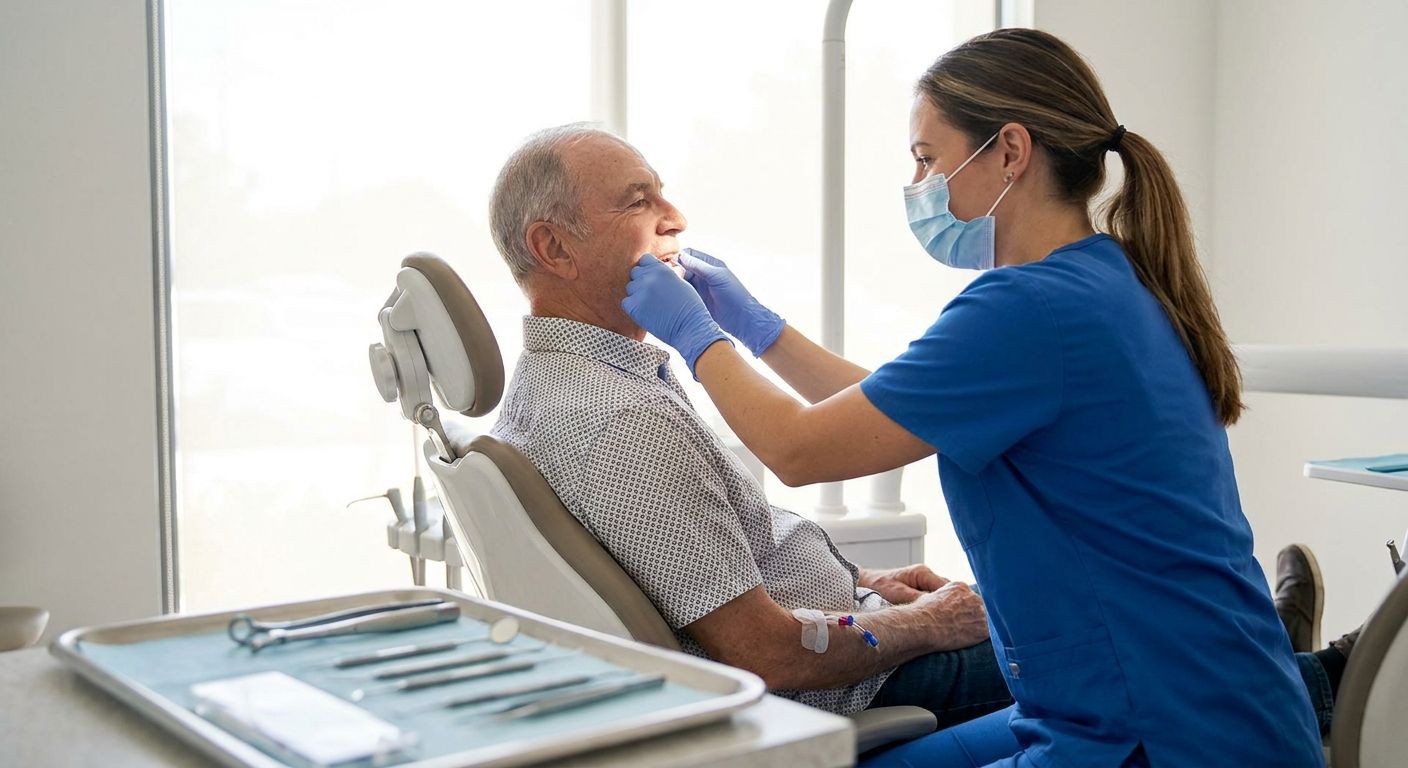
Dialysis patients need dental care planned around fluid restrictions, bleeding risk, and vascular access protection, not treated like a routine six-month cleaning. Hemodialysis and peritoneal dialysis change how your body handles anesthesia, antibiotics, and healing, so a dental visit that ignores your treatment schedule can trigger complications that follow you back to the dialysis chair.
- Dental care for dialysis patients works best on non-dialysis days, ideally the day after a hemodialysis session.
- Uremia and heparin used during dialysis raise bleeding risk, so tell your dentist before any extraction or deep cleaning.
- Fluid restriction common in dialysis patients causes dry mouth, which speeds up decay and gum disease.
- Dental Arts of Atlantis coordinates dialysis dental care with your nephrology team rather than treating it as a standard cleaning.
- Antibiotic premedication is still standard for some dialysis patients with an AV fistula or graft before invasive procedures.
Why dental care matters for dialysis patients
Chronic kidney disease slows tissue healing and shifts how your immune system handles bacteria in your mouth. Dialysis patients carry a well-documented higher rate of periodontal disease and dry mouth compared to the general population, a pattern tracked by kidney health researchers for years. Untreated gum infections can complicate a vascular access site and add strain to a body already working through three or four dialysis sessions a week.
For families managing dialysis alongside work, school pickups, or a spouse's care schedule, a poorly timed dental appointment does more than waste a morning. Dental Arts of Atlantis builds comprehensive dental care plans that account for a dialysis calendar before touching a drill, which is a different starting point than a general practice that only asks about medications at check-in.
In 2026, more dialysis centers are asking patients directly about their dental history at intake, because untreated oral infection is now recognized as a real complication risk during long-term dialysis. Dental care for dialysis patients has to fit inside a tighter medical calendar than most general dentistry, and that starts with timing.
Step 1: Time your visits around your dialysis schedule
The day you pick matters as much as the dentist you pick.
- Schedule non-emergency dental work on a non-dialysis day, ideally the day after a session once heparin has cleared
- Avoid appointments within a few hours of dialysis, when blood pressure swings are common
- Ask your nephrologist for a written note confirming your current schedule and any restrictions
- Keep your dialysis center's number in your dental chart for same-day questions
- Bring your dialysis calendar to the front desk when booking so staff can flag it before confirming a slot
Step 2: Share your vascular access details and medication list
A dentist can't plan around what they don't know.
- List every blood thinner, phosphate binder, and blood pressure medication you take, with timing
- Note whether you have an AV fistula, AV graft, or a peritoneal dialysis catheter, since either affects arm and body positioning during a procedure
- Bring recent lab values if your dentist requests them ahead of an extraction or deep cleaning
- Flag any history of endocarditis or heart valve disease, since it changes premedication decisions
- Review the dental care for patients on blood thinners protocol before scheduling anything invasive
Step 3: Manage bleeding risk before any procedure
Uremia thins clotting ability even without medication, so this step isn't optional for dialysis patients.
- Ask your dentist to check clotting status before extractions or deep scaling
- Request hemostatic measures built into the appointment plan, not added after bleeding starts
- Avoid aspirin-based pain relief after a procedure; ask for an alternative safe for reduced kidney function
- Never adjust anticoagulant dosing on your own; that call belongs to your dentist and nephrologist together
- Confirm with your dialysis center whether heparin dosing needs adjustment on oral surgery days
Step 4: Treat dry mouth from fluid restriction and medication
Dry mouth in dialysis patients comes from two directions at once: fluid limits and the medications that manage kidney disease.
- Sip water in small, restriction-friendly amounts instead of large gulps
- Use an alcohol-free fluoride rinse to fight decay without adding to thirst
- Chew xylitol gum between meals to stimulate saliva flow, if your care team allows it
- Ask about prescription saliva substitutes if dryness disrupts eating or sleep
- Work through the dry mouth caused by medication checklist if multiple prescriptions are drying your mouth out beyond what fluid restriction explains
Step 5: Watch for gum disease tied to kidney disease and diabetes
Diabetic nephropathy is the leading cause of kidney failure requiring dialysis in the United States, which means gum disease and blood sugar control are often the same fight.
- Check gums weekly for redness, swelling, or bleeding when you brush
- Ask for periodontal charting at every cleaning, not just a visual check
- Treat early gum disease before it reaches bone loss around the teeth
- Coordinate blood sugar control with gum treatment; each condition worsens the other, as outlined in gum disease management for diabetic patients
- Ask about shorter appointment blocks or extra cushioning if diabetic neuropathy makes sitting still uncomfortable for long stretches; the reasoning behind supportive chairs for diabetic neuropathy applies just as much in a dental chair as it does anywhere else
Step 6: Coordinate antibiotic premedication when needed
Not every dialysis patient needs premedication, but the ones who do can't skip it.
- Ask whether your vascular access, heart valve history, or joint replacement calls for premedication before dental work
- Bring documentation from your nephrologist or cardiologist if premedication was recommended previously
- Time the antibiotic dose exactly as prescribed, since dialysis timing affects how the drug clears your system
- Walk through the antibiotic premedication before a dental visit checklist so nothing gets missed the morning of your appointment
- Confirm with your pharmacist whether the dose needs adjustment for reduced kidney function
Step 7: Address bone health before implants or major restorative work
Renal osteodystrophy, a bone-weakening condition common in long-term dialysis patients, changes the math on implants.
- Ask about renal osteodystrophy before committing to implants or bone-anchored work
- Request imaging that shows bone density at the implant site, not just a visual exam
- Discuss parathyroid hormone levels with your nephrologist if a bone graft is being considered
- Weigh a removable option against an implant-supported one based on bone quality and healing capacity
- Ask for a staged treatment plan that gives bone grafts time to integrate before implants go in
“Dental care for dialysis patients works when the dentist and nephrologist share the same calendar, not when they work around each other.”
Comparing your care options
| Option | Best For | Key Limitation | Verdict |
|---|---|---|---|
| General dentist without renal training | Routine cleanings between dialysis sessions | May not adjust for bleeding risk or premedication | Hold |
| Dentist coordinating with your nephrology team | Extractions, deep cleanings, implants, bone grafts | Requires extra communication time before treatment | Buy |
| Hospital-based dental clinic | Complex medical histories or transplant planning | Longer wait times, less day-to-day continuity | Hold |
| Comprehensive family dental practice | Dialysis patients managing general and cosmetic needs together | Not an urgent-care walk-in clinic | Buy |
Coordinate your dialysis dental care
Bring your dialysis schedule and medication list to your next visit.
Common mistakes dialysis patients make
- Scheduling a filling or extraction the same day as dialysis, then dealing with excess bleeding from residual heparin
- Skipping antibiotic premedication because "it wasn't needed last time," without checking with a nephrologist first
- Treating bleeding gums as normal, when it's actually early periodontal disease accelerated by uremia
- Managing fluid-restriction dry mouth with sugary lozenges, which speeds up decay instead of controlling it
- Not mentioning dialysis to a new dentist at all, assuming it only matters for a primary care doctor
FAQ
Is dental care safe for dialysis patients?
Yes, dental care is safe for dialysis patients when the dentist knows about the vascular access, medications, and dialysis schedule ahead of time. Most routine work and many procedures can be done safely with the right timing and precautions.
What day should dialysis patients schedule a dental appointment?
The day after a hemodialysis session is usually best, once heparin has cleared and blood pressure has stabilized. Avoid booking within a few hours before or after dialysis.
Do dialysis patients need antibiotics before dental work?
Some dialysis patients need antibiotic premedication, particularly those with a vascular access history or heart valve disease, but not all do. Check with your nephrologist or cardiologist before assuming either way.
Why do dialysis patients get dry mouth?
Fluid restriction limits how much water dialysis patients can drink, and many kidney disease medications reduce saliva production on top of that. The combination speeds up tooth decay and gum irritation if left untreated.
Can dialysis patients get dental implants?
Dialysis patients can get dental implants, but bone density needs to be checked first because renal osteodystrophy weakens bone over time. A staged plan with imaging and possible bone grafting is common before implant placement.
Is bleeding a bigger risk for dialysis patients during dental procedures?
Yes, uremia thins clotting ability even without added blood thinners, so bleeding risk during extractions or deep cleanings is higher than average. Dentists plan hemostatic measures into the appointment ahead of time for this reason.
How often should dialysis patients see a dentist?
Most dialysis patients benefit from a dental checkup every three to four months rather than the standard six-month interval, given the higher rate of gum disease and dry mouth. Ask your dentist to set a schedule based on your gum health specifically.
Does gum disease affect dialysis or kidney function?
Untreated gum disease adds a chronic infection source that can strain a body already managing kidney failure, and it’s linked to worse outcomes in patients who are also diabetic. Treating it early is part of managing dialysis care overall, not a separate issue.
One last thing
The detail most dialysis patients miss in 2026 isn't the bleeding risk or the premedication list, it's the arm. If you have an AV fistula, tell the dental team before they ask you to sit or recline, because pressure on that arm during a long appointment can affect access function. It takes one sentence at check-in and it's the sentence most patients forget to say.
Related guides